Greetings, Legions of the Unspoken! With the holidays and the general life-iness of life, it’s been a while since we met like this, hasn’t it? (Every way I try to say this makes me feel like Mr. Rogers.) Fear not, though, since it’s time once again to take a look into another comic book from that most misunderstood decade. We’ll get right back in the swing of things with a fun two-issue story, Justice League Task Force #7 and #8.
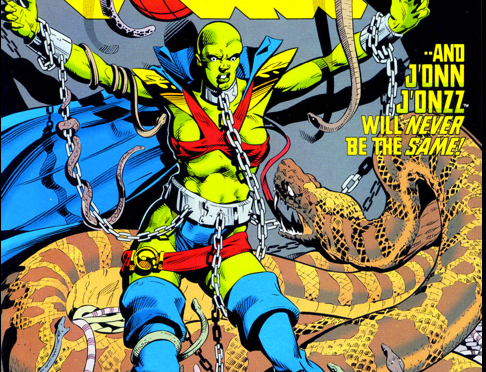
There is no other way to summarize this comic than to say it’s the one where Martian Manhunter turns into a hot chick. Sure, other things happens, but if this were a Friends episode, it would definitely be called The One Where J’onn Is J’oan. (Considering this is a 90s comic website, I feel it’s only fitting and, more importantly, more amusing to keep my references era-appropriate.)

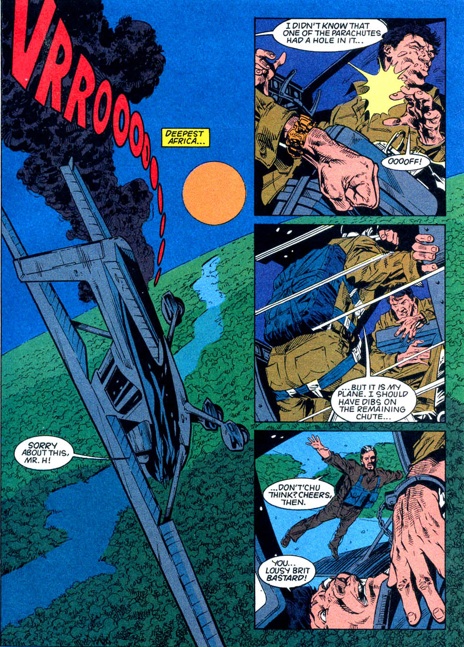
This Justice League Task Force, whose monthly title spun off of Justice League Europe in 1993 and ran just over three years, was formed by U.N. representative Hannibal Martin with Martian Manhunter at the helm and boasted a revolving line up depending on the mission. In this particular instance, Martin assembles a team to rescue one Agent Henry Haggard, who has managed to get his hands on some terrorists’ “McGuffin virus,” the name of which should tell how important it is in and of itself to the actual story. Haggard is then unfortunately left to die in the unlikeliest of places and taken captive by a subterranean, green all-female society.
Haggard’s lady captors, the Daals (*small, begrudging groan*), will allow ambassadors to collect him, but they must be female. If you think these ladies are chosen just for being any old skirts, though, oh ho, how wrong you’d be! Wonder Woman is selected for being from an all-female society, Maxima for her psionic powers and status as a sovereign, Vixen and Gypsy for their respective animal and camouflage powers being useful in a jungle, Dolphin because the passageway to this part of Deepest Africa is underwater, and Martian Manhunter for being….green?
No, really, that’s all the justification we get why a dude has to go to the place where dudes are banned. Martin says it and they all stare at Martian Manhunter expectantly like it makes perfect sense. Well, that and his being the task force’s usual leader, which, sure, I get, but it still kind of seems like the team of women with super powers, which includes at least two sovereigns, would be able to, you know, conduct a mostly diplomatic mission to rescue some guy on their own just this once.
Of course, without Martian Manhunter turning into Martian Womanhunter there is no story here, and while I feel it’s necessary to at least address the silliness of the premise, from the start it’s plain that writer Peter David intends a fun and lighthearted tone for these issues and doesn’t really have much of an agenda as far as gender politics go. There are plenty of playful jokes along the “men won’t stop for directions” line, but it’s all pretty good spirited and doesn’t feel too cheap. For instance, when Martian Manhunter procures a romantic movie to entertain his teammates, their reaction is charmingly and decidedly mixed.

I like that Wonder Woman is apparently a sap. I like that Gypsy thinks it’s hysterical. I like that Maxima thinks it’s horrible. I like that there doesn’t really have to be any more to it than that. I like that it feels like a reaction you would realistically get if you put a group of women with strong and wildly disparate personalities in front of a romance flick. (I was going to say, “Hey, remember when we called them flicks?” and then I remembered Netflix.)
Considering those strong and proud personalities involved, my first inclination was to be skeptical that none of the women on the team would take issue with needing a man on an all-female mission, but I feel like those with the strongest objections would be the ones cackling at An Affair to Remember and, therefore, equally willing to have a good chuckle at Martian Manhunter’s discomfort at having to grow boobs. (Well, to be fair, they all find that funny.)

I can tell the Internet has scarred me forever when I have to keep reminding myself this is a comic book and not just especially well drawn fan art. Like could have forgotten I was writing an article and not just on Tumblr when I looked away from the screen momentarily. I am so used to coming across an inordinate amount of racy drawings of my favorite characters that when I see boob straps and bikini-bottomed genderbent Martian Manhunter, I assume someone only drew it for titillation, even though this comic is from a time when such art would have been, presumably, private collection only. (At least I hope so.) And then it’s depressing that I just expect this lady version of Martian Manhunter to be bent over something and spread wide open in the next panel.
To be clear, I certainly have no problem with people drawing and sharing whatever weirdo drawings their hearts and other organs desire, but it’s interesting how much twenty-plus years on the Internet, coming across detailed drawings of beloved characters’ genitals without seeking them out, tends to reduce the novelty of something like Martian Manhunter as a lady. None of that, of course, is this comic’s fault.

Now that everyone looks the part and has the majority of the giggles out of their system, the task force sets off on their rescue/diplomacy mission, which, of course, encounters peril on the way. The one (and only) thing you need to know about this bit is that that they shoot Dolphin out of the torpedo tube.

The only thing you need to know about the next bit is that once they fight off the Daals and are found worthy, they are taken to their leader, Her Who Must Be Served. Her takes one look at J’oan J’onzz in all her green glory and is, of course, instantly smitten, declaring that J’oan will be her mate. (Ugh, just like a girl to skip over the action to get to the romance, amirite? Maybe if someone had sent a man along with me to write this article, I’d have included more of the fighting.)
Having watched a fair amount of science fiction where the one lady in the group is always getting captured by natives, only to have their leader fall for her, it’s a nice change of pace when the trope is twisted or subverted, even if the guy in this scenario still has to be a lady at the time for it to happen to him. Once again, it’s happened more frequently since 1994, and if any nerd tells me they don’t think of this when they think of this premise, I’ll call them a liar.
Despite what the cover of Issue #8 would have you believe, J’oan is treated quite well in captivity. The rest of the task force is viewed with considerably more wariness, thus proving the old cliche that women are just naturally suspicious of and incapable of getting along with other women (especially when a man is involved, even if they don’t know he’s a man). Considering there is no scenario even remotely close to the one depicted here, I have to assume those are purely metaphorical snakes, and as such, it’s a fairly accurate representation of what it’s like to be a lady sometimes.

J’oan is prepared for the wedding and continues to play along in the hopes of peacefully finding Haggard and the virus (and, let’s be honest, because she’s a bit of a tease). Gypsy, who has been camouflaging herself to stay with J’oan, tells her to take some Midol when she complains of feeling tense and irritable, a moment I enjoy because it’s possibly the only time someone has ever offered Midol in the interest of being helpful and not as a sarcastic PMS joke. (I mean, it’s a bit of a sarcastic PMS joke too, but still.) J’oan also begs Gypsy not to tell Blue Beetle, Batman, or any other pals about this mission, which is a shame because I’d love to read a comic of nothing but this story being explained to Batman. Hell, if I weren’t this far in already, I might rewrite this whole article and address it to Batman. (If he’s not an insufferable gossip, why is he spying on everyone all the time, huh?)
While they wait for their next move, the hens get to clucking about a lady sovereign wanting a lady mate. Maxima says some homophobic and sexist stuff and then uses the tried and true, “I’m not a bigot, but…” Wonder Woman calls her out before turning into tea drinking Kermit.

Gypsy, to answer Dolphin’s question, is off finding Haggard, who sees her, hears her name, and asks her if she’s the Gypsy, the stripper. Small piece of advice for the gentlemen out there: one of the few things worse than asking a lady if she needs a Midol is assuming she is a stripper, especially if she is in a position to save your life. She leaves him where he is so as not to arouse suspicion (and also probably the stripper thing), and the wedding proceeds as planned.

I can’t help but shake my head that they can show two supposedly female characters standing together on their own marriage altar, holding their faces two inches from each other, specifically articulate that they are kissing, and still not show them actually kiss. It’s hard to come down too harshly on a comic from 1994, though, when depicting any kind of same sex relationship is something that is still a struggle to this day with comic books and cartoons. This would even be just about the least controversial circumstance in which two ladies could kiss, considering that, strictly speaking, neither of them are actually ladies.
Yes, that’s right. Her Who Must Be Served, in a twist no one could have possibly seen coming, is a hermaphrodite. I have to say, I kept waiting for a crass joke or something we’d feel a lot more uncomfortable reading now than we would have twenty years ago, not because I go out of my way to look for these things but because nothing was the subject of more punchlines in the 90s than “chick with dick” jokes. (Just ask Eddie Murphy.) Well, unless it was a straight guy character vigorously assuring another male character that he isn’t gay but is totally cool with it if anyone else is. There’s pretty much just a Crying Game reference, though, and they move on. (And to be honest, if they hadn’t made the Crying Game reference, I would have felt obligated to myself, what with the fuss I made about 90s jokes and all.)

Martian Manhunter, of course, decides this charade has gone on long enough, and reasserts his masculinity in a shower of muscles:

Meanwhile, Wonder Woman has been busy saving Haggard and Dolphin has found the virus, so the task force fights their way to freedom. They escape as far as a volcano and fly away, all except Martian Manhunter, who is paralyzed by his fear of fire. Her Who Must Be Served catches up and rages out on him, thinking that they have been laughing at Her. Their tussle almost puts them both in the volcano because what’s the point of having a volcano if someone doesn’t at least almost fall in it? Martian Manhunter manages to save them both, and they part on surprisingly cordial terms, considering that they’ve both had kind of a weird day. Her even tells him that he can come back if he ever changes his mind, and he considers it at least enough to tell his task force that it’s tempting.
All in all, a fun read with some great banter between the characters and not nearly as many groans as I would have expected. I haven’t mentioned the art yet (penciled by Sal Velluto, inked by Jeff Albrecht with Aaron McClellan, and colored by Glenn Whitmore), but I enjoyed it quite a bit as well. It’s colorful and vibrant and dynamic, and some of the facial expressions alone were worth the read.

Must like the task force itself, JLTF have a revolving door of writers and artists, so I can’t vouch for what the rest of the title is like, but what I can vouch for is that Dean Compton and I are going to have a great time with our next podcast (which I’m still lobbying to be called The Spoken Decade), all about the Over the Edge crossover event! No one is more excited for the Punisher’s return to the screen than Dean Compton, so you won’t want to miss out on his thoughts on Over the Edge or on some of the other Punisher stuff we’ll be taking a look at in the coming weeks! Till then!