Tag Archives: DC Comics

Smile Because It Happened – Death: The High Cost of Living by Emily Scott

Every once in a while I read or watch something so mind-boggingly good, so paradigm changing, that all I can do is get pissed off. While that might seem like an odd reaction to discovering a great piece of art, I believe those who, like me, love nothing more than tumbling down the pop culture rabbit hole and losing yourself to someone else’s world, will understand. The best works, the ones we revisit over and over, feel like they were made just for us, and it’s hard not to rue all the time lost we could have spent loving them with our whole hearts, to wonder how someone, anyone could not have put something so obviously meant to be enjoyed by us in our hands any earlier.

At the top of this list for me is Neil Gaiman’s Sandman. It’s probably for the best that no one gave it to me as a teenager because it may have actually blown a crater into my mind, but when I did finally lay eyes on it, I became so enraptured and thought it so perfectly suited to my tastes that I was baffled it hadn’t found its way to me sooner. I mean, it’s not like I didn’t know weird gothy kids who liked to read. What I do know is that Sandman would have been so hugely influential on me at such a formative age, both as an aspiring writer and a fervent reader, that it might have changed the whole direction my pop culture path took. Hell, I might have even started reading other comics.

Scandalized
I call the last one Unbeloafable.

Yes, that’s right, people reading a comic book blog, I was not what you would call a comic book fan. I was too busy reading Neitzchse and Camus and thinking it made me very smart and cultured (news flash, 15-year-old me: it mostly made you kind of a douche). It never would have occurred to me that I could have found anything as profound as the philosophy I was pretending to understand in a comic. I just wish now that someone would have told me that not only could I do that very thing, but I could also read about angsty cosmic entities while doing it. (The first person to make a joke in the comments about Neitzchse’s Superman gets a prize.)

By the time the proprietor of this blog, Mr. Dean Compton, gifted me the first volume of Sandman (for which I will always be grateful), rightfully insisting that my loving it was a foregone conclusion, I had grown out of much of my literary snobbery. Four years of assigned reading in college had taken much of the appeal and romance out of reading things because they were “important,” and I had spent the following several years discovering all the other places beauty and wisdom could be found on a steady regimen of the best fantasy literature and science fiction had to offer. Now I much prefer my profundity to be accompanied by wizards or spaceship battles and always get a little disappointed when a book is lacking them.

I am disappointed in the Internet that I could not quickly find a picture of wizards on a spaceship.

That is not to say, though, that I think my tastes have gotten more lowbrow. My definition of what constitutes great literature has merely expanded. The cream of the comics crop could stand up to any work of literature in any genre, and I can’t imagine that many who encounter Sandman would argue it doesn’t deserve its place in that conversation. It’s heartbreaking and funny, epic and intimate, weighty and whimsical, a story about stories, and its popularity, critical acclaim, and endurance are all more than justified.

No small part of that popularity and longevity is the character Death, sister of Dream, the titular Sandman. Her actual part in the series may be small, as Gaiman wanted to parcel out her appearances specifically because readers liked her so much, but she more than makes up for lack of panels by being every different kind of awesome when she does show up.

I love how the contrast of Death's perkiness with Dream's sadsackness makes Dream's word bubbles seem to drip with that much more ennui. I also love that I am not the only one who loves the word 'fantabulous.'
I love how the contrast of Death’s perkiness with Dream’s sadsackness makes Dream’s word bubbles seem to drip with that much more ennui. I also love that I am not the only one who loves the word ‘fantabulous.’

Just as I have encountered almost no one who has read Sandman and not liked it, I don’t know anyone who doesn’t enjoy Death. Few characters in any work seem to be as universally loved. (A short list of other fictional characters no one hates that Dean and I came up with because you know you were curious: Indiana Jones, Wolverine, Robocop, the Ghostbusters, Tyrion Lannister, Ashley J. Williams, the Dude, and David Bowie. Yes, David Bowie counts.) Her popularity was something even I was aware of as early as the mid-90s, when I barely knew who Neil Gaiman was, and I assumed it had a lot to do with the fact that all most of her fans would have to do to cosplay her is choose from any of the 1,000 black tank tops they already owned, put on slightly less make up than usual, and rock their favorite ankh necklace with pride. (In the interest of full disclosure, my favorite ankh necklace was a large silver number with a yin yang symbol in the middle that I wore to church to get a rise out of people.)

Even after I read Sandman and discovered for myself what the fuss was about, it still didn’t necessarily make it obvious why Gaiman had chosen to portray Death as an enthusiastic, compassionate, attractive young woman. All the love I and countless others have for her might be evidence enough that Gaiman made a good decision, but I think there is more to it than idea that he made her likable so that we would like her or even that she works so well because her Not-So-Grim Reaper stands in such stark contrast to so many other portrayals of Death. She, just like Dream and the rest of their siblings of the Endless, are meant to be the embodiments of their respective concepts, and there is no denying that we, as a species, are a little obsessed with death, drawn in and attracted to its mystery, anxious to flirt with it, unable to forgot about it even if it’s been a while since we’ve seen it. What more fitting way to portray that than a fun and charming pretty girl? (It’s also established that the forms of the Endless are subjective, so it’s also possible Death’s appearance is something of a commentary on her intended audience, just as I assume the artists drew Dream to look like an even floppier-haired Neil Gaiman.)

Of course, it could just be coincidence, as Dream also appears to herald the coming of Sad Keanu.

Given the character’s likability, it’s unsurprising Death received her own miniseries, Death: The High Cost of Living, in 1993, about midway through Sandman’s original run. The story revolves around a day that Death spends as a mortal, which she must do once a century to better understand the lives she must take away. Just as in Sandman, though, we don’t consistently see a great deal of Death, or at least not as much as I might have expected for a series that is purportedly about her.

We open instead with a haggish pile of an elderly woman named Mad Hettie and a few Cockney street punks, the sort of characters I will assume appear in everything Gaiman writes till I read otherwise. The woman has tasked the youths with finding her a dove, but when they are no longer satisfied with her five quid compensation and attempt to rob her, Hettie proves herself to be more than you’d expect. The street toughs, exactly as you’d expect, prove not to be so tough, and leave her to perform some blood magic, also something you’d expect from the moment you knew that a lady named Mad Hettie wanted a particular kind of bird.

If it weren't for Monty Python, I might never have noticed how often, true or not, people get accused of witchcraft in popular cultural. I will now give you a moment to hear the entire "she turned me into a newt" scene in your head…….all right, we good?
If it weren’t for Monty Python, I might never have noticed how often, true or not, people get accused of witchcraft in popular cultural. I will now give you a moment to hear the entire “she turned me into a newt” scene in your head…….all right, we good?

We next meet Sexton Furnival (who seems to have a silly name so he can repeatedly and resignedly acknowledge he has a silly name), a sixteen-year-old who, more so than Death, functions as the story’s true protagonist. As a protagonist he suffers from the same problem that all teenagers do, real or fictional, in so much as he is not particularly pleasant to be around. While I’m sure I would have identified more with him had I read this comic as a teenager, it’s not a given, as my hatred of teenagers was never so intense as when I was one.

Reading it now, more than a decade removed from my adolescence, I just cringe as I remember my own mopey, self-important musings (and then cringe a little more when I think about how I’ll probably do the same about the things I say now when I’m 40). My new standard for how well a teenage character has been portrayed is how retroactively embarrassed they make me for my own teenage self, and by that measure, Sexton is pretty damn accurate.

With the ringer tee, that haircut, the Nirvana poster, the complaining about his mother's wishy washy hippiedom, and his writing a suicide note à la Doogie Howser diary, the only way this could be more 90s is if the next panel contained Will Smith showing Alanis Morisette how to do the running man.
With the ringer tee, that haircut, the Nirvana poster, the complaining about his mother’s wishy washy hippiedom, and his writing a suicide note à la Doogie Howser diary, the only way this could be more 90s is if the next panel contained Will Smith showing Alanis Morisette how to do the running man.

Sexton is suicidal because…just life, you know, man? I’m being glib, but he states he doesn’t have any particular reason for wanting to die beyond not having any particular reason to want to live, which is a worthwhile distinction to make. As the story progresses, Sexton encounters more than one person who has more reason (i.e. an actual reason) not to go on but still does, and it serves to throw his own more nebulous woes into stark relief. While that might not be the most exciting choice narratively, I appreciate that Gaiman is addressing the fact that depression often needs no specific catalyst and that at an age where you are trying to figure out what your life is going to be all about, it can often feel like there is no point to any of it. You’re old enough to start to recognize that adults are enormous hypocrites and that being one might not be something to look forward to after all, but you’re too young to do anything about it except resign yourself to becoming one.

While Sexton can be insufferable, he is nonetheless relatable. I may want to smack him when, for example, he tells the mother of the wheelchair-bound neighbor boy that that he can TOTALLY understand how her son gets really bored, but I still remember a time when I was the one deserving that smack. We have all deserved that smack. We have all inflated our problems or lack thereof, taken our health or our youth or the gift that is life for granted. Had Gaiman given Sexton a more concrete or tragic source for his suicidal thoughts, it would only remove some of that universality and muddy the waters by putting an emphasis on life being worthwhile in spite of its ugliness rather than it being worthwhile because of all its beauty, no matter how small.

Sexton finds himself at a garbage dump and manages to end up trapped underneath a refrigerator, leading to, what we would call in the parlance of our time, a meet cute with the original Manic Pixie Dream Girl. Death rescues him from the refrigerator and offers to clean him up, all the way remaining indomitably cheerful in the face of Sexton’s relentless snideness. We learn that she is spending the day in the guise of Didi, a teenage girl whose family was recently killed. Sexton learns that his savior is the manifestation of Death living a once-in-a-century day as a mortal and responds how anyone not being on the right side of the fourth wall might.

Death’s face in the last panel is what I will now picture every time I shrug for the rest of my life.

After storming out of her apartment, Sexton gets taken hostage by Mad Hettie, who extracts a promise from Death/Didi to find her heart, which the 250-year-old woman has apparently hidden and forgotten where. Now on a mission to locate the missing heart AND get the most out of her short time in the flesh, Didi embarks with Sexton on an adventure of free cab rides and hot dogs on what would be a pretty ideal New York City day if it weren’t for his refusal to enjoy anything and her being the temporary physical embodiment of a cosmic entity with a few hours left to live.

The crazy kids end up at the show of a family friend of Sexton’s, where he continues to mope about with the sort of fervor only the young have the energy to muster. He meets a young girl who tells him what is basically the SADDEST STORY EVER, obviously about herself, a fact that, along with the point, completely passes Saxton by.

Cool story, bro.
Cool story, bro.

Our dichotomous duo soon find themselves taken prisoner by a man known as the Eremite. Ultimate-source-of-all-human-knowledge Wikipedia tells me the Eremite is suspected to be Mister E, bent on revenge on Death following the events of another amazing series of Gaiman’s, Books of Magic (which I’m sure we’ll take a look at here at The Unspoken Decade at a future date because what’s life without something to look forward to?). While not knowing the Eremite’s identity doesn’t especially detract from the story, knowing it does help him from feeling like just a random crazy dude around to wreak havoc.

I have been going through the main points of the plot pretty thoroughly so far, but the more I talk about them, the more obvious it is that they are inconsequential. Not to say that the story is bad or uninteresting, but the real meat of these books can be found in the quiet conversations rather than in the major narrative conflicts, which are resolved almost by afterthought. Didi and Sexton are rescued by Mad Hettie and Didi’s awesome neighbor, the heart’s recovered, and Death’s ankh, stolen by the Eremite, is simply replaced with a cheap version from a street vendor.
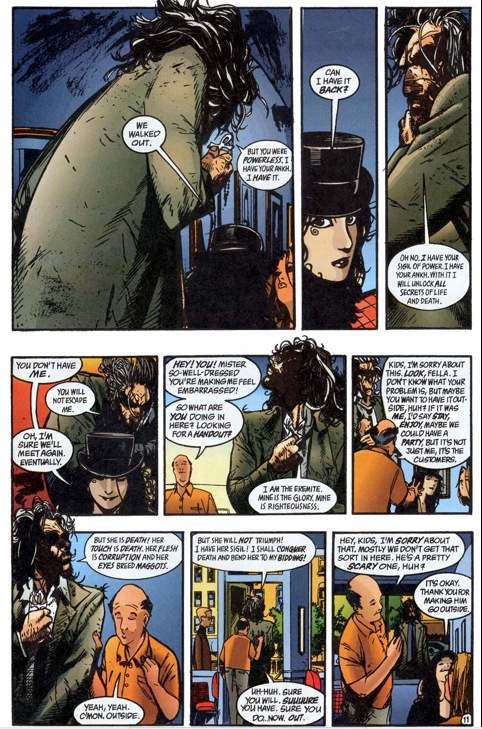
In any story where the main antagonist is thwarted by a deli owner, you know he was never much of a threat to begin with.

This is ultimately a story about Sexton and Didi, about the sort of unforgettable day you only seem to have when you’re young, where everything and nothing seem possible at once, where a random encounter with a sympathetic stranger can make all the difference between delight and despair. The idea that you have to take time to enjoy the small things or appreciate life in all its complexity is nothing new, but the many intimate and poignant moments mean that, whatever their sum, the individual parts make the story.

We like spending time with Death, whether she is thwarting a mystic plot or merely laying some hard truths on a misguided kid, and delight in her presence the same way she delights in something as simple as eating a bagel. (I totally get the bagel delight. If I only got to live one day every century, finding a fresh bagel would be at the top of my To Do list too.) No matter how serious the subject matter, High Cost of Living never takes itself too seriously, giving it a decidedly more easygoing feel than much of Sandman.

ProfoundThe drawback to this breezier tone was that the overall work felt a little frothy, a little insubstantial on first read. Once I had given it time to percolate in my brain, I realized I was comparing it to Sandman, which just isn’t fair. Not that one is good and the other is bad, but this book deals with its weightier topics on an intimate, micro scale rather than the epic, multidimensional cosmic clusterfuck that is Sandman. Had I read this when it came out, I probably would have just mentally inserted it into the larger Sandman tale, where it would have fit perfectly, not just because it’s the same author with a shared character but because Sandman was a book that told so many different stories in so many different ways. Reading it  now, the best thing to do for me and the comic seemed to be to judge it as a standalone, both because it could easily make its case as a great and poignant piece of art without Sandman even existing and because it makes it feel less methadone after a Sandman binge.

My other initial quibble was that we don’t really gain much new insight into Death, since her role in the narrative is mostly as a vehicle for Saxton’s character arc, but I quickly came to the conclusion that I was dumb for thinking anything else would happen. It’s fitting that we don’t learn a great deal of significance about Death because Death as a character is meant to be the embodiment of death itself, and death with a small ‘d’ will always be a mystery till Death with a capital ‘D’ comes for us all. I am more than happy to enjoy the little things, a fresh bagel here, a good comic there, till that happens.

The Death of Me

Finding Love in a Hopeless Place-The Justice Society of America

To enjoy the Justice Society of America as much as I did at the time I did is to be almost as big an anomalous anachronism as they are.  I suppose on the surface, a WWII team that was still active in the 1990’s seems silly, but somewhere in that silliness lay magic.  Even beyond that silliness, within the JSA was sternness beyond reproach.  I respected and revered the JSA for reasons that I did not and still do not fully understand.

Part of my adoration has to be their connection to WWII.  I recently wrote a guest blog for www.longboxgraveyard.com  about the All-Star Squadron, another title I love that features the JSA.  In that article, I talked about my reverence for WWII, both as a young man obsessed with the maps in the encyclopedia that told the story of WWII, and I am also an ardent antifascist (to the point where you can find me on twitter as @theantifascist), which enables me to identify with the brave men and women who stood up against blatant oppression and repression so that the world might be a slightly freer place.

Another reason for my reverence is my unrelenting passion for things I get interested in.  As was noted in the first entry here at The Unspoken Decade, I must learn everything I possibly can about anything I am into.  I must know the history, and I must know it fast.  When it comes to superhero comic books, they really do not get much more historic than the Justice Society of America!

Of course, no amount of obsession with history could have made me more interested in the JSA than, say, A FUCKING FANTASTIC COMIC!  Which is what the Justice Society of America comic released in the 1990’s totally is in every possible way.  Don’t believe me?  Choke on this, hater.

Maybe if Hawkgirl and Hawkman fly around that monster long enough they’ll defeat it.

I recall vividly the very first time I laid eyes on a copy of this series.  I was in Springfield, MO.  My Dad had just killed himself. (BUZZKILL,)  We were in town for the funeral, and needless to say, I was quite distraught.  I did my best to keep it together, and all things considered I did a good job.  I was about a year into collecting comics at this time, and to make a shitty situation better, my parents (Mom and Stepfather) had promised to take me to a “big time” comic book store.   Despite the pallor of the trip, I could not help but be excited for this.  Our town had a great comic book store, and in hindsight I love it even more than I loved it then, but I was enchanted by a bigger store with more back issues.  My local store was also a used bookstore, and most of the space was dedicated to the books.  While my 13-year old self occasionally wandered into that section to snicker at the double entendre titles adorning the romance books, I hungered for what I believed a “real” comic book store to be like.  Now that I think about it, what the hell could that even mean?  Did I think Goddamn Stan Lee and Frank Miller were gonna be playing catch with an NFL Superpro football or something?  I haven’t the slightest.

We would not get to that comic book store until the very end of the trip, in what was a hilarious horrorshow that I will save for another article, but during our sojourn, we stopped at several convenience stores in Springfield.  These stores were like magic to me because unlike the backwoods gas stations we had down south, these stores had COMIC BOOKS!  Of course, I was mesmerized at every stop, and I always found some excuse to go in and gaze at the comics.  That’s where I was first introduced to the greatness that is Mike Parobeck’s art.

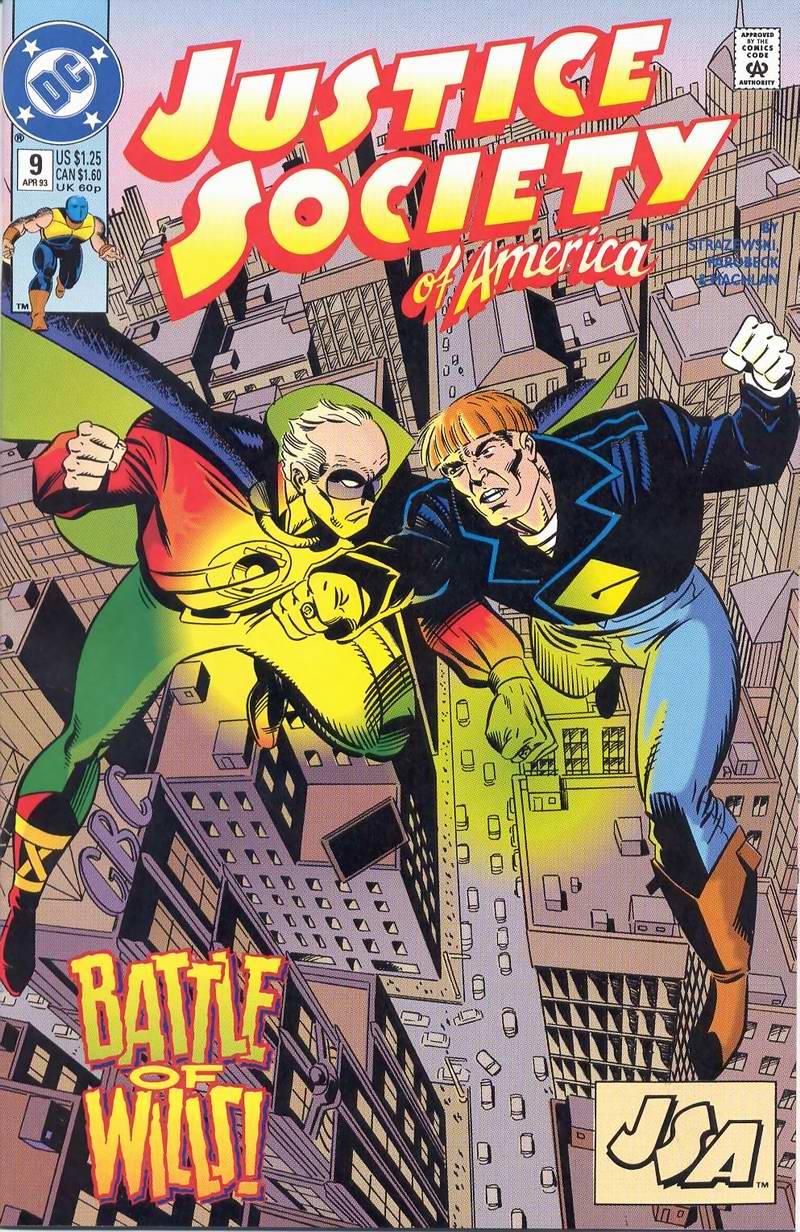
We finally get the answer to the question of who would win a fight between a balding guy and a guy with bad haircut.

(We finally get the answer to the question of who would win a fight between a balding guy and a guy with bad haircut.)


I was, and still am, a giant Guy Gardner fan.  He’s still one of my favorite Green Lanterns, mostly because he is the only character in superhero history that got super powers who isn’t all the way good or bad.  He’s an asshole, but he isn’t evil.  He’s like a cop who actually plays by the book, but that same cop likes letting everyone know just how good he is, how bad they are, how lucky they are to know him, and you get the joke by now.  Of course, that cop-stache ain’t going to go well with that do.

Speaking of Guy’s haircut, I find it sort of spectacular he had that haircut because it is the sort of bad haircut most assholes had, but just two years later, this haircut was all the rage.  Even I had one, although all pictures of said haircut have been destroyed…

But the point is that the cover with Guy drew me in, and then I couldn’t really stop staring at it.  I actually got in trouble for looking at it when we stopped at a gas station at night under a street light for the few seconds we would be there.  I just could not stop looking at it.  Then, I read it.  Then, my life changed.


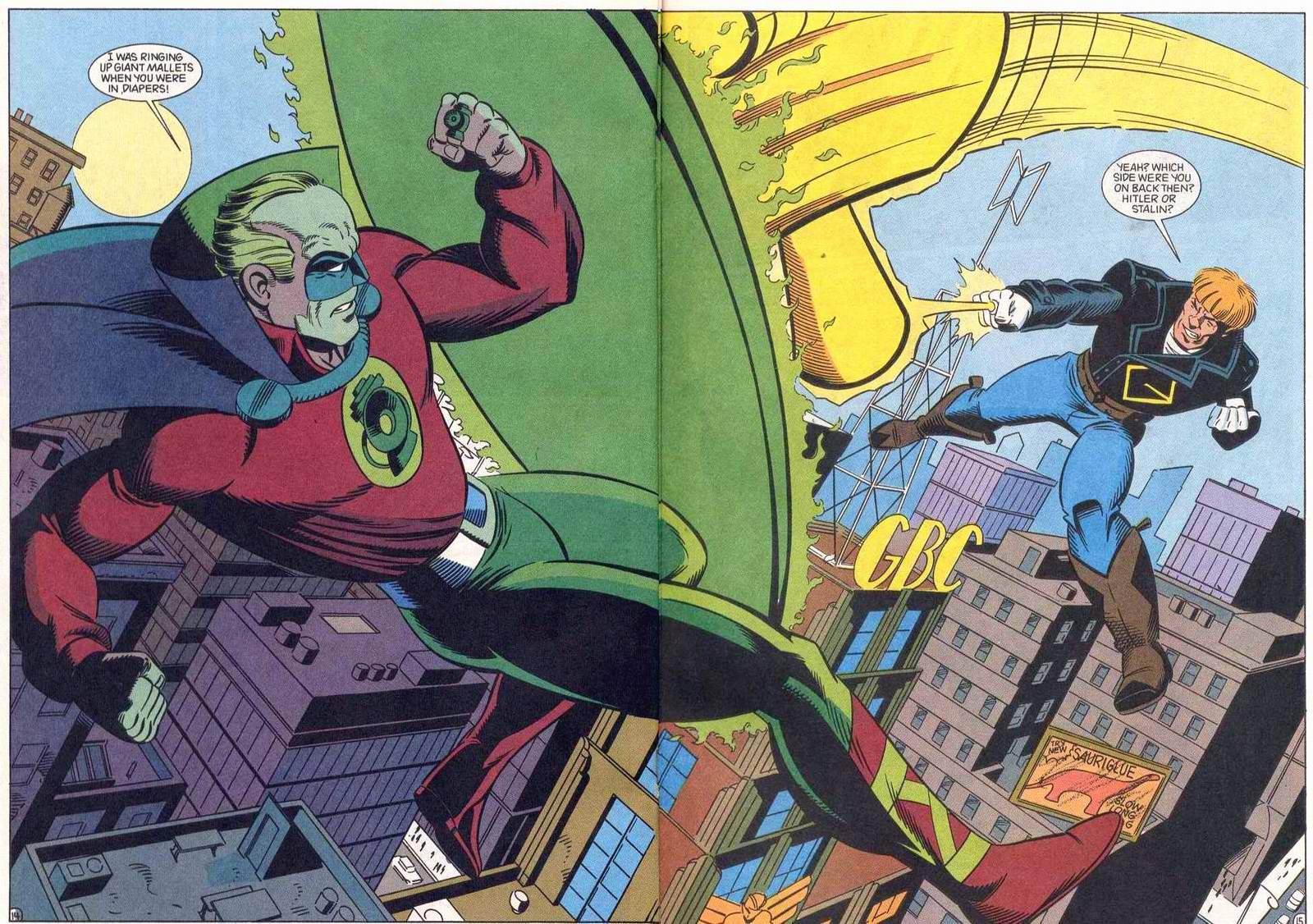
Justice Society of America V2 #9 - Page 15
If anyone ever tries to tell me folks with rings that do anything they will fighting each other isn’t cool as hell then I will refer them directly here and immediately accept their apology and firstborn in restitution.

I just loved it.  I loved the art, but I also loved how much I cared about folks much older than me.  I had heard of the Justice Society prior, both through comic book cards and through the issues of All-Star Squadron I had thumbed through at the flea market.  I was interested, but this was the first time I was captivated.

Len Strazewski does a tremendous job of getting Green Lantern over immediately as not just a formidable ringslinger, but he also makes him cool.  Like, he is cooler than the cool grandpa you wish you had.

Justice Society of America V2 #9 - Page 18
Alan Scott, Golden Age Green Lantern, calls Guy Gardner a Looney Tune, then dispatches him like one. That’s how it’s done!

The dialogue is also spot on.  Some folks have denigrated it as “old-fashioned,” but imagine that, some guys who fought in WWII talk differently than other folks in the 1990’s.  I don’t find it to be “old-fashioned” at all, though.  I think it is straight-forward, as people of that era often were.  These are folks who just do not mince words, and that happens to be a massive part of their appeal to me.  The JSA came to me during what was a rather tumultuous time in my life, as referenced earlier.  Their strength and matter-of-fact attitude helped me feel and stay safe in a world that for me was changing fast.

I loved that comic so much, that the comic book part of the trip was grand.  I had found a treasure in a bad part of my life in a place I never thought I’d find it.  Of course, that just meant that the next day I would find another issue of Justice Society of America in a different gas station!

Justice Society of America V2 #8 - Page 1
Only bad thing about this cover is you can’t see the cool eye logo they wear on their hoods.

I felt like some sort of Texas oil man who had struck two gushers in as many days!  My good fortune was much needed at this time, and again, I just read it over and over again. I loved the introduction of Jesse Quick.  The idea that these identities would be mantles to be passed in legacy was sacrosanct to me.  I wanted to believe in such a thing, especially at this time.  I wanted to believe in legacy; even if I hadn’t, the Justice Society of America would have convinced me otherwise anyhow.   There isn’t a damn thing this series gets wrong.  For Christ’s sake, look how it starts!


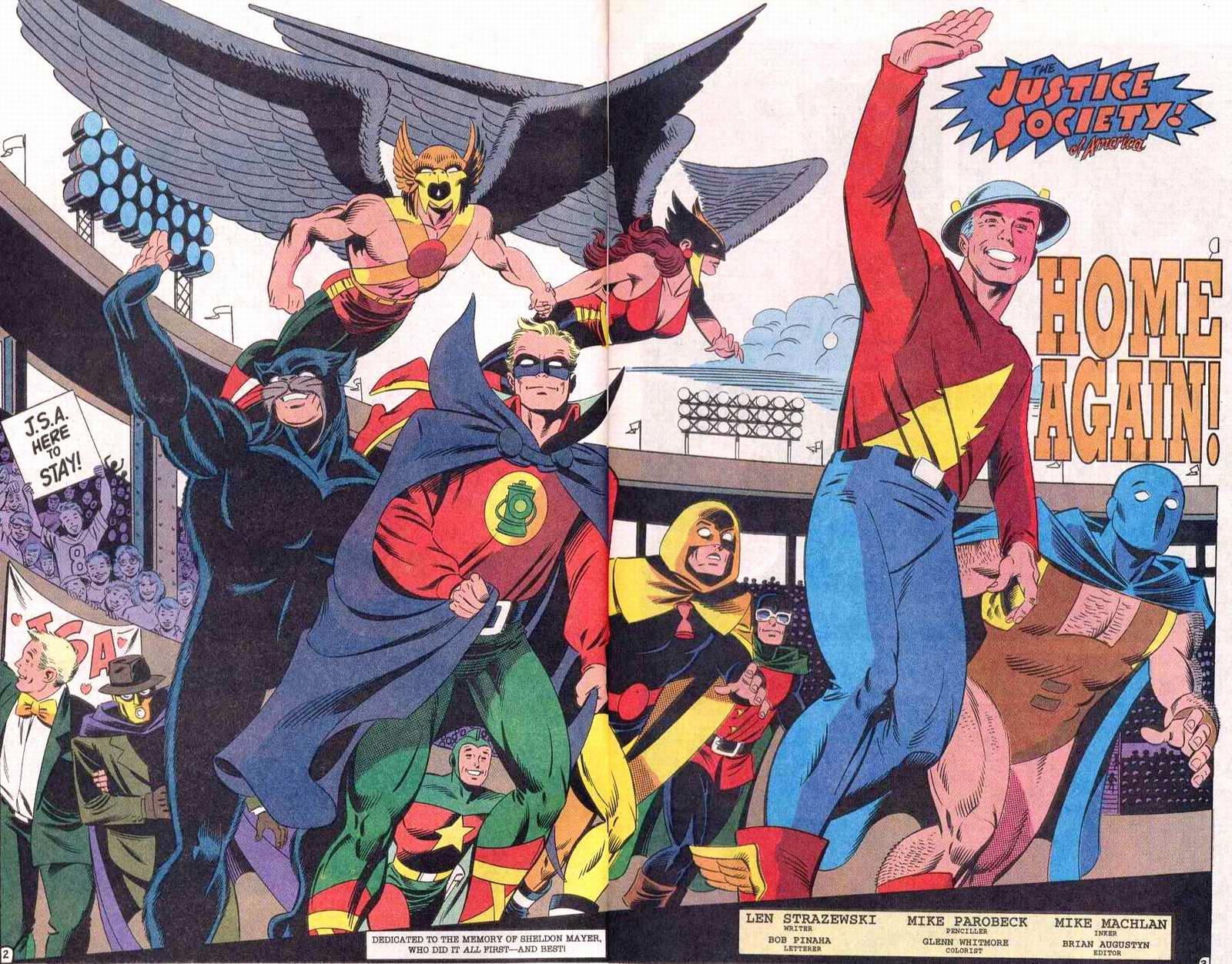
Nice Sign, #8...
Nice Sign, #8…

The JSA has returned in all of their glory!  This is from Issue #1, and the splash page is beautiful.  Mike Parobeck did such an amazing job with all of these guys, and really on everything he touched.  I also don’t want to underestimate the coloring in this book.  The colors pop in a way that matches the never-say-die attitude of these members of The Greatest Generation.  Many times over the course of this title, the JSA triumphs seemingly with just their grit and determination!   Strazewski and Parobeck do a great job of making almost everything they do inspiring.  Even a subplot about Wildcat and The Golden Age Atom wondering if they are too old or too depowered to help, they inspire.  When Hourman struggles with addiction to Miraclo, the drug that gives him his power, his struggle inspires.  This title never loses sight of the fact that the JSA were a beacon of hope to many in the DC Universe, starting with Superman practically worshipping them in issue #1; the guest appearance that really hammers home the relationship of hope and legacy, though, is the appearance of The Flash in #5.

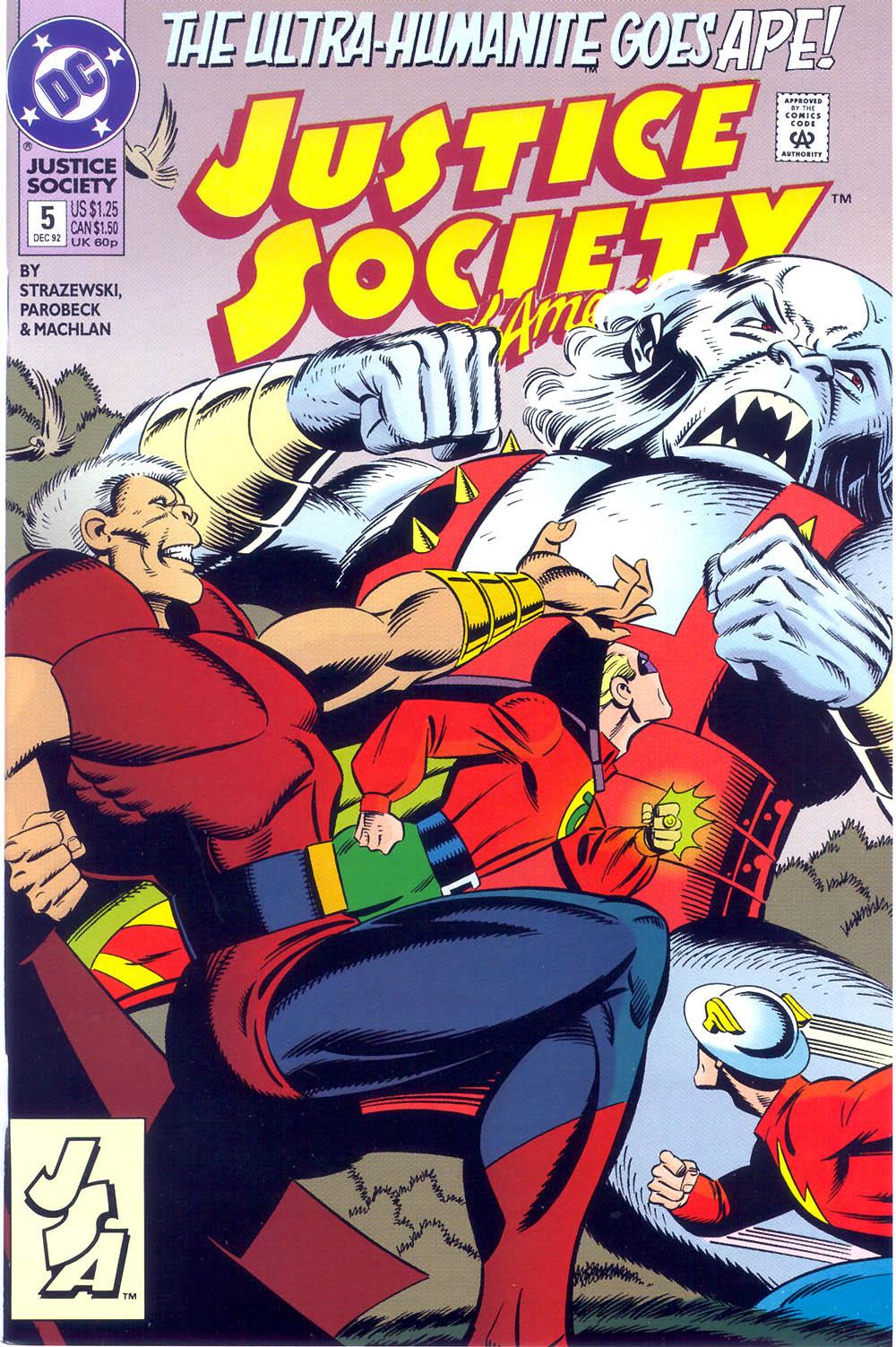
(Ultra-Humanite looks like a cross between an ape and a sad old man.  That Hulk Hogan hair just isn’t working in this picture.
Ultra-Humanite looks like a cross between an ape and a sad old man. That Hulk Hogan hair just isn’t working in this picture.

Despite having been overwhelmed by the Ultra-Humanite, and despite being seemingly outclassed, the JSA tackles and defeats Ultra-Humanite en masse, with a joviality and determination that could be reserved only for the best of friends!

Wildcat can't believe it's not butter.
Wildcat can’t believe it’s not butter.

I love how their camaraderie may be their best weapon.  Their ability to fervently believe in each other and always have each other’s backs makes saving the world not just cool to see, but it comes across as cool for them to do.  Basically, they are the most effective and fun-having extended family since Full House.

For real though, no matter how dire the situation, and no matter how serious the threat, the JSA never loses their swashbuckler attitude, and why should they?  No matter what the threat was, if I was the fastest man alive or if I wielded the magicks of the Lords of Order then I would also constantly be having the time of my life as well, although I’d be slightly more selfish than these guys.  I’d totally use those magicks to make a giant pie that I would then shove into the “face” of a planet.  I’d also do the world saving stuff, but I am just too much of a scamp to never indulge the great interstellar pranks I could do with, say, a power ring.

Unfortunately, the fun and adventure in this title would not last long.  Despite good sales, the brass at DC decided that the JSA didn’t fit into their plans.  Len Strazewski (who I am interviewing on my radio show, Compton After Dark on 5/4 at www.vocnation.com) thinks that Mike Carlin is the man primarily responsible, but whoever it was very short-sighted, as the JSA still had lots to offer.  I find it very telling that unlike other titles that were canceled at this time (many of them canceled for much worse sales than JSA had) got twelve issues to fill out their stories.  This instance of Justice Society of America only got ten.  Black Condor got 12!  Primal Force got 12!  Black Canary got 12!  All of them, and I like all of them and plan on bringing y’all articles on each one of them in the future, had worse sales than JSA.  Why cut this title two issues earlier than was the standard paradigm at the time?  I have no idea other than what Len says, which is that there was enmity against the title within the front office.

Enmity or not though, the Justice Society of America goes out with a bang!

Justice Society of America V2 #10 (1993) - Page 1
I love how angry they all look. They must know they are being cancelled. Especially nice is how angry Sandman is able to look DESPITE WEARING A MASK.

 Since issue #1, we have been dealing with a sub-plot involving everyone’s favorite ornithological archaeologist couple, Hawkman and Hawkgirl.  They’ve been in Egypt, unearthing some sort of bizarre GIANT MUMMY.  Caps are there just to let you know how giant it is.

Unfortunately for the Hawks and the rest of the JSA, this mummy is actually Kulak, a little-used Spectre villain who showed up here to plague the JSA!  The fact that Kulak, former high priest on the planet Brztal, had hardly been used since the Golden Age prior to this is some sort of insult to everything great about comic books.  He uses magic, has a GIANT EYE as his symbol, and went toe-to-toe with The Spectre!  Naturally, he has everything it takes to essentially enslave the Hawks and have Carter Hall turn the entire world against the rest of the JSA!  He also had the ability to be super creepy as he intimates doing the nasty with Hawkgirl.

Justice Society of America V2 #10 (1993) - Page 6
I wish the panel where Hawkgirl holds that whip and moans while Kulak licks her with his oversized tongue was more suggestive

Sadly, for the last time, we see the JSA’s indomitable spirit enable them to rise to the occasion and defeat a foe who had them badly on the ropes, and once again some of the members who possess the least powers are the ones that rally the team and remind them all that no matter what the odds are, they can prevail; at least, they can prevail provided they are fighting Wotan or the Ultra-Humanite, but against the powers of a DC Comics editorial mandate they are helpless.  Of course, they really didn’t get to fight too fairly.  Can you imagine a DC Editor telling Dr. Mid-Nite no?

Justice Society of America V2 #10 (1993) - Page 15
Golden Age Green Lantern is very whiny considering he has a magic ring that can do ANYTHING while Dr. Mid-Nite is just a blind guy who can see.

The Hawks get freed, and the JSA finds a way to save the day.  Everything feels really rushed, and I wonder if it is because the cancellation came on quickly.  I will definitely be asking Len on my show May 4th about that!

This series came to me at a time in my life when I really needed something like this, and I could not be more thankful.  That having been said, this book would be wonderful to me no matter when I would have discovered it.  Good story, great art, and a sense of spirit that few comic books ever have.  This book is inspiring without being preachy about it; there’s a sense of pride and determination that I took away from it.  I think many others do too.

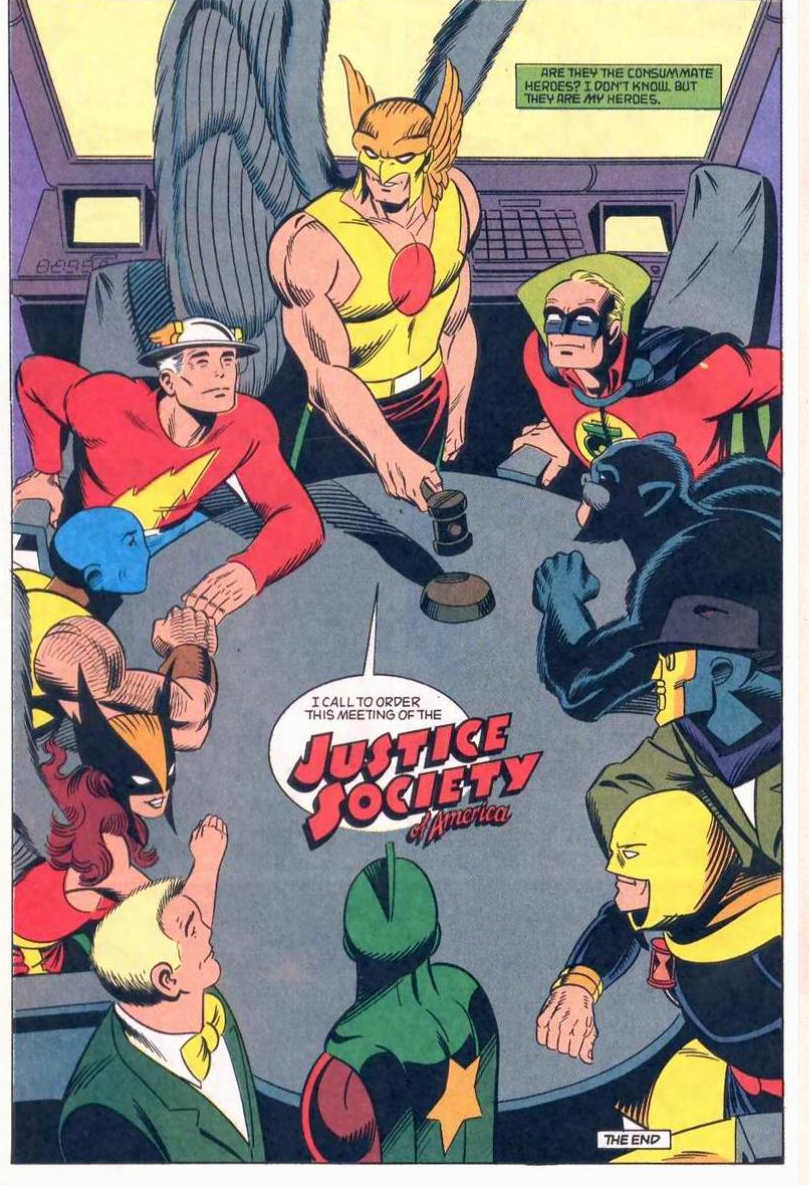
I am going to leave you with the last shot of the book and the comments Len made in the last LetterCol in JSA.  Even in their last moment, the JSA seems so regal, as though even though they know that this book is going away, nothing will ever really dampen the legacy they built.  No matter what the company that owns them does with their name and with the characters, the Justice Society of America will always persevere, and no enemy will ever hold them down for long, unless that enemy is the Golden Age Green Lantern arch-enemy Sportsmaster.

sportsmaster
He is evil and good at sports? So that makes him, who, Barry Bonds?

Don’t forget to listen to my radio show, Compton After Dark, Sunday, May 4th, 2014, as we will be interviewing the writer of this book, Len Strazewski!  It’s at 11:30 PM EDT on http://www.vocnation.com!  Enjoy the pinup and Len’s thoughts below, and join us here at The Unspoken Decade next week when we tackle Darkhawk!  Not literally.


jsalastjsalastlen