Tag Archives: Image Comics

Daniel Clowes’ “Eightball” — A Personal Reminiscence : Part Five

1614593-p00001

So — how cringe-worthy would it be if I started this installment of our ongoing Eightball retrospective by saying something like “Hey, we want some Pussey — Dan Pussey, that is!”?

I admit, I thought about — for all of about a second. Then I decided not to. Then I (sort of) did it anyway. And that, friends, is the evolution of the creative process in microcosm (even if it’s a hell of stretch to call what I’m doing here “creative”).

For a longer-running (and, obviously, better) example, might I direct your attention to Dan Clowes’ five-year stint chronicling the exploits of the aforementioned Mr. Pussey, something of a “stand-in” character for any number of “young hot-shot” comic book artists that his creator had the misfortune of having to rub elbows with at various conventions and signings over the years — and perhaps even for said creator himself,  if he’d chosen to follow only a slightly different career path and hawk his wares in service of “The Big Two” rather than striking out on his own with more personal (as well as infinitely more relevant and, yeah, better) independent efforts.

To be completely fair, I’m not sure how much of a “dear God, this could be me!” viewpoint was running through Clowes’ mind when Pussey made his first appearance in 1989 in the pages of Eightball number one, but something very akin to sympathy does begin to sink in by the time the character “dies,” in 1994, in issue fourteen. Oh, sure, there’s still something of a “shooting fish in a barrel” vibe going on even at the end, but by then Dan C. has put Dan P. through the wringer in his various occasional appearances over the years, and when he exits a future Earth broke, forgotten, and warehoused in a gigantic nursing home, there’s an almost wistful sort of tone to the proceedings, as if the author is telling his creation “sorry I was so rough on you, buddy — maybe you were, sorry to say,  too easy of a target — so let’s just end things now.”

Clowes-Pussey-Bunkbeds-for-web

Lending a bit of credence to my “there but for the grace of whatever higher power you believe in go I” theory is the fact that Clowes introduces us to himself before we meet his (at least possible) warped alter ego at the outset of Pussey’s first appearance, with some windbag asshole (who later wrote a letter to the artist when he recognized himself — a letter that Clowes actually, and memorably, printed) telling a bemused “alternative” cartoonist that he has a million ideas for comic scripts and that he should drawn them for him in exchange for “a percentage of the profits” — but as the douchebag makes his departure, our artist crosses paths with another clueless dolt — and our “camera” follows that dolt to the decidedly dingy offices of the Infinity Comics Group, where he and his fellow conscripts have been recruited from the ranks of low-print-run fanzines to begin a “new era” of super-hero storytelling (with titles like “Marionette Squad” and “The Ten-Year Robot War”) being spearheaded by an octogenerian Stan Lee clone named, you guessed it, Dr. Infinity (who would later “star” in a segment of his own where he was shown to be the living personification of every shitty, despicable move made by management against the comics creators who kept them in business, from DC brass screwing Jerry Siegel and Joe Shuster out of the rights to Superman to an admittedly heavily-fictionalized re-telling of William Gaines hanging his EC artists out to dry during the congressional witch-hunt against that publisher, and the industry in general, in the 1950s).

And so begins Dan Pussey’s “alpha,” but there were a number of quite entertaining, incisive, and sometimes even poignant moments to enjoy in the “on-again, off-again” appearances he would make over the years before getting to the “omega” we already mentioned. Like his ultimately-fruitless quest to find an authentic artistic “voice” of his own Eightball number three — his pathetic, superheroine-based masturbation fantasy in number four — his dalliance with the “gallery world” in number nine — the flashbacks to his pathetic childhood in number twelve — so many memorable tales of haplessness to be had.

It may sound — okay, it does sound — corny, but re-reading all of these again in The Complete Eightball Issue Numbers 1-18 (note that the Dan Pussey stories have also been collected, by themselves, in the Pussey! paperback collection issued by Fantagraphics and pictured at the outset of this write-up) both brought a huge smile to my face and threw into sharp relief the more considered — and less caustic — tone that Clowes took toward his hard-luck “hero” as the stories unfolded.

pusseynosuperheroes

Of course, then-current events in the “comic book landscape” made their way into the Pussey narrative, as well, with Dan functioning as a doppleganger of sorts for the Image creators who were at the “top of the heap” at that time, but Clowes had the good sense to foresee the inevitable collapse their glut of garbage would have upon the industry, and that scenario plays a large part in, as the character himself  claims it’s pronounced, “Poo-say”‘s demise, so this series of strips — in addition to being the only holdover between “phase one” and “phase two” of Eightball, as we’ve previously discussed, gets bonus points for being eerily prescient, as well. Clowes not only had his “finger on the pulse,” he knew what would happen once he pressed in.

F3F9C7C2-ABCF-401D-91A09E1F7E0B2115

And so it is that the wonderfully sporadic misadventures of Dan Pussey probably have the greatest amount of sheer nostalgia value of anything in the pages of Eightball. Everything Clowes depicted either had happened, was happening, or would happen soon enough (in relative terms, of course — by now, it’s all happened), and while it would be a definte reach to say that the real Dan ever lost his contempt for the fake Dan entirely, by the time it was all said and done you could definitely sense that he viewed him as something of a tragic, rather than a purely sickening, figure.

Such a process of “warming up” to his characters would play an ever-greater role in Eightball as a whole, and we’ll delve into that more deeply next time when we take a look at the modern masterpiece that is “Ghost World.” Looking forward to seeing you then!


Daniel Clowes’ “Eightball” — A Personal Reminiscence : Part One

8ballc-3d

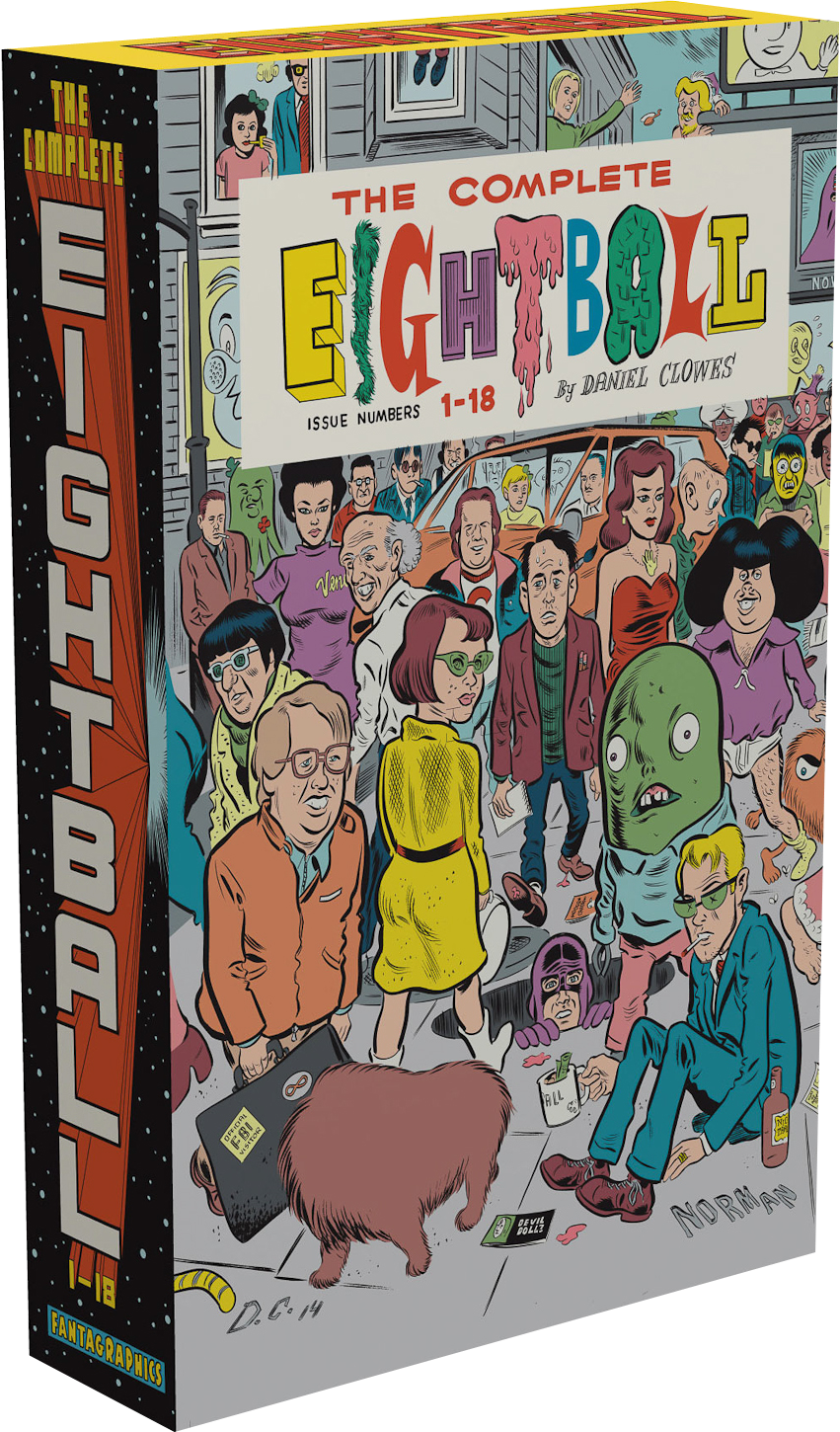
Hey, friends, concurrent with the long-awaited release of Fantagraphics Books’ astonishing The Complete Eightball Issue Numbers 1-18 super-deluxe hardcover slipcase boxed set — which you really need to go out and buy as soon as your budget can possibly accommodate its admittedly heavy $119.99 cover price (thank God for online discount retailers, am I right?)—Dean graciously invited me to take a breather from my usual hangouts (trashfilmguru.wordpress.com , unobtainium13.com , sequart.org , and dailygrindhouse.com is where most of my shit can be found if you’re interested) to stop by here and share my thoughts on this, my all-time favorite comics series.

Does that mean it’s the “best” comic ever? Hell no — although a strong case could probably be made in its favor — it simply means that Eightball was my “go-to book,” for all intents and purposes, for its entire 15-year, 23-issue run, and that in a very real sense I grew up right along with it, and matured at a rate vaguely approximate to that of series creator’s Dan Clowes’ evolution as an artist.

Yeah, sure, he’s a good number of years older than I am — and he’s certainly done a heck of a lot more with his life — but it’s truly uncanny how the trajectory of his his “career arc” seemed to hit just the right notes, at just the right times, in relation to “where my head was at” whenever any given new issue would hit the stands (which was usually a bit of mystery in these pre-Diamond Previews days — the book started out, in theory at any rate, on a thrice-yearly scedule, but delays weren’t just common, they became flat-out expected in fairly short order). The series debuted in August of 1989, when I was still in high school, and breathed its last in June of 2004, when I had just returned from spending nearly two years bumming around various parts of the world. Needless to say, a lot happened — both with the comic and myself — in the years in between, and as I sat down to start writing about it, I realized that my own personal memories were so inextricably linked to the material itself that there was pretty much no point trying to separate one from the other and fake some kind of “objective, dispassionate distance.” If that’s the sort of criticism you’re into, more power to ya, but you just ain’t gonna find it here. Eightball is too fucking personal to me. It means too much.

16778279475_4528a93830_o1

And so, what started out as a simple run-down /recap/appraisal of the series has morphed into a multi-part semi-monstrosity that I hope at least some of you good readers out there will find worth your time. Shit, maybe you’ll even be able to relate to parts of it. I realize that the subject matter is pretty far removed from this site’s unofficial remit of finding something at least semi-worthwhile in the Image, Marvel, etc. steroid-pumped superhero fare that was utterly ubiquitous in the 1990s (and that remains nearly as ubiquitous in the bargain boxes of comics shops today  — those that survived the implosion the onslaught of those titles brought on, that is), but what the hell. Eightball was — and still is — proof that there were, in fact, good comics coming out during that decade,  as well.

What do I mean, exactly, by “good”? Now there’s a question that you probably only need to consider on a site devoted to ’90s comics! As a semi-useful (I hope, at any rate) shorthand definition let’s just say that I mean books that possessed actual artistic merit that was obvious at the time, as opposed to, let’s face it, the absolute glut of material whose sole worth lies in its nostalgic value (although Clowes’ series certainly has plenty of that going for it when viewed from our present 2015 vantage point). Books that were more concerned with growing up than offering ever-flashier, but ever-more-creatively-stagnant, versions of the same sort of post-modern hyper-mythology that, let’s face it, has been getting bigger,louder, and more brash ever since Jack Kirby invented it, but with increasingly diminishing returns as the years go by absent the heart, humanity, and soul that The King imbued all of his works with. Books that were about real people dealing with real situations in real ways.tumblr_inline_nk2y3zR42O1s2tgut

Not that Clowes’ subject matter was primarily autobiographical in the same way that Harvey Pekar’s, Chester Brown’s, Joe Matt’s, and Seth’s (to name just a few) was. Granted, there’s a superb autobio piece called “Blue Italian Shit” in Eightball #13, but there’s also a wickedly precise deconstruction of the genre (“Just Another Day”) in issue five.  If that seems a bit scattershot or incongruous, rest assured that it is — and that’s one of the very best things about this series. Eightball, you see, is that now-rarest of beasts — the single-creator anthology comic. Adrian Tomine’s still got Optic Nerve going (occasionally) for D+Q, sure, but on the whole, let’s be honest — this is pretty much a dead format. And the  comics medium in general is desperately more impoverished for its passing from the scene.

Heck, kids today might be flat-out flabbergasted to discover that once there was a time when all of the creators just mentioned a moment ago, as well as the likes of Julie Doucet, Peter Bagge, Dennis Eichhorn, and the guy who started it all, Robert Crumb, had the freedom to just sit down at their drawing board (or typewriter) and crank out whatever kind of stories they wanted and that, miracle of all miracles, somebody would even publish them ! But those of us who are getting a bit longer in the tooth remember those times well indeed, and while none of these admitted labors of love moved  anywhere near the number of copies of Spawn Vs. Youngblood or whatever, they still sold at a clip that most “Big Two” books today would kill for.

Such are the vagaries of time, I guess. There’s no doubt that if Clowes was just getting started today and wanted to attempt something of this sort in the modern marketplace that he’d be confined to the so-called “digital realm,” but goddamnit, I still miss the days when indie creators who were living on the genuine margins still managed to find a way to get this stuff printed.

16590887960_cd8bd22393_b1

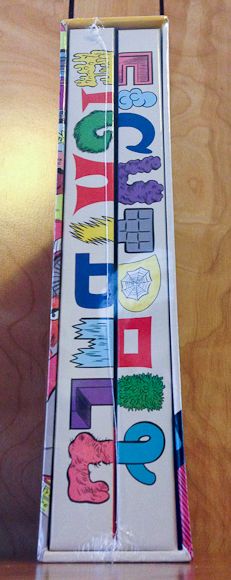
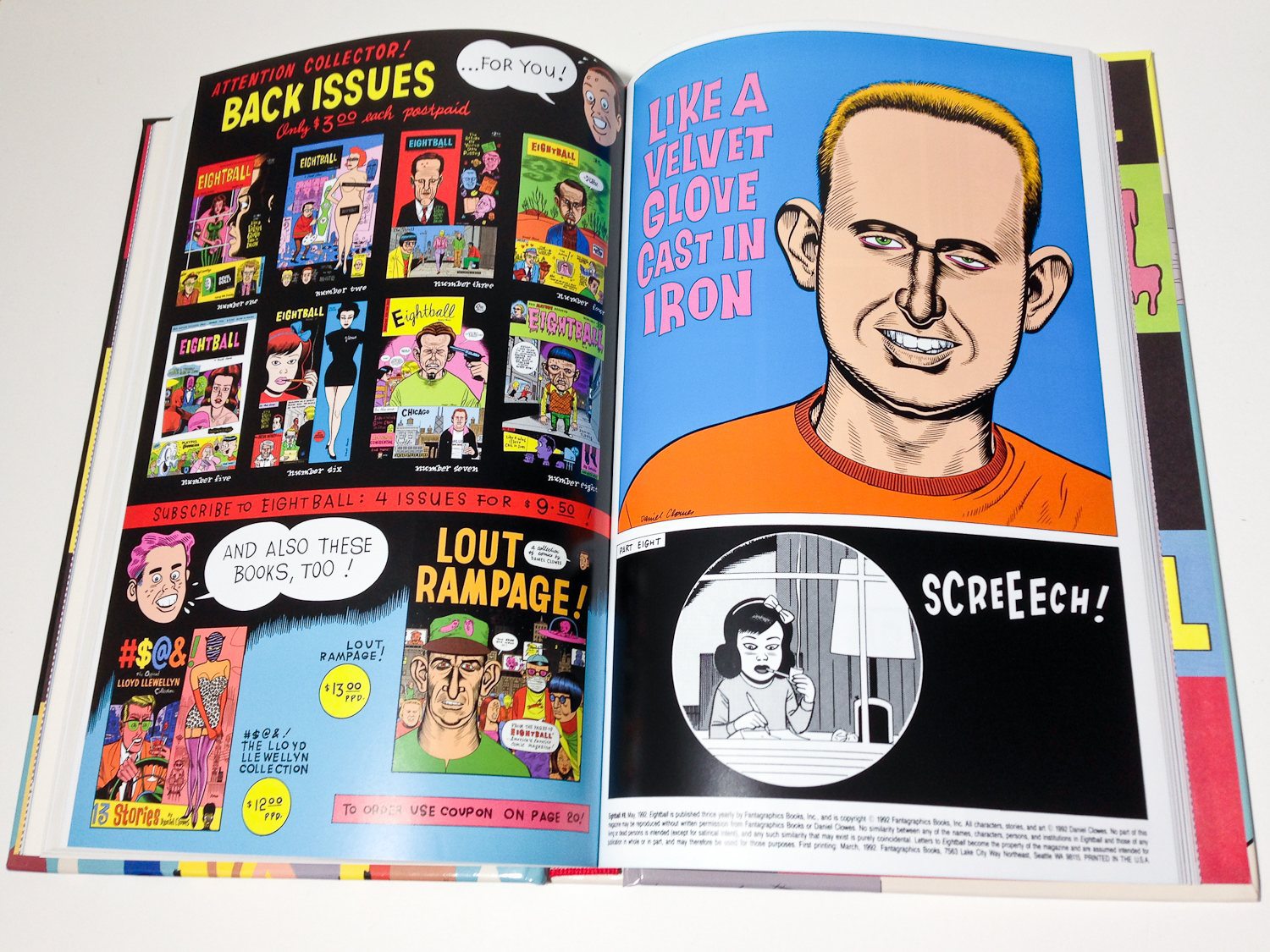
And has it ever been printed in this new collection! Fantagraphics has gone well and truly “above and beyond” with the physical product here, making exact facsimilie reproductions of each and every issue (no easy task considering that Eightball went through a fair number of format changes during its lifespan) and binding them inside two standard-comic-sized hardcovers that can be fully opened without cracking or damaging the binding in any way. Throw in some new front and back cover on each of the volumes as well as on the slipcase itself, and you’ve got yourself a package that can be looked at and drooled over for hours on end before you even start reading the thing.

It’s all here, folks — not just each and every story and strip, but the letter columns, the product-order pages drawn by Clowes, the whole nine yards. We go from cheap black-and-white newsprint for the first four issues to glossy covers and paper with increased color content in the interior pages to heavy-duty cardstock covers with even better, shinier paper inside. Hell, even the original mistakes are left intact — the most noticeable being when the printer accidentally ran the Ghost World segment in issue 16 in a risible sort of “split pea soup” yellow rather than the “cool blue” of all the other chapters. I hate to name-drop Kirby again in relation to a series that belies almost no influence from him whatsoever, but, as he once famously stated in 1970s DC “house ad” — “Everything is ‘as it was!'”  Yes, right down to the “Modern Cartoonist” pamphlet insert included with issue number 18.

CH6WpBfUkAAUzFZ

You’re alive? On this planet? And you still haven’t bought this thing yet? What — do your kids need to eat or something? And to think — I’m brow-beating you this mercilessly before I’ve even really started in on examining the actual merits of the comics themselves. Shame on me! Have I no class? No empathy? No basic salesmanship skills?

I’m going to plead the fifth on all of the above, but I’ll tell you what — that’s not a bad spot at all to leave things at for this introductory go-’round, but as for what’s still to come — Eightball went through four distinct creative  phases, each “anchored” by a central work, and when we dive in with part two of our analysis here we’ll break those down and then get into the nitty-gritty of critical dissection. We’re going to pay a little less attention to “phase three” and “phase four” because they’re not included in this collection (and, in fairness, while “phase three” started in 1998,  it concluded in 2000,  and “phase four” — apologies to Saul Bass — was entirely post-millenial, so they sort of fall outside of the loose parameters of this site), but for the sake of completeness even they will be addressed in due course. So buckle up! This is gonna be fun, I promise! As Clowes himself would say — welcome to my house of dreams!

The Great Debate-90’s comics vs. 70’s comics!

Hello, Legions of the Unspoken!  I had the chance to have a great conversation with Paul O’ Connor of Longbox Graveyard about the merits of the 70’s and Bronze Age vs. the 90’s!  Scroll through some cool covers of both decades, and then you’ll find the podcast!  Take a listen and comment with some of your thoughts!  Thanks again Paul!  Transcript coming soon!

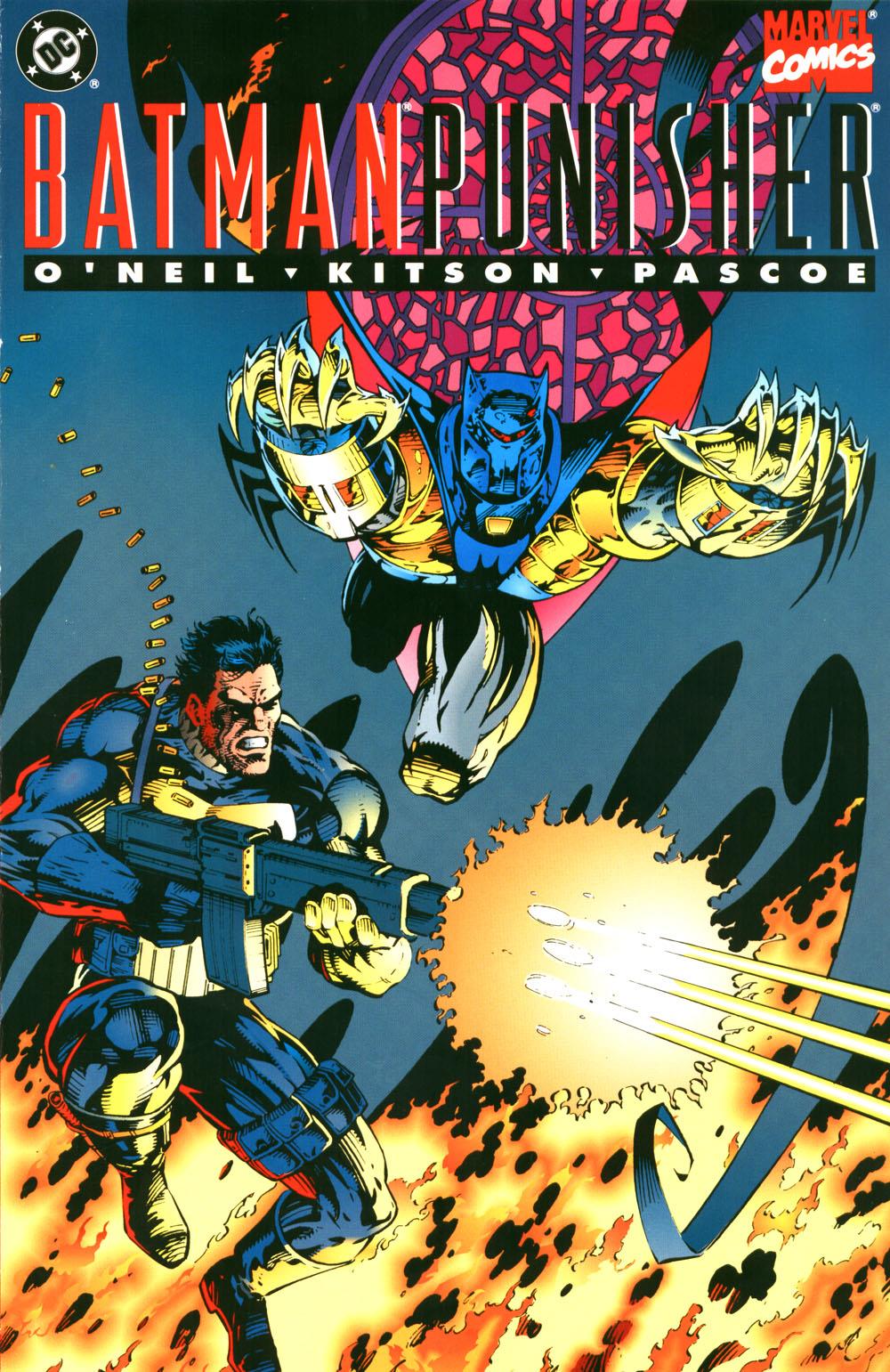
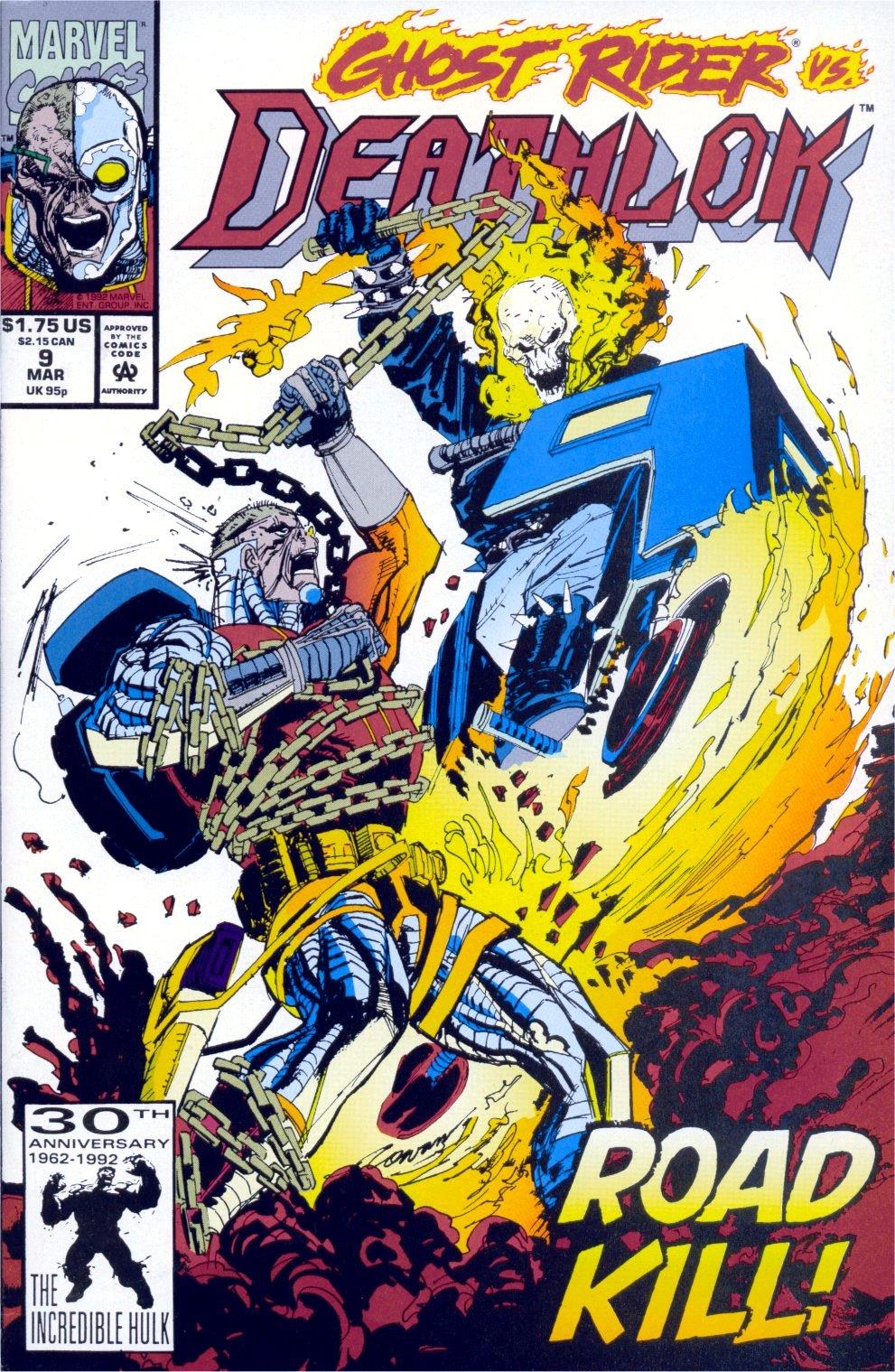
Avengers175 - Page 1 WestCoastAvengers #89 - Page 1Iceman Limited Series #1 (of 4) (1984) - Page 1Batman & Punisher - Lake of Fire #425 - Page 1IM128 - Page 1Deathlok #9 - Page 1

Listen by clicking the link below!!!

150331_002