Daniel Clowes’ “Eightball” — A Personal Reminiscence, Part Six

GhostWorld2


Do you have a best friend?

If pressed to name one,  I’d have to say that it’s my wife, and hopefully you readers out there who are married feel the same about your spouse. But chances are that if you’re either a) still single; b) younger than I am; or c)both, somebody else is your best friend.

Assuming, of course, that you have one. Which I sincerely hope you do, because best friends are generally a pretty cool thing to have — in fact, in our increasingly isolated, atomized world, where the vast majority of “social” interactions are merely a pale electronic approximation of what that word used to mean, I would even go so far as to argue that they’re absolutely necessary.

I’m pretty lucky —I  had a hell of a great best friend for about a decade or so. Man, the times we had. The trouble we got into — and out of. The crazy fucking nights that we didn’t deserve to survive but somehow did. I could tell you stories for hours — but don’t worry, friends,  I wont.

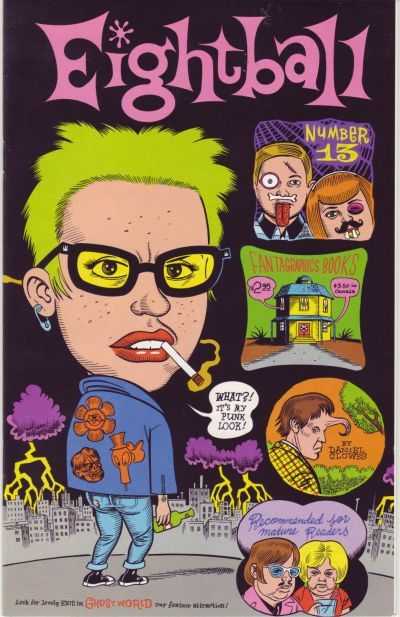
Instead, let’s talk about Enid Coleslaw (an easily-deciphered anagram of — well, I’m assuming you’ve got that figured out already) and Rebecca “Becky” Doppelmeyer, the two recent high school grads, who have apparently been best friends since childhood. that are at the center of Ghost World, the four-year-long narrative that runs in issues 11-18 of Daniel Clowes’ Eightball and serves as the “anchor” for what I’ve been referring to as “phase two” of this series I can’t seem to shut up about.

Enid and Rebecca are obvious outcasts who have chosen to embrace, to one degree or another,  the fact that they don’t “fit in” and run with it. Truth be told, both of them seem to have a bit of a “too cool for school” attitude that can sometimes get in the way of their growing up (a vastly over-rated enterprise, anyway), with Enid being the self-appointed pace-setter in this regard and Rebecca, to put it bluntly, always living in her shadow. Sure, there’s a justifiable level of resentment on Rebecca’s part that goes along with that, but on the whole, the two of them are so joined-at-the-hip that within a few pages of the opening installment, it’s impossible to imagine one getting through life without the other — and yet the main “through-line” of this story is about how that seemingly impossible situation comes to pass.

EB11CoverWeb

I’ll be honest — I don’t know how much of a detailed analysis of Ghost World is really necessary here (and no, I’m not just saying that because I’m in a lazy mood). Chances are you’ve read it in either single-issue form, one of its many collected editions, or seen the 2001 film based (a bit too loosely for my tastes, although I know that’s not a terribly popular opinion) on it. I’ve absorbed it in all of these formats on countless occasions myself, and while the comic book story certainly never fails to impress regardless of how you take it in, I have to admit that reading it again in serialized fashion as I recently have by means of The Complete Eightball Issue Numbers 1-18 is probably my preferred method of “experiencing” this genuine classic. There’s nothing wrong with sitting down and reading it all in one go, mind you, but I think it works better in smaller chunks spread out over time, with other stories interspersed between segments, simply because it’s an incredibly episodic narrative that can feel a bit disjointed when consumed in a single intake. Plus, the even aqua-hued color palette of the trade and hardback collections gives it a more uniform feel that, in some ways, does the material a (slight, at any rate) disservice.

Allow me to explain : Ghost World starts with a “cool blue” tone for its first five chapters, then assumes a truly bizarre chicken-shit-yellow tone for its sixth (a printer’s accident maintained for the sake of historical authenticity in the aforementioned Eightball omnibus double-hardcover), and finally settles into an aqua-blue tone similar — but not quite  the same as — the one adopted for the “graphic novel” collection for the last two segments, which see a remarkable, but completely relatable, shift occur in the Enid/Becky relationship.

To make a long story short (and if you want a longer analysis, I highly recommend Fantagraphics’ 2013 release The Daniel Clowes Reader, which contains a number of absolutely absorbing academic essays about the cartoonist’s work, the majority of which are, in fact, dedicated to Ghost World), this is a slow-burn chronicling of the dissolution of a friendship — and since our theme here is that of a “personal reminiscence,” allow me to take a moment to relate to you, dear reader, about how the inevitable drifting apart of Enid and Rebecca eerily mirrored my own “split” with my one-time best friend. Even though I said just a few paragraphs back that, ya know, I wasn’t going to bore you with stories about my own life.

43722-7153-51101-1-eightball


Okay, fair enough, Enid and Rebecca had a lot more drama involved when they parted company — even if a lot of it was gloriously subtle drama that eventually came to a head in a number of different ways — while my own situation was, frankly, more dull, but the coincidental timing of both was, at least from where I’m sitting, flat-out uncanny.

Consider : my former best friend and I were riding pretty high when Ghost World made its debut in Eightball #11. We were nearing the end of our collegiate years, as opposed to our high school years, but there was a very real sense that, even though neither of us had much of a clue what we were going to do with our lives, the world was our oyster. We’d take our time getting there (wherever “there” was), sure, but we were both bound and determined to have a damn good time along the way. We had the same interests, the same ideals, and conveniently enough for both of us, we never seemed to have crushes on the same girls (as opposed to the low-level competition that Enid and Rebecca have going on over their slightly-older friend Josh). Times were very good indeed.

By the time Ghost World settled into its multi-issue “groove” that showed the depths of our protagonists’ co-dependency, it’s fair to say that the same thing was happening with my friend and I. We shared a nice-and-affordable two-bedroom apartment, ran in the same extended social circle, and were generally thick as thieves. Times were good, bordering on great.

But damn — you know how it goes. Human beings are, I think, restless by nature — at least humans in their early-to-mid-20s — and at more or less exactly the same time the wheels came off the whole Enid-and-Rebecca pairing in unforgettable fashion, my friend and I started moving in distinctly different directions in life. I settled into a “career”-type gig while he and his girlfriend-at-the-time headed west. We let our lease on our place go  just a few short months after Eightball#18, containing the final (extended) segment of Ghost World, hit the shelves. But the writing had been on the wall for some time, and the last two chapters  of Clowes’ soon-to-be-most-celebrated work in particular really hammered home some of the stuff I was going through, to the point where I could certainly see my own life being reflected back at me in the exploits of two fictional late-teens women.

tumblr_inline_n9achejotx1s2tgut

What happened next? Well, Enid and Becky went on to conquer all media for a time, didn’t they? The first collection of Ghost World in hardcover and trade paperback was a huge hit, not only in the “comic book world,” but the larger sphere of pop culture in general. There were even Enid Coleslaw dolls at one point. And in 2001, a very well-received movie directed by Terry (Crumb, Bad Santa) Zwigoff became something of an indie-film sensation, and helped launch the career of somebody you may have heard of named Scarlett Johansson (who starred as Becky, with Thora Birch assuming the role of Enid and Steve Buscemi appearing as a new character named Seymour, whose storyline didn’t really do much for me). How well-received was it? Well, Zwigoff and Clowes got themselves an honest-to-goodness Academy Award nomination for the screenplay they co-authored, so I’d say it went over very well on the whole. So well, in fact, that they got back together in 2006 to make a second (and, in my own humble view, superior) flick extrapolated from an Eightball story, Art School Confidential.

As for yours truly, what can I say? Life goes on. My friend had some rough patches for a few years, but ended up coming out the other side pretty well, getting married in 2001 (a fair number of years before I finally tied the knot) and having a heck of a remarkable son. But our inexorable drift continued apace, especially when I split the country for about a year and half and did an admittedly lousy job of keeping in touch with just about everyone, and we both changed so much over time that we’re well and truly barely recognizable to each other anymore. The advent of social media made it easier to keep in touch — not that there’s any valid excuse for us to fall as out of touch as we did given that we live in the same fucking city — but that turned out to be more of a curse than a blessing given that we both seem to have, shall we say, remarkably different communication styles these days, and eventually an insipid argument that began on facebook led to a blow-up that resulted in the two of us not talking to each other for a couple of years.

We got together for a dinner — minus the drinks that used to be de riguer for both of us — about a year ago and everything was pleasant enough, but in all honesty that wasn’t anything so much as a hatchet-burying exercise, and it’s not like we ever really followed through on any of our “let’s get together sometime, man” half-assed promises. I’m grateful for the past we had together and the good times, absolutely, but there’s no future there. The harsh truth of the matter is that I think the guy is, sorry to say it, pretty much just a prick, and I’m not even terribly concerned that he’ll take exception to me saying so because I doubt he can be bothered to read any of the shit I write. Also, who knows? Chances are pretty good that his opinion of me is more or less the same.

And so, assuming I haven’t lost any of you fine folks over the course of my little “WTMI” info-dump there, I hope it’s abundantly clear why Ghost World is such a remarkable (not to mention remarkably poignant) work in my estimation. It’s supremely gifted storytelling, expertly written and  drawn, with genuinely memorable characters (especially some of the side characters! Who can forget “the Satanist couple”? Or professional dickhead John Ellis? Or “Weird Al” the waiter?), at-times-painfully perfect dialogue, and, unlike Clowes’ earlier long-form narrative Like A Velvet Glove Cast in Iron, showcases the heights of emotional resonance an artist can achieve when he’s willing to allow himself to become fully  invested in his characters as people. It’s a masterpiece of the medium, truly one of the very finest stories ever committed to the comic book page, cleverly disguised as a love-letter to teenage girl “outsiders.”

Reading it again in an exact facsimilie of its original publication format brought a tidal wave of memories flooding back, it’s true, but ya know what? I think I’d be perfectly comfortable labeling Ghost World a masterpiece even if I didn’t have such a personal connection to it, so obvious and undeniable is its quiet, unassuming , and above all heartfelt magnificence.

Daniel Clowes’ “Eightball” — A Personal Reminiscence : Part Five

1614593-p00001

So — how cringe-worthy would it be if I started this installment of our ongoing Eightball retrospective by saying something like “Hey, we want some Pussey — Dan Pussey, that is!”?

I admit, I thought about — for all of about a second. Then I decided not to. Then I (sort of) did it anyway. And that, friends, is the evolution of the creative process in microcosm (even if it’s a hell of stretch to call what I’m doing here “creative”).

For a longer-running (and, obviously, better) example, might I direct your attention to Dan Clowes’ five-year stint chronicling the exploits of the aforementioned Mr. Pussey, something of a “stand-in” character for any number of “young hot-shot” comic book artists that his creator had the misfortune of having to rub elbows with at various conventions and signings over the years — and perhaps even for said creator himself,  if he’d chosen to follow only a slightly different career path and hawk his wares in service of “The Big Two” rather than striking out on his own with more personal (as well as infinitely more relevant and, yeah, better) independent efforts.

To be completely fair, I’m not sure how much of a “dear God, this could be me!” viewpoint was running through Clowes’ mind when Pussey made his first appearance in 1989 in the pages of Eightball number one, but something very akin to sympathy does begin to sink in by the time the character “dies,” in 1994, in issue fourteen. Oh, sure, there’s still something of a “shooting fish in a barrel” vibe going on even at the end, but by then Dan C. has put Dan P. through the wringer in his various occasional appearances over the years, and when he exits a future Earth broke, forgotten, and warehoused in a gigantic nursing home, there’s an almost wistful sort of tone to the proceedings, as if the author is telling his creation “sorry I was so rough on you, buddy — maybe you were, sorry to say,  too easy of a target — so let’s just end things now.”

Clowes-Pussey-Bunkbeds-for-web

Lending a bit of credence to my “there but for the grace of whatever higher power you believe in go I” theory is the fact that Clowes introduces us to himself before we meet his (at least possible) warped alter ego at the outset of Pussey’s first appearance, with some windbag asshole (who later wrote a letter to the artist when he recognized himself — a letter that Clowes actually, and memorably, printed) telling a bemused “alternative” cartoonist that he has a million ideas for comic scripts and that he should drawn them for him in exchange for “a percentage of the profits” — but as the douchebag makes his departure, our artist crosses paths with another clueless dolt — and our “camera” follows that dolt to the decidedly dingy offices of the Infinity Comics Group, where he and his fellow conscripts have been recruited from the ranks of low-print-run fanzines to begin a “new era” of super-hero storytelling (with titles like “Marionette Squad” and “The Ten-Year Robot War”) being spearheaded by an octogenerian Stan Lee clone named, you guessed it, Dr. Infinity (who would later “star” in a segment of his own where he was shown to be the living personification of every shitty, despicable move made by management against the comics creators who kept them in business, from DC brass screwing Jerry Siegel and Joe Shuster out of the rights to Superman to an admittedly heavily-fictionalized re-telling of William Gaines hanging his EC artists out to dry during the congressional witch-hunt against that publisher, and the industry in general, in the 1950s).

And so begins Dan Pussey’s “alpha,” but there were a number of quite entertaining, incisive, and sometimes even poignant moments to enjoy in the “on-again, off-again” appearances he would make over the years before getting to the “omega” we already mentioned. Like his ultimately-fruitless quest to find an authentic artistic “voice” of his own Eightball number three — his pathetic, superheroine-based masturbation fantasy in number four — his dalliance with the “gallery world” in number nine — the flashbacks to his pathetic childhood in number twelve — so many memorable tales of haplessness to be had.

It may sound — okay, it does sound — corny, but re-reading all of these again in The Complete Eightball Issue Numbers 1-18 (note that the Dan Pussey stories have also been collected, by themselves, in the Pussey! paperback collection issued by Fantagraphics and pictured at the outset of this write-up) both brought a huge smile to my face and threw into sharp relief the more considered — and less caustic — tone that Clowes took toward his hard-luck “hero” as the stories unfolded.

pusseynosuperheroes

Of course, then-current events in the “comic book landscape” made their way into the Pussey narrative, as well, with Dan functioning as a doppleganger of sorts for the Image creators who were at the “top of the heap” at that time, but Clowes had the good sense to foresee the inevitable collapse their glut of garbage would have upon the industry, and that scenario plays a large part in, as the character himself  claims it’s pronounced, “Poo-say”‘s demise, so this series of strips — in addition to being the only holdover between “phase one” and “phase two” of Eightball, as we’ve previously discussed, gets bonus points for being eerily prescient, as well. Clowes not only had his “finger on the pulse,” he knew what would happen once he pressed in.

F3F9C7C2-ABCF-401D-91A09E1F7E0B2115

And so it is that the wonderfully sporadic misadventures of Dan Pussey probably have the greatest amount of sheer nostalgia value of anything in the pages of Eightball. Everything Clowes depicted either had happened, was happening, or would happen soon enough (in relative terms, of course — by now, it’s all happened), and while it would be a definte reach to say that the real Dan ever lost his contempt for the fake Dan entirely, by the time it was all said and done you could definitely sense that he viewed him as something of a tragic, rather than a purely sickening, figure.

Such a process of “warming up” to his characters would play an ever-greater role in Eightball as a whole, and we’ll delve into that more deeply next time when we take a look at the modern masterpiece that is “Ghost World.” Looking forward to seeing you then!


The Original Man in Black – James Robinson’s reinvention of “The Shade”

“A villain? Oh yes, it’s a badge I wear with some degree of pride. But not this hour. I must say it’s nice to play Errol Flynn for a change, instead of Basil Rathbone.” – The Shade

In honor of the MLB All-Star Game the Unspoken Decade has decided to take a look at a few of our favorite “All-Star” characters from our favorite decade. Being the contrarian that I am I have chosen to examine the Shade, reintroduced by James Robinson and Tony Harris during their historic run on Starman.

SHADE10
I am not sure if this image is canon after the events of “Flashpoint” but really that is their loss.

Starman is one of the great success stories of comics during the nineties. Not only did it reinvigorate a property that had grown stale, it properly introduced the world to its creators, and, most importantly, did so from one month to the next.

Unlike many well remembered comics from that time Starman was not a limited series or a one-shot event. It was a “Top of the Pile” book that came out month after month and it got people to go to comic stores. It built community and told a long form story in a way few other titles have done up until, or since, then.

I am a fan of Garth Ennis and John McCrea’s Hitman. I would, at times, place this similar work of nineties’ long form storytelling ahead of Starman but I believe that I may be in the minority. Starman is a beloved series and if you have never had the chance to read it, or if you began but never finished, do yourself a favor and see it through. It is not the most readily available series but it is worth tracking down.

SHADE01
Now that is an origin story. All silhouettes and reserved acceptance.

I enjoy, and appreciate Starman but rarely because of Jack Knight, the star and heir apparent to the legacy of Starman. He was never why I choose to reread the series long after it had concluded. For me it was all about the Shade.

Originally introduced by writer Gardner Fox, during the forties, to bedevil the Jay Garrick version of the Flash, the Shade (or Richard “Dickie” Swift as he was eventually revealed to be named) is an unlikely cult favorite. He is a British dandy from the 1830s with roots in the work of Charles Dickens as opposed to the pulp adventure or sci-fi stories of most supercharacters.

His abilities range from the generic “darkness manipulation” to the disturbing implication that he accesses a realm at the root of all evil, somewhere the Old Gods or Many-Angled Ones call home. When he is conjuring shadow-demons and blades I prefer to believe that he is accessing the same Darkforce Dimension that others have been accessing since before there was a name for it. From the Shroud and Darkstar, to Obsidian and Nightshade, and even Jackie Estacado.

If that is the case then why is Shade immortal? Why does he no longer age? Why does he appear to be haunting the background of the shared DCU as if he were no more than one of his own, ever present shadows? If you know anything about Fox, a devout fan of HP Lovecraft, the answer may be lurking somewhere deep beneath the surface.

SHADE02
Her own shadow, above his bowed head, as she is committed to the pit by her own hand.

Before Shade, Fox introduced the very concept of the superteam with the Justice Society and was asked to revive the concept years later as the League. Have you ever wondered why the Justice League fought weird, mystical characters at the time that they were introduced? Tell me that Starro does not appear as if it should come from the same place as Cthulhu.

As a fan of “weird fiction” I assume that it informed most of Fox’s work, not just where the influences are explicit. You may not find much stygian darkness in the Golden Age stories as Shade is mostly a Green Lantern knockoff at that time. When fans were reintroduced to the character after the events of Zero Hour the disturbing implications seem to surface.

Darkness comes from him though he never seems to be distressed. He is not dark or mopey but always looking for the next adventure even if one is as mundane and revealing as a long walk on an autumn night. His powers take the form of living, murderous shadows or even cephalopod tentacles but this never means that he is a dreary man.

Shade could be keeping the darkness at bay with all of the blood he has shed, feeding it if you will, but I choose to believe that he simply accepts what he is and that having darkness powers does not mean that you need to be dark.

Shade haunts the stories of Starman. He provides context for the events going on in the Knight family’s beloved Opal City (a character as much as a setting) and introduces Jack to the unending weirdness of the DCU. Shade is a man of style who makes a point of commenting on how people dress and he aids in grounding the story to its time, including when he narrates a story set in the far past.

SHADE03
Just think of how many Dibneys could have been saved if Brad Meltzer had read this before writing “Identity Crisis.”

Sometimes a criminal or a murderer, sure, but “Dickie” is never boring or without comment. He is unflappable and refers to “The Shade” as his stage name. You almost feel as if the going-ons of superherodom are just the distraction he needs from being something he fears.

He mentions having honed his abilities over his century and a half with them and acknowledges the readiness at which he disconnects from people. This last bit is a favorite of mine because when Shade does connect with someone it is not easily won by either party.

His friendship with former DC mainstay, the Scalphunter, is often referred to and at least once I found myself wondering if a simple hero had swayed Shade from being a greater menace to the world just by happening upon a situation where he could be nice to him.

In 1997 Robinson wrote a four issue Shade miniseries. Each issue featured a different artist though I am partial to the first issue’s work by Gene Ha. Issue two has JH Williams III but I am afraid that I am not familiar with the final two artists enough to speak to their work. It certainly seems as if Robinson also favored the earlier issues as there is noticeably fewer run-on captions featuring narration by the Shade though that could be because of the nature of the tale.

The Shade keeps journals. This is a fact crucial to his role in Starman and it is explored here as he tells the readers about the Ludlow Family, who has a longstanding, one-sided blood feud with him that he dearly wishes they did not.

Minor point, but if James Robinson happens to read this (Hi, Jimmy! I loved League of Extraordinary Gentlemen the movie.) please rerelease these issues without the fancy script font for the Shade’s scribblings. That gets tiring quickly.

SHADE04
Not from the original series but literally the only full body shot I could find “in costume.”

We are presented with bits of Dickie’s origin though for more on that I highly recommend the 2011 Shade series, written by Robinson and featuring a variety of exceptionally talented artists during the course of its 12 issue run, including Cully Hammer, Darwyn Cooke, Frazer Irving, and a final issue by Ha.

For the most part we are shown how much of a contradiction the Shade is. This is, I would wager, much the same as with any real person. We do things we want and cannot always explain why. We may be afforded the time, and incentive, to attempt to understand them later on but often we fail to recognize that. Dickie is comfortable with his murders (which are primarily in self-defense or of bad men) but there is no finer connoisseur of food in wine in superhero fiction than he.

Few panels are wasted on explaining what Shade can do. He is the narrator and main character but the plot is put into motion by others. Shade is the threat, the boogeyman, and the excuse for superpower to enter into stories of familial betrayal and corruption.

For all of his stygian prowess Dickie is a surprisingly upbeat man with a desire to enjoy the life he leads at a pace of his choosing. His interactions with the Flash and Starman (of both eras) are presented as what he does because he chooses to do so. He is above the desires of petty villainy and is actually shown to be doing quite well for himself.

Could he be an arch-mage, foe of luminaries such as the Sentinels of Magic (another nineties’ concept no one ever did anything with), commanding an army of shadow demons in an attempt to revert the world to darkness for the glory of his own personhood? Sure, but you can only tell that story once and other have done a better job at it.

SHADE05
This line needs to be uttered by Jon Pryce in a movie version before it is too late.

Shade prides himself on the quality of his coffee and technically had Oscar Wilde as a sidekick. He is the immortal who keeps the DCU in perspective, both for himself and others (hence all of the journaling) as opposed to measuring his worth by the influence he can have in directing the course of events throughout the world.

He is not Ra’s al Ghul, Vandal Savage, or any of the other long-lived, crazy people superheroes usually fight. Maybe this is because he was a content person before gaining great, poorly defined, superpowers and that did little to change what he wanted out of life. Maybe the trick to avoiding superpeople battles in the future is to only give powers and abilities to those who are already not hurting for their place in the world.

Dickie does not seem to concern himself with the future. When asked if the feud with the Ludlows is at an end he all but shrugs. He is not a detective, he is the mischief maker. He writes down his observations, his travels, and his adventures as he attempts to reconcile them. He takes thing slow and he enjoys all that he can.

SHADE07
Lines such as this make me appreciate this character more than whoever it was that starred in “Man of Steel.”

He does not dwell because he does not have to. As far as he can tell he will be around forever. His immortality, more than any other attribute (including his penchant for dark clothes and smoked sunglasses), is what he relies on. What other character can boast an arch-rival as interesting and complex as the seemingly never-ending string of descendants from a perverted British family that predates the American Civil War?

Not only do the Ludlows lend themselves to the telling of a variety of different types of stories (most of which are at least hinted at during this series) but they prove to be the one aspect of the Shade’s life that he cannot take in stride.

They reappear from beneath the veneer of supposed friends and lovers, more often than not harming the Shade’s few friends instead of himself. For the man who only wants to enjoy life, seek thrills, and not be bothered with the moroseness that he should, by all rights, be enveloped by, it is something incredibly mundane (at least by comparison) that often hurts him the most: People raised to hate something they know nothing about.

Dickie outlasts Robinson within the DCU and has continued to appear. Maybe not having created him in the first place meant that he could not be put into the same “do not touch” box as Jack Knight and the other extended family cast members. Or maybe it is that no one has tried.

Either way, the Shade continues to haunt the periphery of the world that the superheroes operate in. He has yet to suffer a direct setback because of his powers. By that I mean that unlike other heroes, it has yet to be proven that his powers are killing him or the world he lives him. In all likelihood he will outlive the current crop of heroes and be around to remind the next exactly which struggles they should learn from and which they should put behind them.

What story is there for a man who takes almost no active part in the world? The beauty of the Shade is that the world he finds himself in becomes the story. Timelines, and bloodlines, can be played with and Dickie himself is quick to hint at untold tales and adventures that he played a part in but can only barely recall now. Or so he claims.

The Shade does not want your crossovers or your ridiculossness but business is business when it must be done.

The Shade allows for worlds to be built and his callous nature means that more often than not he is at the center of attention of someone looking for retribution. He is not against involving himself and does so sometimes only to his own detriment. He also has a friend named Bobo.

I have no idea what the current state of the DCU is. Continuity, for whatever that word is worth, is apparently different after Convergence but I remember a time when a monthly book was allowed to shape an ongoing story more than what was happening in the books published alongside it. Starman was a semi-obscure character, out-of-publication for decades, who became one of the most well-regarded superhero comics of all time.

The Shade should never have been anything other than a rogue, trotted out to fight the Justice Society occasionally, but instead I rank him as one of my favorite characters. His name alone is one of the few that will get me to pick up a title, though hopefully that means Robinson is along for the ride because they certainly seem to bring out the best in each other.

The Gimmick Era Has Never Been Covered So Well.