“A villain? Oh yes, it’s a badge I wear with some degree of pride. But not this hour. I must say it’s nice to play Errol Flynn for a change, instead of Basil Rathbone.” – The Shade
In honor of the MLB All-Star Game the Unspoken Decade has decided to take a look at a few of our favorite “All-Star” characters from our favorite decade. Being the contrarian that I am I have chosen to examine the Shade, reintroduced by James Robinson and Tony Harris during their historic run on Starman.

Starman is one of the great success stories of comics during the nineties. Not only did it reinvigorate a property that had grown stale, it properly introduced the world to its creators, and, most importantly, did so from one month to the next.
Unlike many well remembered comics from that time Starman was not a limited series or a one-shot event. It was a “Top of the Pile” book that came out month after month and it got people to go to comic stores. It built community and told a long form story in a way few other titles have done up until, or since, then.
I am a fan of Garth Ennis and John McCrea’s Hitman. I would, at times, place this similar work of nineties’ long form storytelling ahead of Starman but I believe that I may be in the minority. Starman is a beloved series and if you have never had the chance to read it, or if you began but never finished, do yourself a favor and see it through. It is not the most readily available series but it is worth tracking down.
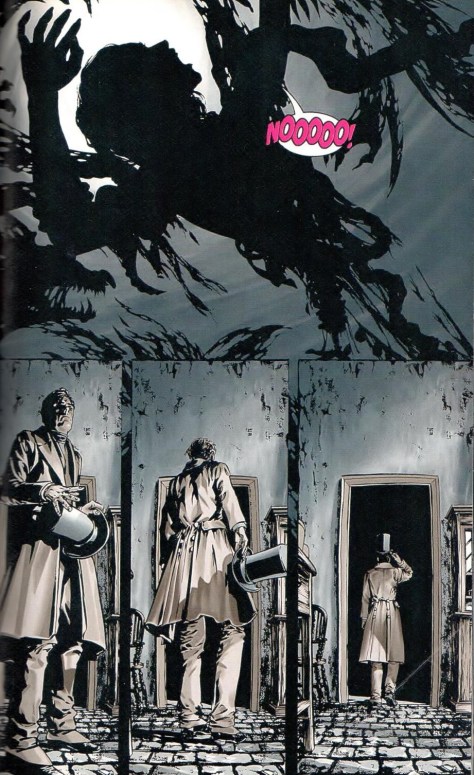
I enjoy, and appreciate Starman but rarely because of Jack Knight, the star and heir apparent to the legacy of Starman. He was never why I choose to reread the series long after it had concluded. For me it was all about the Shade.
Originally introduced by writer Gardner Fox, during the forties, to bedevil the Jay Garrick version of the Flash, the Shade (or Richard “Dickie” Swift as he was eventually revealed to be named) is an unlikely cult favorite. He is a British dandy from the 1830s with roots in the work of Charles Dickens as opposed to the pulp adventure or sci-fi stories of most supercharacters.
His abilities range from the generic “darkness manipulation” to the disturbing implication that he accesses a realm at the root of all evil, somewhere the Old Gods or Many-Angled Ones call home. When he is conjuring shadow-demons and blades I prefer to believe that he is accessing the same Darkforce Dimension that others have been accessing since before there was a name for it. From the Shroud and Darkstar, to Obsidian and Nightshade, and even Jackie Estacado.
If that is the case then why is Shade immortal? Why does he no longer age? Why does he appear to be haunting the background of the shared DCU as if he were no more than one of his own, ever present shadows? If you know anything about Fox, a devout fan of HP Lovecraft, the answer may be lurking somewhere deep beneath the surface.

Before Shade, Fox introduced the very concept of the superteam with the Justice Society and was asked to revive the concept years later as the League. Have you ever wondered why the Justice League fought weird, mystical characters at the time that they were introduced? Tell me that Starro does not appear as if it should come from the same place as Cthulhu.
As a fan of “weird fiction” I assume that it informed most of Fox’s work, not just where the influences are explicit. You may not find much stygian darkness in the Golden Age stories as Shade is mostly a Green Lantern knockoff at that time. When fans were reintroduced to the character after the events of Zero Hour the disturbing implications seem to surface.
Darkness comes from him though he never seems to be distressed. He is not dark or mopey but always looking for the next adventure even if one is as mundane and revealing as a long walk on an autumn night. His powers take the form of living, murderous shadows or even cephalopod tentacles but this never means that he is a dreary man.
Shade could be keeping the darkness at bay with all of the blood he has shed, feeding it if you will, but I choose to believe that he simply accepts what he is and that having darkness powers does not mean that you need to be dark.
Shade haunts the stories of Starman. He provides context for the events going on in the Knight family’s beloved Opal City (a character as much as a setting) and introduces Jack to the unending weirdness of the DCU. Shade is a man of style who makes a point of commenting on how people dress and he aids in grounding the story to its time, including when he narrates a story set in the far past.
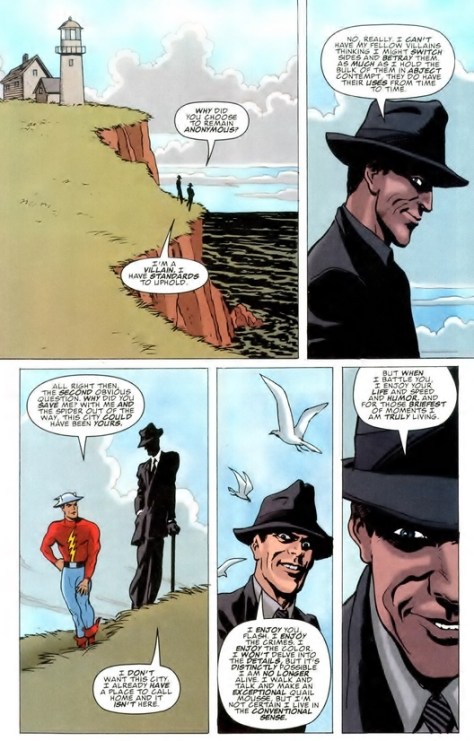
Sometimes a criminal or a murderer, sure, but “Dickie” is never boring or without comment. He is unflappable and refers to “The Shade” as his stage name. You almost feel as if the going-ons of superherodom are just the distraction he needs from being something he fears.
He mentions having honed his abilities over his century and a half with them and acknowledges the readiness at which he disconnects from people. This last bit is a favorite of mine because when Shade does connect with someone it is not easily won by either party.
His friendship with former DC mainstay, the Scalphunter, is often referred to and at least once I found myself wondering if a simple hero had swayed Shade from being a greater menace to the world just by happening upon a situation where he could be nice to him.
In 1997 Robinson wrote a four issue Shade miniseries. Each issue featured a different artist though I am partial to the first issue’s work by Gene Ha. Issue two has JH Williams III but I am afraid that I am not familiar with the final two artists enough to speak to their work. It certainly seems as if Robinson also favored the earlier issues as there is noticeably fewer run-on captions featuring narration by the Shade though that could be because of the nature of the tale.
The Shade keeps journals. This is a fact crucial to his role in Starman and it is explored here as he tells the readers about the Ludlow Family, who has a longstanding, one-sided blood feud with him that he dearly wishes they did not.
Minor point, but if James Robinson happens to read this (Hi, Jimmy! I loved League of Extraordinary Gentlemen the movie.) please rerelease these issues without the fancy script font for the Shade’s scribblings. That gets tiring quickly.
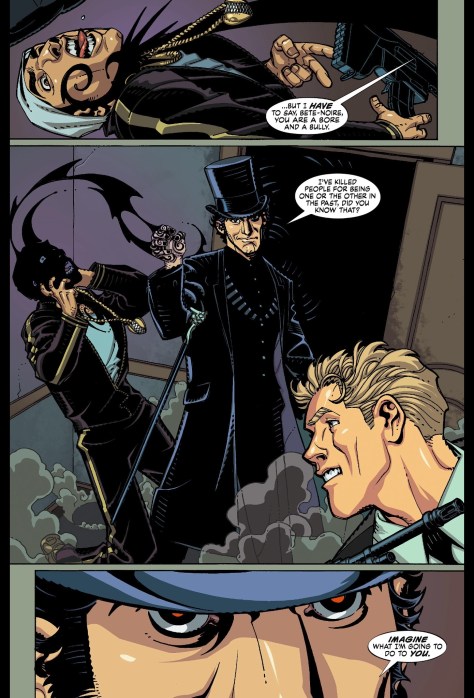
We are presented with bits of Dickie’s origin though for more on that I highly recommend the 2011 Shade series, written by Robinson and featuring a variety of exceptionally talented artists during the course of its 12 issue run, including Cully Hammer, Darwyn Cooke, Frazer Irving, and a final issue by Ha.
For the most part we are shown how much of a contradiction the Shade is. This is, I would wager, much the same as with any real person. We do things we want and cannot always explain why. We may be afforded the time, and incentive, to attempt to understand them later on but often we fail to recognize that. Dickie is comfortable with his murders (which are primarily in self-defense or of bad men) but there is no finer connoisseur of food in wine in superhero fiction than he.
Few panels are wasted on explaining what Shade can do. He is the narrator and main character but the plot is put into motion by others. Shade is the threat, the boogeyman, and the excuse for superpower to enter into stories of familial betrayal and corruption.
For all of his stygian prowess Dickie is a surprisingly upbeat man with a desire to enjoy the life he leads at a pace of his choosing. His interactions with the Flash and Starman (of both eras) are presented as what he does because he chooses to do so. He is above the desires of petty villainy and is actually shown to be doing quite well for himself.
Could he be an arch-mage, foe of luminaries such as the Sentinels of Magic (another nineties’ concept no one ever did anything with), commanding an army of shadow demons in an attempt to revert the world to darkness for the glory of his own personhood? Sure, but you can only tell that story once and other have done a better job at it.
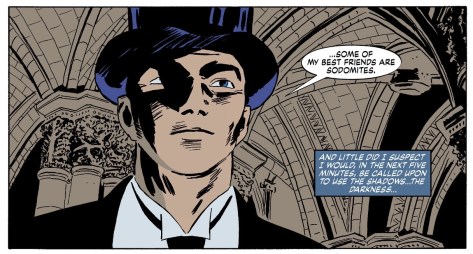
Shade prides himself on the quality of his coffee and technically had Oscar Wilde as a sidekick. He is the immortal who keeps the DCU in perspective, both for himself and others (hence all of the journaling) as opposed to measuring his worth by the influence he can have in directing the course of events throughout the world.
He is not Ra’s al Ghul, Vandal Savage, or any of the other long-lived, crazy people superheroes usually fight. Maybe this is because he was a content person before gaining great, poorly defined, superpowers and that did little to change what he wanted out of life. Maybe the trick to avoiding superpeople battles in the future is to only give powers and abilities to those who are already not hurting for their place in the world.
Dickie does not seem to concern himself with the future. When asked if the feud with the Ludlows is at an end he all but shrugs. He is not a detective, he is the mischief maker. He writes down his observations, his travels, and his adventures as he attempts to reconcile them. He takes thing slow and he enjoys all that he can.

He does not dwell because he does not have to. As far as he can tell he will be around forever. His immortality, more than any other attribute (including his penchant for dark clothes and smoked sunglasses), is what he relies on. What other character can boast an arch-rival as interesting and complex as the seemingly never-ending string of descendants from a perverted British family that predates the American Civil War?
Not only do the Ludlows lend themselves to the telling of a variety of different types of stories (most of which are at least hinted at during this series) but they prove to be the one aspect of the Shade’s life that he cannot take in stride.
They reappear from beneath the veneer of supposed friends and lovers, more often than not harming the Shade’s few friends instead of himself. For the man who only wants to enjoy life, seek thrills, and not be bothered with the moroseness that he should, by all rights, be enveloped by, it is something incredibly mundane (at least by comparison) that often hurts him the most: People raised to hate something they know nothing about.
Dickie outlasts Robinson within the DCU and has continued to appear. Maybe not having created him in the first place meant that he could not be put into the same “do not touch” box as Jack Knight and the other extended family cast members. Or maybe it is that no one has tried.
Either way, the Shade continues to haunt the periphery of the world that the superheroes operate in. He has yet to suffer a direct setback because of his powers. By that I mean that unlike other heroes, it has yet to be proven that his powers are killing him or the world he lives him. In all likelihood he will outlive the current crop of heroes and be around to remind the next exactly which struggles they should learn from and which they should put behind them.
What story is there for a man who takes almost no active part in the world? The beauty of the Shade is that the world he finds himself in becomes the story. Timelines, and bloodlines, can be played with and Dickie himself is quick to hint at untold tales and adventures that he played a part in but can only barely recall now. Or so he claims.

The Shade allows for worlds to be built and his callous nature means that more often than not he is at the center of attention of someone looking for retribution. He is not against involving himself and does so sometimes only to his own detriment. He also has a friend named Bobo.
I have no idea what the current state of the DCU is. Continuity, for whatever that word is worth, is apparently different after Convergence but I remember a time when a monthly book was allowed to shape an ongoing story more than what was happening in the books published alongside it. Starman was a semi-obscure character, out-of-publication for decades, who became one of the most well-regarded superhero comics of all time.
The Shade should never have been anything other than a rogue, trotted out to fight the Justice Society occasionally, but instead I rank him as one of my favorite characters. His name alone is one of the few that will get me to pick up a title, though hopefully that means Robinson is along for the ride because they certainly seem to bring out the best in each other.