Tag Archives: Marvel

Blade: Hunting Solo by Emily Scott

Greetings, Legions! As you may have noticed in the past, the Halloween season is one of our favorite times of year, for many reasons, but especially because it gives us an excuse to delve into some of the more horror-based titles of The Un-spook-en Dead-cade. (If there’s a better way to scare people than with bad puns, I don’t know what it is.) Just before Halloween, Dean Compton (this site’s proprietor) and I will be bringing you another edition of The Spoken Decade, where we’ll take a look at The Rise of the Midnight Sons. Right now I’ll be digging into one of the Midnight Sons better known members, your favorite dhampir and mine, Blade!

Blade, created by Marv Wolfman and Gene Colan, first appeared in 1973 in Marvel’s The Tomb of Dracula. (I read some of The Tomb of Dracula, and when I first saw Marv Wolfman’s name, I thought they had given themselves spooky names, like the crew of The Simpsons on Treehouse of Horror episodes.) The character popped up in a number of other titles throughout the subsequent years, including Vampire Tales, Nightstalkers, and the aforementioned Midnight Sons, before getting his first solo title, Blade: The Vampire-Hunter, in 1994. The series ran for 10 issues, which were penciled by Doug Wheatley, and the first eight of which were written by Ian Edginton. (I tried to make up spooky versions of their names without success. Suggestions welcome.)

The series wastes no time not only in letting the reader know who the Big Bad is going to be but also in going straight for the Biggest Bad:

blade-big-one
I am so used to associating the Wesley Snipes’ movie with this character that my first thought about this cover was, “Damn, he’s so fancy.”

One of the best parts of any vampire property is seeing which parts of vampire mythology they use or discard, embrace or mock, and this title also wastes no time showing us what it looks like when Blade takes down a bloodsucker. I have mostly come across vampires either bursting into flames when destroyed or getting dusted like on Buffy, so I must say this is, hands down, the coolest visual representation of a vampire eating it that I have ever seen:

blade-dusting
It’s like his soul is a Lisa Frank cheetah.

This image is the first part of a vision being had by one John Carik, former professor and current psych hospital patient covered in scarred sigils and marks known to the doctors as Bible John. He sees the fight to defeat Varnae, First Lord of the Vampires, which took the lives of Blade’s Nightstalker companions, Hannibal King and Frank Drake. John also sees Blade struggling under the weight of his survivors guilt, but what he sees next causes him to break out of the hospital to warn Blade — the return of….DRACULA! (I hope I’m not the only one who reads that name in their head in the bad Transylvanian accent every time. Also, never look up what real Transylvanian accents sound like because it is woefully and disappointingly NOTHING like what Count Chocula sounds like.)

After the deaths of his colleagues, Blade tries to make a new start in his old New York stomping grounds. We learn through some incredibly expository dialogue that Blade is hoping to make his new life a fairly normal one and that he is earning his keep by renovating the house his landlady, Julia Suarez, received from her ex-husband in the divorce settlement. Blade tells Julia he has no interest in talking to a reporter who calls asking about the Nightstalkers, or anyone else for that matter. He also decides to go by the name Hannibal Francis Blade to honor his fallen brothers.

This “normal” life lasts for about ten minutes till Bible John catches up to Blade, tells him he can’t deny his heritage, which he knows a surprising amount about, and gives him the not-as-cool-looking-as-it-sounds Witch Compass. The compass will point to negative energy, and Blade must not be as ready as he pretends for a quiet existence because all it takes for him to bust out the blades again is a twitch of the compass’s needle and the fact that Bible John DID know a thing or two about him.

blade-water
Blade hates evil AND hydration.

The compass leads Blade to the lair of Aaron Thorne, the new leader of Lord Varnae’s secret cult, the Bad Seed. Thorne is hatching a plan to essentially enslave the entire country with a drug that has been mixed with his thralls’ blood. Once loyal to him, everyone will therefore also be loyal to Varnae, whom the Bad Seed intend to bring back to un-life. Blade is not the only one who might interfere with their plans, though, a fact Thorne discovers with his Necrotech program. (I’m just going to let him tell you about Necrotech, since there is no way I can improve on this explanation.
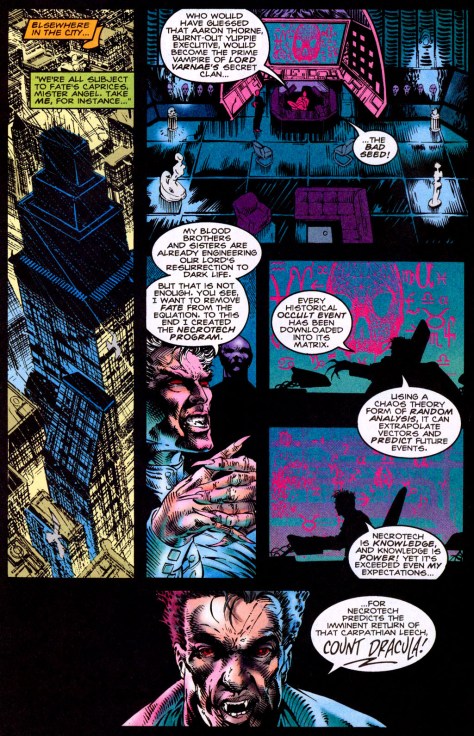
blade-gobblygook
This is some of my favorite techobabble since “Reserve the polarity of the neutron flow.”

Blade, of course, does indeed interfere, and takes on Thorne, who wastes no time in telling Blade that he thinks he’s useless. Thorne gains the upper hand and mocks Blade with the idea that his anger and obsession have made him inhuman. And because the 90’s were a beautiful and strange time when a vampire comic could also have a touch of the TGIF sitcom, that accusation strikes a chord with Blade when he remembers what his landlady told him earlier: “It’s only human to grieve and be angry, but don’t let it eat you up.” Those simple words allow Blade to give focus to his anger and relieve Thorne of some of his own Lisa Frank cheetah spirit energy. In the process, Blade delivers some words that would stick with me if he were my sitcom friend (and are also good advice to anyone taking on a vampire): “A nice fat ego makes an easy target.”

Thorne’s minions do much of Blade’s work for him in destroying the drug blood farm (three words that feel weird to type in that order) when they shoot barrels full of chemicals they were explicitly told not to shoot. Blade accepts that he is still in this fight, but this time with a renewed perspective and on his own terms. Thorne is somewhat less pleased with the outcome of the fight and swears revenge on Blade. The reporter looking for Blade earlier goes looking for information on the Nightstalkers but finds more than she bargained for. In fact, she finds…DRACULA!
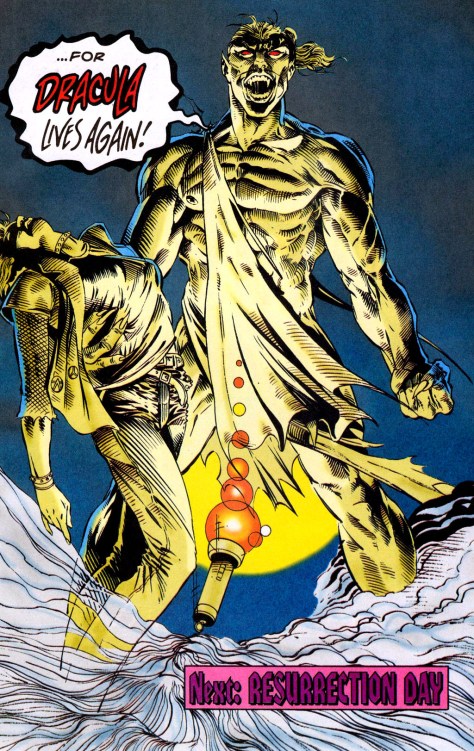
blade-dracula
I’m just going to type it like that every time I have to type the name of…DRACULA!

Thorne puts out the word that he is looking for Blade, who is fulfilling his domestic duties to Julia. Some bats show up on the search, and Blade is suddenly concerned about the fact that Thorne might have survived the explosion after all. He also laments that he may have doomed them both by not bringing his knives into the house as a concession to trying to live a normal life. (I’m not sure I understand his logic here, since it seems like the useful concession would be, you know, keeping the knives and NOT hunting vampires. Then people would just assume he is a mall ninja.) There is no reason to fear, though, as Julia saves the day again, this time with her mop instead of her wisdom. Bible John has the terrific timing to show up just then and warn Blade about his vision, and the two agree that together they will stop…DRACULA! before he can manifest.

Little do they know that he is already back, having turned the reporter into his thrall and using her to lure in her friend, a fellow reporter at the world’s sleaziest newspaper. Seriously, this place doesn’t really seem to be essential or even particularly important to the plot (at least for this story arc), but this is a 90’s comic site after all, and this newsroom is the 90’s-ist. I would love to watch the 90’s HBO sitcom based on this newspaper. It could come on after Arliss.
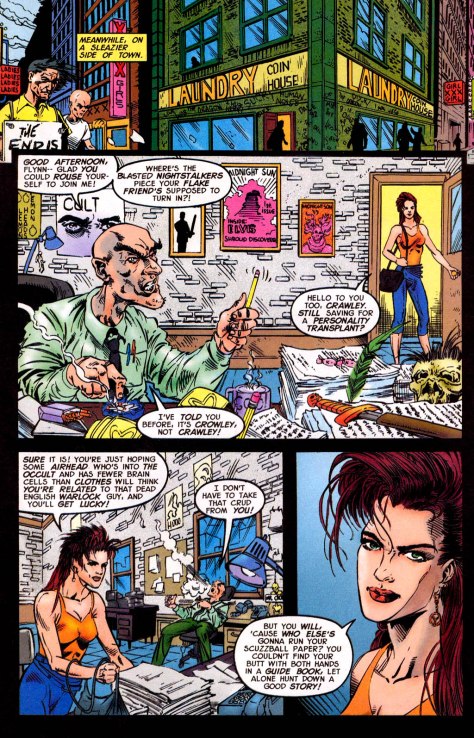
blade-sleaze-times

blade-press
I kept coming up with cheesy names like The New York Slimes, but it would just be called Press and not get picked up for a second season.

Anyway, vampires.

So Blade and Bible John follow the compass to the Body Hammer, but once they arrive, they realize they are too late to stop…DRACULA! He has already enthralled what seems to be the entire club, and they must fight their way through them all before getting to the big boss himself. Once again Blade gets mocked by a vampire for hunting vampires, a task they understandably don’t see the value of, despite the number of vampire asses it seems Blade has kicked. Blade tells…DRACULA! that he can’t kill him if he wants to know where his wife and son are, but…DRACULA! just finds that claim amusing, reasoning that he can turn Blade and have the information from him willingly.

This is as good a time as any to heap some praise on the artists of this book, who manage to create something that reminds me, in a good way, of things I already like but still has its own aesthetic. The fight scenes all have dynamism to them that I don’t always notice or appreciate in other comics, so in addition to looking beautiful, it was easier for someone like me, who doesn’t necessarily have the visual vocabulary that comes with a lifetime of reading comics, to follow what was actually going on. I have already mentioned penciler Doug Wheatley, but I want to make sure to mention colorist Tom Zuiko and inker Chris Ivy as well for helping to put together a comic I just really enjoyed looking at.

blade-fight
Dracula would make one hell of a wide receiver.

…DRACULA! goes for the bite and attempts to turn Blade, apparently having forgotten that he is a dhampir and can’t be turned. This lapse in memory confuses Blade, who wonders if something didn’t go according to plan when…DRACULA! was brought back. Since Blade is immune to the bite of a vampire, Bible John is next on the menu, but the sigils he has carved into his flesh protect him and burn…DRACULA! Meanwhile, Blade has received assistance from a strange source, Thorne’s crony Angel. Since Blade’s…blade was broken in the fight, Angel bestows a knife on him, and for a moment, it seems Blade is much invigorated and….DRACULA! more susceptible to harm. Thorne watches the wings, hoping his two enemies take each other out.

Blade quickly realizes he has been had and that the knife has put him under Thorne’s influence. He refuses to participate in the charade any longer and throws the knife at Thorne. The two vampires finally get around to paying attention to each other, and the bloodsucker brawl begins!

blade-christopher-lee
I like to entertain the idea that Dracula has a home theater in his castle and strong opinions about different actors’ portrayals of him.

I suppose since I included two pages of a newspaper office, I should probably include at least that many of two vampires fighting each other.
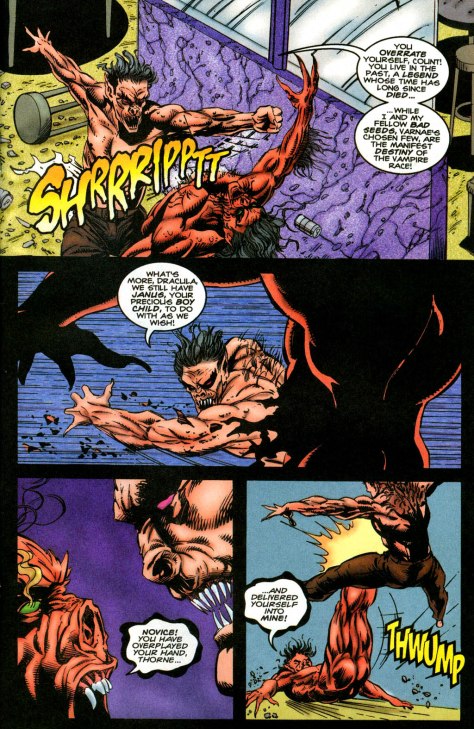
blade-brawl-i

blade-brawl-ii
I suppose this is more exciting.

While Thorne and…DRACULA! duke it out, Blade and Bible come up with a plan involving one of my least favorite vampire weaknesses, running water, but use it in a way I enjoy. Blade fights his way past Angel to the sprinkler release valve and douses the lot of them. Thorne thinks it’s some trick of…DRACULA!’s right up to the point that the water starts to burn him, and…DRACULA! mocks Thorne for not knowing his own weaknesses while he mildly smolders. Thorne calls for Angel to carry him away, foiled for the time being. Calling it a skirmish rather than a true battle…DRACULA! does his usual parlor trick of turning into mist once a fight has reached a standstill, and Blade tells him that he’ll be ready for him, any time, anywhere.

This first story arc does a pretty great of setting up a title, giving us plenty of potential for future conflict, interesting antagonists, and a solid supporting cast, including a super hardcore landlady. If all of those elements weren’t enough to keep me reading, this trip-tastic cover to Issue #4 might just do the trick.

blade-groovy
Dude got ripped in the psych ward.

I hope you’ve enjoyed this look at Blade:  The Vampire-Hunter! Join us next week for Rise of the Midnight Sons, and I scare up and down– er, swear…that I will do my best to keep the Halloween puns to a minimum.

SBTU Presents VS: War Machine vs. Cable


Hello, Legions!

Welcome to another fabulous edition of not just The Unspoken Decade, but that nifty blog crossover epic we call “Super Blog Team-Up!”  This go-round we at SBTU have decided to utterly enthrall you with some of the most violent and spectacular clashes of all time, as we present VS!

Here where it’s always 1996, we bring you two of Marvel’s heaviest hitters when it comes to firepower.  One is James Rhodes, better known as the operator of he most offensively-powerful armor this side of a Hulkbuster, War Machine!  The other is the son of Cyclops and Madelyne Pryor, sent to a far future to cure his techno-virus, he has now returned to the present day as the telekinteic cyborg warrior known as Cable!

Personally, I have always wanted a Punisher/War Machine/Cable team-up.  They could call it “big guns, bigger attitudes”.  It writes itself!  WHERE ARE YOU, MARVEL?  GET THIS DONE.

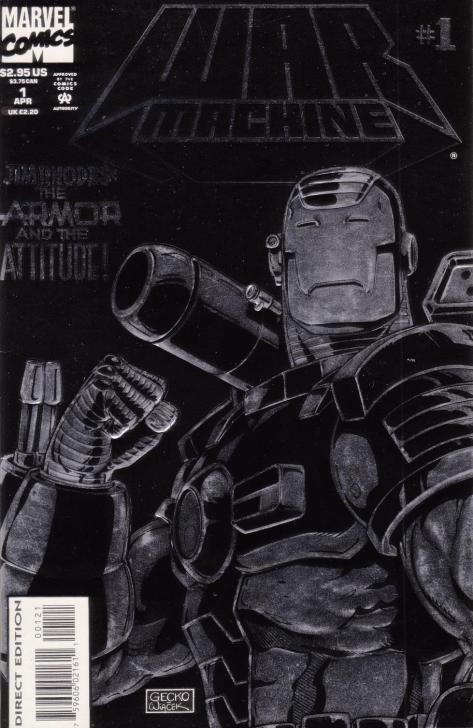
The fight between Cable and War Machine takes place over the first few issues of War Machine’s first solo title. Written by Len Kaminski and Scott Benson, penciled by Gabriel Gecko, and inked by Pam Eklund, War Machine #1 hits our reality in April of 1994 (according to the copyright indicia) as an attempt to sort of stretch the parameters of the super hero game.  The first issue has James Rhodes getting caught up in an international incident that ties the hands of most of the other heroes.  It also sports a die-cut foil cover that is sort of hard to display on the internet.

War Machine #1 - Page 2
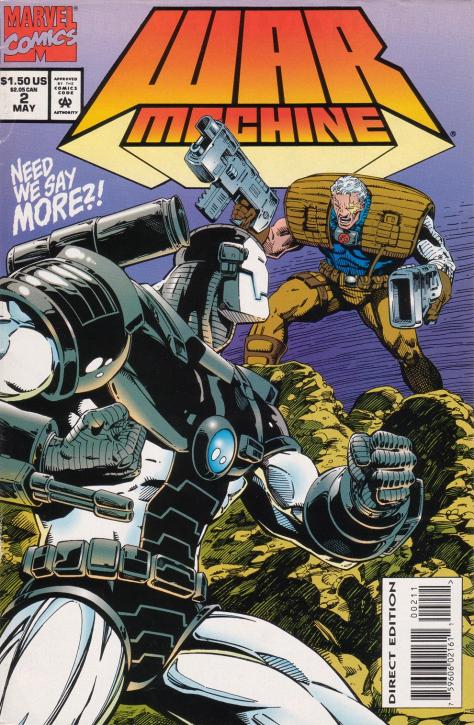
You decide which is deadlier;  THE ARMOR OR THE ATTITUDE!

War Machine’s armor is probably my favorite Iron Man armor ever.  I mean, just look at it.  Right there on that cover, you can see two guns on his wrist, a giant cannon on his shoulder, and what appears to be a missile battery on his other shoulder.  Beautiful.  Also, you just know that his chest circle fires SOMETHING AWESOME.

In real life, I tend to be a defense first guy (as a fan of the 2015 WORLD CHAMPION Kansas City Royals, how can ya blame me?).  In my genre fiction, give me the guy who has little protection who comes out with every gun he has firing as he simply overpowers his enemy with a fierce barrage from his armada!  That’s War Machine in a nutshell, although I am underselling the brilliant strategic mind of one James Rhodes as well.

The selling point of these early issues of War Machine is that James Rhodes isn’t gonna sit idly by as the technicalities of the world prevent him from taking the fight right to the bad guys.  After he makes a connection with a famous international diplomat, Vincent Cetewayo, who is looking to start a corporation known as “WorldWatch” that would help deal with international crises before they develop, James is intrigued.  He refuses Cetewayo’s offer at first, but after reading his book, James seems to be coming around on the idea.  Of course, then said international diplomat is kidnapped by the regime he once fled, Imaya.  Due to the fact that this African nation is full-fledged member of the United Nations, many heroes are paralyzed by international law as it prevents them from acting…

War Machine #1 - Page 20
Nick Fury’s fingerless gloves will be available at a K-Mart by you soon.

The angry phone call Rhodes is on doesn’t seem to get Fury on the line, as Rhodes quickly shows up at S.H.I.E.L.D. HQ with harsh words for Nick Fury.

War Machine #1 - Page 21
As a matter of fact, what is Punisher’s GPA?

C’mon War Machine, how could you possibly figure that Fury wouldn’t know who you were and what you were up to?  It’s his game!

War Machine #1 - Page 22

It’s insanely hard not to side with War Machine here.  It isn’t like Fury doesn’t go off half-cocked when he feels like it, the UN and S.H.I.E.L.D. be damned.  Now that War Machine needs some help,  though, Fury is acting like these rules are suddenly sacrosanct.  That’s government bureaucrat types for ya, amirite?  Also, ain’t it against international law to, y’ know, just kidnap a guy off a hijacked airline?  Oh, UN, you’re so delightfully unwieldy.

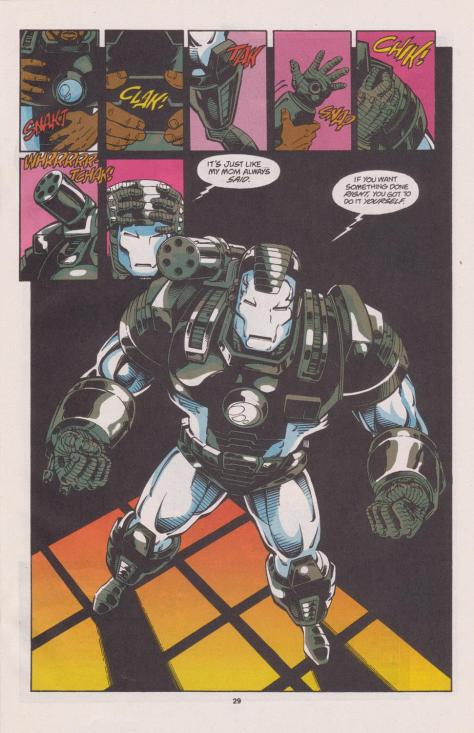
After seeing that he’ll get no help from Fury in regard to this, War Machine says the line that seemingly has to be said in nearly every action flick and story:

War Machine #1 - Page 24
My Mom said the same thing, but then she made me do whatever she was talking about.

War Machine plows into Imaya, taking out soldiers and warplanes left and right.  He’s doing very well against these instruments of war, which might be ironic because he is a War Machine.  Or is it just meta?  I dunno, Alanis Morissette forever ruined all of our understandings of ironic.  (Also, if you think that joke is too old, you’re the one reading a 90’s comics website, pal.)

While War Machine’s attack may make for impressive viewing, X-Force’s leader Cable doesn’t like it.

War Machine #1 - Page 26
Despite being a super computer that allows Cable to teleport places, the computer is somehow incapable of telling Cable about this “Dragonfly” ship once he leaves.  If only they could text in the 90’s.

So it appears Cable has taken umbrage with War Machine going solo in a War Zone.  Apparently, Cable is the only guy allowed to do what he wants with big guns, a gleam in his eye, and a devil-may-care attitude.  When it isn’t him, Cable is super concerned with geopolitical events and how a solitary man with an advanced suit of armor trying to rescue a man destined to be tortured and killed could upset the entire balance of power in Africa!

War Machine #1 - Page 34
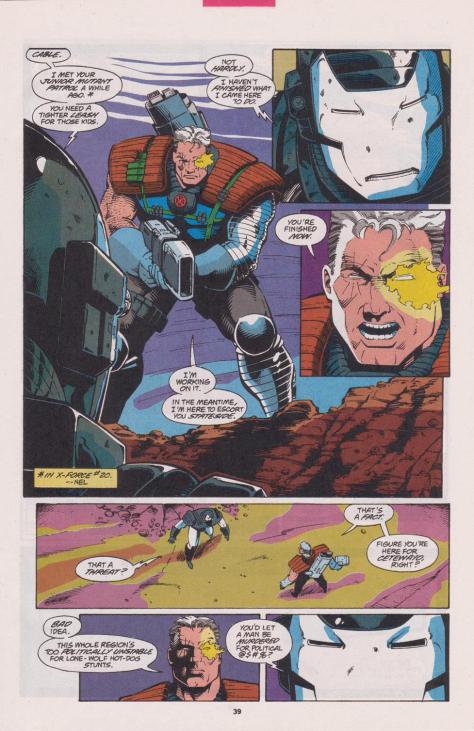
Cable’s entire history as a character, whether with the Wild Six Pack and X-Force has been nothing but Lone-Wolf Hot-Dog Stunts.  Also, I am pretty sure lonewolf and hot dog don’t have hyphens.

Now, before we can get to laser fights, Cable and War Machine have to try and win the debate.  I’ll spare you my opinion of who is right, but I’d love to know yours in the comment.  (Here’s a hint as to whose side I am on; it’s War Machines’s.)

War Machine #1 - Page 35
I don’t necessarily think Cable is wrong, (although barring some development in X-Force or his solo book of which I am unaware, it is odd to see him as the voice of so-called reason and restraint here), but to sit around talking when any number of heroes could save a man who is definitely going to be tortured and killed is just wrong in my eyes.

This exchange of philosophy does nothing to change the mind of either Cable or War Machine, and so we get Cable and War Machine throwing down!  We also get Cable spouting a line that’d lead one to believe he was trying out for a Viagra commercial.

War Machine #1 - Page 36
HEYOOOOOOOOOOOOOOOOOOOO!

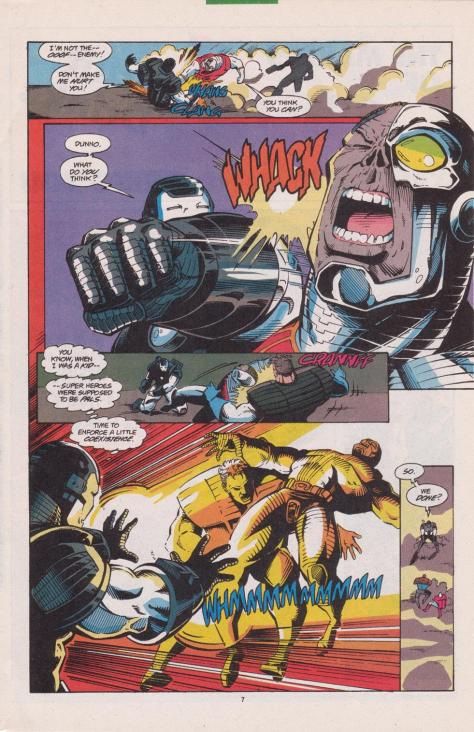
Cable draws first blood, knocking War Machine down and into some boulders.  War Machine doesn’t take this lying down, however, and quickly takes over on offense.  He separates Cable from his firearm, which leads to the most ineffective strategy Cable has ever employed against an opponent.

War Machine #1 - Page 38
At least the kick was with Cable’s cyborg leg, but it seems to me like a master strategist like Cable would have done a smidge better than punching War Machine in the head with his normal arm.  I’m gonna give him an out and say it was telekinetically aided. See how nice I can be, folks?

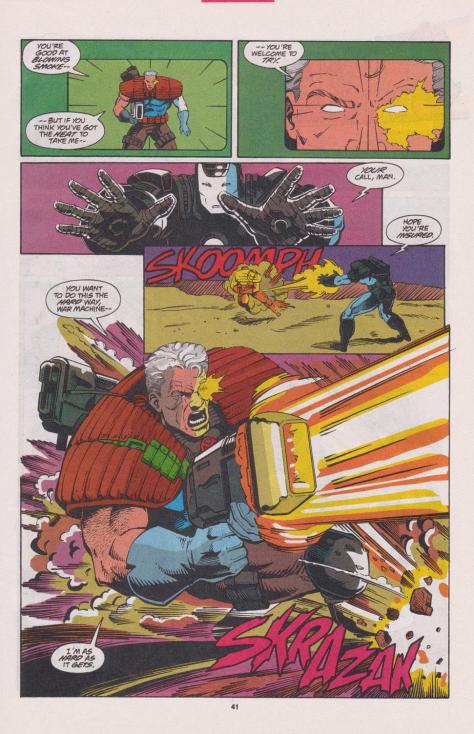
The back and forth is fairly evenly matched, but just when it appears that Round 2 is about to start, a new competitor enters the ring and it becomes a triple threat match!

War Machine #1 - Page 41

War Machine #1 - Page 42


That’s where War Machine #1 leaves off, and Page #1 of issue #2 may be my favorite page by Gecko in either issue. But first, the cover to War Machine #2!

War Machine #2 - Page 1
You probably could have mentioned that Deathlok is guest-starring too.
War Machine #2 - Page 2
War Machine busts into a country, bullets flying, and now he wants to talk, haha!

Not only is this a great page artwise to me, I love the succinctness in getting all three of the players across.  With just three panels, you know who everyone is, what their motivation is, and how they are feeling about the situation.  One can even reasonably assume that Deathlok is housing two personalities based on what we see here, which he is.

What we really need, though, is a two-page splash showing us just how badass all these guys look together.

War Machine #2 - Page 3
Cable’s gun is the best thing about the 90’s.  I love it.

Basically, we get the same conversation that Cable and War Machine have been having, but now Deathlok is thrown in, and he is on War Machine’s side.  This sits none too well with Cable, who decides to use that awesome gun of his (for real, I could talk for hours about Cable’s guns.  Ask Emily.) to solve a problem.  That problem’s name is Deathlok!

War Machine #2 - Page 4
If the computer part of Deathlok was really that smart, then he probably would have armed defensive systems before Deathlok got shot.

War Machine tries to play peacemaker, but all that does is rile Deathlok up in his direction.

War Machine #2 - Page 6
War Machine pines for the days of Gardner Fox’s Justice League of America.

War Machine finally uses his massive firepower to overcome the both of them, as he attempts to talk some sense into these guys.  It’s sorta funny how all of a sudden after breaching international borders and shooting down Imayan warplanes in Imayan airspace that War Machine now fancies himself the voice of reason.  Of course, seeing as he is the only 100% human guy here, maybe he’s the only one we can trust.  One way or another, War Machine incapacitates them both, and then he gets to deliver a lecture because to the victor go the soliloquies.

War Machine #2 - Page 7
Deathlok is still holding a grudge because Cable shot him in the back?  Sheesh!  It’s been 30 seconds, dude.  GET ON WITH YOUR LIFE!

For those of you placed your wager on “the three guys yap until Imayan ground forces show up,” head to the window and collect.  You have to wonder what sort of resistance they could possibly put up to these three, seeing as how War Machine just single-handedly thrashed their entire goddamn air force.  I do suppose that being in the military in a despotic dictatorship probably just has you going out in your tank even after a solitary armored figure has taken out all your air support.  Your choice is get killed by War Machine or get killed by your superior in the ranks.

Cable, though, can teleport, so he has lots of choices, including the choice to allow Deathlok and War Machine to reap what they have sown without him around.

War Machine #2 - Page 8
Deathlok is now mad at Cable for not taking part in a war he never wanted to happen. What?  That makes no sense. Unless Deathlok is jealous. Something tells me that Deathlok’s envy circuit is on OVERLOAD!

And that’s the end of the Cable vs. War Machine showdown.  It’s a rather typical Marvel hero vs. hero fight, in that there is no clear winner, although it’s a little less like a typical Marvel hero fight because Cable and War Machine are at odds from the start and there is no misunderstanding between them before they pal up and head after the baddies!  I suppose Deathlok is the one who handles that role with ol’ Rhodey here.

The rest of the early War Machine story arc is good.  You get to see War Machine take on a nation’s entire armed forces as he teams with Imayan freedom fighters to liberate their country.  Cable plays a small role by evacuating Cetewayo to the camp of said freedom fighters.  If he had just done that to start, there’d have been no fight!  But then again, I wouldn’t have this article, either.  Hmmm.

For real, though, scope out the rest of this early War Machine arc if for no other reason than to just see this image explained:

War Machine #3 - Page 24

Now that you have had a nice fight here, maybe you should go take a gander at the other folks playing along with Super Blog Team Up!  Check out the links below:

Coffee & Comics Blog

Bronze Age Babies w/ Tales of Suspense #58!

Between the Pages w/ some Star Wars action!

Crapbox Son of Cthulhu 

Chris is on Infinite Earths -Guy Gardner vs. Blue Beetle

Longbox Graveyard features Human Torch vs. Sub-Mariner!

Superhero Satellite -Batman vs. Green Lantern

The Retroist-Joker vs. Sherlock Holmes

In My Not So Humble Opinion-Captain America vs. Wolverine

New Beginnings at the End of All Things: Man-Thing Vol. 3 by Emily Scott

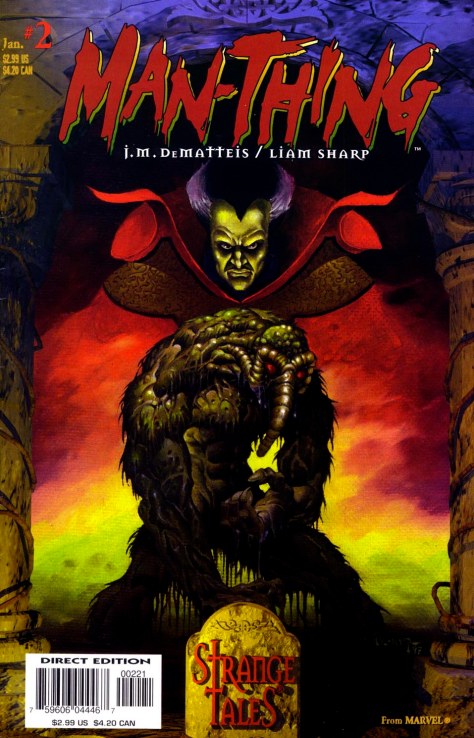
Greetings, Legions of the Unspoken! Emily Scott here to be your guide through the weirdness that is Man-Thing. And it is weird. Look at that thing up there. It looks like the yip yip aliens from Sesame Street and the Jolly Green Giant had a demonic love child. And that doesn’t begin to scratch the surface, nor is Man-Thing even the weirdest looking character in the comic. Some characters even look strange relative to their usual strange selves, like Doctor Strange here, looking like an alien vampire:

Man-Thing_V3-2-01
The Google Image search for “alien vampire” is disappointingly mundane.

As someone who did not grow up reading many comics, I had only really ever heard of Man-Thing peripherally as a cult figure and usually just to differentiate him from Swamp Thing, who would debut a few months after Man-Thing in 1971.  And while I will be conducting a search of this article when I’m finished to make sure I never typed Swamp Thing by accident, the characters’ similarities don’t much extend beyond the gist of their origin stories (scientist working on some super special formula ends up fused with a swamp).

When you sum it up, it does sound pretty darn specifically similar, but the idea of the muck monster has been expanded in many directions, as further evidenced by the fact that the same guy can do very different things with characters who bear more than a passing resemblance to each other. Steve Gerber, who created Man-Thing’s pal Howard the Duck (yes, pals, really) and wrote a beloved and definitive 39-issue Man-Thing run, also created the Ultraverse’s Sludge, a character who shares a thing or two with Man-Thing (a man-thing or two?), including a destructive touch and a less than pleasant odor, but Gerber takes that story to such a different place that drawing too many comparisons is unfair. (A story you can hear all about on the podcast Dean Compton and I did on Sludge!)

The biggest difference between Man-Thing and characters like Swamp Thing or Sludge is that Man-Thing isn’t really a character at all. He is basically non-sentient, and other characters often think immediately upon meeting him that there’s not a whole lot going on upstairs. He’s almost completely reactionary, so the characters surrounding him must by needs drive the action. At the start of our tale (Man-Thing Volume 3, which ran from December 1997 to July 1998), however, Man-Thing does something unexpected: he leaves the swamp due to an urge within himself. He is then promptly hit by a car.

Man-Thing_V3-1-06
“Let’s get out of here before he IDs us!”

And what is it that makes this walking bag of weird act of its own volition? An echo, a psychic reverberation from the end point of all things, the nexus of oblivion, a place for which this creature serves as a guardian. It looks like this:

Man-Thing_V3-1-03
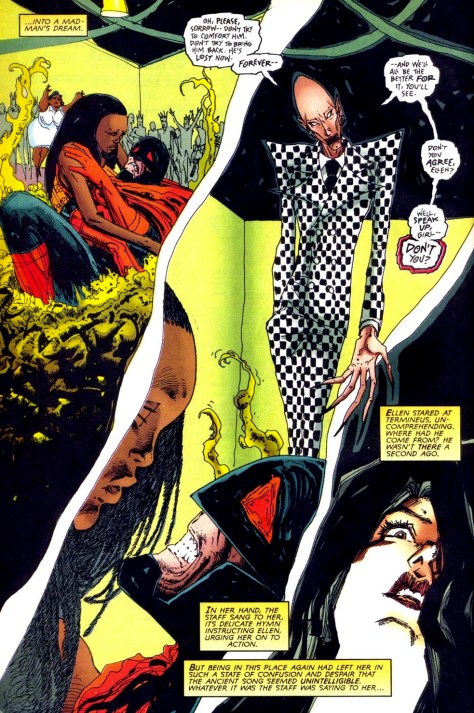
The terminus of reality always seems to have two things in it: clocks and checkerboards.

J. M. Dematteis does some great writing on this book, but Liam Sharp frequently steals the show with his art, which often resemble what I assume an acid trip would look like if I had a better imagination. This comic often delves into some cosmic, mystical stuff, so a lot is asked of Sharp, but he delivers every time with images that are beautiful and grotesque, mesmerizingly abstract and all too real. At times when I didn’t know what exactly was going on, I was more than happy to stare at Sharp’s work till I figured it out.

And there are definitely times when I was not sure what was going on. A lot of the sentences in the notes I was taking while reading end in question marks instead of periods. For instance: “So and so happened?” as opposed to “so and so happened.” Answers were often forthcoming, but for all the things that happen(?) in this comic, it usually seems more interested in why characters do rather than what they do. While the specifics of the plot aren’t paramount (and become somewhat moot as the story progresses, as it never got its planned, published ending), some groundwork is, of course, necessary.

One thing Man-Thing’s wife (or should I say the wife of Ted Sallis, the man Man-Thing used to be) does a lot of is punish herself. Having lived for years under the burden of the guilt of betraying her husband and a face scarred beyond recognition by Man-Thing (whom she doesn’t yet know used to be her husband) Ellen Brandt exists in what appears to be a constant state of turmoil, unable to find a moment’s peace and receptive to the idea of letting oblivion consume her. No small wonder, then, when she puts herself in the path of bullets intended for Man-Thing, who has inevitably attracted an angry mob as he shambled through town.

Man-Thing_V3-1-22
Talk about a bullet with butterfly wings. (Yes, I included this page just so I could make that reference.)

The magic comes courtesy of Stephen Strange, who has foreseen that Man-Thing has a critical part to play in the repair of the crack running through all realities. Strange takes them back to his sanctuary and then into what Ellen assumes is the very soul of the Man-Thing, a putrid and oppressive place. There she sees her past with Ted play out, all the way from her attempting to work through her father issues by marrying Ted through her disenchantment due to his neglecting her for work to her eventual betrayal, when she joins those attempting to steal the Super-Soldier Serum he is working to replicate. When she relives Man-Thing scarring her face and realizes that this creature used to be her husband, it becomes overwhelming, and when she must make the decision not to surrender to oblivion, she finally understands that it’s not the muck and grime and desolation of Man-Thing’s soul she is trapped in – it is her own.

Info dumps are never easy to do without feeling clunky, but this issue goes about it cleverly by giving us a pretty thorough outline of Man-Thing’s origins, which would have obviously been helpful to a new reader in 1997 who didn’t have access to Wikipedia, while at the same time using that story to tell us things in the present about Ellen, who for all intents and purposes is the main character Man-Thing could never really be. Something Dematteis does very well in general is make the comic accessible, even when fairly esoteric things are being discussed. So when Ellen accepts that it is her fate to help Man-Thing collect the fragmented shards of the nexus, we might not know exactly what that entails or why it’s happening, but we damn sure understand why she’s doing it.

Man-Thing_V3-2-19
I think 90s comic book artists must have been contractually obligated to include at least one page of art with writing you can only half read over it.

The first stop on their quest is the Roswell Sanitarium in Massachusetts, former residence of Ellen and current residence of Mr. Eric Payne, formerly known as Devil-Slayer. You can probably guess from his name that the guy didn’t sell insurance or anything before he was institutionalized. Having lost his wife and his cosmic cloak through his own actions, Payne has surrendered to his own personal demons, both figuratively and then literally when a mysterious figure known as Mr. Termineus shows up in a Santa suit to deliver them personally. (Did I mention this is a Christmas issue, since it wasn’t already odd enough?)

Termineus, who is humanoid except for the fact that he has a censor bar for a mouth, also delivers a Christmas gift to Ellen, a staff that allows her to journey to the places the nexus fragments have been scattered. On the one hand, his actions certainly aid Ellen and Man-Thing in the moment, but on the other, they cause the nexus fragment inside Payne  to amplify his pain, drawing the reality around him into it and oblivion. Further obscuring his true motives, Termineus has been visiting Job, the child of the couple who hit Man-Thing with their car when he first came out of the swamp. (We’ll later discover this child is actually Ellen and Ted’s, born after Ted’s transformation and put up for adoption. This probably seems an odd piece of information to mention as an aside, but the payoff of this storyline happens after the eight-issue run.)

Man-Thing_V3-4-21
He dresses like the trumpet player in a ska band; he obviously can’t be trusted.

The expression “Whatever knows fear burns at the Man-Thing’s touch!” comes into play in a big way when Payne starts to rip Man-Thing apart, and Man-Thing’s not having it. Man-Thing burns the living hell out of Payne, both sort of literally and figuratively, restoring his sanity and extracting the fragment. Termineus tries to take it for himself, but Sorrow, the enigmatic lady seen cradling Payne up there, has her Glenda the Good Witch moment and turns it into a gem on a necklace only Ellen can wear. Then we all hear the quest completion video game music, and it’s off to the races for the next fragment!

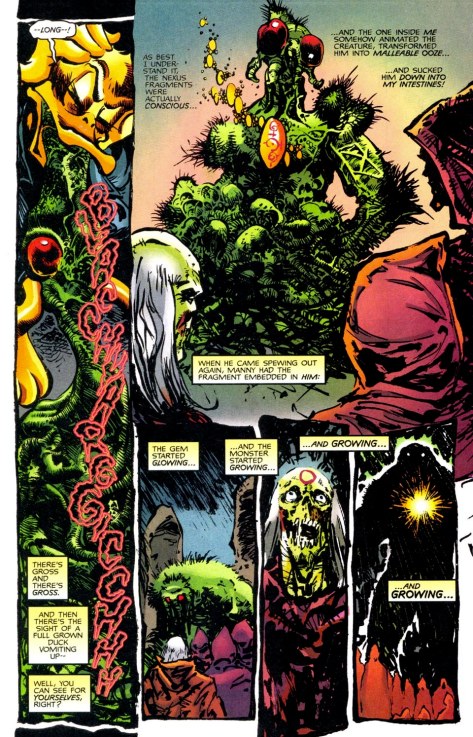
That fragment is found in a delightful place, that being the insides of one Howard the Duck. Howard is brought to the swamp by a creature who promptly cuts Man-Thing to ribbons. That creature turns out to be a man going by the name Mahapralaya, who has a cult devoted to entropy. They have heard about the crack in the nexus from Termineus and believe they can speed up the destruction of the universe by destroying the nexus’ protector. If that doesn’t work, they can always cut out the fragment inside Howard and destroy it, preventing it from ever being repaired.  Man-Thing’s solution, once he re-forms, is also delightful.

Man-Thing_V3-6-17
Seeing Howard the Duck vomit up Man-Thing isn’t even close to the most disturbing visual I have of Howard the Duck. Not. Even. Close.

The last fragment recovered in this run is one that belongs to both land and sea, and as such can only be accessed by one person….Namor the Submariner. (Whatever else someone might think of this comic, they’d have to appreciate the strange bedfellows this comic creates. Though now that I think about it, ducks also belong to both land and water, so maybe it’s not quite as strange as it seems on the surface…and now I’ve arrived at the terminus of all types of analytical writing: the overthink, where you get so in the habit of looking for connections that you start seeing them everywhere.)

Man-Thing_V3-7-08

Man-Thing_V3-7-02
No jokey captions, just some really lovely art.

Namor follows Man-Thing (excuse me, Mer-Thing) down to the bottom of the oceans, to the lost former crown jewel of Atlantis, the City of the Golden Gate, where Ellen awaits with Evenor, its guardian, to tell them they can’t take the fragment because it’s embedded in the shroud of the goddess Cleito, and to disturb it would be desecration. Namor decides he wants no part in any desecration. They all end up back in time, when the City of the Golden Gate was still a utopia, and get the gem from Cleito herself. (This is a part of my notes when I used a lot of question marks, so you’ll excuse me if I’m vague on the specifics.)

Man-Thing_V3-8-09
I mean, you tell me.

They witness the beginning of the end of the city, and that’s about where we run out of story. The tale was continued in Strange Tales Vol. 4, but the third and fourth issue were never published. From what I can tell from various wikis, the story was summed up in a Spider-Man book and came to a rather satisfying end where you learn the fate of the Sallises and the nexus, as well as some answers to the identity and motives of characters like Sorrow and Mr. Termineus. I would feel weird summarizing a summary of something I haven’t actually read, so I’ll leave that link for the curious.

So what does it all mean? I really can’t say. Not because I don’t have my own ideas about the comic’s ideas but because they feel personal and specific to me. As I mentioned, when you read something with the intent of writing about it, you start looking for the meaning in everything, trying to hear as much as you can of what it’s trying to tell you, but the more answers I asked for, the more questions I was asked. So much of this story deals with personal demons, with the thin line between reality and invention, with having to exist inside your own head or not at all, that I’m not sure I could tell someone else what they would get out of it. I don’t know that the comic has anything especially profound to say, but the ability to make a reader ask his or herself questions that lead to profound personal truths might be the bigger compliment to bestow on a work of art.

And a work of art it certainly is. Of light and shadow. Of order and chaos. Of endings and beginnings. Of redemption and fear. There’s a saying (that I couldn’t find the origin of to save my life) that all fear is the fear of death, and another thing this comic did especially well was examine if, for many of these characters, there is truth to that notion, from the entropy cult preferring sweet oblivion to mere death to Namor deciding the end of all things was preferable to the violation of his own sacred beliefs to Ellen, having to face life beyond that fear once it’s all been burned away. And what can happen when your fear is burned away and you can embrace your fate and allow yourself a chance at redemption?

Man-Thing_V3-8-22.jpg
Oh. : /

I hope you’ve enjoyed this look at Man-Thing! If no fragments of reality set up shop in your psyche before next week (or even if they do), be sure to come for another exciting round of Super Blog Team-Up! Dean Compton will be back to bring you War Machine Vs. Cable, and I know you don’t want to hurry yourself toward oblivion before you read that!