Tag Archives: 90s comics

The Character of a City-Gotham Nights

Hello there, Legions of the Unspoken!  I hope you have enjoyed the debate I had with Paul O’Connor of Longbox Graveyard over 70’s vs. 90’s comic books, and I hope you come down strongly on my side that the 90’s are the best!

Seriously, though, we had a good-natured conversation about 90’s comics myths, 70’s comics, the differences between the two eras, and all sorts of cool stuff.  Take a listen here if you haven’t, or give it another one if you have!  The classics never get old, do they?

I sure hope not because today I’m taking a look at one of the all-time classics in superheroes, Batman!  We won’t be looking at him in the traditional sense, however.  We’ll be looking in particular at one of the most important supporting characters in the Batman mythos.

The supporting characters are almost what drives Batman.  If Batman’s rogue’s gallery are counted as supporting characters, then they’re almost certainly the most important element to Batman’s tapestry.  Even if we don’t count the Joker or Calendar Man, the supporting cast makes the Batman comic book come alive in ways many other comic books do not.  Robin, Alfred, Commissioner Gordon, Batgirl, Nightwing, Lucius Fox, Leslie Thompkins, and more bring out the “man” in Batman, and that’s good, because otherwise Batman would just be a weird rich dude who beat up the criminally insane and street level criminals.  Thanks to them, he is now a weird rich dude who beats up the criminally insane and street-level criminals  while having relationships with various folks.

The most important character in the Batman books, though, could possibly be Gotham City.  Gotham City gives a vibe few other locales, fictional or otherwise,  in comic books of any genre can match.  I think it may be the only location in comic books, especially superhero comic books, that can actually say it is a character (other than Danny the Street, of course).  Gotham City means as much to Batman as Batarangs, the Batwing, and Alfred’s snide comments.

I think we can all agree that the architecture in Gotham City reflects the environment that it is, but it is often people that determine the character of a city.  We speak differently about the people of New York City than we do the folks of Los Angeles.  In fact, we think of people within those cities as being vastly different!  Beverly Hills and Compton aren’t the same, and neither are Staten Island and Queens.  The people of Gotham City are a proud lot, but they are also a hard lot.  Their city reflects them, even as their hero reflects their city.  Gotham Nights was a 4-issue mini-series published by DC Comics in 1992 that attempted to show us Gothamites, and by doing so also showing us their city.

John Ostrander handles the writing chores, while Mary Mitchell and Bruce Patterson are on top of pencils/inks.  The book reads well, although it is not as good as some of Ostrander’s other works, such as Suicide Squad, Grimjack, Punisher, or Spectre, but it is a very solid read.  Of course, it is also important to note that Ostrander’s high marks are so high that is no surprise that some of his other works don’t measure up to them.  Even Justin Verlander can’t throw 100-MPH every pitch!  What he can do, though, and what Ostrander does here, is deliver a solid outing each time.

We get an enjoyable read that may not quite reach its potential, but I think some of that is due to space limitations.  If one is going to do a mini-series about the people of Gotham City in a way to bring the city to life in a new way to Batman fans, it seems like it would need to be longer than four issues.  The stories about the individuals are charming, but they feel rushed.  Just as we start to get to know the varied types of folks that comprise the human landscape of Gotham City, the series ends.

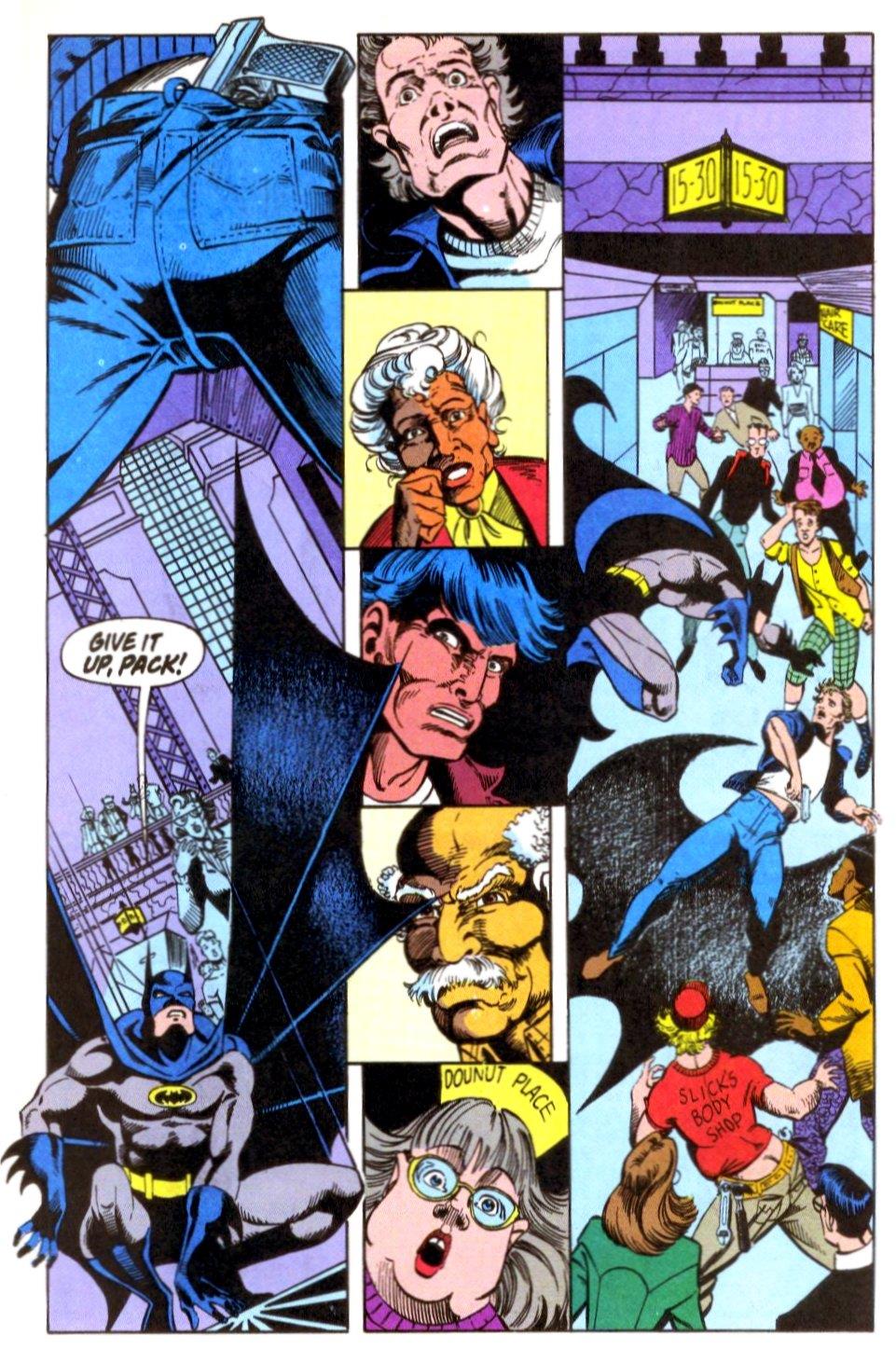
But for something to end, it must begin, yes?  This series starts with Batman chasing a mook.  Doesn’t it seem like all Batman titles are legally required to start that way?

Gotham Nights #1 - Page 2
That mook looks a bit more like he is doing the Batdance than he is running away from Batman. Remember Batdance? I don’t think anyone does except me.

The very start of the series has most of the action you’ll see from Batman in this story.  That doesn’t make it bad, but it does mean that if you are buying this because you wanted to see Batman swoop down on every mugger in every alley of  Gotham City then this book isn’t for you.  I think the covers sort of told someone that, but I can only imagine how ripped off someone might have felt if they got this on an impulse buy hoping to see Batman doing Batman stuff.

Gotham Nights #1 - Page 1
This is the cover that I think could have inspired the most of those regretful impulse buys.
Gotham Nights #2 - Page 1
The first time I saw this cover, I thought it was Catwoman enticing some hapless mark. It isn’t, but that isn’t bad.
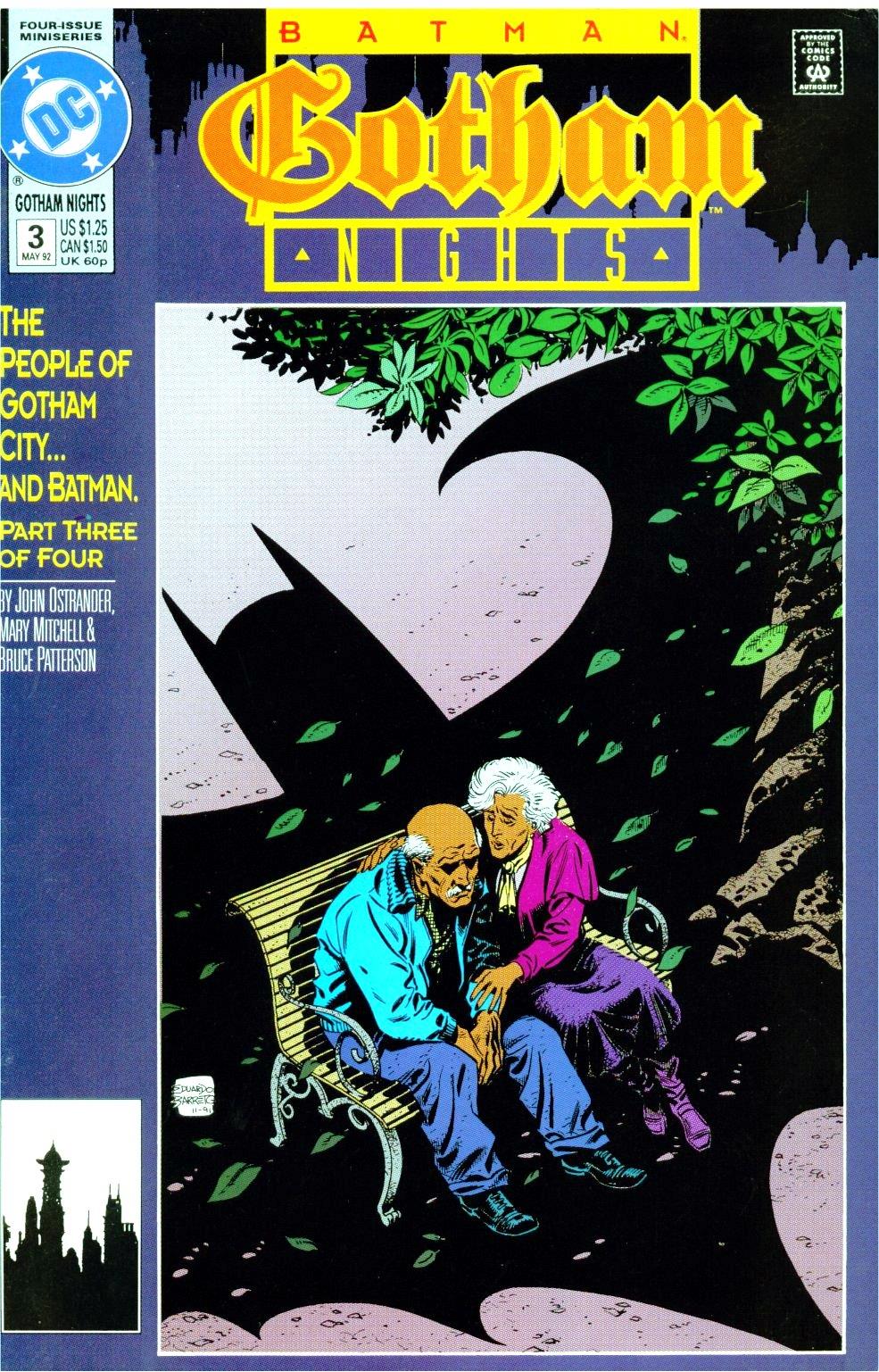
Gotham Nights #3 - Page 1
All I can imagine when I see this is the idea that Batman is enforcing one of the vast array of anti-homeless ordinances that have sprung up across the United States. “It’s illegal to sleep on a park bench after dark, citizens! Let the Shadow of the Bat remind you!” Seriously, though, those laws are bunk.
Gotham Nights #4 - Page 1
The pastries and the gun make for a beautiful dichotomy.

The covers have a cool design, and I especially enjoy the bordering.  I feel like that alone sort of set these apart as “not your typical Batman book”, although with the first (and possibly the fourth) issue(s) I can see a casual fan picking it up and being disappointed that there isn’t more Batman in it.

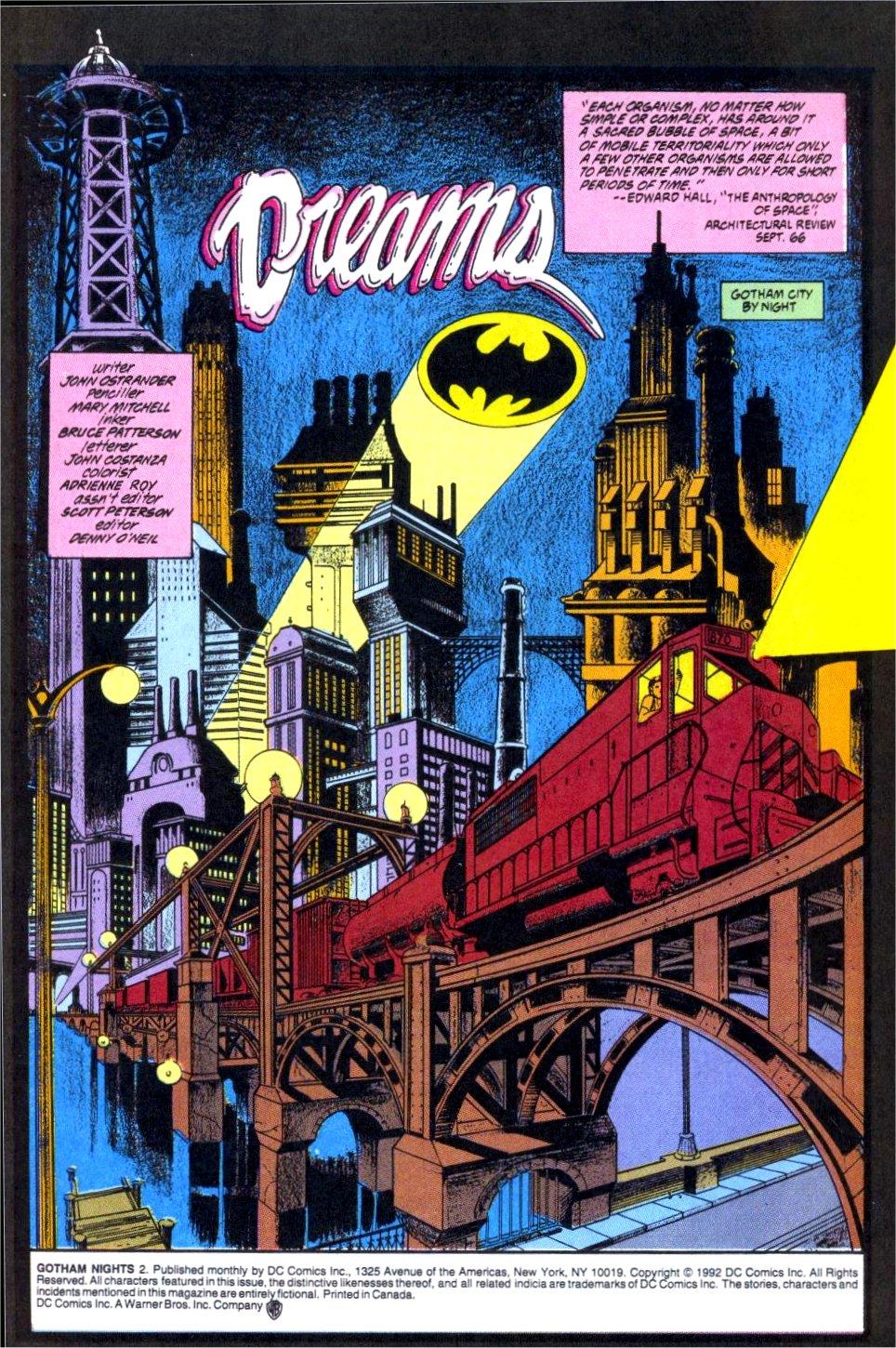
But just because there isn’t more Batman doesn’t make this title a disappointment.  In fact, I’d say it is almost worth it for the great art of Gotham City alone.  Mary Mitchell and Bruce Patterson make the city come alive as a character in and of itself. Some of their work makes the buildings of Gotham seem like the night solidified  as they reach as high as they can into sky in an attempt to embrace their ethereal cousin…
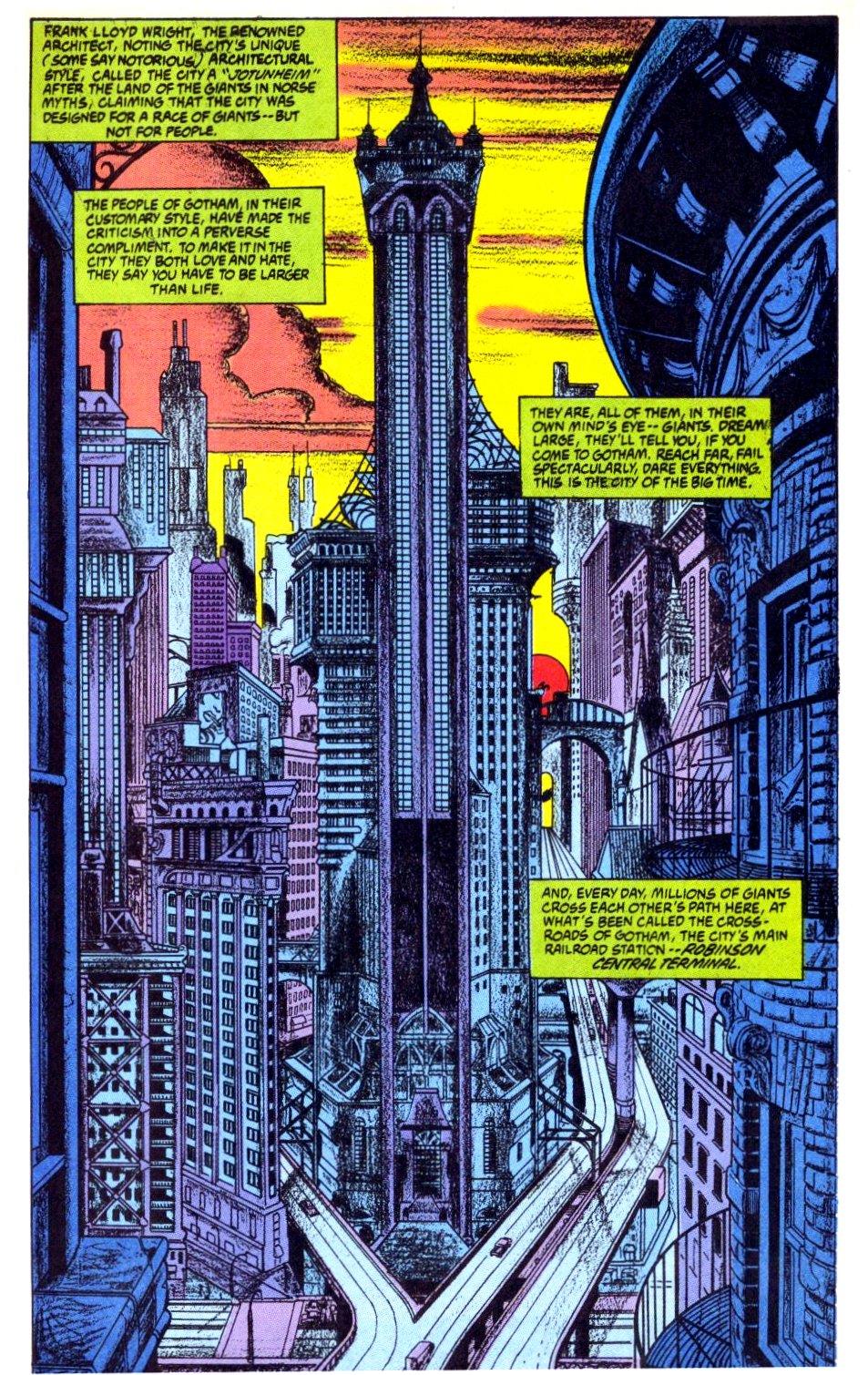
Gotham Nights #1 - Page 5
That quote about Gotham being for giants sums up the way Gotham City has looked in nearly everything except the Batman ’66 TV show.
Gotham Nights #1 - Page 4
Man, is there anything one can’t quote Churchill about?
Gotham Nights #2 - Page 2
With just that single train, Gotham City has better mass transit than Atlanta.
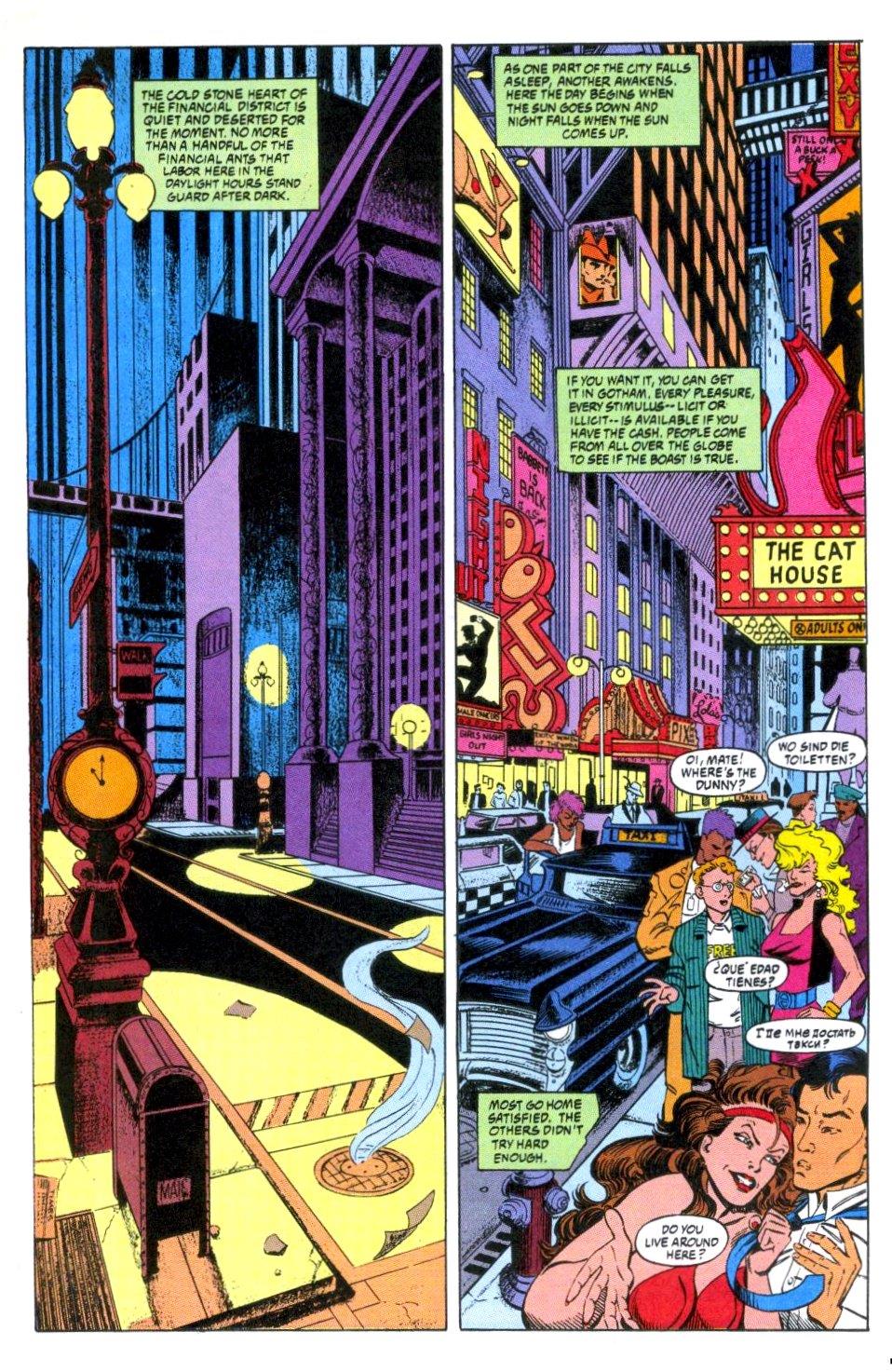
Gotham Nights #2 - Page 3
Different parts of a city make a city’s personality so varied. I love that Gotham City is no different.  Of course, someone just out of the panel is bemoaning the lack of English being spoken, because, hey, Gotham City is no different.

The pages almost allow the city to breathe.  If it could breathe, you just know Gotham’s breath would be rank.  Thankfully, you don’t have to smell that, while you still get to enjoy the scenery.

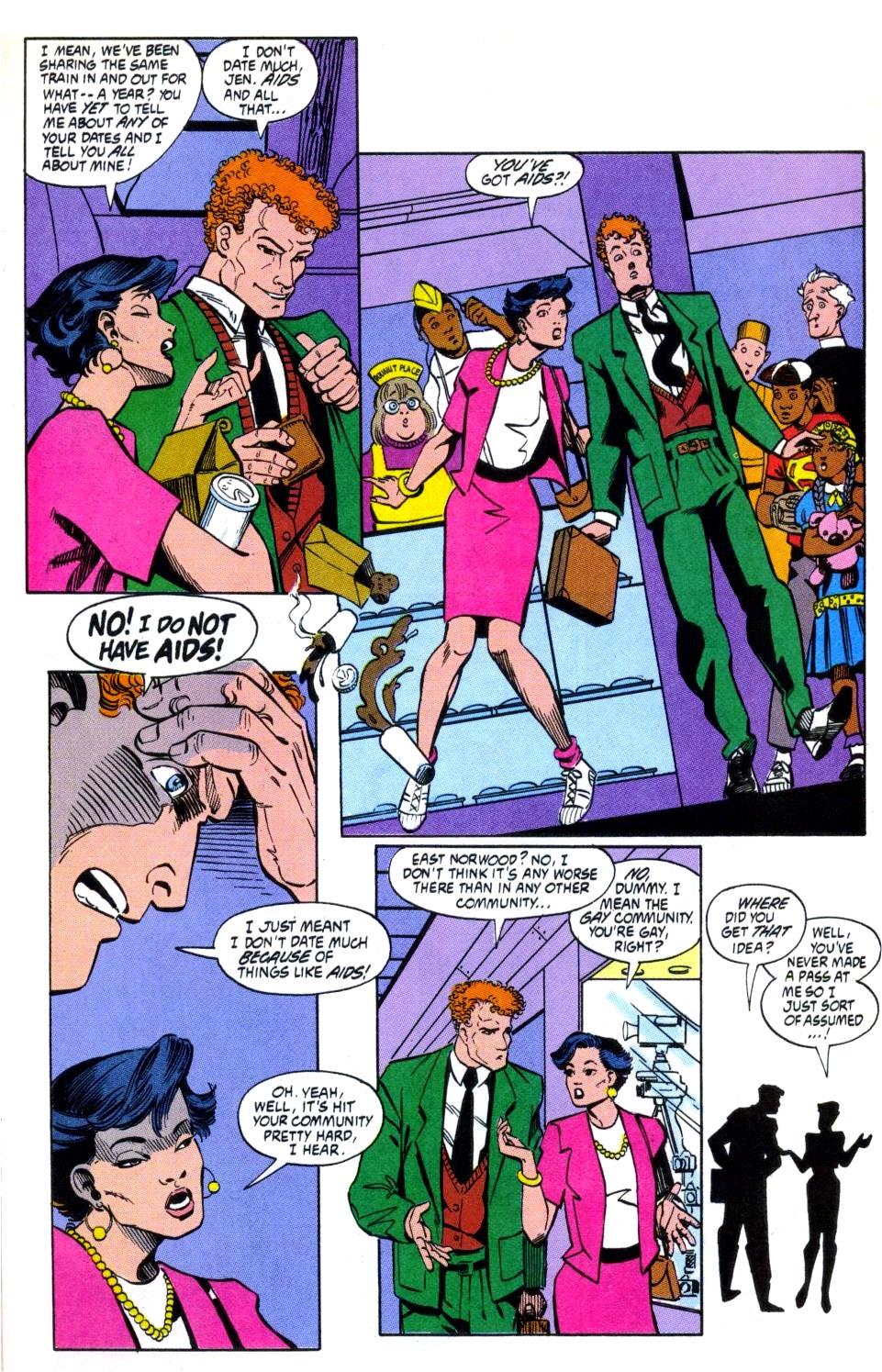
Of course, as I stated earlier, cities become characters due to the folks than inhabit them.  While it seems like Gotham City is populated solely by guys who are part crocodile or have clocks for faces, most of the people in Gotham City are quite normal…some of them appallingly so.  Take Jimmy and Jennifer.  These two folks remind me of that non-couple we all know.  You know the one.  They obviously like each other, but neither do much of anything about it other than act in a flirtatious way toward one another that annoys all around them.  That having been said, they are nice people, even if Jennifer has little to no idea how to act in regard to talking about sexually transmitted diseases in public.

Gotham Nights #1 - Page 10 Gotham Nights #1 - Page 11 Gotham Nights #1 - Page 12

Jennifer’s way-too-loud discussion about AIDS in public followed up by her assumption that Jimmy is gay due to his concern over AIDS and his never having made a pass at her sort of tells you what sort of lady she is.  Jimmy also seems to be judging her because she has sex and dates a lot, so you can tell what sort of person he is fairly quickly as well.  They are nice enough folks, but there is a bigger picture they aren’t getting.

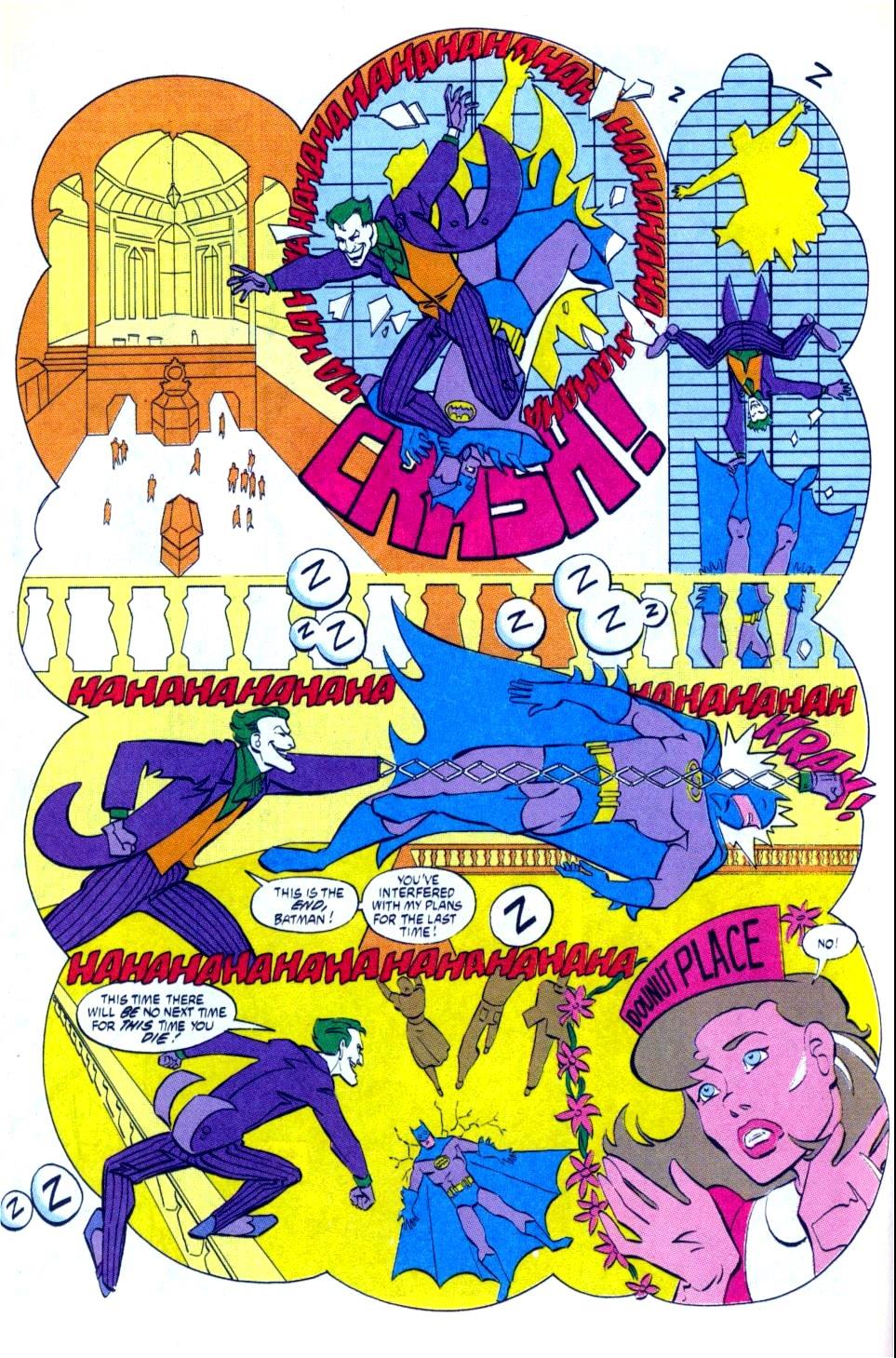
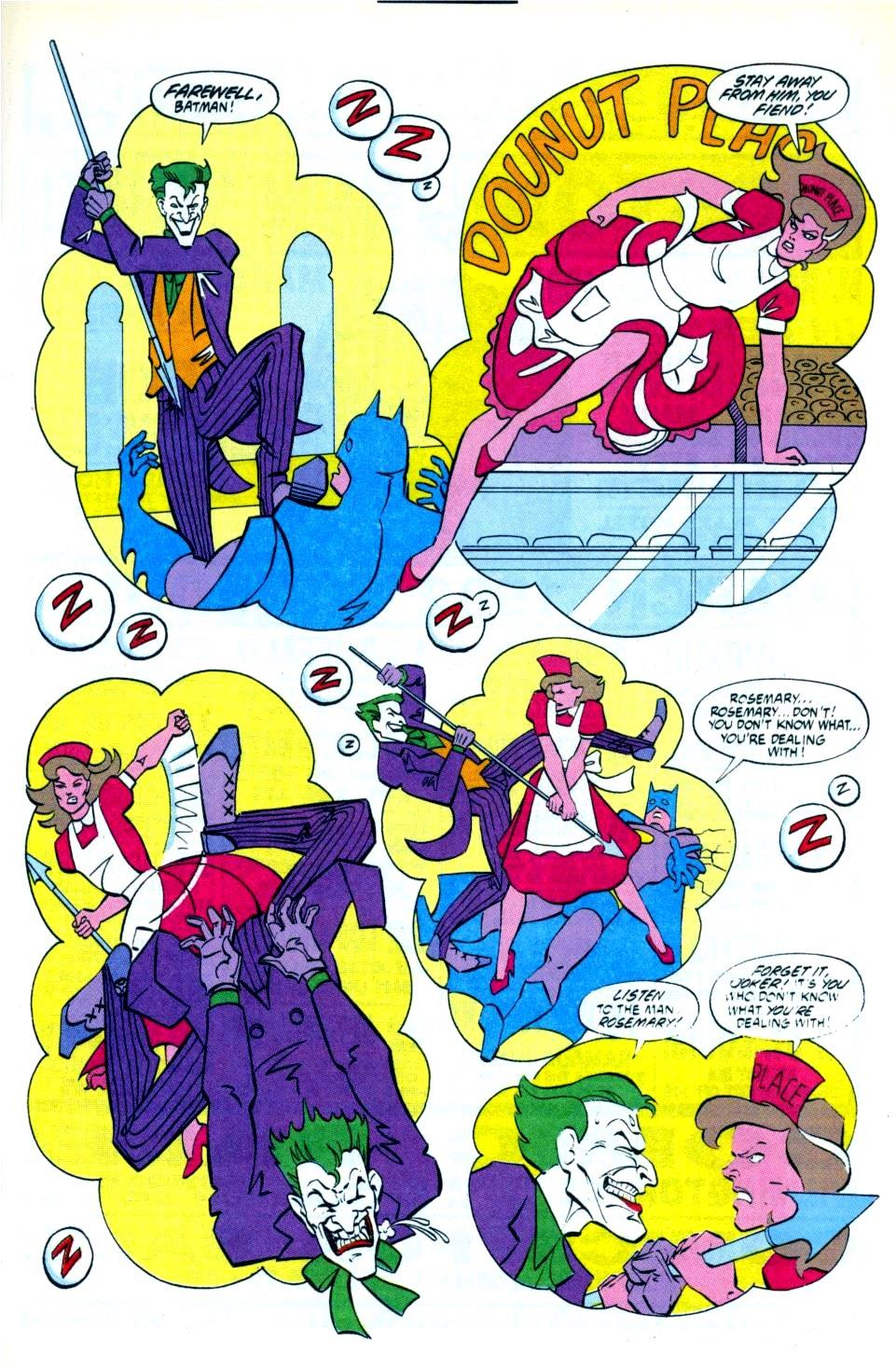
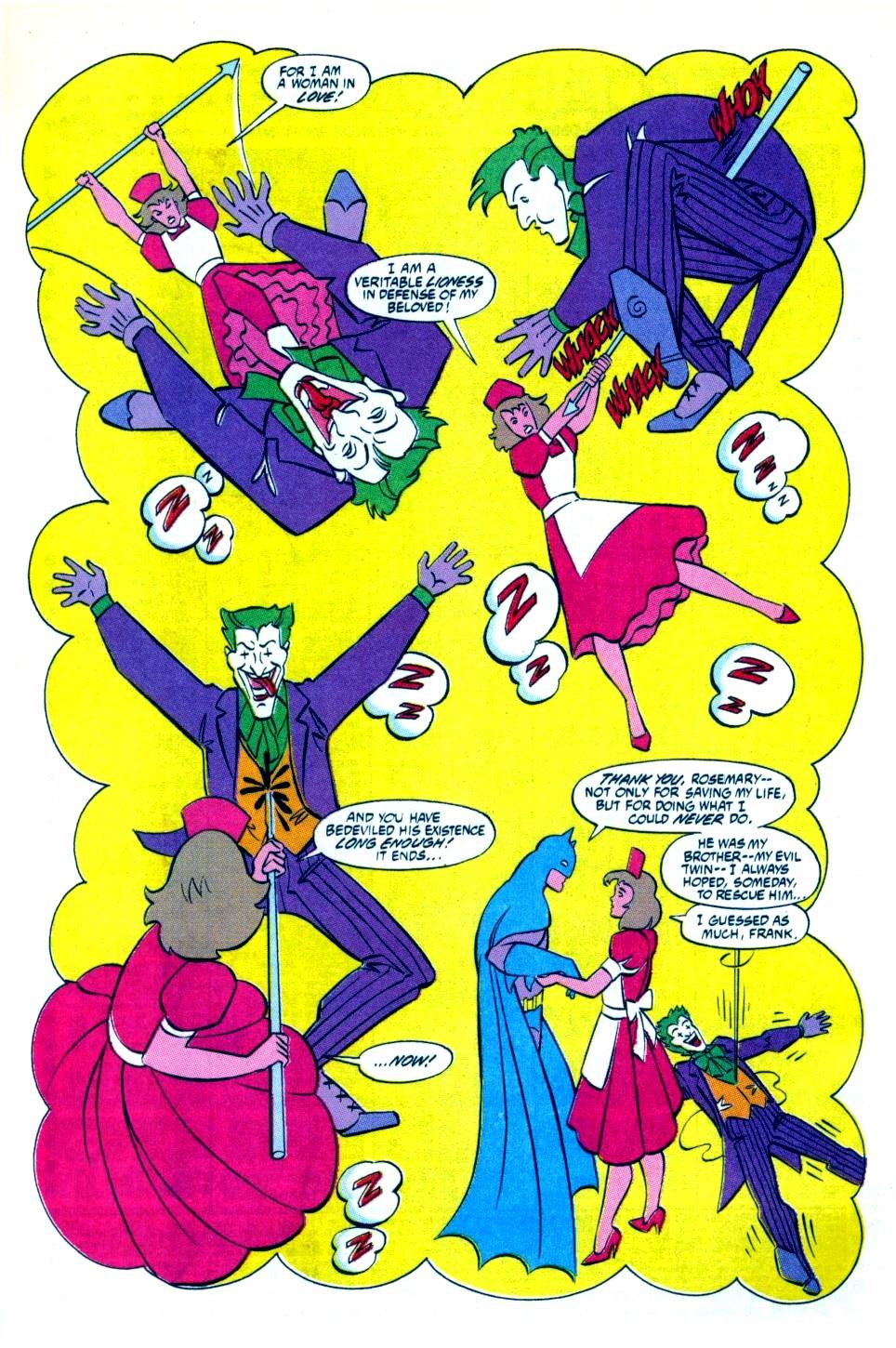
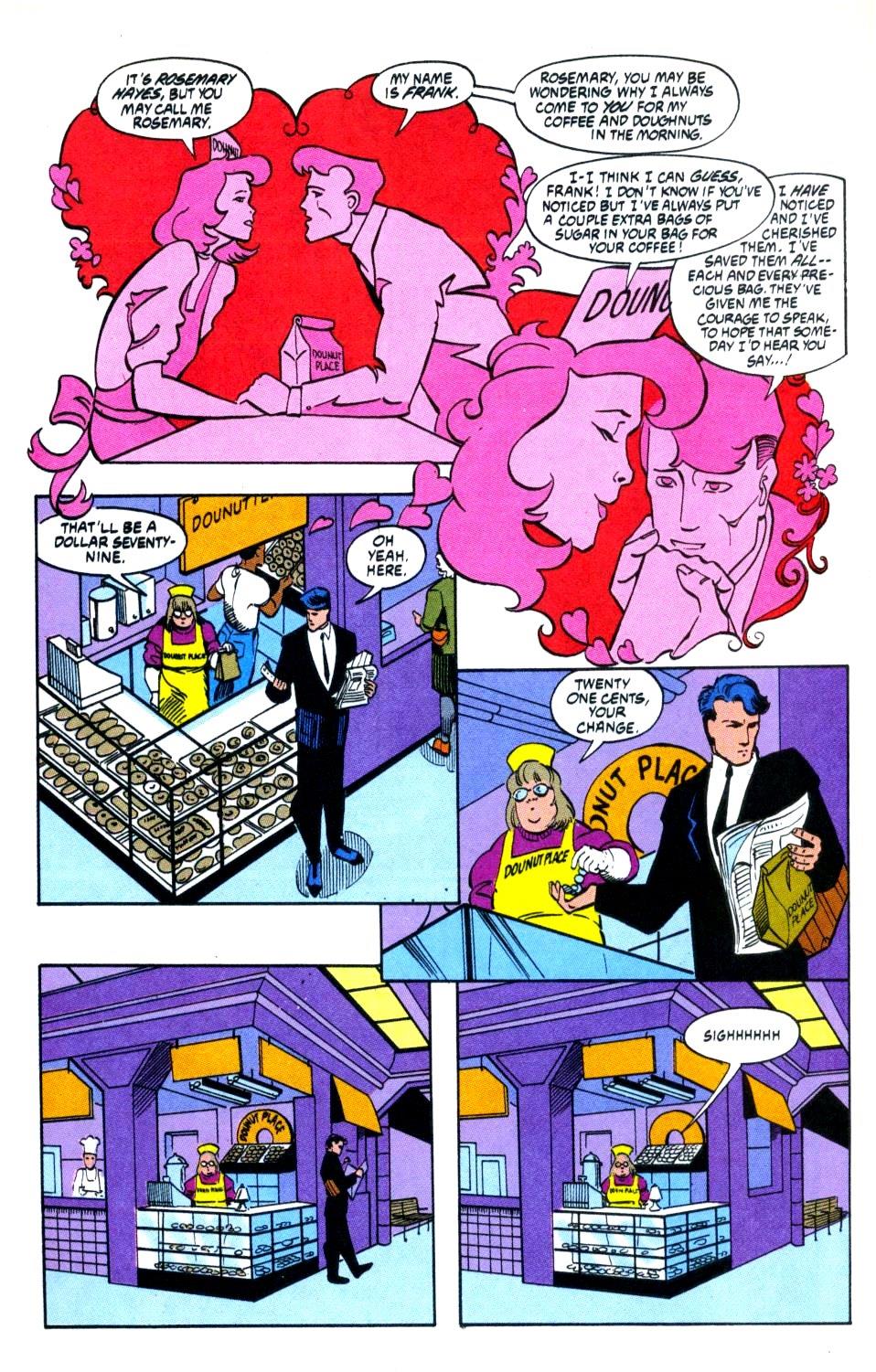
You may not have noticed the doughnut lady who dealt with Jimmy’s ever-so-clever order.  That seems to be par for the course for her, as she is perpetually building her own world in her own head.  I don’t blame her; I spend a great deal of my time dreaming about what my life would be like if I won the lottery.  (Basically, it would be more or less the same but with more comic books, less work, and probably an Unspoken Decade magazine.  Maybe it will happen!  Keep dreaming, Legions!)

Her name is Rosemary Hayes, and she is something to behold in her dreams.  Aren’t we all?
Gotham Nights #1 - Page 8 Gotham Nights #2 - Page 12 Gotham Nights #2 - Page 13 Gotham Nights #2 - Page 14 Gotham Nights #2 - Page 15

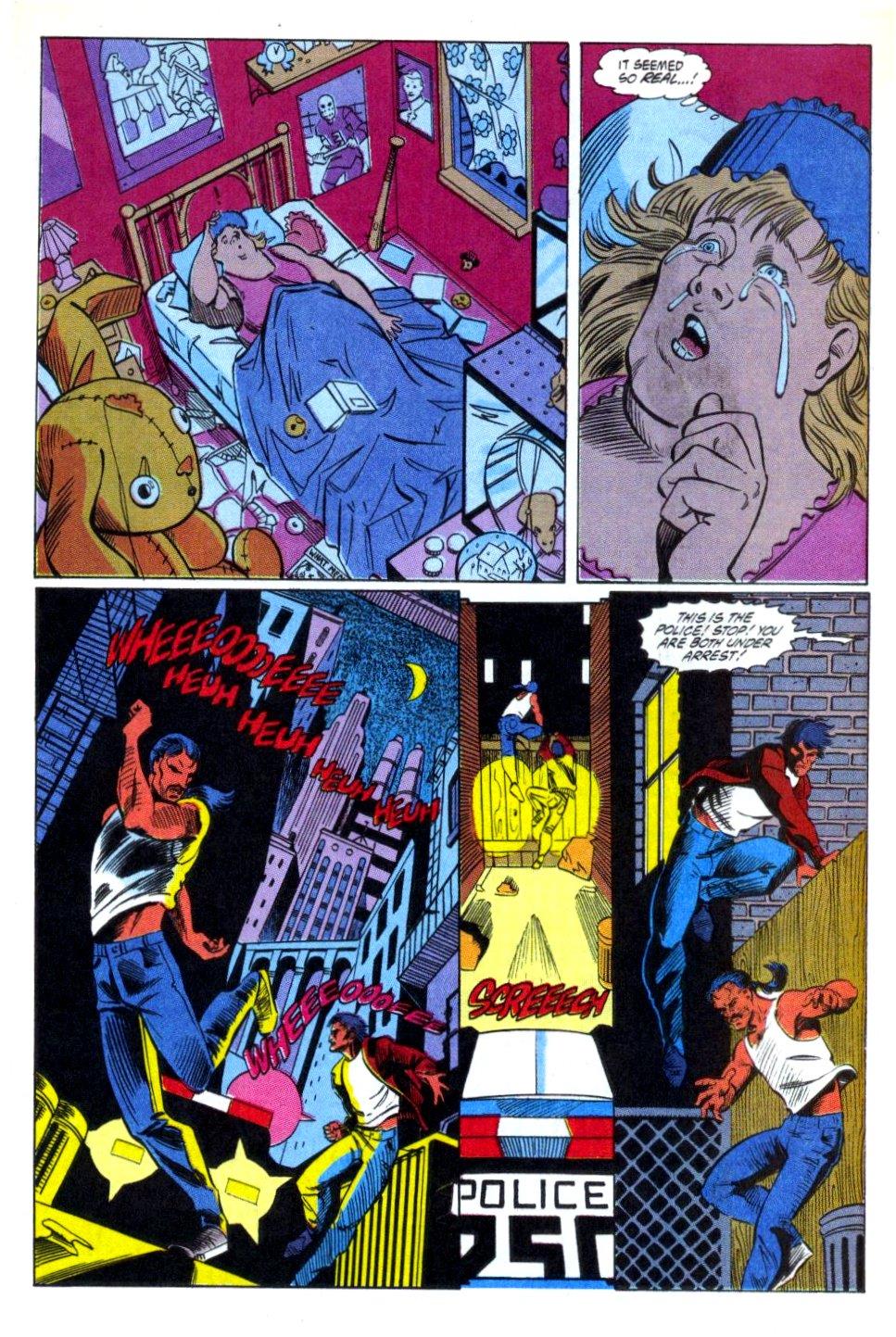
Man, she sure makes Wonder Woman fat in her dreams!  I love it!  Her character is a tragic one, whose loneliness reaches out and just grabs you through the page.  I feel so badly for her after this next page, when she wakes up and the reality of her dreams dissipates with ever beam of light that makes its way into her eyes.  We’ve all felt that way after a dream, right?
Gotham Nights #2 - Page 17
I have felt that too, Rosemary. It just ain’t fair.

Life, of course, isn’t fair to many folks, but it seems decidedly harsh on Joel and Emma, an older couple who have all sorts of problems, ranging from health to money.  Being broke is bad, but it is also tough to watch the world change around you when things are going poorly for you, especially as you get older.  That gets really tough if you recall when things were different, when you were younger, and when you could do something about it.  Things could not be going much more poorly for Emma and Joel, so Gotham, being the harsh mistress that it is, ups the ante just a little.
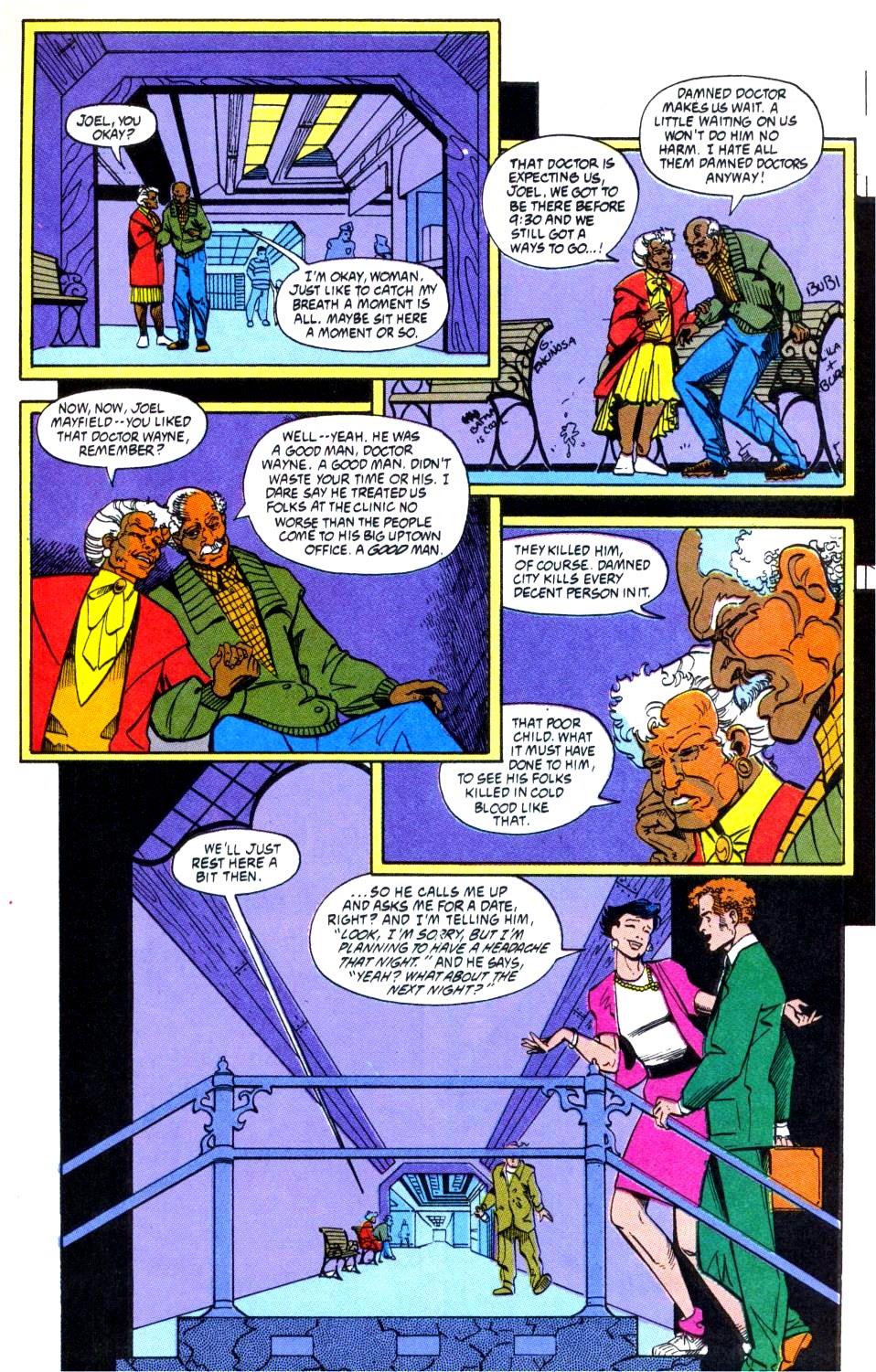
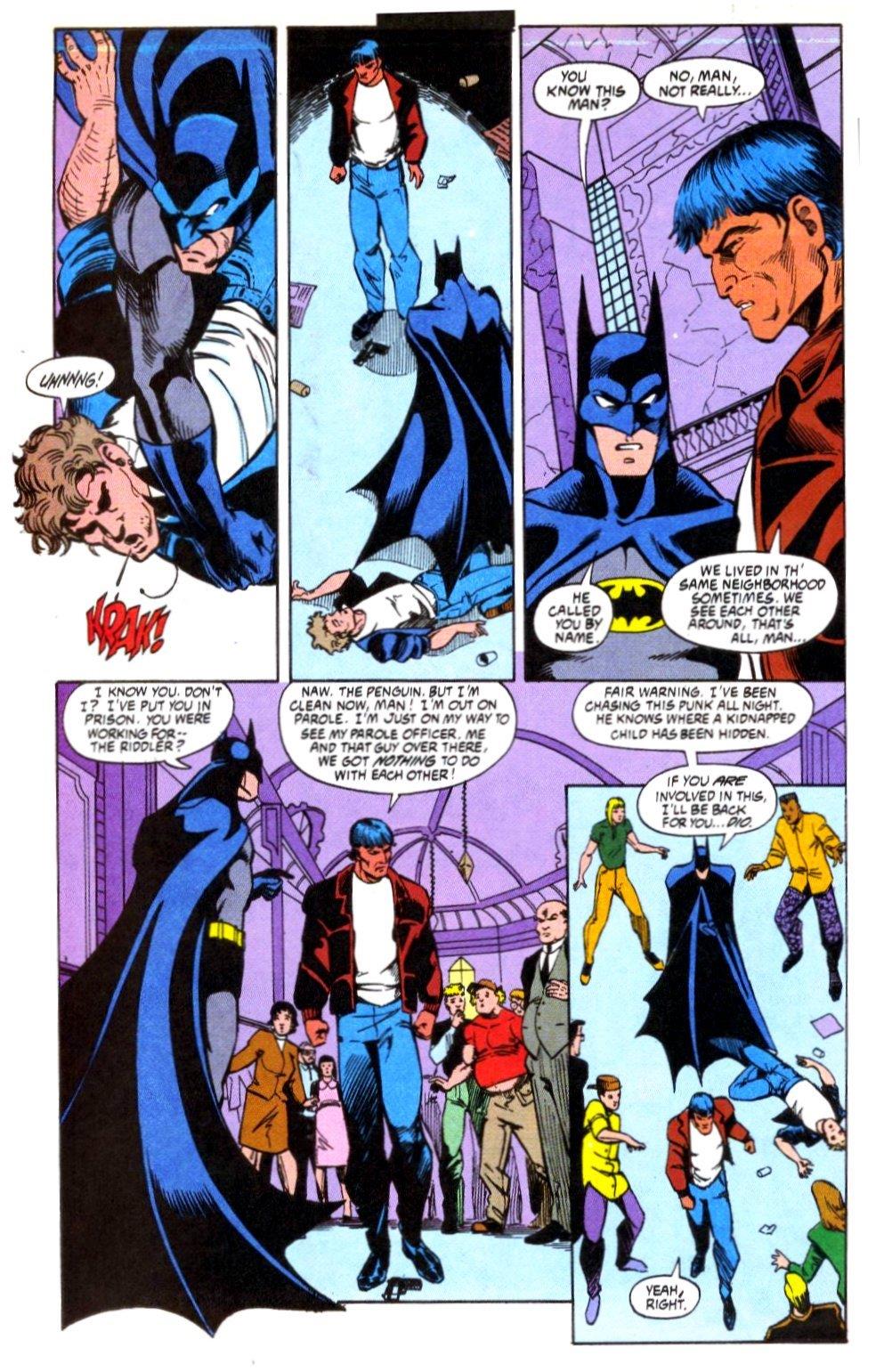
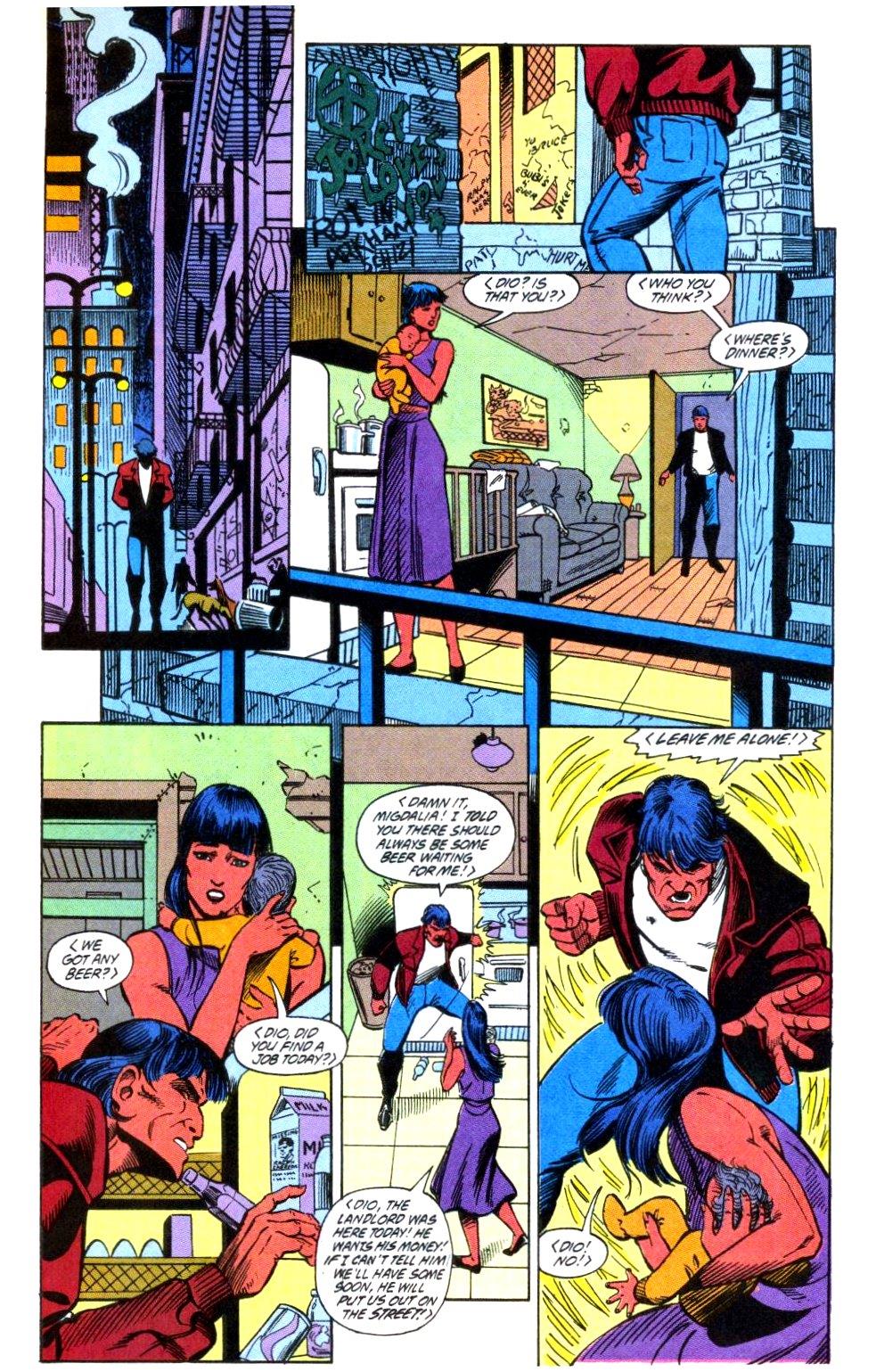
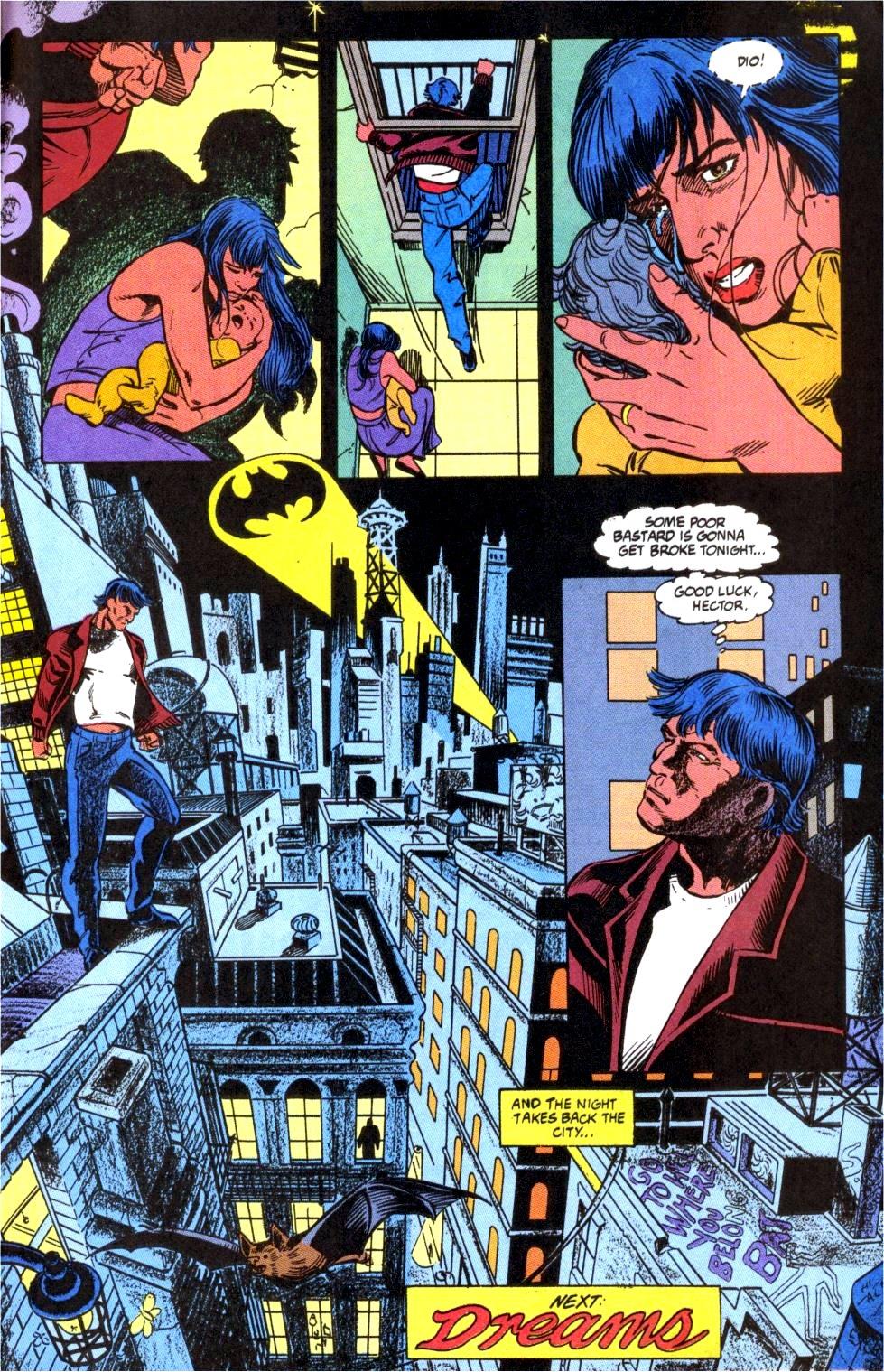
Gotham Nights #1 - Page 9 Gotham Nights #1 - Page 20They will support and care for one another as best they can through these issues, but at least they do have each other.  Dio is an ex-con on parole, who insists on pushing away anyone who is close, especially his pregnant wife.  He also has words with Batman, who says he’ll be keeping an eye on him.  I love that; it’s so small-town sheriff in a western, but it is also so Batman.  Those two genres don’t line up that neatly very often…
Gotham Nights #1 - Page 14 Gotham Nights #1 - Page 15

Gotham Nights #1 - Page 16

Gotham Nights #1 - Page 23 Gotham Nights #1 - Page 24

Dio’s path in life hasn’t taken him anywhere awesome thus far, except maybe for his wife, Migdalia, but all he seems to do for her is to threaten to hit her and demand beer.  I am a big fan of beer, but I am not so much a fan of a violence against women.  He also appears to have a past as a high-end henchman, having worked for The Penguin.  I like that Batman has such a memory that he recalls this guy; Penguin must have stopped dressing his guys like he did in Batman ’66, where they’d have a hard time being told apart.

Dio’s tale is a sad one, and no tale in the book is devoid of heartbreak.  The question is is how will these people that comprise the great city of Gotham survive their personal tragedies?

Gotham Nights reminds us that each city, even the fictional ones, are full of people.  These people have dreams, hopes, fears, bouts of depression, hankerings for ice cream, and all of the various feelings that go together to make up human existence.  You’ll see these folks rise, fall, get up, stumble, sleep, eat, and engage in all sorts of activities just to keep their lives moving along.

Normally, I go through bit by bit and give you the story, but that seems a disservice to such a character-drive story as this one.  Instead, go out, find the book, and see yourself in these characters for yourself.  See yourself and your choices in a new light.  See yourself in Gotham Nights…and never forget one thing always remains constant in Gotham City…

Gotham Nights #4 - Page 23

Hope you had fun, Legions of the Unspoken!  Next week, Emily Scott brings you Bill and Ted’s Excellent Comic Book, and Darry Weight takes a look at Cable. We’ll talk Rob Liefeld’s Avengers in an upcoming podcast, and Super-Blog Team Up returns on 4/21 with Top 10’s!  Hope to see you there for all of it, folks!

The Great Debate-90’s comics vs. 70’s comics!

Hello, Legions of the Unspoken!  I had the chance to have a great conversation with Paul O’ Connor of Longbox Graveyard about the merits of the 70’s and Bronze Age vs. the 90’s!  Scroll through some cool covers of both decades, and then you’ll find the podcast!  Take a listen and comment with some of your thoughts!  Thanks again Paul!  Transcript coming soon!

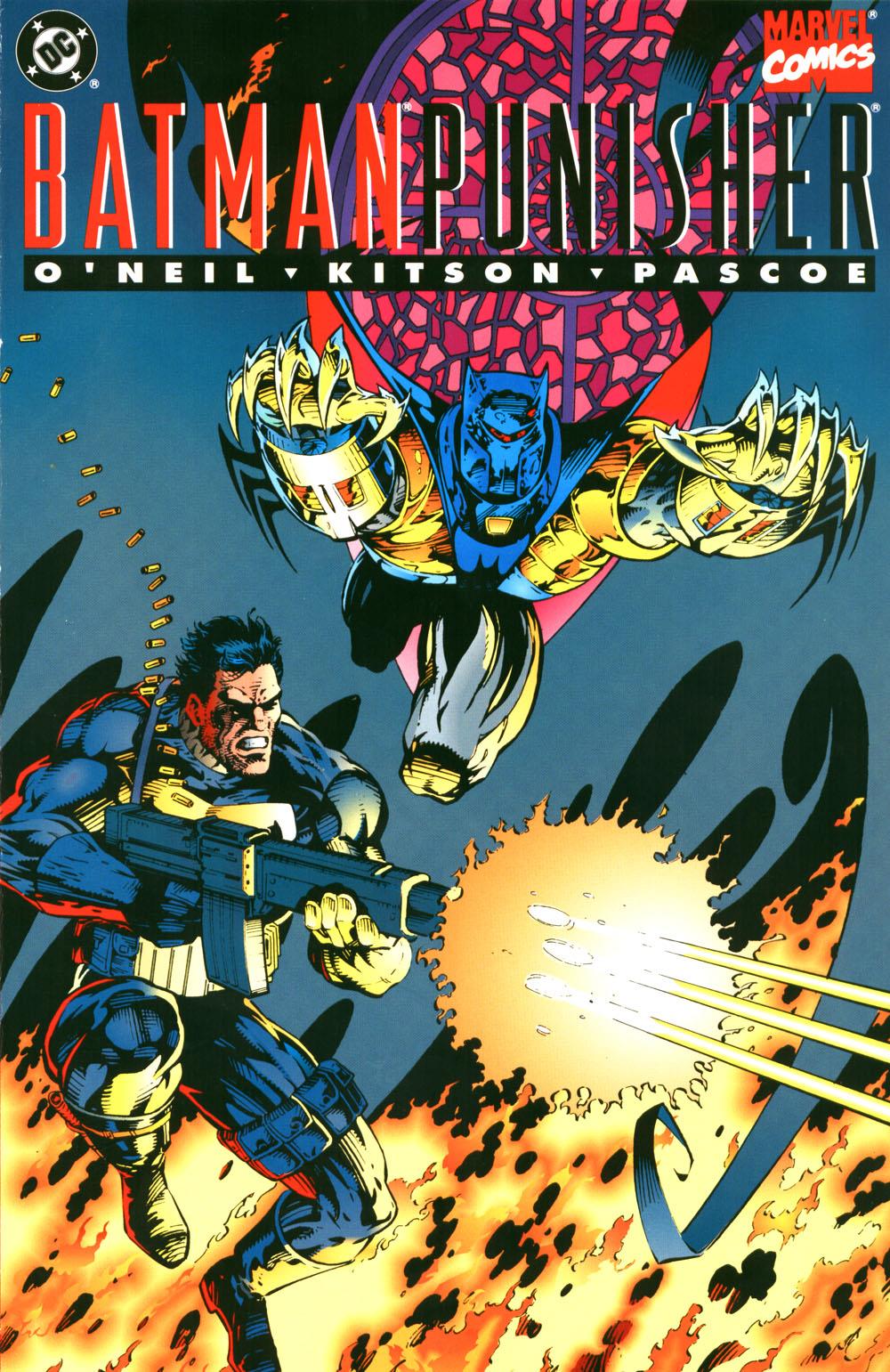
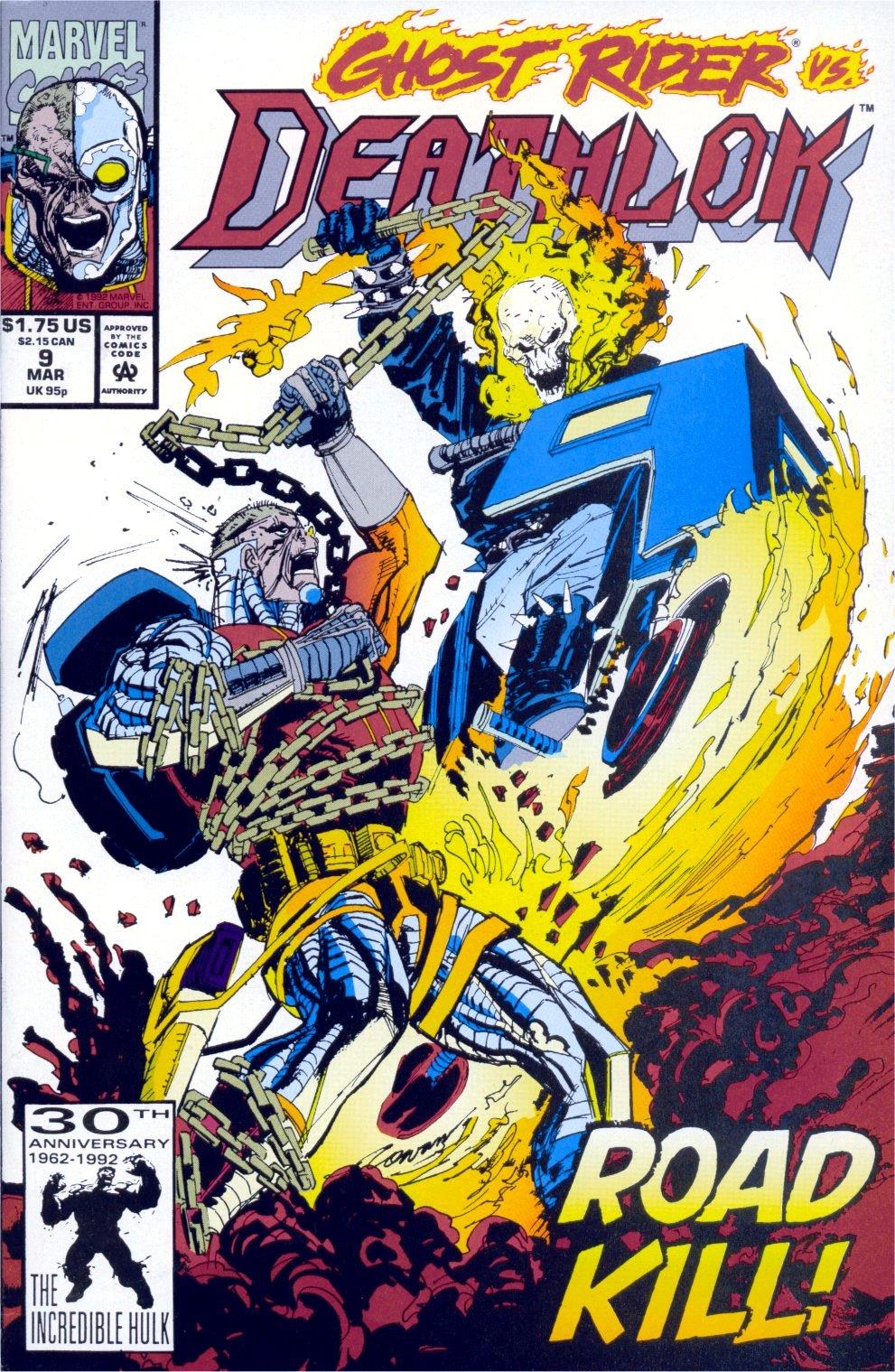
Avengers175 - Page 1 WestCoastAvengers #89 - Page 1Iceman Limited Series #1 (of 4) (1984) - Page 1Batman & Punisher - Lake of Fire #425 - Page 1IM128 - Page 1Deathlok #9 - Page 1

Listen by clicking the link below!!!

150331_002

AlieNation: Skrull Kill Krew by Emily Scott

Greeting, Legions, and welcome back to Madness Month here at The Unspoken Decade! I don’t know that I truly understood the meaning of the word “madness” until I experienced a certain ongoing basketball tournament Dean Compton-style, complete with days of games on multiple screens and more junk food than anyone in their right mind would ever consume, but now I am well prepared to take a look at some lunacy in the comic book realm. If you haven’t already, I strongly encourage you to take a glance at Dean’s take on Ghost Rider #33 and Darry Weight’s Venom: The Madness, but if you’re in the mood for madness of a slightly more irreverent nature, there’s no better place to turn than 1995’s Skrull Kill Krew.

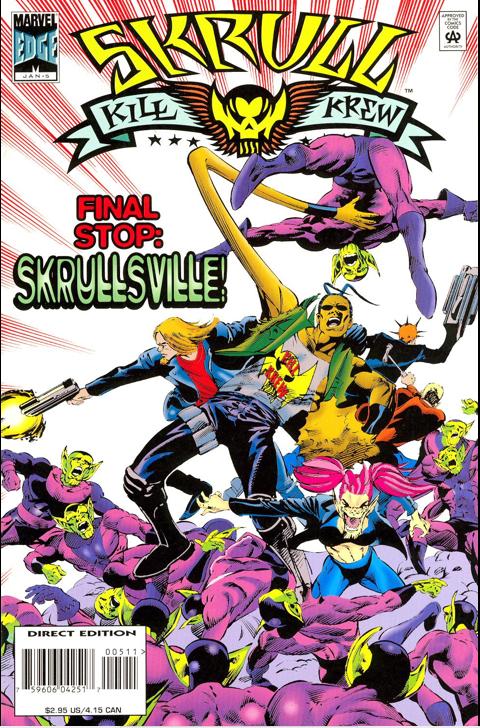
Created by writers Grant Morrison and Mark Millar and artist Steve Yeowell, Skrull Kill Krew was published under the short-lived Marvel Edge imprint, which included many established Marvel titles like Ghost Rider, Punisher, and Daredevil. As the name would suggest, and since it was practically the law in the mid-90’s that things be made more extreme, Marvel Edge trafficked in edgier fare, and Skrull Kill Krew is nothing if not on the fringes of normalcy. From the first cover, it’s obvious this comic is going to have some fun and not be too concerned with how it goes about doing it.

Skrull Cover
This is a great cover for this book – it perfectly captures its tone and content…but I can’t stop fixating on there only being two ellipses. WHY? If I ever stop being bothered by things like that, it will be the first indication I have been replaced by a Skrull.

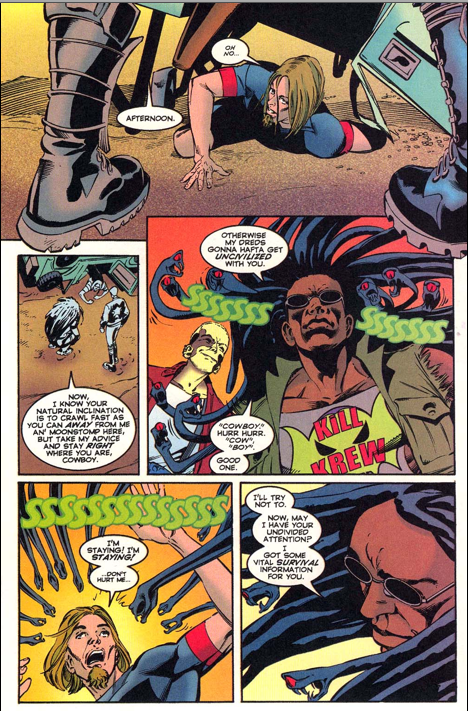
We first meet Krew members Ryder and Moonstomp, who bust in on a history class, blow away the teacher, making the “she’s history” joke you totally see coming but would be disappointed if it weren’t there, take out a student, announce they were aliens, and dismiss class more flamboyantly than anyone since Alice Cooper. It’s a fitting introduction for this motley Krew because it’s exactly what you’ll get a lot more of in the rest of the books. Not to say that there is no depth to this series, but it doesn’t deviate far from the pattern of find Skrulls – make snarky quips – violently dispose of Skrulls. It’s entertaining, but anyone looking for something more probably wasn’t paying much attention to the cover up there when they picked this up.

One other thing the Krew does is recruit new members, but considering their recruitment techniques don’t look terribly different than their Skrull extermination techniques, their potential members can be a little reluctant. Dice, a surfer dude who has been experiencing strange visions and mood swings, runs from them, quite understandably so, as the Krew has shot his girlfriend after announcing themselves as “two seriously violent individuals” and started chasing him down with all the subtlety you would expect from people who mow down alien infiltrators in crowded public places.

Skrull Dread
I’d like to read the issue where they just can’t figure out why they aren’t meeting their recruitment goals.

The smarmy blonde British guy is Moonstomp, who we learn is a white supremacist who likes to deal out his violence with a claw hammer even though he could morph himself into any weapon. The black guy is Ryder, who we infer hates Skrulls enough to work with a white supremacist to take them out. The title doesn’t last long enough for them to get much character development beyond that, but the story doesn’t particularly demand any more of them.

Their partnership exemplifies some of the best and worst of humanity, something simultaneously beautiful and ugly. One on the one hand, it’s comforting to think that if there were an outside threat, we would put aside our differences and work together as a species to ensure our own preservation. On the other, it’s disheartening that it might take something decidedly more foreign than people of other races to make us finally set aside those prejudices and come together as one human family. I said that this story was not without depth, but this is the sort we get – not really examined in any meaningful way but there if you care to look for it.

Skrull Depth
The only depth they’re concerned about is how deep they’re burying these Skrulls, amirite??

In the second issue, we get an explanation of the Krew’s origin and powers. The gist is that in the 60’s, the Fantastic Four defeated some Skrulls impersonating them. Reed Richards, demonstrating what Ryder rightfully calls a “highly idiosyncratic sense of humor,” hypnotizes them into thinking they are cows and left them to graze. (You know you’ve read too much Greek mythology, when you find yourself wondering if Mr. Fantastic planned on boning any of the bovine.) During the Kree-Skrull War, they were changed back into Skrulls, but this time when they were defeated and turned back into cows, the Alien Activities Commission decided to do something weird and gross and send the cows to the slaughterhouse.

Skrull PETA
PETA would have a field day with this.

Those cows were turned into burgers, and some of the people who ate them died, some were unaffected, and some, our protagonists, were infected by the Skrull meat in a way that gave them powers like shape-shifting, ability to detect Skrulls, and near indestructibility, as well as an increasingly violent and irrational urge to off the Skrulls. The unfortunate side effect, though, is a bad case of dying soon, as the virus eats all of someone’s brain tissue in a few years. (This comic was created at the height of the Mad Cow Disease scare in the UK, and while it doesn’t necessarily have anything profound to say about media-induced panic or the horrors of mass food production, it capitalizes well on that panic, and using the cows was a clever way to integrate an older, fairly minor idea into the modern world.)

Just as the Fantastic Four all got different powers as the result of their exposure to cosmic rays, so too do the Skrull Kill Krew get unique powers from their Skrullovoria Induced Skrullophobia that reflect their personalities. Spiky haired punk rocker Riot, named because she is a Riot Grrrl and this is the super 90’s, transforms into a huge prickly insect. Dice’s powers manifest at random. Catwalk, the supermodel, turns into a giant cat. The most compelling affect of their powers, though, belongs to Moonstomp, who appears to be the only one exhibiting any of the degeneration yet. He has multiple dark patches on his body that are spreading, and it would have been interesting to see if a fairly flippant book would have handled a white supremacist turning black with any kind of subtlety.

Skrull Spread
Who would have thought that the most controversial thing about this would end up being the mention of Bill Cosby?

It’s not just playing on the idea of Mad Cow that makes this comic feel so much like a product of its time. In fact, of all the 90’s comics I have looked at for The Unspoken Decade, this might feel the most 90’s of all. It’s more than the “edginess,” the over the top violence, or the fact that the Krew all look like they stepped straight off the set of Hackers. There’s something about the anything goes, nothing-to-lose, nihilistic tone that transported me straight back to the mid-90’s, but it’s hard to separate how much of that is the comic, about a group of invincible feeling young people, and how much of it is a product of the fact that the height of my own invincible feeling growing up took place in the mid-90’s watching movies like Natural Born Killers and talking about how nothing really mattered.

Skrull Hackers
In addition to Moonstomp and Ryder, our Krew is rounded out by Baby Spice, Annie Lennox after she stuck her finger in a light socket, and…an amalgam of every character Matthew Lillard has ever played.

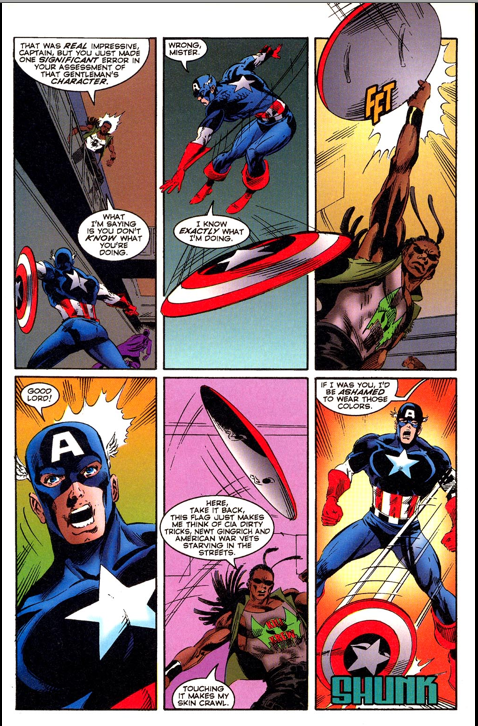
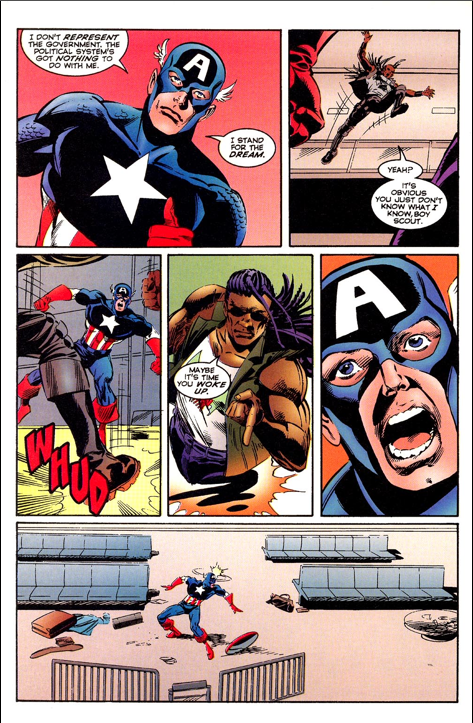
Something decidedly un-90’s in this comic is an appearance by the Man out of Time himself, Captain America, which feels incongruous for a number of reasons other than time. Not only does Captain America have a completely disparate mood from Skrull Kill Krew, but, as Dean pointed out when we were puzzling it over, if they were trying to use a big hero to sell more books, someone like Wolverine would have been a better option in 1995. It’s possible they used Cap just because he would have been such a random choice. It’s also possible they use him specifically because he represents an old-fashionedness and supposed conformity they were trying to flout.

The last reason would make the most sense to me because it would explain the diatribe below by Ryder that doesn’t really fit into the rest of the book otherwise. I can tell I’m no longer my younger cynical 90’s self because instead of thinking, “Yeah, you tell that old jingoistic bastard!” I just wanted to yell at Ryder not to talk to Captain America that way. I also want to balk at the idea that he could handle Cap so easily, but I suppose this is his comic and all.

Skrull Cap 1

I can tell I'm no longer my younger cynical 90's self because instead of thinking, "Yeah, you tell that old jingoistic bastard!" I just wanted to yell at Ryder not to talk to Captain America that way.
…then Ryder stormed off to blast Rage Against the Machine and talk on the phone about how Cap just doesn’t, like, get it, man.

The actual storyline involving Captain America doesn’t seem especially important, but the book gives the impression that it might have led to something significant had it continued. Basically, the President of Slovenia is flying into America, and Cap is at the airport to greet him. Baron von Strucker has other plans, though, and intends to take the president, and Slovenia, for himself. The Krew show up looking for Catwalk, who happens to be on the same plane, and realize the president is a Skrull. Strucker buggers off when he sees how many superpowered people are about, and the Krew, realizing the president is Skrull, tussle with Captain America, who thinks he is just protecting an important person. Oh, those wacky superhero shenanigans! Cap tells Nick Fury what happened, and Fury divulges that he knows exactly who Ryder is.

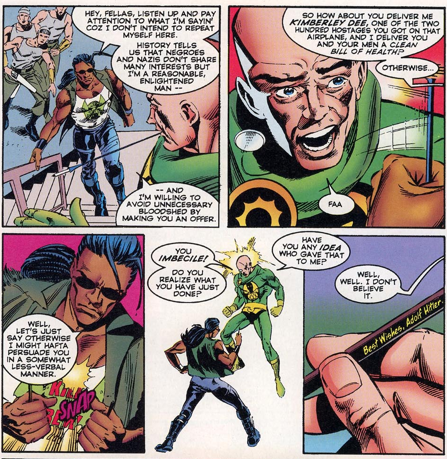
That revelation seems to be the most important part of the whole story, since it teases an even bigger reveal about Ryder, but I suppose that reveal will have to forever reside in Speculation City. At least we get this great moment with Strucker. Take that, fascist:

I feel like that impersonal message is the Nazi equivalent of Hitler writing "Have a nice summer" in your yearbook.
I feel like that impersonal message is the Nazi equivalent of Hitler writing “Have a nice summer” in your yearbook.

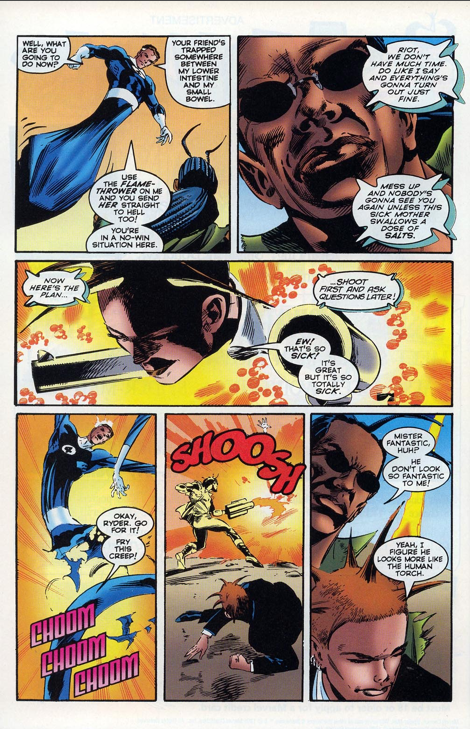
The other big cameo in these issues is the Fantastic Four, which makes sense, since Reed Richards’ actions caused this whole chain of events in the first place. The only problem is that it’s not the Fantastic Four at all; once again, those menacing Skrulls have impersonated them. There is some nice Twilight Zone-esque stuff at the beginning of the comic as we see a town completely get taken over by Skrulls from the perspective of a traveling salesman, but otherwise, there isn’t much in the way of plot to get in the way of multiple pages of the Krew beating up on the Fantastic Four replacements.

Skrull Four 1Skrull Four 2

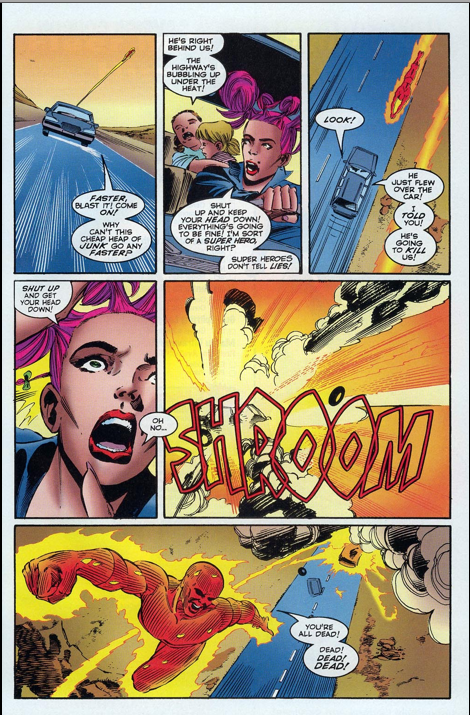
Even for an evil alien, that Skrull Human Torch is just way too stoked about them being dead.

Once the Krew have dispatched with the Fauxtastic Four, they turn their attention in the last issue to the town, which has been entirely replaced with Skrulls. This title was originally meant to be ongoing, but when it was cancelled, editor Tom Brevoort convinced Marvel for one more issue, making it into a mini-series. While it’s always nice when series get a resolution, Skrull Kill Krew has so little going on in terms of plot or character arcs that it’s really a resolution in name only. But when the majority of its action involves the killing of as many aliens as possible, I suppose there could be no better resolution than the all out mayhem that accompanies the mass slaughter of an entire town of them.

Skrull Kill
Pictured: the entire comic. Seriously, nothing happens in this issue except this gang killing an entire town of Skrulls. That’s it. It’s all variations on a theme.

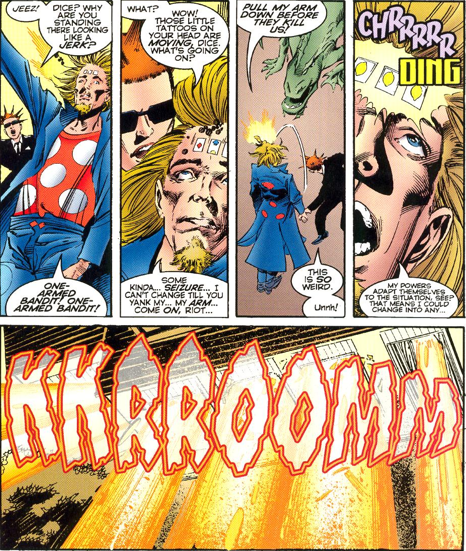
I hope when I keep saying that there isn’t much going on plot-wise that it doesn’t come off too disparagingly because the other thing completely lacking in Skrull Kill Krew is pretense. It never once tries to be something it’s not, not for a moment, so while it’s most decidedly not a masterpiece, it most certainly is what it sets out to be, which is a rollicking good time. The sort of comic where you can kick back and enjoy some wanton destruction and not bat an eye because someone’s powers, which they acquired by eating ground up alien, cause them to turn into a human slot machine whose jackpot is becoming pure energy. Yes, that happens:

I would never joke about something like this.

It might not be a huge letdown that the series didn’t go on longer like some other comics I’ve read recently, but it is nice to know the Krew made a reappearance in Secret Invasion and got a second mini-series in 2009. What was even more intriguing, but also slightly disappointing, was learning that there was talk of making a Skrull Kill Krew television show, which would be the perfect medium for this bunch of freaks. Had it been made, I’m sure it would have held a plum spot on the list of shows from my adolescence that were cancelled too soon.

I hope you’ve been enjoying Madness Month here at The Unspoken Decade, which will conclude with the maddest thing yet! Dean Compton will be allowing an interloper into our midst, one Mr. Paul O’Connor from Longbox Graveyard, to discuss his view on 90’s comics. If you don’t know some of Dean’s thoughts already, you might have forgotten what website you’re currently on, but Paul is a Bronze Age guy, so opinions may vary wildly! You don’t want to miss it!