NO ONE CAN BE TOLD WHO MATRIX IS – Roger Stern and the Unsung Supergirl

Jon Kent: “And so trusting… too trusting.”
Martha Kent: “Yes, and that can be just as dangerous as being too cynical.”

No theme this month, Legions of the Unspoken, so let us take a closer look at a character who has been in the limelight recently. You may have heard about the Supergirl show coming soon to the small screen. You may even have had a significant other asking which comics featuring the Maid of Might they should read. Hopefully you shrugged and pointed them towards Thunderworld because Mary Marvel is close enough.

Supergirl is an interesting character. She has been around for decades but I could not, for the life of me, tell you an interesting thing about her. Before I started reading comics Supergirl had been murdered during Crisis on Infinite Earths but, strangely enough, she seemed to be doing just fine in the halcyon days of the S-Shield numbered covers of the Superman titles. What happened? Did she get better with the reboot? Did Zero Hour kick her back into her prime?

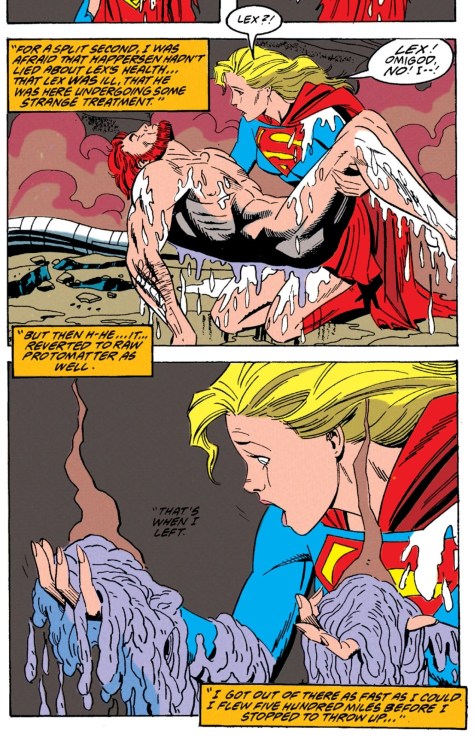
No, of course not. Lex Luthor from a pocket universe cloned Lana Lang and the ensuing “protomatter being” helped John Byrne’s Man of Steel defeat General Zod before coming to the core DCU and promptly banging Lex Luthor while his mind was occupying his own cloned body and masquerading as his son to the world at large.

In case you were wondering, yes, that ginger chinstrap is genetically predisposed as it appears on a freshly baked clone with no indication of having been groomed that way.

This Supergirl was not Linda Danvers. She never wore the white tee-shirt, had flaming wings, or was served a drink by Der Führer (as you Fallen Angel fans may recall). This Supergirl is Mae, short for “Matrix,” and she was the version of the character that ushered in the nineties. She is unique from what came before, and has been overshadowed by what came after. In true Roger Stern fashion her story was unique and worthy of your time.

In the early days of 1994 Stern, along with artist June Brigman (co-creator of Power Pack and one of the only woman I can think of to draw anything related to Superman) helmed a four issue mini-series that explored the backstory of the Woman of Tomorrow (I am coining that because typing “Girl of Steel” is going to end me up on a watch list) and her place in the DCU. It features Lex Luthor II prominently and does a fair job at tying that particular plot thread up. Not sure what your reading habits are but if you enjoy what you read here you can buy the series from “comiXology” (I love them but that branding has to go).

What would come to be defined as this era’s Supergirl mostly came later, from Peter David, until it was promptly overturned by Jeph Loeb. You may also remember Dan “The Man Without a Plan” DiDio telling a roomful of confused onlookers that Matrix had been stricken from continuity. I forget if this was before or after he told similar rooms of people that Stephanie Brown had never really been Robin or that he could not wait to kill Nightwing (I do not know about you but I will never forgive him for Beast Machines never mind his DC work).

Anyone else get a Kevin O'Neill feel from this art? If he ever gets tired of drawing Alan Moore’s Public Domain Fanfic it would be great to see a Supergirl story from him.
Anyone else get a Kevin O’Neill feel from this art? If he ever gets tired of drawing Alan Moore’s Public Domain Fanfic it would be great to see a Supergirl story from him.

The powers that be have done all they can to wipe away the version of Supergirl I first met. She deserves better. This was a Supergirl that had been as different from her former cousin as possible while also acting as a perfect reflection of the Superman brand, and superhero comics in general, at the time.

Mae is young. Very young. She is, at best, a teenager and that is if we estimate the comparable life experience that a protomatter being has compared to a traditionally defined person. She is energetic, curious, and prone to fits upon discovering that her trust has been betrayed. She is exactly the type of teenage superhero we have seen time and time again except instead of trying to be her own person she must grow in the shadow of Superman with little of her own light filtering through.

Mae can shapechange, telekinetically repel everything around her, and generally heal from any wound. She is fluid and not restricted to one thing or another, even gender, as she reminds the omnipresent doctors and scientists who serve as the perfect excuse for a bit of the old exposition. She has only chosen the form that we all know and love because it was Superman who rescued her from her own dying world and brought her to his, complete with the only type of life he could provide: A version of his own. She dresses like him, befriends Lana Lang, and is raised by the very-much alive, and surprisingly spry, Ma and Pa Kent.

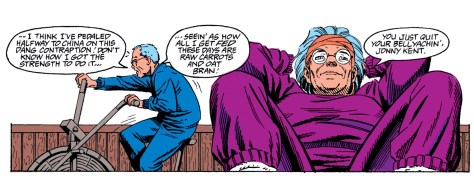
I realize now just how much I never wanted to see Martha Kent from that position. At least Jonathan’s being heart healthy, despite that battle being unwinnable.

She has been forced into this role and this life, her potential squandered. She could have been anything she imagined but instead she must settle for keeping the Supergirl copyright alive and well. Despite his manipulation, Lex at least asks Mae to question what she can do and how she can do it. There is a chance here to present a very different character than the one that came before. The previous Supergirl had to run and hide in an orphanage because her cousin thought that the world was not yet ready for a woman with superpowers to be helping him in his crusade to protect every man, woman, and child from increasingly insane disasters.

Mae is not burdened, as her subsequent version will be, with being a literal Angel of Heaven. She is not trying to accept her destiny but find her place in the world. She is the sole survivor of her world and literally the only one of her kind. Her struggle for identity is entirely separate from Superman’s. During the Silver Age he knew that he was not alone once he met Supergirl but Mae will never experience that. Her life is one of potential solitude but she denies it in favor of embracing the world around her. Installing the “Superman.exe” character model may have been the best way to save a few citizens from the Kryptonian criminals who destroyed her world but it also means that she will be best well known for impersonating Clark Kent after Superman “miraculously” returned from the dead.

The people who surround her remind her what a heel Lex Senior was and judge her for being with his “son.” The inevitable reveal of his shenanigans serves as a wonderful origin story but is squandered as well. Lex, unsuccessfully fighting the effects of Kryptonite radiation poisoning, has decided that the world cannot possibly live without him, regardless of the fact that it was his own hubris which brought him to the brink of this particular flavor of disaster, and does all he can to stave off death. This includes seeing if he can reinvent the process that his alternate version used to create Supergirl in the first place.

Ill defined, psychokinetic powers? Dark, nebulous appearance when enraged? This is why Supergirl fit well with the Legion of Super-Heroes, she was an X-Man.

Mae’s journey in many ways embodies what a fictional character must go through. She began life as sentient protomatter, no more than a medium for ideas to flow into. Stern does a wonderful job at reminding us that Supergirl is not all powerful and does have the limits you would expect of someone still learning to control their abilities. Her appearance, gender, nationality, and superpowers were defined by those around her. Next comes the inevitable confrontation with copyright laws. Supergirl is a brand just unique enough from Superman to be separately marketed and sold on its own. Not in real life but this is true within the bounds of the DCU. Lex assures Mae that this is in her best interest and that none of the money will ever be used to fund a cause that she would not support.

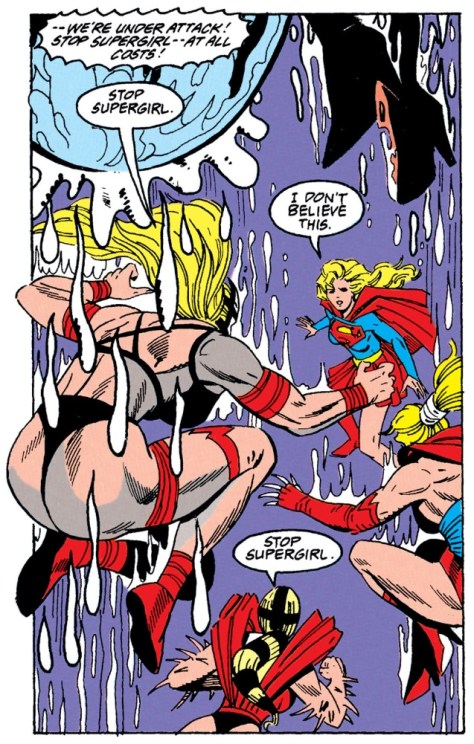
Though not followed-up on in any specific way (this version of the character would not receive an ongoing series) Mae is confronted with funhouse mirror versions of herself that Lex has created. Each one comes from their artificial wombs complete with costume and defining characteristics. None of them look like Mae, exactly, but they do not have to. Lex owns the copyright of what she is so why would he check with her before going to market with versions he believes will do well? The protomatter that Mae is created from can form clothing and so some versions have chosen the less flattering wardrobes of the female superheroes of the day.

I hope this is scathing commentary on the art practices of the industry at the time because otherwise I have no idea what is being shown here.

Supergirl is no stranger to having to prove herself against copies. She herself was created by Otto Binder, the same man who created Mary Marvel for Fawcett Comics and she was arguably surpassed in popularity by her Earth-2 counterpart Powergirl. Here she has the chance to prove to her aggressors that she is her own person and does so with “psi-blasts,” a power Superman never had. Mae is held back by needing to be as close as possible to the idea of Superman. That brand cannot be altered, as too much merchandising rests on its shoulders, and it forces Supergirl to stagnate. If nothing else, it would have been great to see a character who could shapeshift into and out of her secret identity without needing glasses, a slouch, and criminally unaware coworkers.

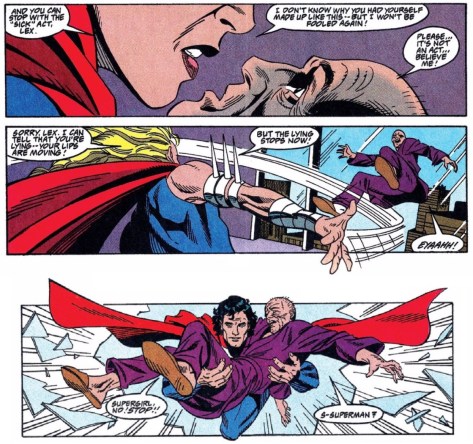
We see part of this potential in what comes next. Unlike Clark Kent, Mae has no way of dealing with the ills of the world. No moral compass was installed as part of the “raised on a farm” service pack and raw, righteous fury leads her to take the fight to Lex. Her shape changes, almost unconsciously, and all limitations leave her. Why should Lex Luthor, father or son, be allowed to continue committing such despicable acts? It is here that Superman makes his first on-panel appearance as he saves Lex and steers the story back into the comforting waters of what each and every reader unfortunately thinks of when they think of a Superman story.

Not that we need a Supergirl who murders anyone (David S. Goyer was still only writing “The Puppet Masters” when this comic came out) but here we are shown that she is not even allowed to express her own rage. Yes, Superman teaches her right from wrong and yes everyone involved would have regretted Lex falling from a skyscraper but part of me will always look fondly upon the time the version of Supergirl that I first got to know threw an awful, decrepit supervillain out of a building. I remind you that the man who once stole forty entire cakes was bedding a teenage (or younger) girl using a cloned body and purple turtleneck.

Yes, those are spikes on her arm, and no they are not adequately explained. It is as if she said her “magic word” but instead of the Wizard Shazam answering it was Rob Liefeld.

Matrix is one of those wonderful anomalies from the nineties. She made sense within the context of the cold, clinical Krypton imagined by Byrne and developed by others, including Stern, with characters and concepts such as the Eradicator. This was a time in Superman’s history when his unflinching morality seemed all the more impressive for being set against such an impersonal heritage. Mae was the supporting character that this version needed and she could have been a notable and complex hero in her own. Lex may hate Superman but no one will ever hate Lex as much as Mae. She returned recently in two-part Convergence story. If you read it, let me know how it is. Keith Giffen and Ambush Bug are a good time no matter what.

Things Just Got – X-TREME!

Greetings Legions of the Unspoken!  We have a special guest author today, Sir Tawmis of Comic Relief Podcast has come on by to give us a write-up on one of, if not the, most 90’s characters, ADAM-X…THE X-TREME!!!!  Thanks for the great work, Sir Tawmis, and don’t forget to scope out the great work they do over at Comic Relief Podcast!

Things Just Got – X-TREME!
Written by: Sir Tawmis

adamx-1 (1)Allow me a moment to talk about X-Treme, or as I like to call him, simply Adam-X. While I talk about him and his origin – I will also highlight some of the things that put Adam-X at the top of my favorite character list – of all comic book characters.

First, I admit. I am a sucker for the obscure characters. I think a lot of that has to do with, deep down inside, I am a writer yearning to flesh out characters who are just begging to have their origins explored – then unleash that untapped potential!

There are few characters that have more potential to be an amazing character than Adam-X.

The character known as X-Treme was created by Fabian Nicieza and Jeff Johnson, and he first appeared in X-Force Annual #2 (October 1993).

adamx-1 (2)When Adam-X appeared, he was the embodiment of a lot of what the 90’s comics represented – he had long hair, backwards hat, blades on his shoulder, wrists and hips. He was a character with a mysterious background, and a lethal hunter. Now, I am not a Child of the 90’s – I consider myself a Child of the 80’s – but I actually liked how Adam-X looked when he first appeared. (Granted, in hindsight, a little less blades on the shoulder and belt/waist might make him marketable in a more modern comic book market, but still!)

In his appearance, Adam-X is hunting down a friend named Michelle Balters (who also happens to be a mutant by the name of Neurotap). X-Force, led by Cable, arrive at the scene and attempt to take down Adam-X. However, Adam-X is easily able to defeat all of the members of X-Force by cutting them, then igniting the electrolytes in their blood.

This is one of the things that really made me like Adam-X. Don’t get me wrong. I was reading and collecting X-Force (and enjoying it!), but I was not a fan of Cable. (Still not a fan of Cable actually…). Come to think of it, overall I am not a fan of time displaced characters (such as Cable, Stryfe, Phoenix {Rachel Summers}, etc.)

So when Cable gets taken down – and not by a team – but a single individual – along with the rest of X-Force? That added so many marks on the “Positives” side of the character, that perhaps, to this very day, that’s why Adam-X remains my favorite character.

Naturally, Adam-X eventually teams up with X-Force, and together, they discover that Adam-X’s employer, Martin Strong is a little shady. And in “natural comic book team up fashion”, Adam-X and X-Force take down Martin Strong.

By the end of the issue, Adam-X is offered a position to join X-Force, but he declines the offer, explaining he wants to find more clues to his past.

adamx-1 (3)It wasn’t long before Adam-X would encounter one of the members of X-Force again. As luck would have it, Adam-X found himself being abducted and dragged into MurderWorld, where he was forced to fight Shatterstar, from X-Force. The two were equally matched, forced to fight to save a woman’s life. However, it finally came down to the two heroes teaming up and realizing the only way out of this was to fight the one behind it all – Arcade himself!

Together, Adam-X and Shatterstar were able to infiltrate Arcade’s hideout in MurderWorld. Arcade quickly (in order to preserve his own life), gave up the information as to who had hired him to abduct them and put them against each other.

As it turns out, someone by the name of Mr. Milbury had wanted Adam-X to be tested, and what better warrior that was evenly matched with Adam-X’s skill than X-Force’s Shatterstar. (Well, if you’re an avid read of the X-Men books, you know Mr. Milbury is an alias for none other than the most sinister of X-Men villains – Mr. Sinister himself!) But what interest would Mr. Sinister have in Adam-X? We’re getting to that, don’t you worry! This entire fight takes place in X-Force #30 – and if you enjoy a good fight between two heroes, pretty evenly matched, I’d recommend picking this up.

adamx-1 (4)The next time Adam-X appears is in X-Men #39, when he witnesses a plane crash in Canada. He rushes to the site of the plane crash and pulls out the pilot, who just so happens to be Phillip Summers, the grandfather of Scott Summers and Alex Summers (better known as Cyclops and Havok, respectively). Adam-X manages to use his power of igniting electrolytes to keep Phillip Summers warm throughout the night as the freezing temperatures continued to plummet. Fashioning a gurney, Adam-X pulls Phillip across the frozen tundra and gets him to a hospital where Scott and Jean rush to the hospital to check on Scott’s grandfather. Adam-X is there and asks Jean Grey to share his memories with Phillip – allowing him to vicariously live through Adam-X’s memories.

Unbeknownst to Adam-X, Scott, Jean – they’re being watched on a monitor, by someone with a red glove (later to be revealed as Erik the Red). Even stranger – Erik the Red is being watched because he is watching over Adam-X, by none other than Mister Sinister.

After Jean links the mind of Adam-X and Phillip Summers, there’s a narrator’s note of: Scott can’t help but feel that his fractured family lines have been made stronger because of this near-tragedy. Little does he know how terrifyingly right he is.

Now this would tie to X-Men #23, when Sinister had told Cyclops: “… but I care enough to wish you and your brothers to be protected from this illness.”

adamx-1 (5)Fabian Nicieza was laying down the ground work to make Adam-X related to the Summers family. As a matter of fact – Well, I am getting ahead of myself. Let me show you more of that ground work that Fabian had created to make this work.

Adam-X’s tie to the Summers family continues next in the pages of Captain Marvel, which stars Legacy (the 90’s version of Captain Marvel and the “genetic son” of Mar Vell). Once again, the typical hero fighting hero is how the issue begins – with Adam-X, being mind-controlled by Erik the Red to attack Legacy. Adam-X manages to become free of Erik the Red’s control, but still finds the urge to fight Captain Marvel.

adamx-1 (6)Eventually, Adam-X and Legacy team up and go after Erik the Red. Fighting through the Sidri (which appeared in Uncanny X-Men #154), Adam-X and Legacy manage to find Erik the Red who takes a moment to monologue about Adam-X’s true destiny:

You have been dubbed the Forsaken One, Adam – but that was a mistake on the Majestor’s part, those many years ago. Truly had you been rightfully admitted into the family, we would not be in this predicament today… I am talking about your destiny here… and that is something obviously enough by the intricate plans of the Crystal Claws which should not be rushed! Empress Lilandra sits on the throne this day only because Majestor D’Ken was driven mad by his experiences inside the M’Krann Crystal! She was not meant to guide the Imperium. You see Adam, YOURS is the destiny of power – for you were bred to introduce a HYBRID of specific genetic potential into the Shi’ar monarchy! Adam-X, you were born to rule the Shi’ar Imperium! Who else should be the heir to the throne of the Imperium but you – the only living child of Majestor D’Ken!

adamx-1 (7)So, let me just put it out there. As a huge fan of the (old) Uncanny X-Men, I can’t put into words how much I love the Shi’ar. So now, here’s this character – that I am already digging for quite a few reasons – and now they’re telling me he’s related to someone of the Shi’ar Empire – and not just someone – but to D’Ken himself!

And note, it says that he’s a Hybrid. So this is where the idea that D’Ken (either through genetic or other more vile ways), had a child with Katherine Summers, who had been abducted by the Shi’ar, as revealed in Uncanny X-Men #156 when Corsair explained:

“… until a teleport beam yanked us aboard the starship. It was a Shi’ar scouting mission. To them, Anne and I were zoo-logical specimens, representing the HIGHER ORDERS OF LIFE ON EARTH. We were separated. On the Imperial Throne World, I escaped the slave pens and set out to find her. She was with the Emperor [D’Ken]. My mistake then was in trying not to kill him with my bare hands instead of shooting him down where he stood. Guards came to his rescue, they wanted to execute me on the spot, but D’Ken had other ideas…”

Fabian, unfortunately departed the X-Books before he could complete the story. When asked, Fabian said:

“The character [X-Treme] WAS created to be the 3rd brother, but once I left the x-books, the following writers/editors chose to ignore the sub-plot(which is their call to make). the good news is that no writer/editor contradicted the storyline plans I had, so maybe someday I could still pick it up.”

 Unfortunately, as fate would have it, in 2006, Ed Brubaker introduced “a mutant that would shake the foundation of the X-Men” – none other than Gabriel Summers, better known as the mutant, Vulcan.

Vulcan was introduced in X-Men: Deadly Genesis #1 which essentially rewrote a large portion of the “Bible” of X-Men comic books – it rewrote Giant Size X-Men #1, stating that after Cyclops and his team had been defeated by Krakoa – Professor Xavier sent in Gabriel’s team – which consisted of himself, Petra, Darwin, and Sway – all of whom, save Gabriel were killed.

And then that’s when Cyclops came back and the new X-Men (Wolverine, Storm, Thunderbird, Banshee, Sunfire, Nightcrawler and Colossus) were formed to save the original X-Men. Now, in order to make this work – one would ask themselves – “How come no one ever mentioned Gabriel before?”

The answer. Mind blowing (literally!). Apparently, so driven by guilt and shame of sending Gabriel’s team to the slaughter (though it was revealed later that Darwin survived), Professor Xavier erased everyone’s mind who knew anything about Gabriel – and the other members of the team. Now, let’s bring this into scope a little. Erase every single person’s memory who knew about Gabriel (or any of the other members of his team). This would include Scott’s parents, brother (Alex), their grandparents, friends, teachers – the scope is mind-blowingly massive – and he would have had to done this for each of the members who perished from Gabriel’s team.

To this very day, I try to figure out – what the editors were thinking. Here, we have Adam-X, already being eluded to being related to the Summers family. Over there, we have Gabriel, who we have to rewrite Giant Size X-Men #1 and come up with this whole ploy that Professor Xavier has wiped out the memory of everyone who knew Gabriel. (Makes you wonder why he never wiped out the memory of anyone who knew John Proudstar, when Thunderbird died so soon after the Krakoa incident fighting Count Nefaria)!

Years would go by before Adam-X would appear again, unfortunately. Marvel had shuffled him away for a number of reasons – one of them being that they were worried that fans would become “confused” because at the time there was an X-Treme X-Men being published monthly. (Because fans wouldn’t be confused by the ten other “X” books and Avengers books being published monthly apparently… the fans could figure that out, but apparently couldn’t figure out why a character named X-Treme wasn’t in X-Treme X-Men… because… that rational of thinking sounds logical). It’s because of this, that I refer to X-Treme as Adam-X instead.

When he next appears, it’s in Uncanny X-Men #513 / Dark Avengers #7 (in 2009). He’s joined several other mutants (Hellion, Match, Lorelei, Avalance, Meld and Sunspot) in an attempt to over throw Norman Osborn who is essentially running everything. Norman Osborn sends his “Dark X-Men” after the small team of resistance – which consists of Cloak, Dagger, Weapon Omega, Namor, Mimic, and Daken.

While I was thankful to see Adam-X surface again, I cringed at the dialogue he was given, as he was essentially written as over the top parody of himself (and all things 1990). It’s painfully clear that Adam-X was added just to mock himself. But again, at least it was nice to know he wasn’t completely forgotten.

adamx-1 (8)He’d appear one more time, in Uncanny X-Men #542 (October 2011) during the time that the Norse God of Fear grants incredible powers to a number of super powered beings – one of them being Juggernaut. Cyclops calls on Adam-X, who appears (back to his original attire) to try and stop Juggernaut.

Several others attempt to stop Juggernaut before Adam-X arrives. Avalanche attempts to separate the road; but Juggernaut continues to walk. A mutant named Face, blasts him with his ‘annihilation beam’ which proves ineffective; Pixie attempts to teleport Juggernaut away, but it’s ineffective; Rogue attempts to absorb his powers and render him unconscious; she is instead, rendered unconscious and rescued by Magneto. Mercury tries to fill his lungs; but she’s expelled, when she realized she was being dissolved while inside Juggernaut; Pyslocke tries her psychic blades, but they too, prove ineffective. Adam-X is the only one, who proves effective in doing anything to Juggernaut; he manages to ignite his blood, however, the downside is that Juggernaut, for fifteen minutes burns anything he touches.

I had hoped, if the latest Cyclops series had continued (which had the time misplaced Scott Summers traveling around with the now living Corsair) – that somewhere in their space adventures, the writer would bring in Adam-X and perhaps elude again, to the family connection (and perhaps have a Shi’ar adventure).

Such was not my luck. I look forward to Adam-X appearing again. I’m hopeful that one day, someone will write him again – and develop him as Fabian had intended. After all, while everyone debated who the third Summers brother was – Sinister had said brothers – never indicating just how many “brothers” he had meant. So it still stands to reason that Adam-X could be connected to Katherine Summers and D’Ken. It’s already official that he’s connected to D’Ken as Marvel now officially names his real name as “Adam Neramani.”

Until then. I will continue to fight for Adam-X.

THE LAST AVENGERS STORY – The World According to Dr. Henry J. Pym

“Boyoboy, a pointless scuffle. Just like old times…” – Hawkeye

Have you seen “Marvel’s The Avengers: Age of Ultron”? I assume you have. We here at the Unspoken Decade have. This month we want to share our boundless enthusiasm for all things Avengers with you and are taking a closer look at some of our favorite Avengers’ stories.

In 1995 Peter David wrote his first and only (aside from the “Season One” OGN) Avengers’ story, “The Last Avengers Story,” featuring the first American work of Argentinian artist Ariel Olivetti. Seeing print alongside such avant-garde alternate reality stories as Warren Ellis’ “Ruins” and Garth Ennis’ “Punisher Kills the Marvel Universe,” it is a trip through the bleak wasteland of the far future of 2016. It is also the story of the “last” Avenger, the man, the myth, and the legend himself, Hank Pym.

AVENGERS02
Everyone believes the universe singles them out; only failed entomologist Hank Pym has proof that the universe cannot stand him, although said universe has good reason.

This is not a comic about hope. It is not a comic about why you would want to be a superhero. This is a comic about what happens when you are a superhero, even if you cannot help it. Most importantly, this is a comic about family. “The Last Avengers Story” features cameos and appearances by many notable Avengers and some members who were, at least at the time, candidates from some weird future. This includes Cannonball, the Nigh-Invulnerable Man (sort of like “The Human Rocket” except with even more innuendo), so we can assume Jon Hickman was a fan. One notable absence is Tony Stark.

At no point during the two issue, prestige-format limited series does anyone acknowledge the fate of the team’s longtime benefactor or his “armored bodyguard.” Instead the story focuses on and shows the fruit of the Pym family tree. As if the entirety of what the Avengers are had been focused through the lens of Hank Pym, the doughy, porn-‘stached form of Hank Pym.

Have you ever had to acknowledge anything sadder than that?

In a world without the Avengers (it has been about two or three decades since we last saw the originals “in action”), things merely moved on. The Avengers became a poorly run franchise full of unlikable, younger heroes that are (since this was 1995) promptly “nuked” from existence.

High Tide, we hardly knew ye. Maybe you will return, along with your teammates Sequoia, Gestalt, and Super-Ego in an ongoing series featuring “The Just.”

When we first meet Hank (again) he is retired (again) and desperately trying to repair things with Jan van Dyne (again). The difference here is that this is the beginning as opposed to most Hank stories, where the failure comes later. Years after he first provided superpowers to a young woman in hopes of having her like him, the Wasp has begun to shrink, about an inch a year, and it is not to enhance her abilities. One of Hank’s only unobstructed accomplishments is killing the one person he loves more than life itself, and, as far as we are shown, Hank is no closer to solving the dilemma after a decade of constant work.

Hank has grown fat and watched the world slowly become unrecognizable. There are references made to Greenwich Village becoming an unlivable hellhole, while the South Bronx has become trendy and fashionable. If you are not intimately familiar with the various neighborhoods in and around New York this is not that important, but if you are, well, then I guess we could have worse instances of world-building. If nothing else, these issues escaped Peter David’s incessant obsession with puns. The heroes never made the world better. No grand change was made to how man and superman live together and without the constant focus of monthly adventures to distract our heroes they slumped into the same mediocrity that we ourselves can one day expect.

This scene does not appear in “The Last Avengers Story” which is a shame. Any time a carnie punches a man dressed in a flag while still believing he has the moral high ground is cause to celebrate.
This scene does not appear in “The Last Avengers Story,” which is a shame. Any time a carnie punches a man dressed in a flag while still believing he has the moral high ground is cause to celebrate.

My favorite Avenger, Clint Barton (referred to as “Cliff” at the beginning of the second issue because either Mockingbird has some undiagnosed memory issues or no one cared enough about the Avengers to copy edit) is retired and blind, lamenting the loss of the good old days. Bobbi Morse, his wife, hates everyone because Kirby-forbid that character ever to be likable. As another reminder that the world became worse, we are told that President Captain America was assassinated some time ago, under mysterious circumstances that remain unsolved.

Next is Ultron-59, scion of the House of Pym, who has come to issue a challenge: Whatever heroes Hank can muster (the “real kind,” not these “pale imitations of today,” sounding similar to more than one aged fanboy I have met) versus the surviving forces of evil. This, we are told, will be for all the marbles but is one more instance of a child acting out for attention. Not only was he the one who annihilated the New Avengers in one fell swoop, but, to really drive home the point, he pulls out a cigarette and lights it with his eye beams. Take that, Dad! I can choose to smoke, even though I am an unconquerable killer robot. Alongside him is the Grim Reaper, this time played by Billy Maximoff about a decade before, and a world over, becoming Wiccan of the Young Avengers.

More Death Dealer than cosplayer, as if he were the genuine Grim Reaper, barely subsumed in mortal form, ready to usher in the end of all things.

His twin brother Tommy is also around, apprenticing as the Sorcerer Supreme. Their father, the Vision, makes an appearance as we are shown why the Scarlet Witch and Quicksilver are no longer around. This is Hank’s extended family. The wife he could never quite figure out how to love, the son he never intended to have, the grandson he could never have fathomed, and the two great-grandchildren he now must simultaneously fight against and lead into battle.

Reaper is joined by Kang the Conqueror and a shapechanger named Oddball. “The Last Avengers Story” is a story within the story as well, used by Ultron-59 to lure Kang back to this decade because reasons. The nature of Oddball’s relationship to Grim Reaper, which is portrayed as important, is never explained. I like to believe he is the first, non-canonical appearance of Teddy “Hulkling” Altman. In a world apparently constructed around Hank, everyone suffers and no one is truly happy. Even a character that had yet to be created, such as Hulkling, appears to be retroactively sucked into this void. Instead of the Next Generation of Heroes there is a homicidal maniac (Billy), an indecisive shut-in (Tommy), and a pile of nonsense molded to look like a Simon Bisley drawing (Teddy).

Go ahead, tell me that does not look as if it should have been a cover to “Heavy Metal.”
Tell me that does not look as if it should have been a cover to “Heavy Metal.”

The cinematic world of the Avengers is one built by and around Tony Stark. In some cases the fact that he flies around as Iron Man is secondary. He built Ultron, gets credit for bringing the Avengers together, and is in the center of all those group-shot movie posters, inexplicably not wearing his helmet even though they are in the heat of battle. The world of “The Last Avengers Story” eschews Cocktail Shaker Man and focuses on the parts of the Avengers that stem from Hank Pym, a character who has yet to appear in any movie.

Part of that is not his fault; my understanding is that the Ant-Man film was green-lit way back when the first Iron Man film was getting made, so those characters were sequestered away. Still, I cannot imagine Tony Stark being that upset if Ultron-59 came to his door and demanded a Final Battle to get over his Daddy Issues. Tony, unlike Hank, will have moved on, and an Ultron built by him may not end up as needy as one built by Hank. With each reread I am surprised how dark the world presented here is.

This is Wonder Man’s finest story, by the way. Dying to take out the Hulk, the only foe the Avengers never truly defeated. If you have any recommendations otherwise, post below!
Wonder Man’s finest story, dying to take down the Hulk, the only foe the Avengers never truly defeated. If you have any recommendations otherwise, post below!

This story is a tragedy but it is also funny, the humor coming from the absurdity of the situations these also-rans find themselves in. Wikipedia tells me that this comic was written in 1986 and was shelved until the powers that be decided to temporarily replace the “What If?” brand with the darker, and more expensive-per-issue, “Alterniverse” brand. That means that instead of being a contemporary of “The Crossing,” the much maligned Avengers event that shipped merely two months before this far better remembered story, this should actually be considered a peer of Peter David’s own “The Death of Jean DeWolff” and the other boundary pushing stories of the eighties. This is not a parody of the era it found itself in, but is really one of its precursors. I am not sure what of David’s original scripts made it onto the page. There is a reference to the also much-maligned reveal of Alicia Masters as a Skrull from a few years before (She and Johnny Storm, also a former Avenger, have an adult child that Pym attempts to enlist).

This story felt as if it could have been the future that the Marvel eighties promised, an era of Jim Shooter, Frank Miller, and a slow transition from Bronze to Dark. It was not a place of hope, and the noble tended to be ground down. Pym tells his motley crew that he wishes Captain America was there, to lead them, inspire them, and most of all to tell them what to do. Thor, Hercules, and other mythic characters have all perished in a separate, unrelated great disaster. This leaves the team constantly wondering why they should bother, which encapsulates what the Avengers are, both as a team and a franchise. They are not the Justice League. They are not the best of the best, they are the other guys. They constantly change their lineup and most of their greatest foes are former teammates. They occupy a pronounced space in popular culture that can be uniquely self-defeating.

To watch them flounder with existential despair while in the midst of their last great struggle shows that maybe this is what being a hero is. Fighting for what you believe in, no matter the odds, and hoping against hope that your faith in your friends will be enough to see you through. Except if you are Hank “Seriously, I went back to using the name Yellowjacket even after that Salvation-1 business (but that may have actually been a Skrull)” Pym. Then you wait until things get heated, grab your wife, and try to hightail it to the Microverse. My single favorite moment in this comic, possibly in all of Avengers fiction, is the look on Jan’s face as she realizes what Hank is proposing and that he is ready to go, no questions asked. He has thought about this. Amid the carnage and bloodshed of their friends and superpowered children fighting for their lives against a monster Pym himself created, Hank is ready to run away and hide. In fact, that was his plan all along.

I have always imagined Ultron as voiced by Chris Latta, actor behind Starscream and Cobra Commander from back in the day. Constantly manic and angry for no apparent reason.

Hank’s not the noble, inspirational figure of the story, at least not this one. He is not supposed to be. Those who are wear capes, gives speeches, and maintain even heart rates as they calmly tell mad gods to go ☠☠☠☠ themselves. Hank is the one who makes those people shine brighter by comparison. Captain America is a great man in story, but is he an interesting character? When he has something to fight against, sure. When he is disillusioned and coming up against something that makes him question what he believes in or how those beliefs are portrayed in the world. Hank does not have ideals; he just tries to follow those who do. You cannot write compelling fiction about a person who only does good. The writers of “Action Comics” for the last thirty or so years can tell you that.

“The Last Avengers Story” is about the legacy of a man who was there at the beginning of an idea and who sees it through to the end. Hank is murdered by a time traveling former pharaoh who may have once banged his “niece” (again, in another world). His has been a weird life made all the more strange by the fact that he never once made a decision he could really be proud of and that said decisions come back to haunt him in his twilight years. This is not “The Dark Knight Returns,” and the hero does not prove everyone else wrong. Hank, potbelly intact and with only a few flaccid devices at his disposal, can only defeat his villainous son (who should have been Hank’s legacy considering he created AI alone in his basement) by being murdered by an underling.

Hank falls, Ultron slaughters Kang, the man responsible for stealing his victory. Fearing that Ultron will now never know his true purpose he is then murdered by his own son, the barely coherent Vision, moved to action by the death of his “grandfather.” A vicious, awful cycle comes to an end, the dead are buried, and the survivors are left to wonder whether any of this was worth it. There are no celebrations and as far as I can tell Jan is still shrinking, slowly but surely, into eventual oblivion.

I am going to have a difficult time not imagining Hank Pym with a mustache from now on. Because of course he grows that particular poor decision when he passively asks for dispensation.
I always imagine Hank Pym with a mustache because of course he grows that particular poor decision right before passively asking for dispensation.

This comic is in many ways a precursor to DC’s “Kingdom Come.” That story featured a generation of morally vacant, superpowered young people causing more harm than good until their shenanigans reach a boiling point and Superman must be convinced to step in. He assembles together the remaining adult heroes, spanks the children, and ultimately leads to the deaths of an untold number of civilians. Momma Kent’s Lil’ Boy did not have a good time during the nineties is what I am saying. In a similar fashion, Captain America is revealed to have been watching as the world grew steadily worse. Watching the last of his friends taken down by their own inabilities.

Years before, Cap had come forward to lead the nation in light of rampant bureaucratic abuse of his superpowered peers (a government orchestrated “Villain Massacre” is mentioned). He could not have known that in this world the rules of the narrative would not allow for things to end well. He is shown to now be in a regenerative chamber. He is, inexplicably, clad in his full uniform and mask. Hawkeye, still blind, tells a mourning, doubtful Jan that “He” will return. There is a promise of glory to come but none is shown. We are never told how or if Cap has been healed or if something else has occurred to allow him to return. In this story Cap is reduced to a hollow shell, not a real person. His story, if there will be one, is hinted at as the primary story closes, with no acknowledgement if something better is just around this corner.

In this world, where all things apparently stem from Hank Pym, Cap is unable to save the day. He cannot do much of anything because he only exists as the one dimensional caricature he is remembered as. Hank thinks back to him as the father figure he never had, and even then Cap is portrayed only as an example of unyielding heroism. We have been shown in this story what happens to heroes, so why are we to believe now, at the worst of times, that one will change the fundamental nature of things? I do not buy it, and while the first time I read this, I was invigorated by the idea of Cap coming back to deal with all of the nonsense that the future had wrought, I think now of Superman in KC. Maybe Cap would have a titanic battle with Iron Man (our Captain Marvel stand-in) that corrects the indignities heaped on their dead comrades, but more than likely, based on what we have seen, more people would perish in the worst way leaving a still blind Hawkeye proselytizing to no one in particular.

This team went on to include Otto Octavius and even he did not dwell on his shortcomings as much as Pym. Most shown have done far worst, they just moved on.
This team went on to include Otto Octavius and even he did not dwell on his shortcomings as much as Pym. Most shown have done far worst; they just moved on.

Hank could never get out of his own way. This makes a certain kind of sense when you consider that he is an outcast from a different genre than someone like Cap. “The Man in the Ant-Hill,” Hank’s first story, was published in those early, just barely Marvel stories. His peers are giant monsters and unknowable invaders from beyond. He was widowed and traumatized beyond repair before he ever met anyone wearing a brightly colored costume. He belongs in a Chuck Palahniuk novel, not standing alongside Earth’s Mightiest Heroes. Regardless, Hank represents what the Avengers are: what happens when normal people try to make sense of all the incredible crap that they come across while living in a place such as the Marvel Universe.

The Avengers are the number one box office draw in recent history. They have even eclipsed their peers and mass media precursors, the X-Men. There is a different “Last Avengers Story” waiting to be told today. That story will have glory and heroic sacrifice, and it may even have Cannonball. It will not have Hank Pym. It does not need to. The franchise outgrew him. All that he was died unceremoniously in a fight that could have been avoided altogether if he had been better at anything he had tried to do earlier in life. “The Last Avengers Story” is just that, the final tale of a team at a certain point and what that could have meant. So much has changed since then that the franchise is almost unrecognizable by comparison, but that is also its greatest strength. The Avengers endure, no matter what, which is what makes this story as enjoyable as any blockbuster film featuring all the pretty people.

The Gimmick Era Has Never Been Covered So Well.