Category Archives: DC Comics

NO ONE CAN BE TOLD WHO MATRIX IS – Roger Stern and the Unsung Supergirl

Jon Kent: “And so trusting… too trusting.”
Martha Kent: “Yes, and that can be just as dangerous as being too cynical.”

No theme this month, Legions of the Unspoken, so let us take a closer look at a character who has been in the limelight recently. You may have heard about the Supergirl show coming soon to the small screen. You may even have had a significant other asking which comics featuring the Maid of Might they should read. Hopefully you shrugged and pointed them towards Thunderworld because Mary Marvel is close enough.

Supergirl is an interesting character. She has been around for decades but I could not, for the life of me, tell you an interesting thing about her. Before I started reading comics Supergirl had been murdered during Crisis on Infinite Earths but, strangely enough, she seemed to be doing just fine in the halcyon days of the S-Shield numbered covers of the Superman titles. What happened? Did she get better with the reboot? Did Zero Hour kick her back into her prime?

No, of course not. Lex Luthor from a pocket universe cloned Lana Lang and the ensuing “protomatter being” helped John Byrne’s Man of Steel defeat General Zod before coming to the core DCU and promptly banging Lex Luthor while his mind was occupying his own cloned body and masquerading as his son to the world at large.
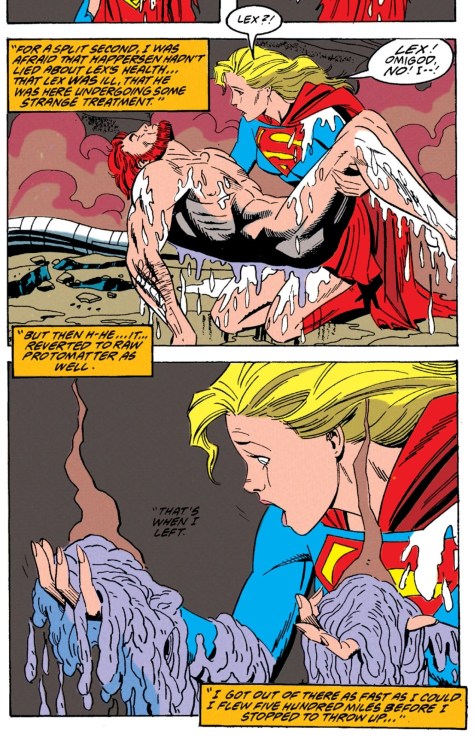
In case you were wondering, yes, that ginger chinstrap is genetically predisposed as it appears on a freshly baked clone with no indication of having been groomed that way.

This Supergirl was not Linda Danvers. She never wore the white tee-shirt, had flaming wings, or was served a drink by Der Führer (as you Fallen Angel fans may recall). This Supergirl is Mae, short for “Matrix,” and she was the version of the character that ushered in the nineties. She is unique from what came before, and has been overshadowed by what came after. In true Roger Stern fashion her story was unique and worthy of your time.

In the early days of 1994 Stern, along with artist June Brigman (co-creator of Power Pack and one of the only woman I can think of to draw anything related to Superman) helmed a four issue mini-series that explored the backstory of the Woman of Tomorrow (I am coining that because typing “Girl of Steel” is going to end me up on a watch list) and her place in the DCU. It features Lex Luthor II prominently and does a fair job at tying that particular plot thread up. Not sure what your reading habits are but if you enjoy what you read here you can buy the series from “comiXology” (I love them but that branding has to go).

What would come to be defined as this era’s Supergirl mostly came later, from Peter David, until it was promptly overturned by Jeph Loeb. You may also remember Dan “The Man Without a Plan” DiDio telling a roomful of confused onlookers that Matrix had been stricken from continuity. I forget if this was before or after he told similar rooms of people that Stephanie Brown had never really been Robin or that he could not wait to kill Nightwing (I do not know about you but I will never forgive him for Beast Machines never mind his DC work).

Anyone else get a Kevin O'Neill feel from this art? If he ever gets tired of drawing Alan Moore’s Public Domain Fanfic it would be great to see a Supergirl story from him.
Anyone else get a Kevin O’Neill feel from this art? If he ever gets tired of drawing Alan Moore’s Public Domain Fanfic it would be great to see a Supergirl story from him.

The powers that be have done all they can to wipe away the version of Supergirl I first met. She deserves better. This was a Supergirl that had been as different from her former cousin as possible while also acting as a perfect reflection of the Superman brand, and superhero comics in general, at the time.

Mae is young. Very young. She is, at best, a teenager and that is if we estimate the comparable life experience that a protomatter being has compared to a traditionally defined person. She is energetic, curious, and prone to fits upon discovering that her trust has been betrayed. She is exactly the type of teenage superhero we have seen time and time again except instead of trying to be her own person she must grow in the shadow of Superman with little of her own light filtering through.

Mae can shapechange, telekinetically repel everything around her, and generally heal from any wound. She is fluid and not restricted to one thing or another, even gender, as she reminds the omnipresent doctors and scientists who serve as the perfect excuse for a bit of the old exposition. She has only chosen the form that we all know and love because it was Superman who rescued her from her own dying world and brought her to his, complete with the only type of life he could provide: A version of his own. She dresses like him, befriends Lana Lang, and is raised by the very-much alive, and surprisingly spry, Ma and Pa Kent.
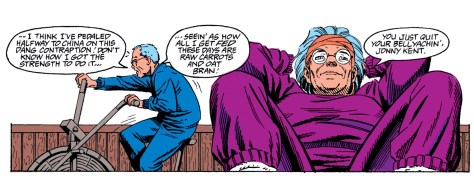
I realize now just how much I never wanted to see Martha Kent from that position. At least Jonathan’s being heart healthy, despite that battle being unwinnable.

She has been forced into this role and this life, her potential squandered. She could have been anything she imagined but instead she must settle for keeping the Supergirl copyright alive and well. Despite his manipulation, Lex at least asks Mae to question what she can do and how she can do it. There is a chance here to present a very different character than the one that came before. The previous Supergirl had to run and hide in an orphanage because her cousin thought that the world was not yet ready for a woman with superpowers to be helping him in his crusade to protect every man, woman, and child from increasingly insane disasters.

Mae is not burdened, as her subsequent version will be, with being a literal Angel of Heaven. She is not trying to accept her destiny but find her place in the world. She is the sole survivor of her world and literally the only one of her kind. Her struggle for identity is entirely separate from Superman’s. During the Silver Age he knew that he was not alone once he met Supergirl but Mae will never experience that. Her life is one of potential solitude but she denies it in favor of embracing the world around her. Installing the “Superman.exe” character model may have been the best way to save a few citizens from the Kryptonian criminals who destroyed her world but it also means that she will be best well known for impersonating Clark Kent after Superman “miraculously” returned from the dead.

The people who surround her remind her what a heel Lex Senior was and judge her for being with his “son.” The inevitable reveal of his shenanigans serves as a wonderful origin story but is squandered as well. Lex, unsuccessfully fighting the effects of Kryptonite radiation poisoning, has decided that the world cannot possibly live without him, regardless of the fact that it was his own hubris which brought him to the brink of this particular flavor of disaster, and does all he can to stave off death. This includes seeing if he can reinvent the process that his alternate version used to create Supergirl in the first place.

Ill defined, psychokinetic powers? Dark, nebulous appearance when enraged? This is why Supergirl fit well with the Legion of Super-Heroes, she was an X-Man.

Mae’s journey in many ways embodies what a fictional character must go through. She began life as sentient protomatter, no more than a medium for ideas to flow into. Stern does a wonderful job at reminding us that Supergirl is not all powerful and does have the limits you would expect of someone still learning to control their abilities. Her appearance, gender, nationality, and superpowers were defined by those around her. Next comes the inevitable confrontation with copyright laws. Supergirl is a brand just unique enough from Superman to be separately marketed and sold on its own. Not in real life but this is true within the bounds of the DCU. Lex assures Mae that this is in her best interest and that none of the money will ever be used to fund a cause that she would not support.

Though not followed-up on in any specific way (this version of the character would not receive an ongoing series) Mae is confronted with funhouse mirror versions of herself that Lex has created. Each one comes from their artificial wombs complete with costume and defining characteristics. None of them look like Mae, exactly, but they do not have to. Lex owns the copyright of what she is so why would he check with her before going to market with versions he believes will do well? The protomatter that Mae is created from can form clothing and so some versions have chosen the less flattering wardrobes of the female superheroes of the day.
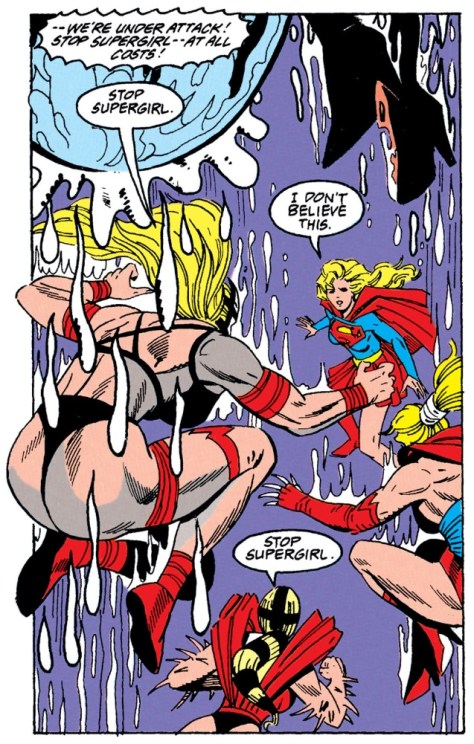
I hope this is scathing commentary on the art practices of the industry at the time because otherwise I have no idea what is being shown here.

Supergirl is no stranger to having to prove herself against copies. She herself was created by Otto Binder, the same man who created Mary Marvel for Fawcett Comics and she was arguably surpassed in popularity by her Earth-2 counterpart Powergirl. Here she has the chance to prove to her aggressors that she is her own person and does so with “psi-blasts,” a power Superman never had. Mae is held back by needing to be as close as possible to the idea of Superman. That brand cannot be altered, as too much merchandising rests on its shoulders, and it forces Supergirl to stagnate. If nothing else, it would have been great to see a character who could shapeshift into and out of her secret identity without needing glasses, a slouch, and criminally unaware coworkers.

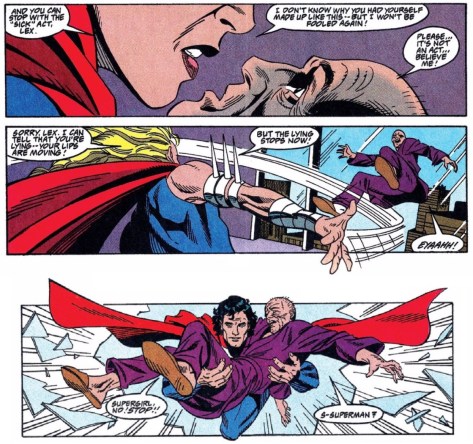
We see part of this potential in what comes next. Unlike Clark Kent, Mae has no way of dealing with the ills of the world. No moral compass was installed as part of the “raised on a farm” service pack and raw, righteous fury leads her to take the fight to Lex. Her shape changes, almost unconsciously, and all limitations leave her. Why should Lex Luthor, father or son, be allowed to continue committing such despicable acts? It is here that Superman makes his first on-panel appearance as he saves Lex and steers the story back into the comforting waters of what each and every reader unfortunately thinks of when they think of a Superman story.

Not that we need a Supergirl who murders anyone (David S. Goyer was still only writing “The Puppet Masters” when this comic came out) but here we are shown that she is not even allowed to express her own rage. Yes, Superman teaches her right from wrong and yes everyone involved would have regretted Lex falling from a skyscraper but part of me will always look fondly upon the time the version of Supergirl that I first got to know threw an awful, decrepit supervillain out of a building. I remind you that the man who once stole forty entire cakes was bedding a teenage (or younger) girl using a cloned body and purple turtleneck.
Yes, those are spikes on her arm, and no they are not adequately explained. It is as if she said her “magic word” but instead of the Wizard Shazam answering it was Rob Liefeld.

Matrix is one of those wonderful anomalies from the nineties. She made sense within the context of the cold, clinical Krypton imagined by Byrne and developed by others, including Stern, with characters and concepts such as the Eradicator. This was a time in Superman’s history when his unflinching morality seemed all the more impressive for being set against such an impersonal heritage. Mae was the supporting character that this version needed and she could have been a notable and complex hero in her own. Lex may hate Superman but no one will ever hate Lex as much as Mae. She returned recently in two-part Convergence story. If you read it, let me know how it is. Keith Giffen and Ambush Bug are a good time no matter what.

The Character of a City-Gotham Nights

Hello there, Legions of the Unspoken!  I hope you have enjoyed the debate I had with Paul O’Connor of Longbox Graveyard over 70’s vs. 90’s comic books, and I hope you come down strongly on my side that the 90’s are the best!

Seriously, though, we had a good-natured conversation about 90’s comics myths, 70’s comics, the differences between the two eras, and all sorts of cool stuff.  Take a listen here if you haven’t, or give it another one if you have!  The classics never get old, do they?

I sure hope not because today I’m taking a look at one of the all-time classics in superheroes, Batman!  We won’t be looking at him in the traditional sense, however.  We’ll be looking in particular at one of the most important supporting characters in the Batman mythos.

The supporting characters are almost what drives Batman.  If Batman’s rogue’s gallery are counted as supporting characters, then they’re almost certainly the most important element to Batman’s tapestry.  Even if we don’t count the Joker or Calendar Man, the supporting cast makes the Batman comic book come alive in ways many other comic books do not.  Robin, Alfred, Commissioner Gordon, Batgirl, Nightwing, Lucius Fox, Leslie Thompkins, and more bring out the “man” in Batman, and that’s good, because otherwise Batman would just be a weird rich dude who beat up the criminally insane and street level criminals.  Thanks to them, he is now a weird rich dude who beats up the criminally insane and street-level criminals  while having relationships with various folks.
The most important character in the Batman books, though, could possibly be Gotham City.  Gotham City gives a vibe few other locales, fictional or otherwise,  in comic books of any genre can match.  I think it may be the only location in comic books, especially superhero comic books, that can actually say it is a character (other than Danny the Street, of course).  Gotham City means as much to Batman as Batarangs, the Batwing, and Alfred’s snide comments.

I think we can all agree that the architecture in Gotham City reflects the environment that it is, but it is often people that determine the character of a city.  We speak differently about the people of New York City than we do the folks of Los Angeles.  In fact, we think of people within those cities as being vastly different!  Beverly Hills and Compton aren’t the same, and neither are Staten Island and Queens.  The people of Gotham City are a proud lot, but they are also a hard lot.  Their city reflects them, even as their hero reflects their city.  Gotham Nights was a 4-issue mini-series published by DC Comics in 1992 that attempted to show us Gothamites, and by doing so also showing us their city.

John Ostrander handles the writing chores, while Mary Mitchell and Bruce Patterson are on top of pencils/inks.  The book reads well, although it is not as good as some of Ostrander’s other works, such as Suicide Squad, Grimjack, Punisher, or Spectre, but it is a very solid read.  Of course, it is also important to note that Ostrander’s high marks are so high that is no surprise that some of his other works don’t measure up to them.  Even Justin Verlander can’t throw 100-MPH every pitch!  What he can do, though, and what Ostrander does here, is deliver a solid outing each time.

We get an enjoyable read that may not quite reach its potential, but I think some of that is due to space limitations.  If one is going to do a mini-series about the people of Gotham City in a way to bring the city to life in a new way to Batman fans, it seems like it would need to be longer than four issues.  The stories about the individuals are charming, but they feel rushed.  Just as we start to get to know the varied types of folks that comprise the human landscape of Gotham City, the series ends.

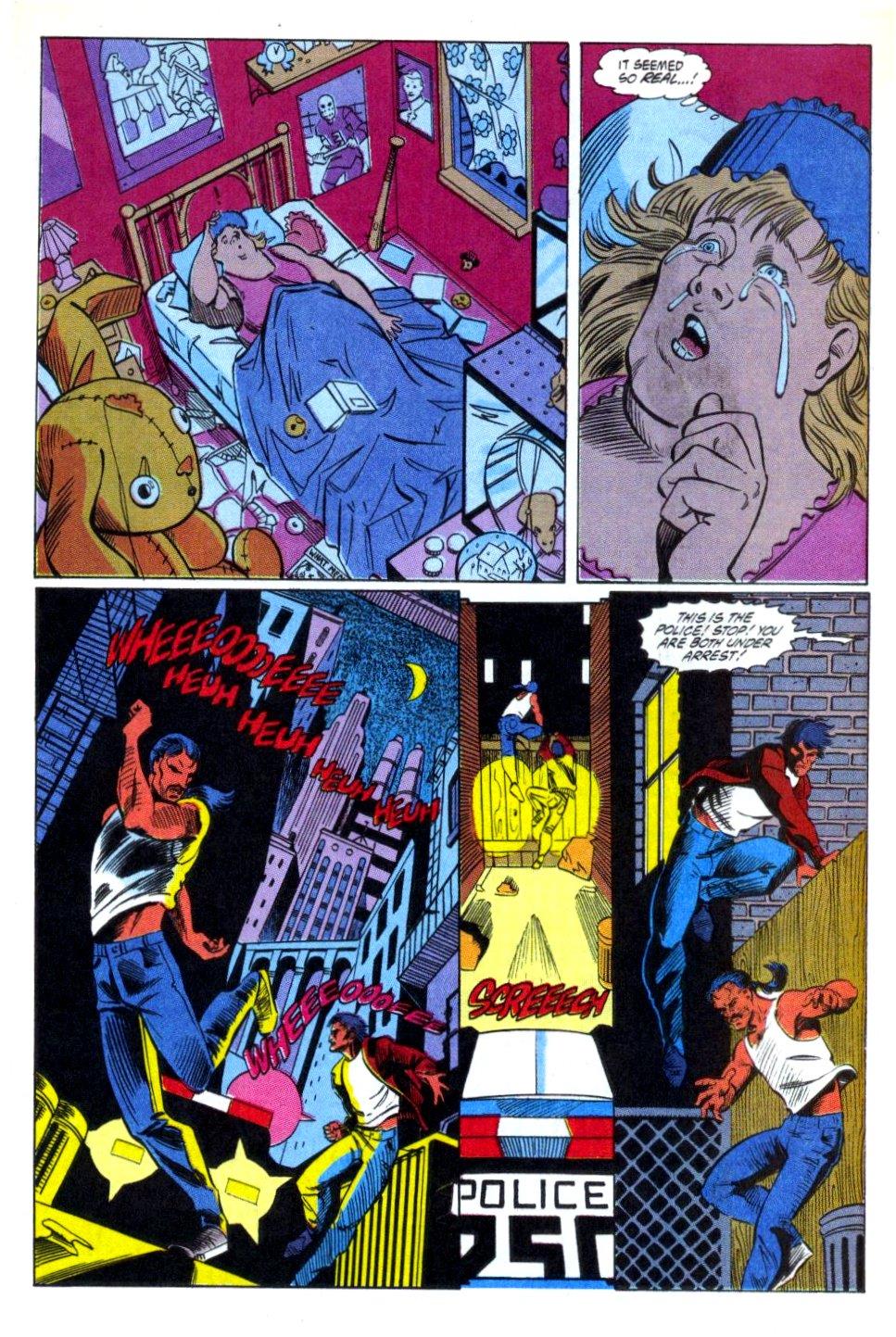
But for something to end, it must begin, yes?  This series starts with Batman chasing a mook.  Doesn’t it seem like all Batman titles are legally required to start that way?

Gotham Nights #1 - Page 2
That mook looks a bit more like he is doing the Batdance than he is running away from Batman. Remember Batdance? I don’t think anyone does except me.

The very start of the series has most of the action you’ll see from Batman in this story.  That doesn’t make it bad, but it does mean that if you are buying this because you wanted to see Batman swoop down on every mugger in every alley of  Gotham City then this book isn’t for you.  I think the covers sort of told someone that, but I can only imagine how ripped off someone might have felt if they got this on an impulse buy hoping to see Batman doing Batman stuff.

Gotham Nights #1 - Page 1
This is the cover that I think could have inspired the most of those regretful impulse buys.
Gotham Nights #2 - Page 1
The first time I saw this cover, I thought it was Catwoman enticing some hapless mark. It isn’t, but that isn’t bad.
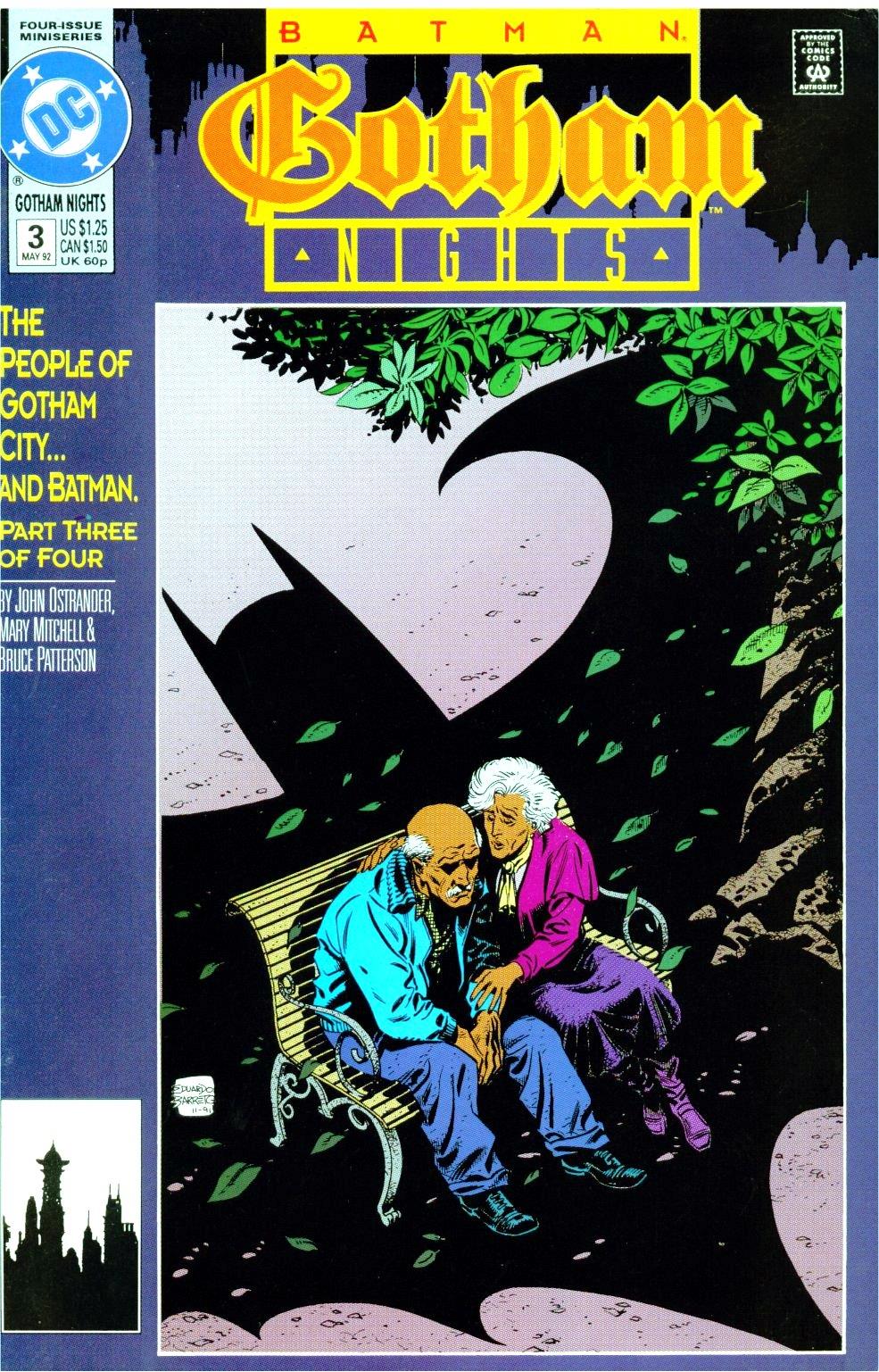
Gotham Nights #3 - Page 1
All I can imagine when I see this is the idea that Batman is enforcing one of the vast array of anti-homeless ordinances that have sprung up across the United States. “It’s illegal to sleep on a park bench after dark, citizens! Let the Shadow of the Bat remind you!” Seriously, though, those laws are bunk.
Gotham Nights #4 - Page 1
The pastries and the gun make for a beautiful dichotomy.

The covers have a cool design, and I especially enjoy the bordering.  I feel like that alone sort of set these apart as “not your typical Batman book”, although with the first (and possibly the fourth) issue(s) I can see a casual fan picking it up and being disappointed that there isn’t more Batman in it.

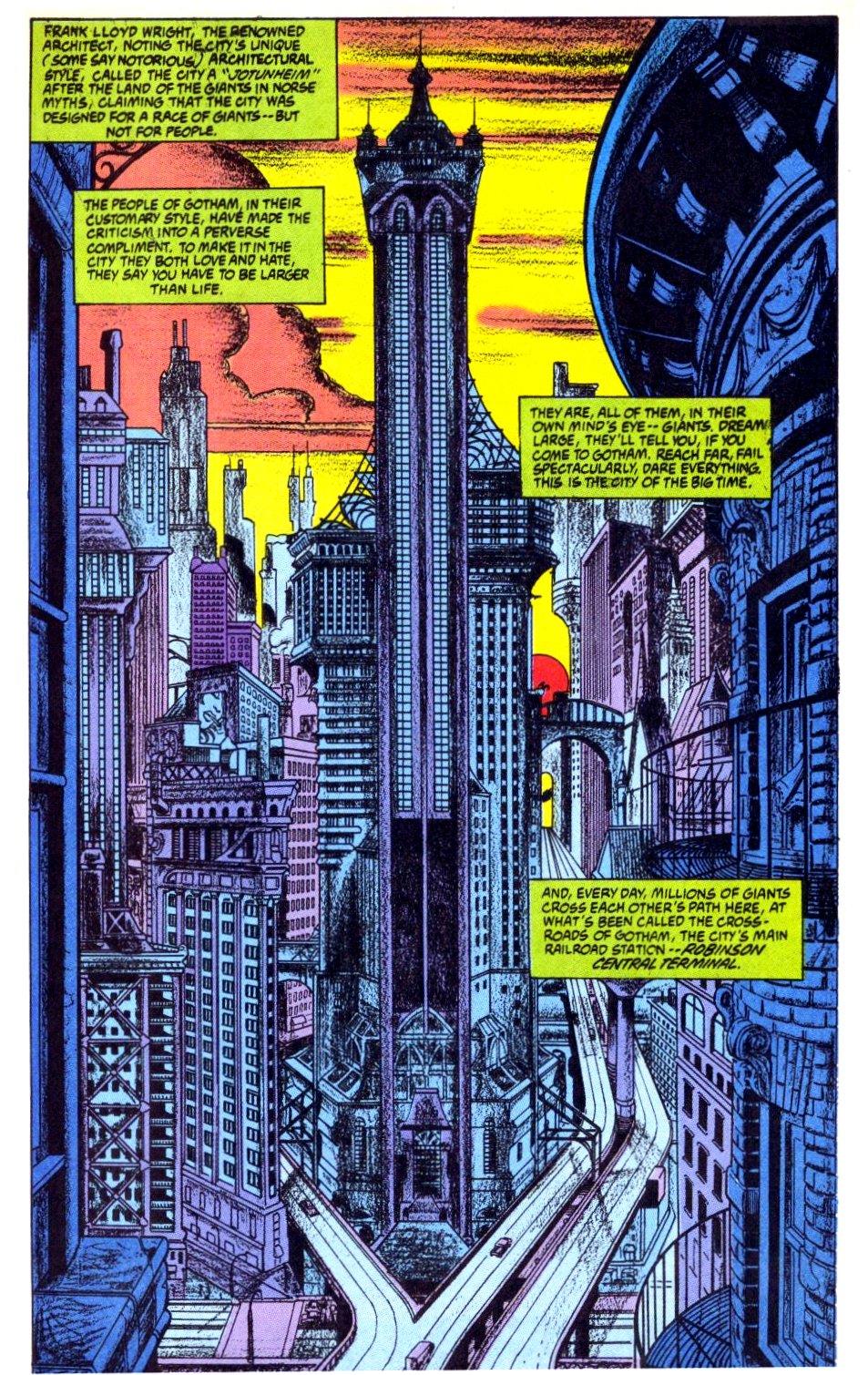
But just because there isn’t more Batman doesn’t make this title a disappointment.  In fact, I’d say it is almost worth it for the great art of Gotham City alone.  Mary Mitchell and Bruce Patterson make the city come alive as a character in and of itself. Some of their work makes the buildings of Gotham seem like the night solidified  as they reach as high as they can into sky in an attempt to embrace their ethereal cousin…

Gotham Nights #1 - Page 5
That quote about Gotham being for giants sums up the way Gotham City has looked in nearly everything except the Batman ’66 TV show.
Gotham Nights #1 - Page 4
Man, is there anything one can’t quote Churchill about?
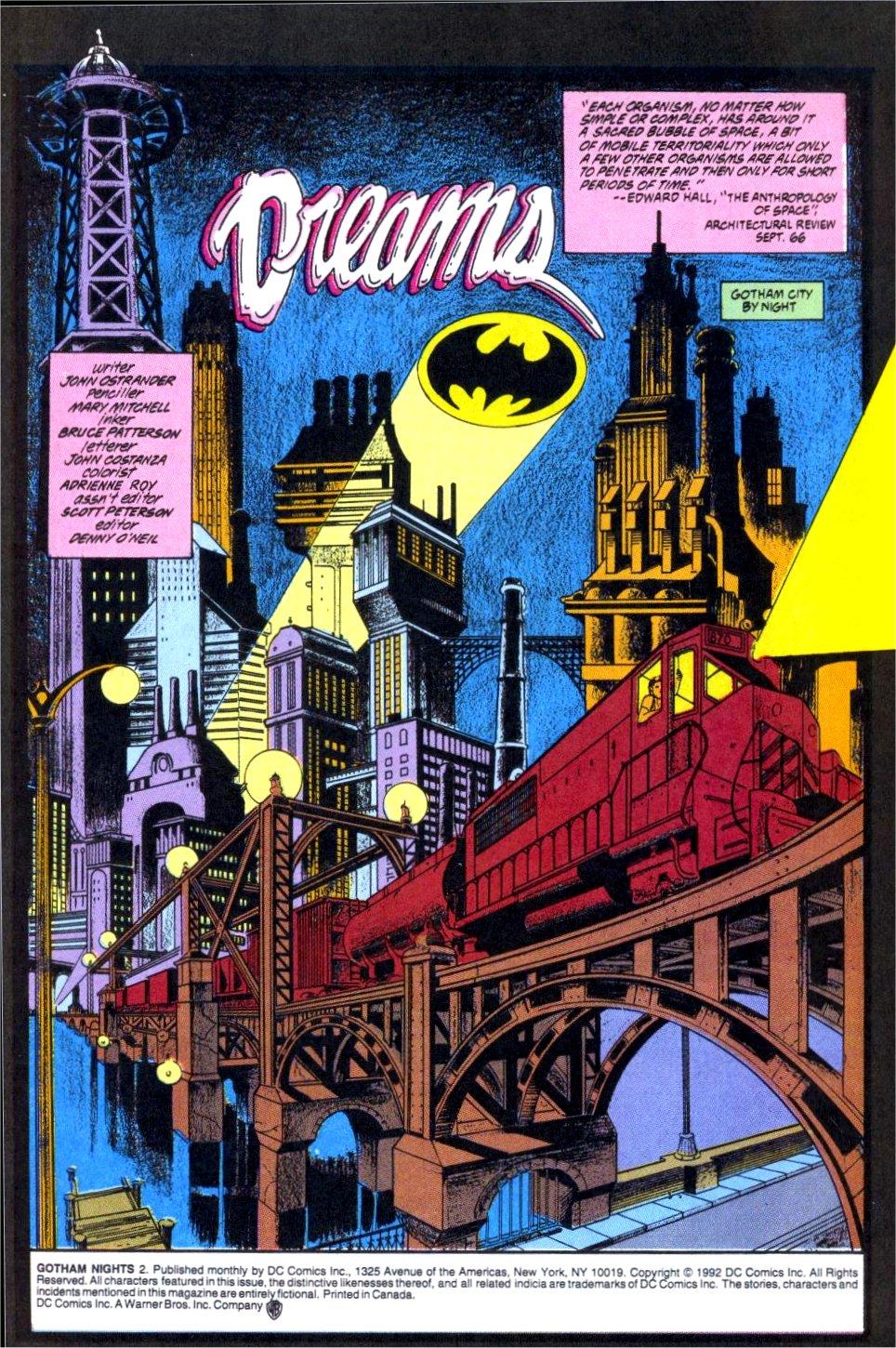
Gotham Nights #2 - Page 2
With just that single train, Gotham City has better mass transit than Atlanta.
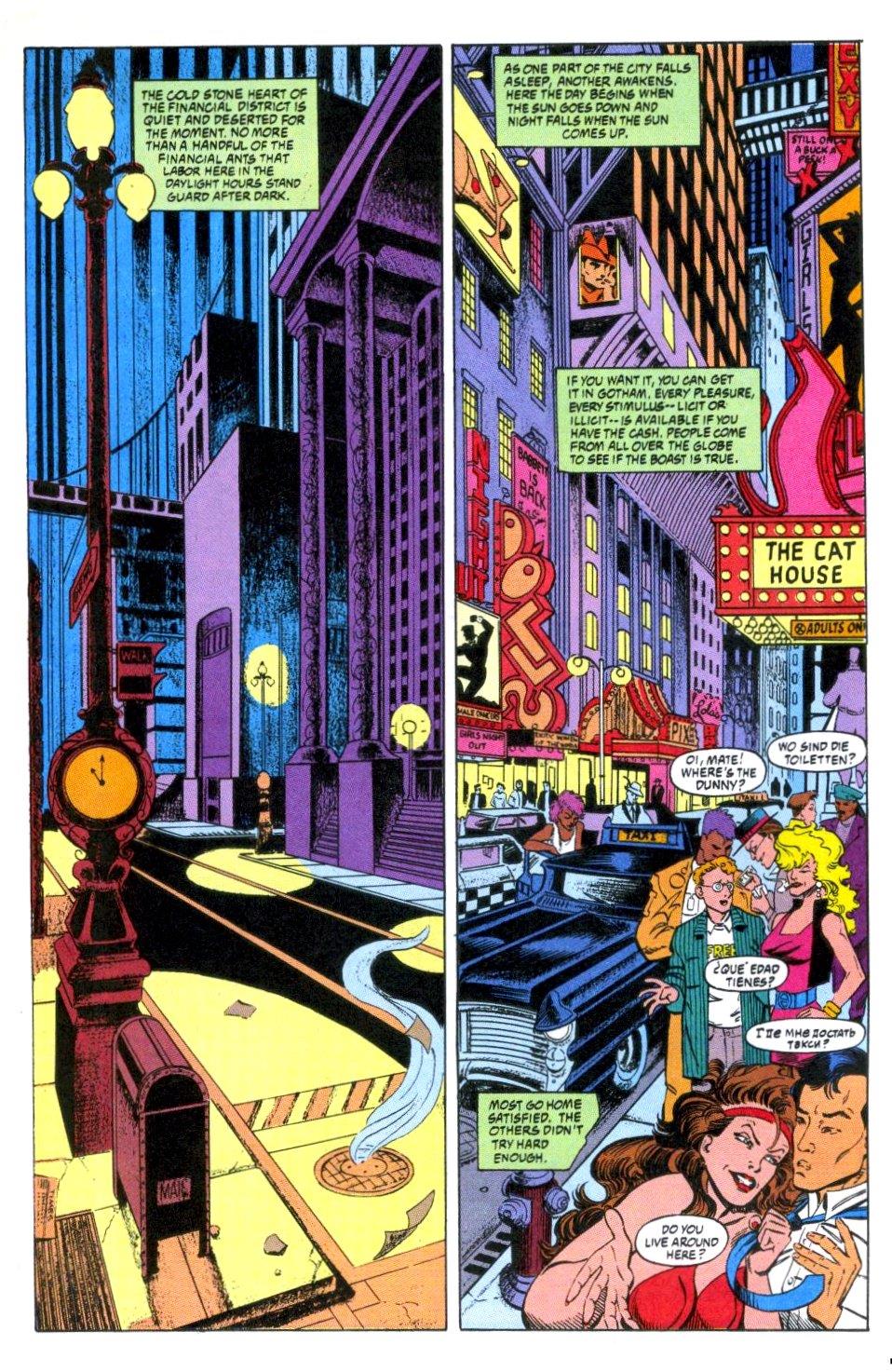
Gotham Nights #2 - Page 3
Different parts of a city make a city’s personality so varied. I love that Gotham City is no different.  Of course, someone just out of the panel is bemoaning the lack of English being spoken, because, hey, Gotham City is no different.

The pages almost allow the city to breathe.  If it could breathe, you just know Gotham’s breath would be rank.  Thankfully, you don’t have to smell that, while you still get to enjoy the scenery.

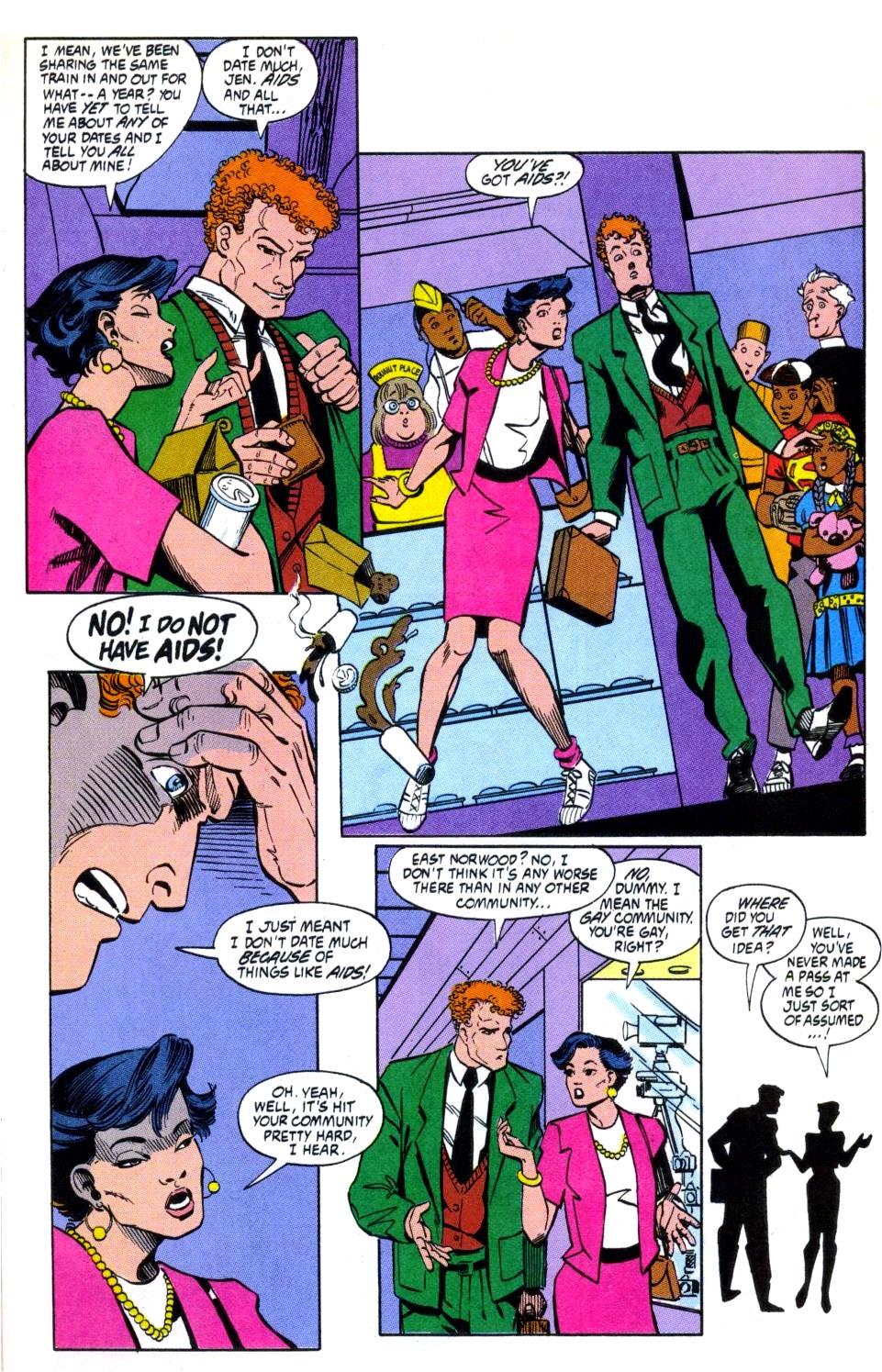
Of course, as I stated earlier, cities become characters due to the folks than inhabit them.  While it seems like Gotham City is populated solely by guys who are part crocodile or have clocks for faces, most of the people in Gotham City are quite normal…some of them appallingly so.  Take Jimmy and Jennifer.  These two folks remind me of that non-couple we all know.  You know the one.  They obviously like each other, but neither do much of anything about it other than act in a flirtatious way toward one another that annoys all around them.  That having been said, they are nice people, even if Jennifer has little to no idea how to act in regard to talking about sexually transmitted diseases in public.

Gotham Nights #1 - Page 10 Gotham Nights #1 - Page 11 Gotham Nights #1 - Page 12

Jennifer’s way-too-loud discussion about AIDS in public followed up by her assumption that Jimmy is gay due to his concern over AIDS and his never having made a pass at her sort of tells you what sort of lady she is.  Jimmy also seems to be judging her because she has sex and dates a lot, so you can tell what sort of person he is fairly quickly as well.  They are nice enough folks, but there is a bigger picture they aren’t getting.

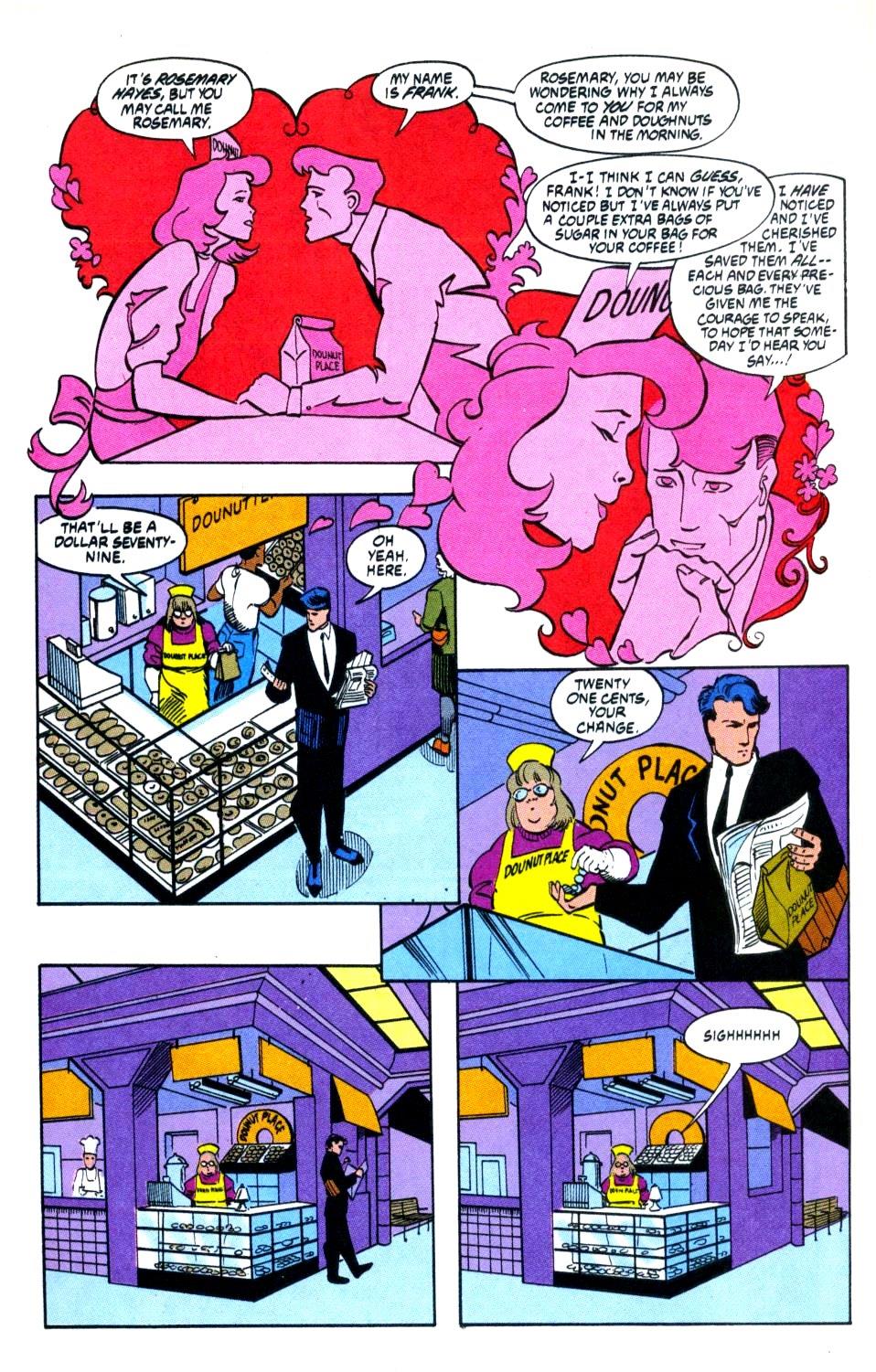
You may not have noticed the doughnut lady who dealt with Jimmy’s ever-so-clever order.  That seems to be par for the course for her, as she is perpetually building her own world in her own head.  I don’t blame her; I spend a great deal of my time dreaming about what my life would be like if I won the lottery.  (Basically, it would be more or less the same but with more comic books, less work, and probably an Unspoken Decade magazine.  Maybe it will happen!  Keep dreaming, Legions!)

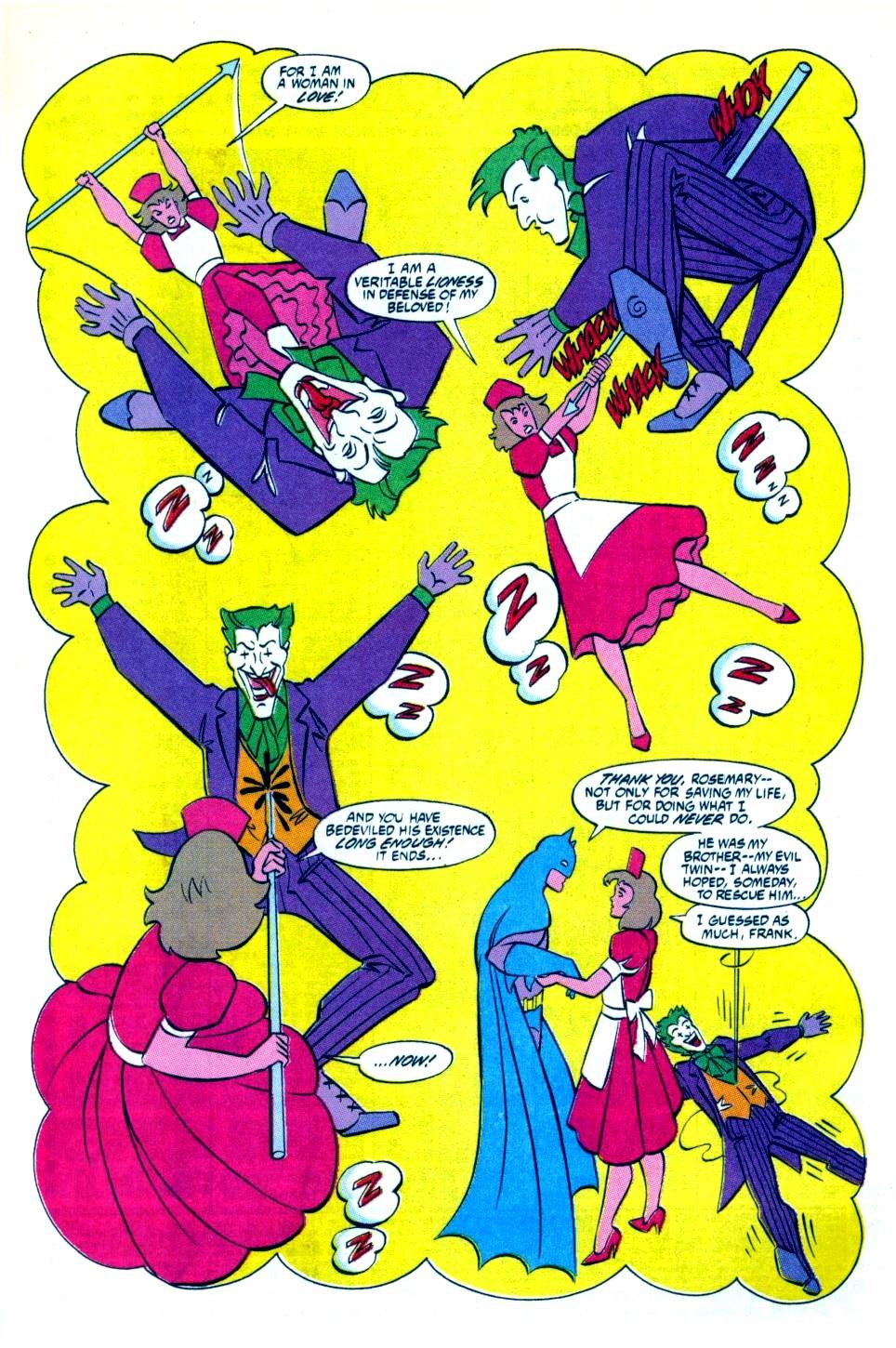
Her name is Rosemary Hayes, and she is something to behold in her dreams.  Aren’t we all?

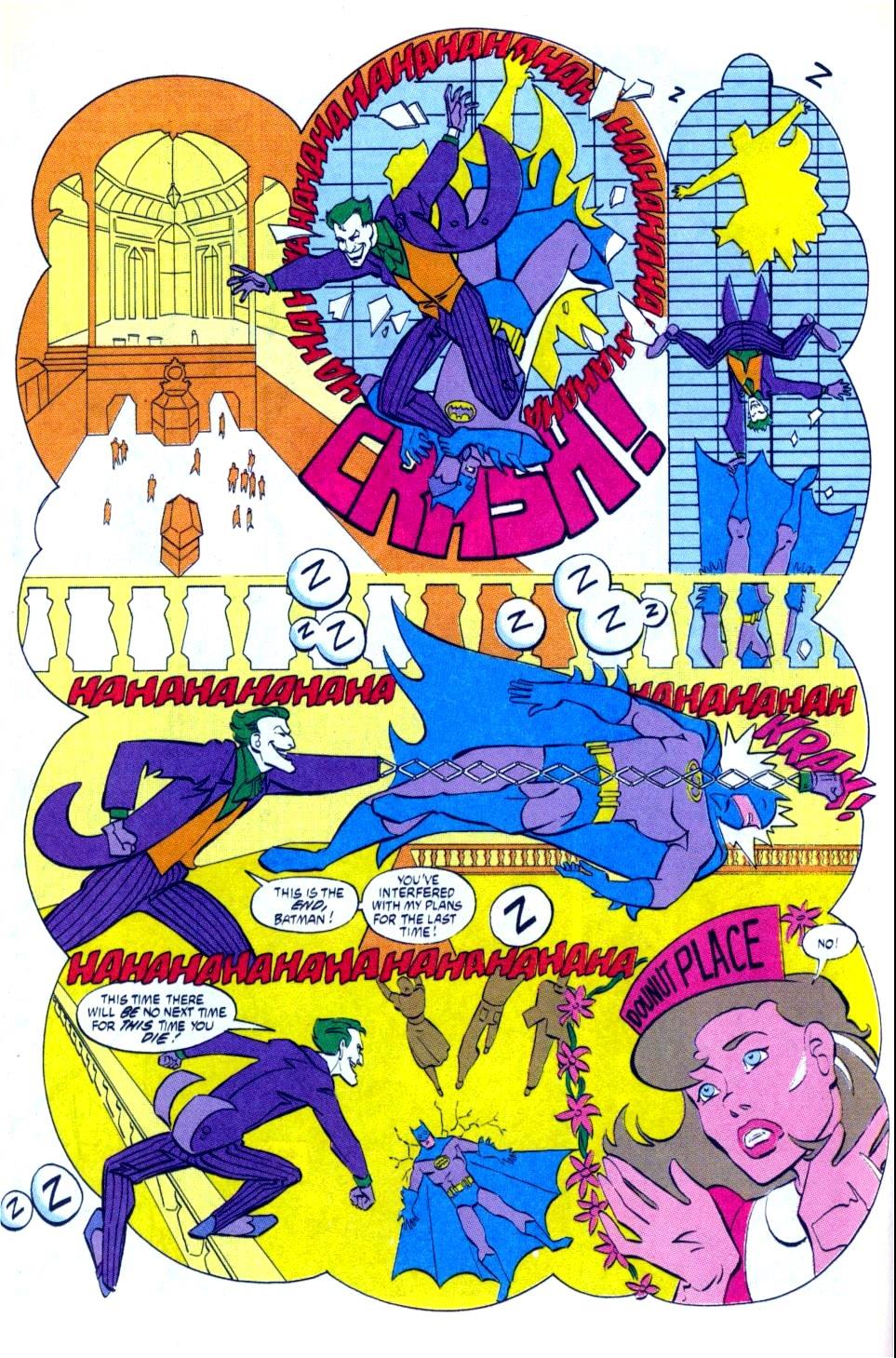
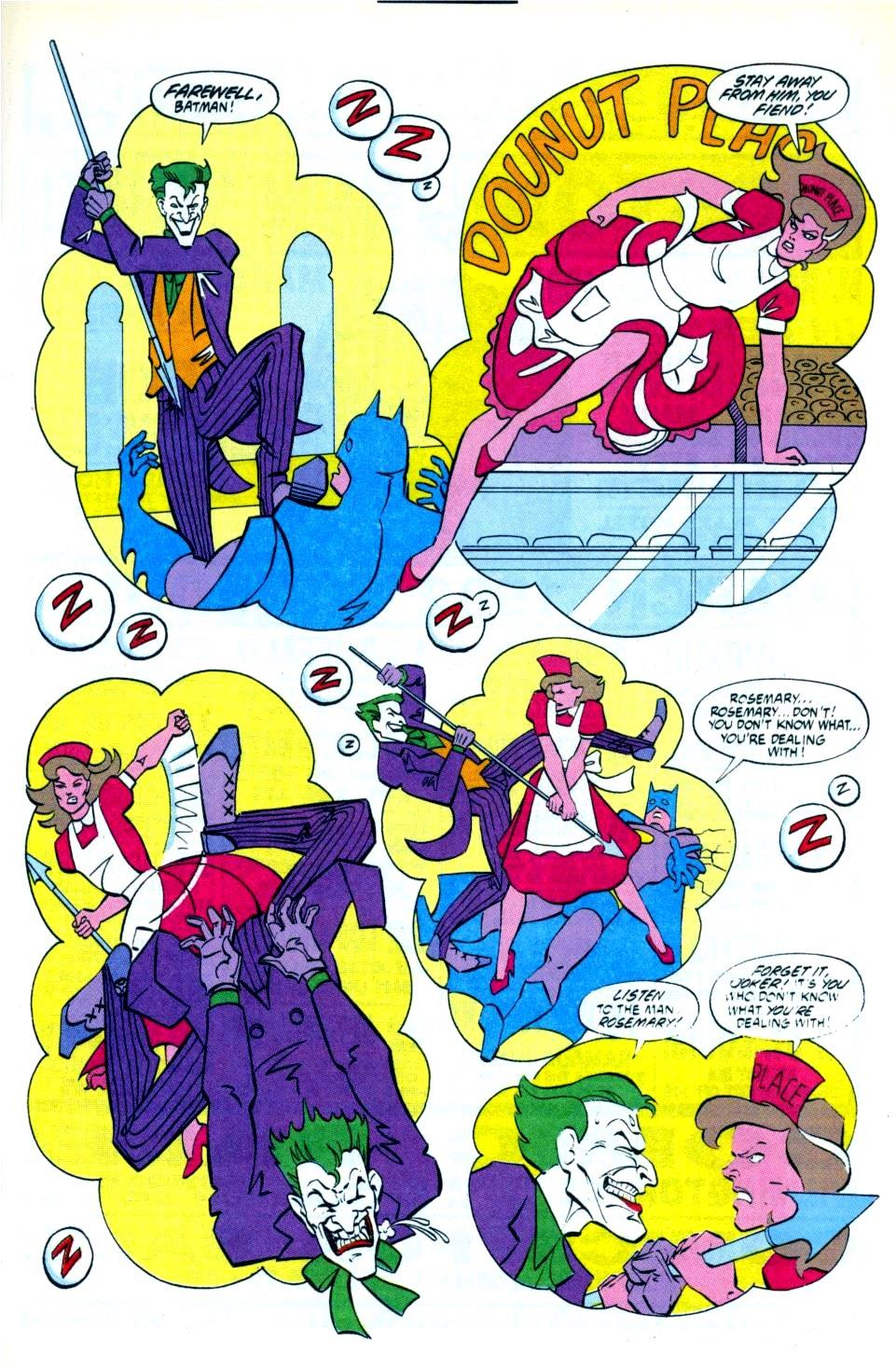
Gotham Nights #1 - Page 8 Gotham Nights #2 - Page 12 Gotham Nights #2 - Page 13 Gotham Nights #2 - Page 14 Gotham Nights #2 - Page 15

Man, she sure makes Wonder Woman fat in her dreams!  I love it!  Her character is a tragic one, whose loneliness reaches out and just grabs you through the page.  I feel so badly for her after this next page, when she wakes up and the reality of her dreams dissipates with ever beam of light that makes its way into her eyes.  We’ve all felt that way after a dream, right?

Gotham Nights #2 - Page 17
I have felt that too, Rosemary. It just ain’t fair.

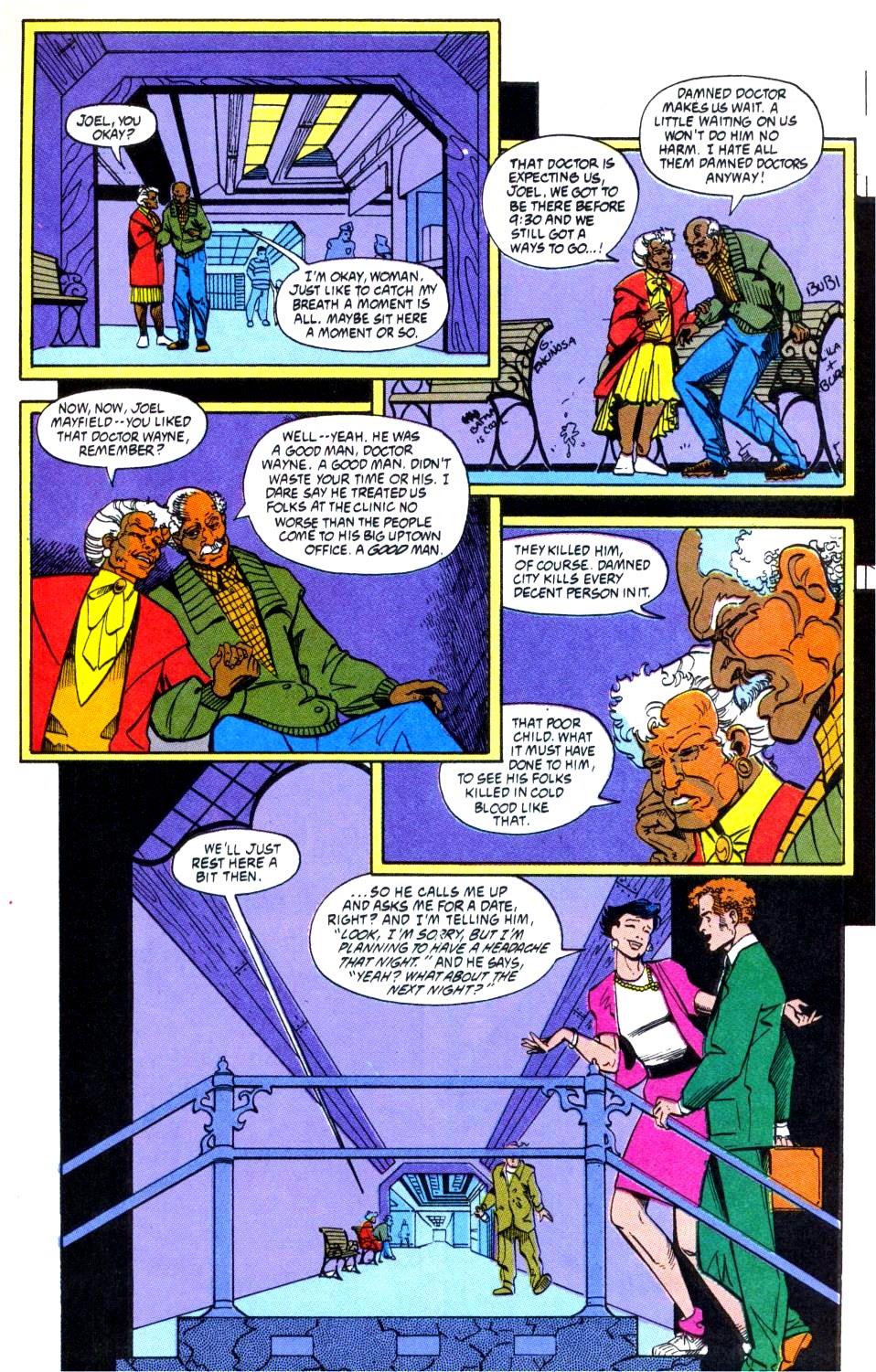
Life, of course, isn’t fair to many folks, but it seems decidedly harsh on Joel and Emma, an older couple who have all sorts of problems, ranging from health to money.  Being broke is bad, but it is also tough to watch the world change around you when things are going poorly for you, especially as you get older.  That gets really tough if you recall when things were different, when you were younger, and when you could do something about it.  Things could not be going much more poorly for Emma and Joel, so Gotham, being the harsh mistress that it is, ups the ante just a little.

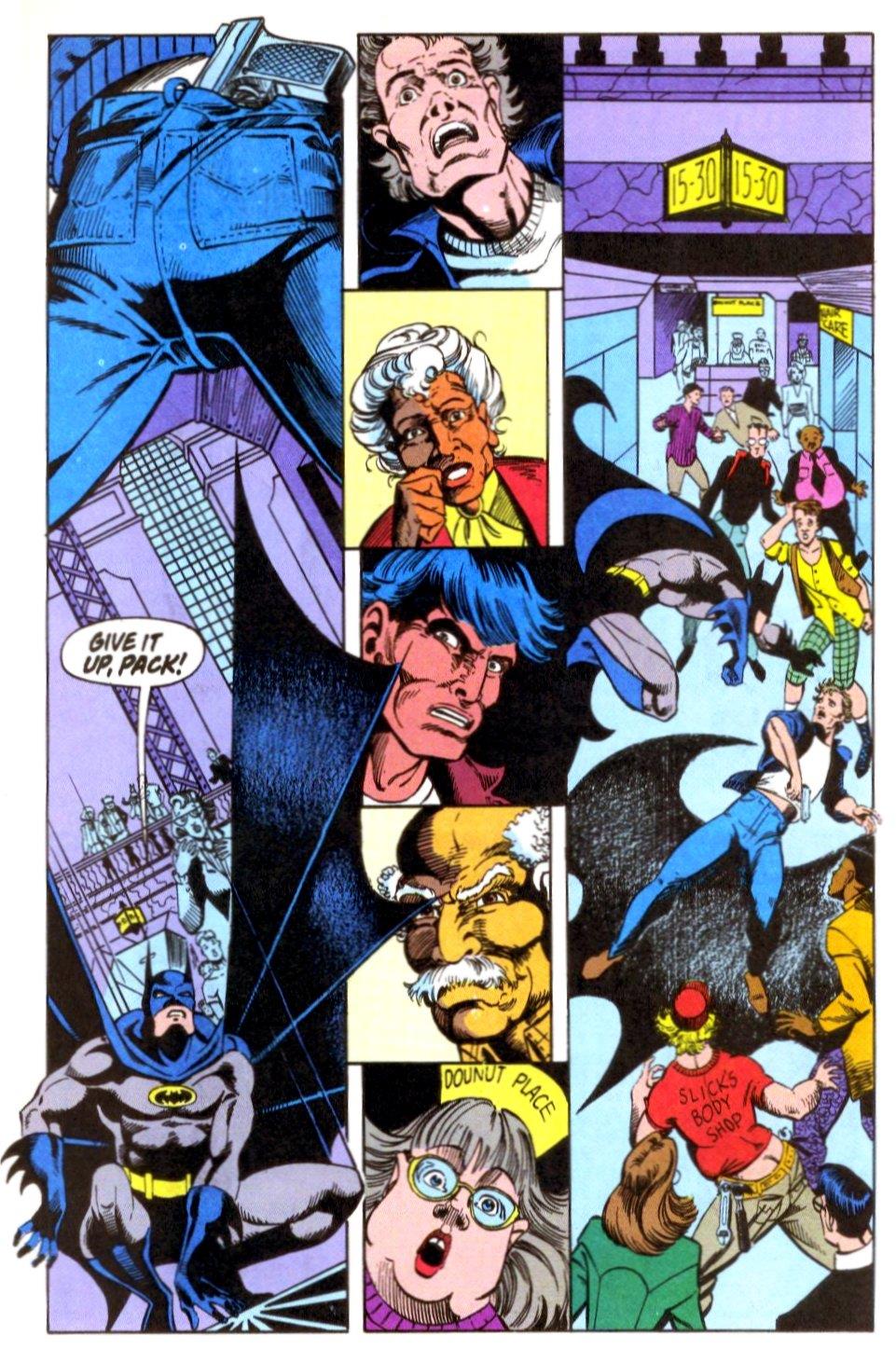
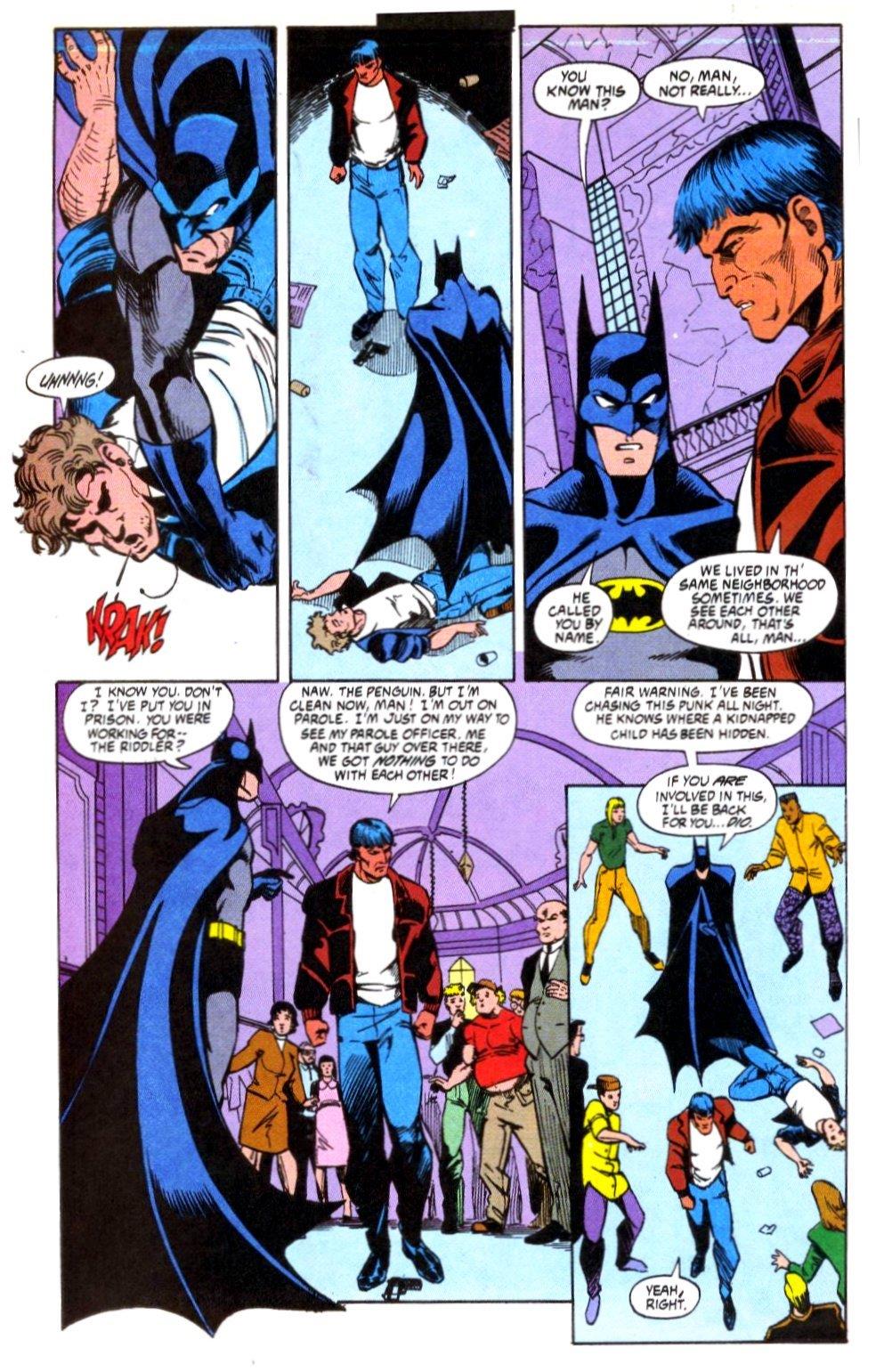
Gotham Nights #1 - Page 9 Gotham Nights #1 - Page 20They will support and care for one another as best they can through these issues, but at least they do have each other.  Dio is an ex-con on parole, who insists on pushing away anyone who is close, especially his pregnant wife.  He also has words with Batman, who says he’ll be keeping an eye on him.  I love that; it’s so small-town sheriff in a western, but it is also so Batman.  Those two genres don’t line up that neatly very often…

Gotham Nights #1 - Page 14 Gotham Nights #1 - Page 15

Gotham Nights #1 - Page 16

Gotham Nights #1 - Page 23 Gotham Nights #1 - Page 24

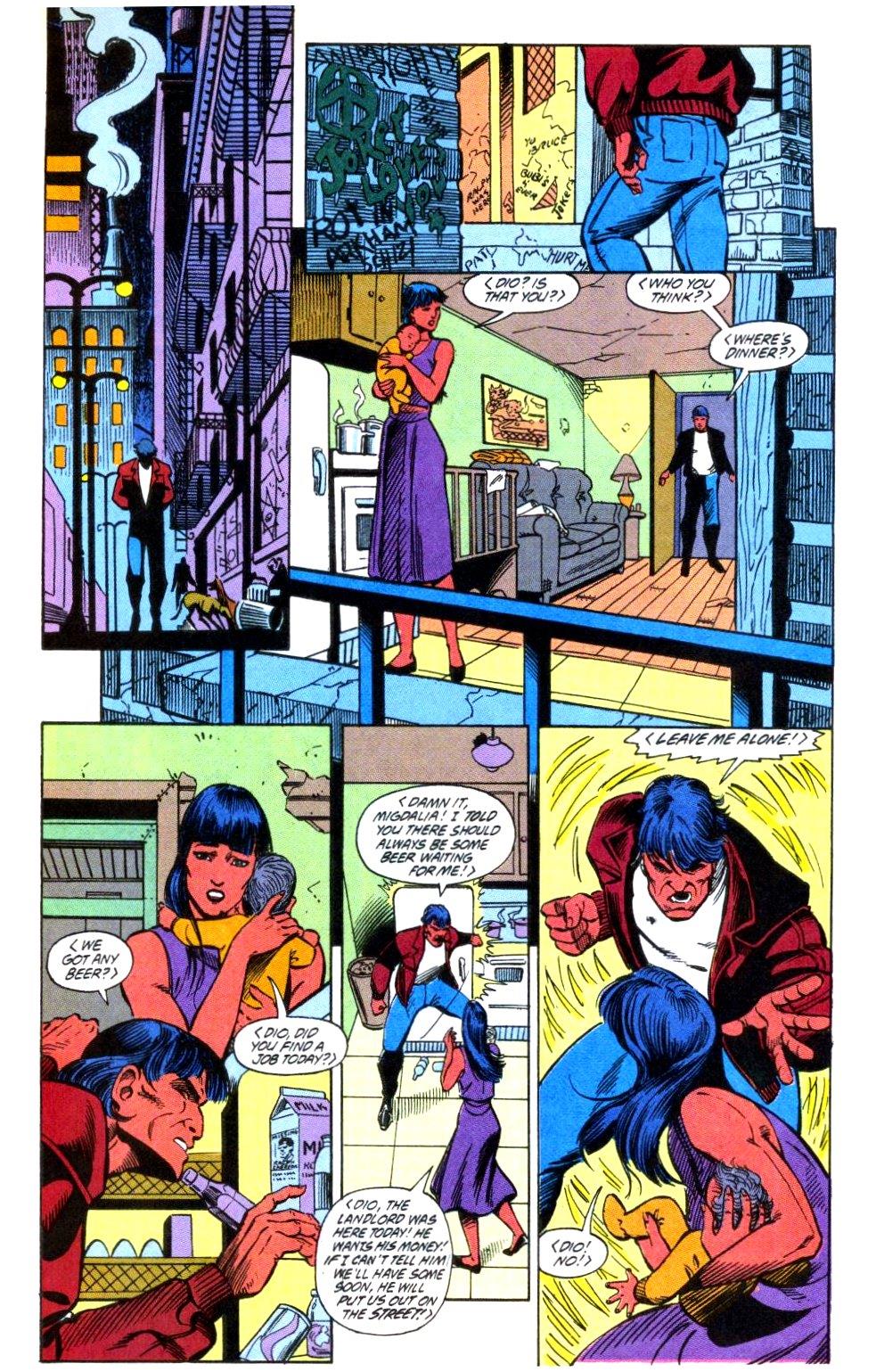
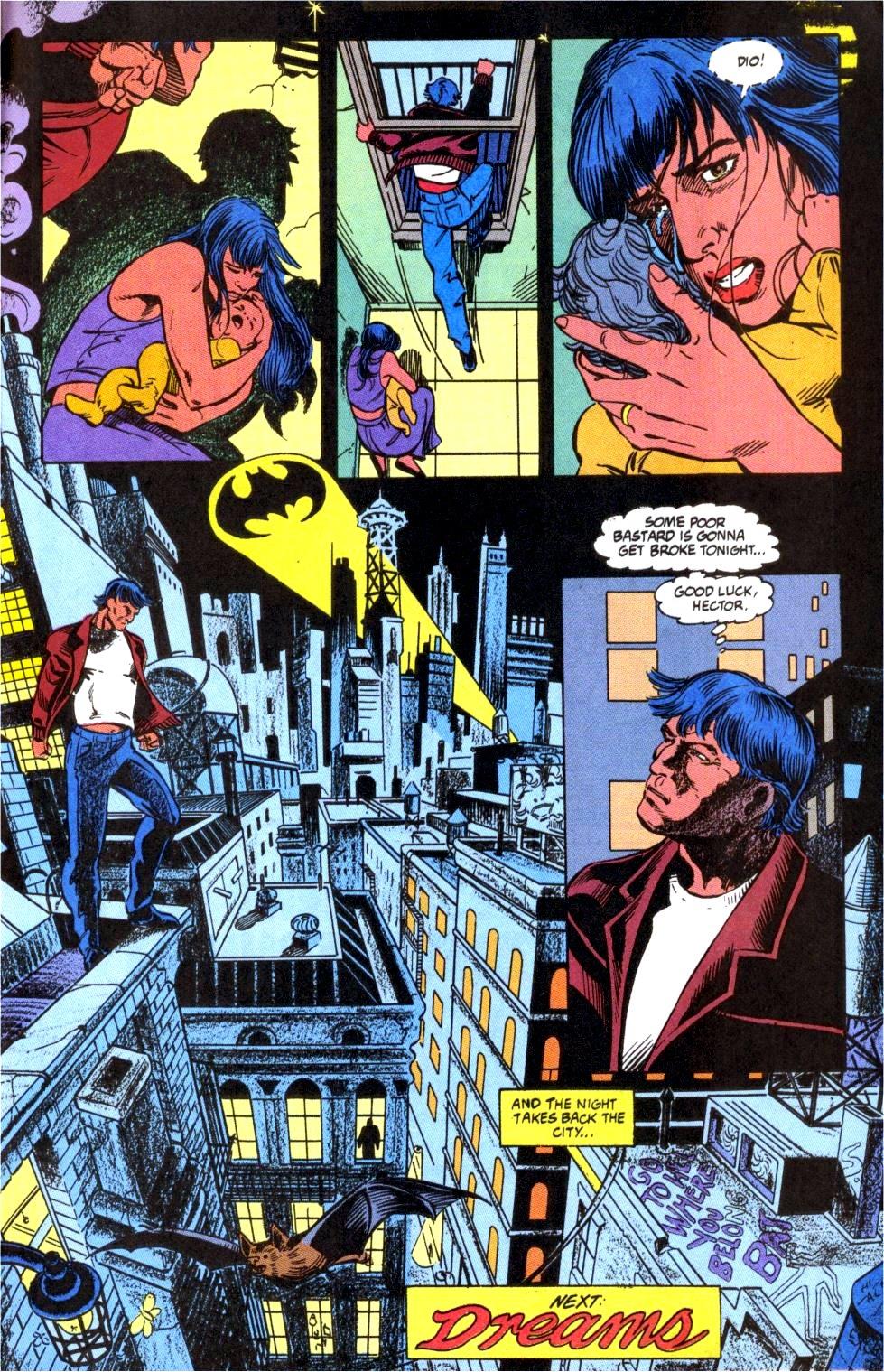
Dio’s path in life hasn’t taken him anywhere awesome thus far, except maybe for his wife, Migdalia, but all he seems to do for her is to threaten to hit her and demand beer.  I am a big fan of beer, but I am not so much a fan of a violence against women.  He also appears to have a past as a high-end henchman, having worked for The Penguin.  I like that Batman has such a memory that he recalls this guy; Penguin must have stopped dressing his guys like he did in Batman ’66, where they’d have a hard time being told apart.

Dio’s tale is a sad one, and no tale in the book is devoid of heartbreak.  The question is is how will these people that comprise the great city of Gotham survive their personal tragedies?

Gotham Nights reminds us that each city, even the fictional ones, are full of people.  These people have dreams, hopes, fears, bouts of depression, hankerings for ice cream, and all of the various feelings that go together to make up human existence.  You’ll see these folks rise, fall, get up, stumble, sleep, eat, and engage in all sorts of activities just to keep their lives moving along.

Normally, I go through bit by bit and give you the story, but that seems a disservice to such a character-drive story as this one.  Instead, go out, find the book, and see yourself in these characters for yourself.  See yourself and your choices in a new light.  See yourself in Gotham Nights…and never forget one thing always remains constant in Gotham City…

Gotham Nights #4 - Page 23

Hope you had fun, Legions of the Unspoken!  Next week, Emily Scott brings you Bill and Ted’s Excellent Comic Book, and Darry Weight takes a look at Cable. We’ll talk Rob Liefeld’s Avengers in an upcoming podcast, and Super-Blog Team Up returns on 4/21 with Top 10’s!  Hope to see you there for all of it, folks!

The Golden Age #4-Bravery When Battling The Enemy Within…

Ah, the end.

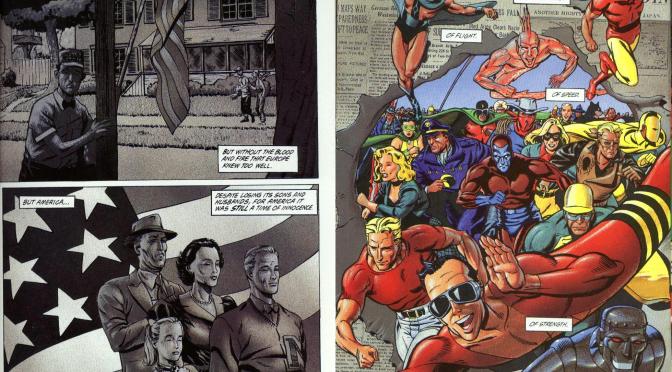
There’s something so bittersweet about the end.  We’ve been keeping up with The Golden Age here at The Unspoken Decade, and this tremendous tale is drawing to an end.  Despite its dour nature, despite how dark everything has been for our heroes, one cannot help but feel like the sun is about to come out and shine brightly upon this age.

Unfortunately, as we all know, it’s always darkest before the dawn, and for some of the Justice Society, it’s going to get so dark that the sun will never shine again.  For others, this will be a new beginning. For the readers, we will get both, as it’s going to be the end of something Golden and the start of something Silver.

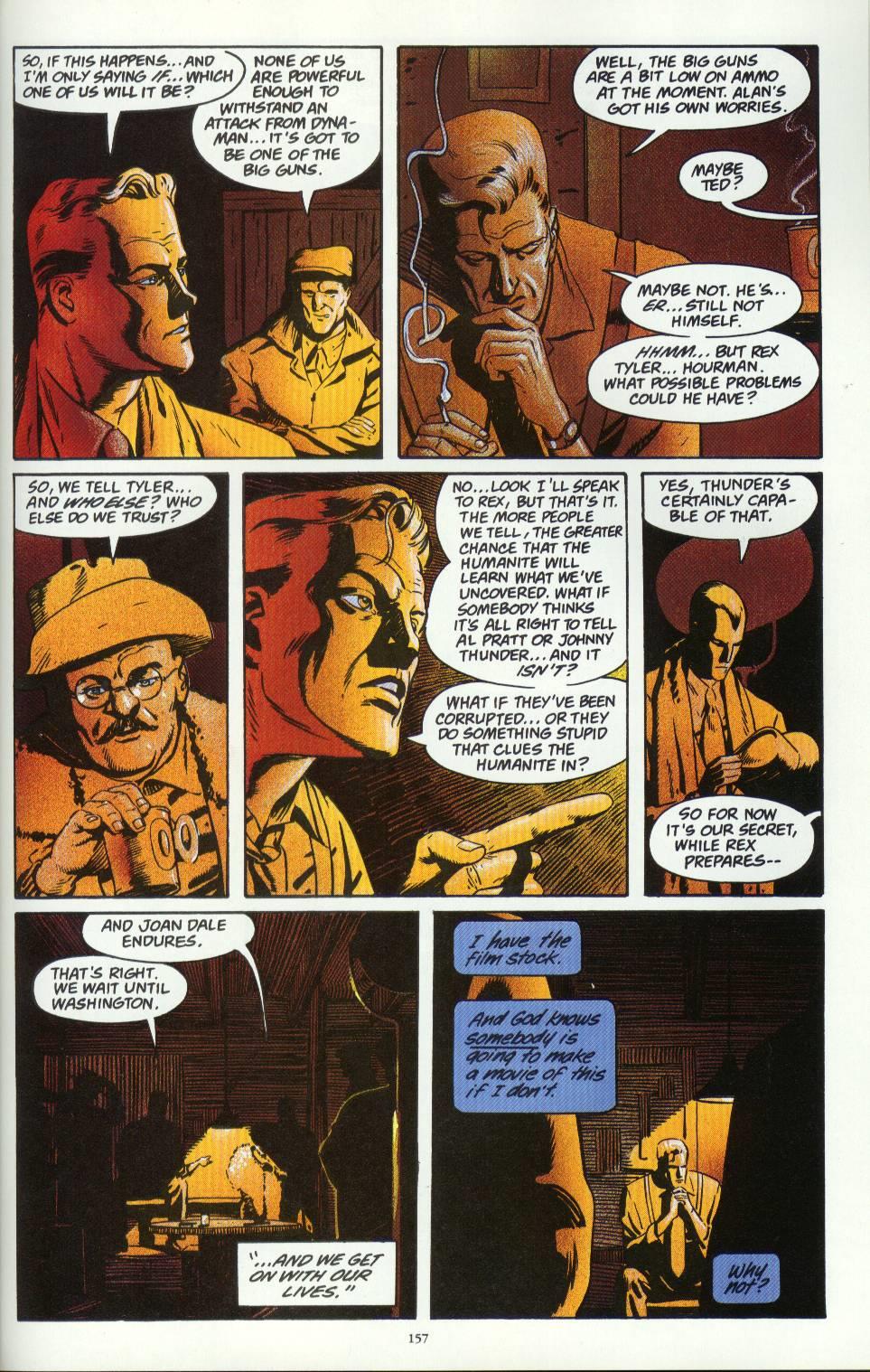
All new births must hurt, though, as we are all well aware, and the birthing of the Silver Age would be no different, as the Golden Age’s death throes echo in me to this day.  The final issue of The Golden Age is a sort of perfect amalgam of pain and beauty, chaos and stability, and hope and despair.  One thing is for sure as we start off this issue: things don’t look good for the JSA right now.

The Golden Age #4 - Page 2

That’s correct, as we told you last time, American hero, Tex Thompson, Senator and WW2 Hero, is really the Ultra-Humanite.  The comic has thus far shied away from telling you who is in Daniel Dunbar’s body, and we will save that reveal for you as well, but you know that if they are only hinting then whoever it is must be rather dastardly…

The problem is that no one will listen to the JSA.  I see this happen all of the time in our real world.  Despite evidence that shows that this behavior is counterproductive, folks are always very willing to simply kowtow to leaders and pundits.  Folks seem ever so eager to believe the biggest and smallest of lies, provided that they are uttered from “official” sources.  Those that question or peruse “unofficial” sources are marginalized as quickly as is possible.  It’s fascinating to see the JSA in such dire straits, as they are usually portrayed and perceived as the elder statesmen of the DC Universe.  In fact, in one of my prior articles here at the Unspoken Decade, I mention that even Superman revered these guys.  To see them on the opposite side is fascinating!

The first few issues of this fantastic mini-series dealt with the character of the JSA and their Golden Age pals.  This issue is no different,  as the few heroes in possession of this secret are testing their own character in order to forge some sort of plan that would give them a of chance against Ultra-Humanite and Daniel Dunbar…

The Golden Age #4 - Page 4

The HUAC continues to dog Alan Scott as well, and as the government and country that he has held so dearly continues its hideous assault against him and his character, his character deepens, thrives, and becomes as strong as steel.  No committee, whether it was the committees we established here in the USA to witch hunt the different people we dared not attempt to understand, nor a communist pogrom would have had the ability to pierce the spectacular moral fortitude Alan Scott possesses.

All that matters to Alan Scott is what is right and just.  All that matters to Alan Scott is that he stand up for it.  All that matters to Alan Scott should be all that matters to us…

The Golden Age #4 - Page 5

In my regular life, many people have seen me stand up many times against oppressive forces.  Obviously, I never stared down a committee like HUAC, but many times, I have stood up to entities that looked to hold me, my family, my co-workers, or my society down.

In my case though, any dirt on my adversaries that I got, I was more than happy to use.  The moral fiber of Alan Scott is truly tough, as I think very few would face the committee as head-on as he plans too.

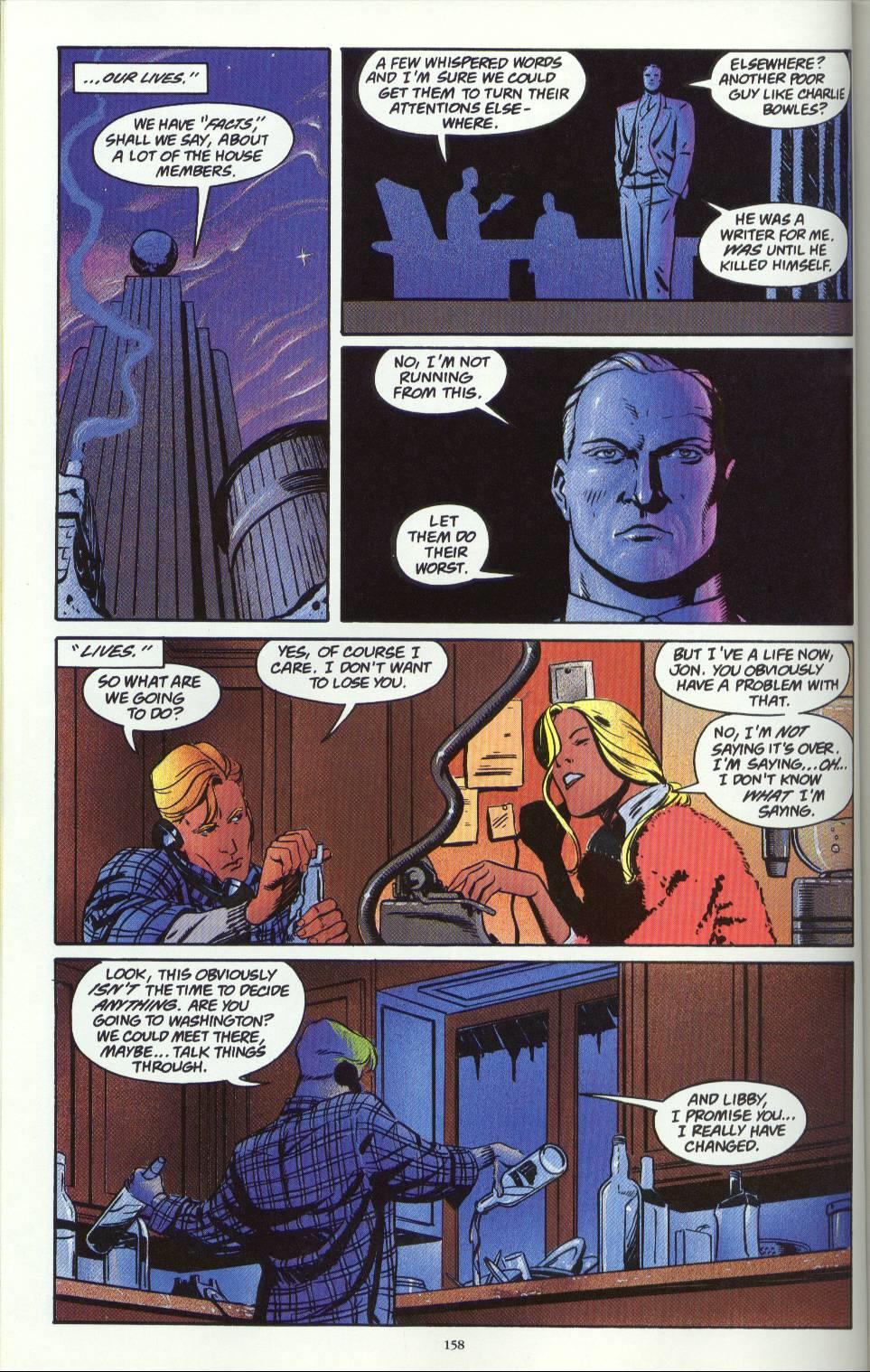
Of course, the challenges and obstacles we all face are never the same.  Just as Alan Scott stands poised and ready to face HUAC with a most noble streak, Libby Lawrence has her own cross to bear, but in her case, it is trying to find the courage to break free of something bad.

The Golden Age #4 - Page 5
Vices and people with vices can easily get a hold on any of us.  In Libby’s case, she allowed herself to become complacent and to submerge her dreams as her boyfriend, Jonathan Law (Tarantula) has drowned his and tried to beat hers out of her.  She’s finding the courage to not just break apart from Law, but to also say yes to herself.  Too many of us never find that courage.  In his defense, Law is sorry and is finding courage of his own, but it seems to be too little, too late…

In the meantime, the heroes gather, as they always do.  From the moment I found myself hopelessly in love with the garishly colored superheroes, I have been a sucker for the moments when all the heroes gather together and stand around in their costumes, moments before uniting to combat a threat to the world, the galaxy, the universe, or reality itself.  These are the times when we naturally see the heroes as people rather than just a bunch of loud costumes with a bunch of powers.  These are the times, much like us, when pals get together, and just like us, those times for the heroes seem to be fleeting and rare, and the gatherings only occur during the best and the worst of times.

The Golden Age #4 - Page 7

Of course, one of the most special things about superheroes, and the mystery men of the Second World War is that they represent hope for the future.  The future is always happening, even when folks aren’t aware of it yet.  Here, we see the unbridled ambition of youth, that devil-may-care spirit, and that eagerness that youth has to prove itself so that it can belong, and we see it in the form of an as yet to be named Superhero that none of the other folks have heard of yet.  That matters little to him; what matters is that he has a place to belong, even if many of the others don’t quite realize it yet.

The Golden Age #4 - Page 8

I think at one point we were all that young man.  We were all so angry, so eager, so dejected, so determined, and since I was young in the 90’s, so EXTREME.  What we all now know, and what this young man will soon learn, is that maybe we should not be in such a hurry to grow up.  Growing up means hard choices, facing tragedies, and never really knowing or understanding why your life goes the way that it does.  Many of the heroes assembled here are going to be wondering what happened shortly, as a force of nature is about to upend their entire status quo, as it does for many of us adults.

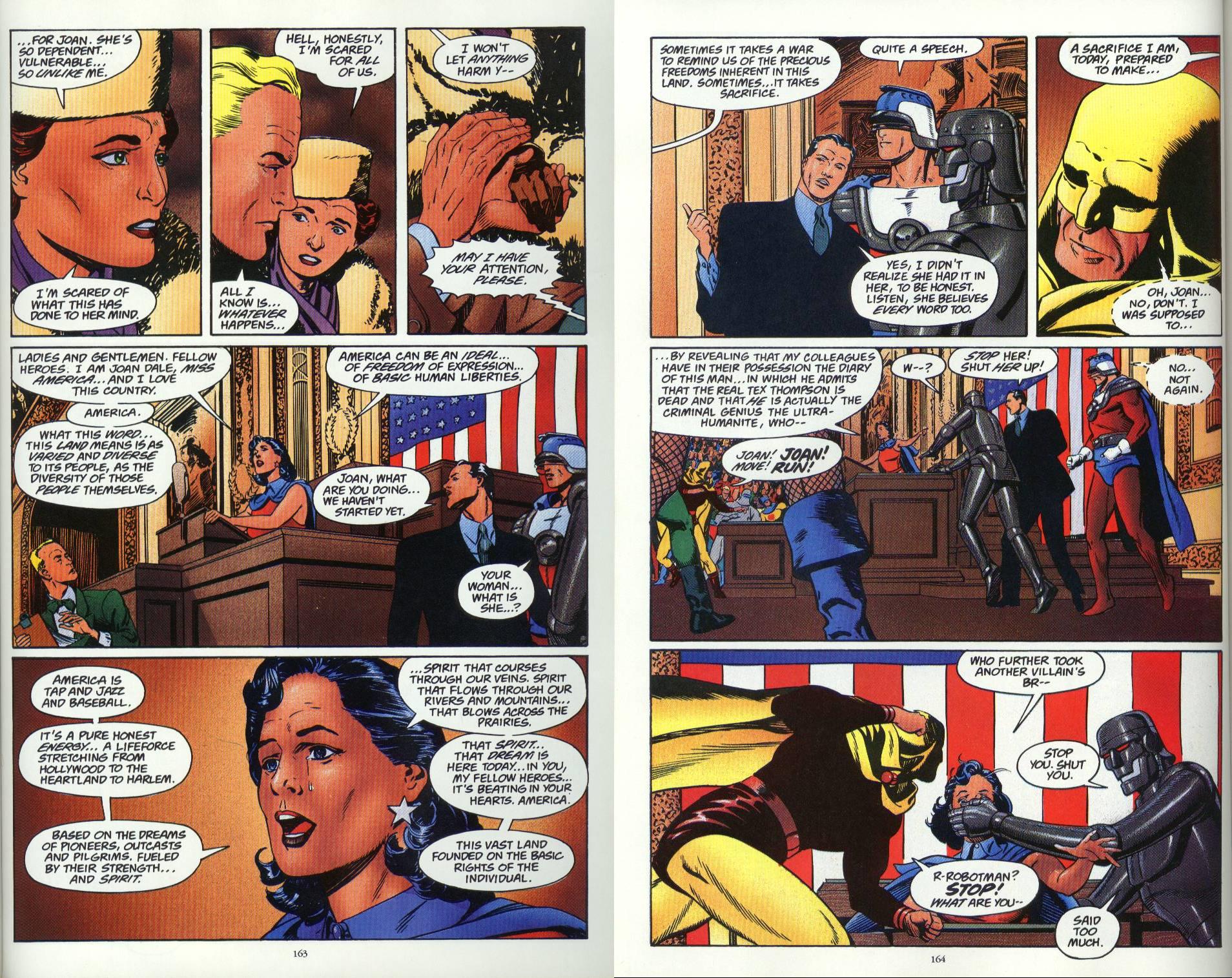
In the meantime, the heroes with the skinny on what is actually going down with the Ultra-Humanite are beginning to put their plan into motion.  One of them, however, calls an audible.  One of them had decided she just hasn’t done enough to thwart this plan.  One of them is going to jumpstart the plan on her own.  One of them won’t survive her gambit, although she certainly inspires many of her fellow heroes to take up arms against their oppressor.

The Golden Age #4 - Page 10

American culture is jazz and baseball, although I think we have to add in pro wrestling and superheroes as well.  These things are inherently ours.  We brought them to the world.  I know folks would like to believe in a lot more of what she said, but, well, as an anarchist, I think it is a pipe dream.  The state is the state, whether it is called The USA, the USSR, the UAE, or Uganda.  We will see that even as our heroes expose the corruption of Thompson and how he is actually the Ultra-Humanite, that things will go along in a similar fashion, as the Joe McCarthy of this Earth rises to fill the vacuum Thompson leaves.  He will engage in the same red-baiting that Thompson did, just as McCarthy did on our Earth.  No nation, regardless of the ideals it purports to espouse, is immune from the power mongers and the need for the elites to maintain the status quo at the expense of the non-elite.

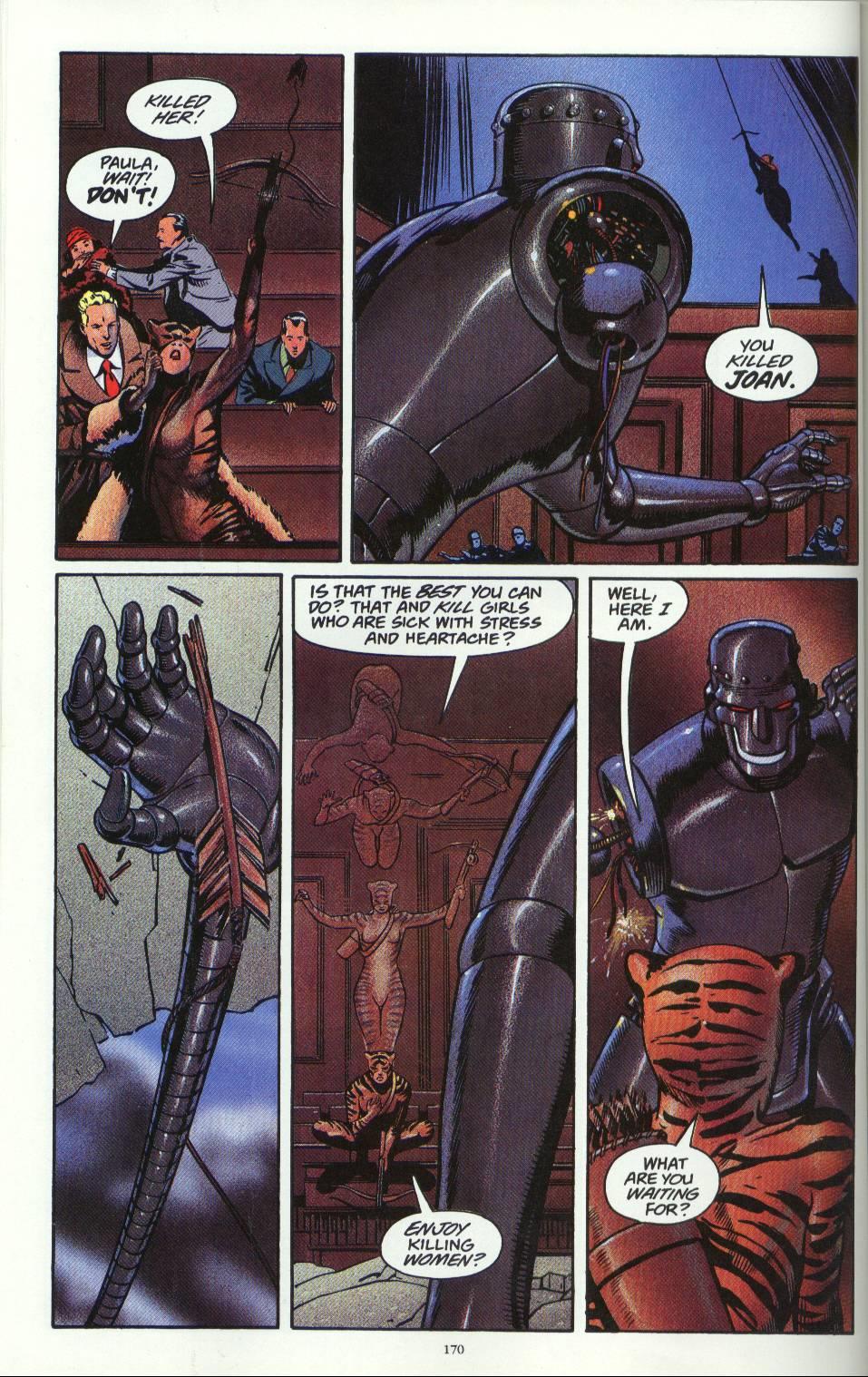
Robotman, as you see, has no qualms with this.  I love Robotman (especially the often-forgotten Golden Age Robotman), and it is a shame to see him make such a dastardly heel turn, although it makes perfect sense.  Robotman would be cold and efficient due to the dichotomy between his organic brain and his steel body, and one of the heroes most likely to buy into the law and order nonsense of those like Thompson or McCarthy.  So it is he who smashes Miss America in a vain attempt to silence her truth.  She dies; the truth lives on.

The government’s witch hunt against Alan Scott and others like him is continuing even as the Ultra-Humanite is being revealed.  Scott is defiant, and he, like me, has nothing but contempt for government apparatuses that are utilized to hold down those who would dare to be different and question the integrity of the powers-that-be.  I wonder if this cycle will ever stop.  Alan Scott and I both certainly hope so.

As he faces down those small-minded men, the mystery men go to war with Dunbar, and to say they did not fare well would be such an understatement…

The Golden Age #4 - Page 16

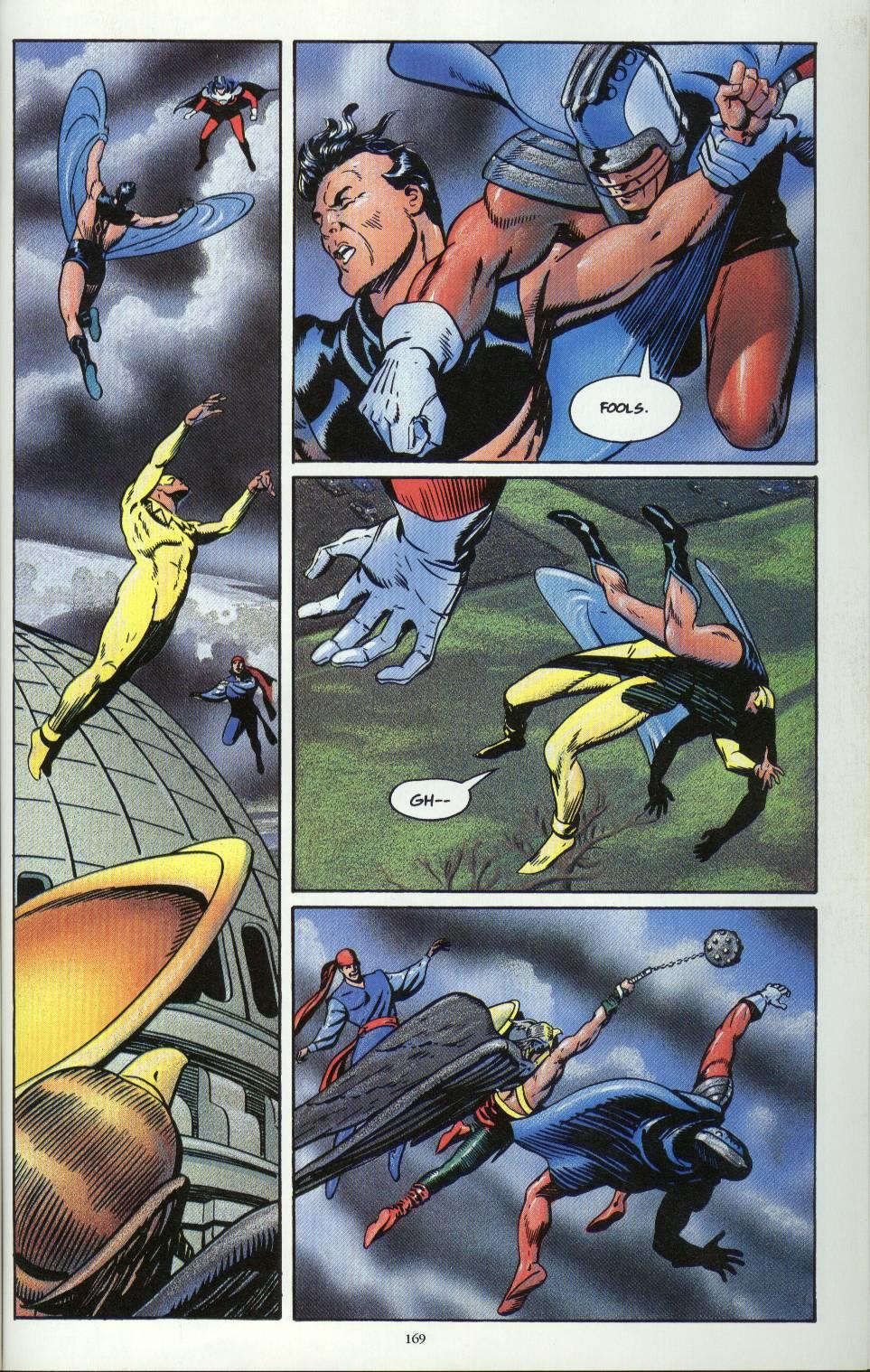
I have heard that the bright colored superheroes are like our gods and mythology, and there are few moments that reinforces that notion better than this one.  Here we see the gods rise up as they attempt to crush their challenges, but like many of the powers that would face a god, Dunbar is in possession of a nearly limitless power all his own.  We see Hawkman, Black Condor, and The Ray attempt to subdue Dunbar, and their story isn’t over.

Some gods stay grounded, looking in vain for advantages against overwhelming odds.  Some gods look for inspiration in  the Earth, the sky, or themselves, but some look for inspiration in the cold realm of vengeance…

The Golden Age #4 - Page 17

Robotman vs. Tigress seems a one-sided affair, but how could one not admire the vehemence with which Paula Brooks attacks the steel monstrosity in the name of vengeance for her friend?   Despite how Robotman just murdered her pal with nary a second thought, Tigress is displaying nerves of steel that despite being made of metal, Robotman could only wish he had.

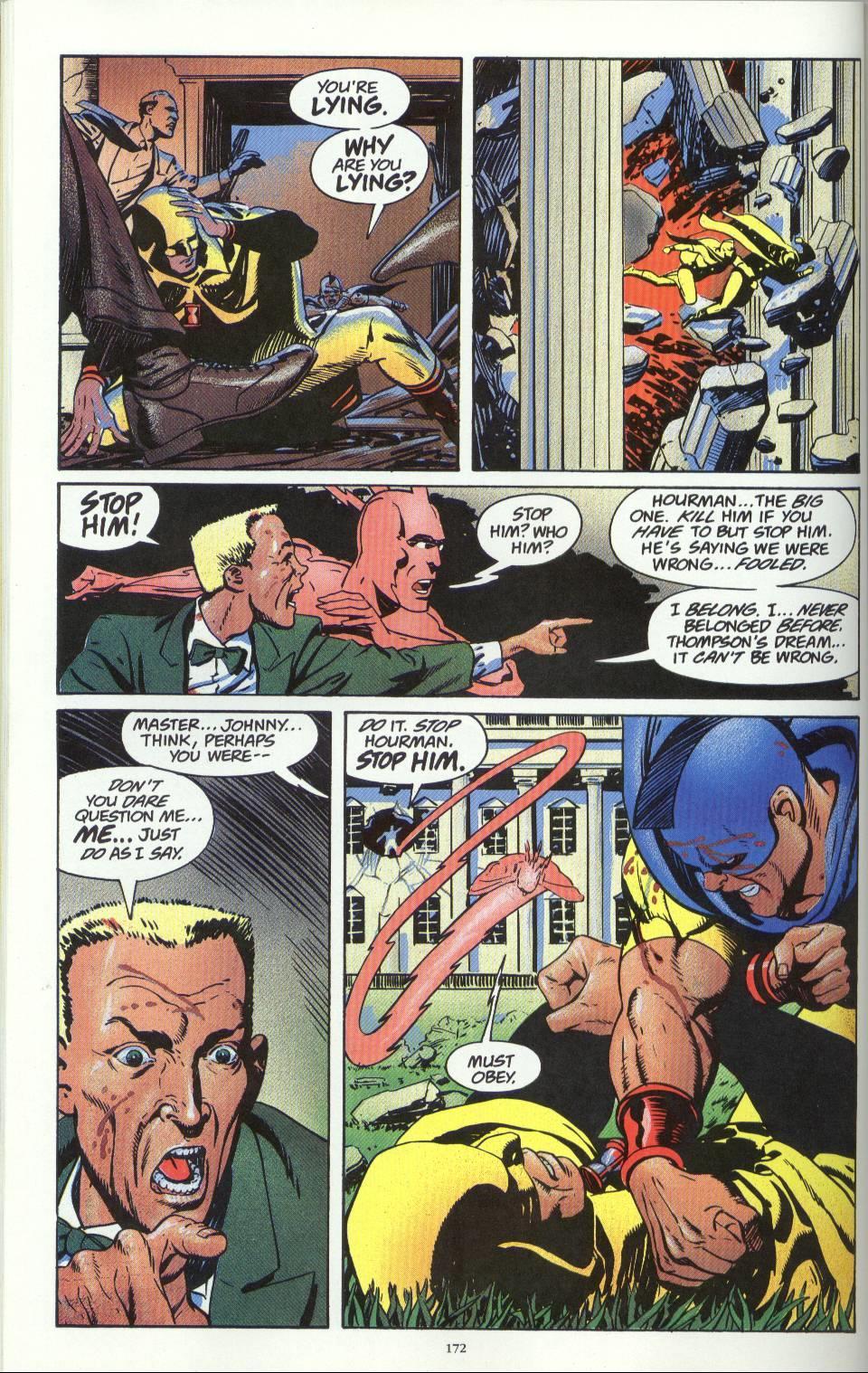
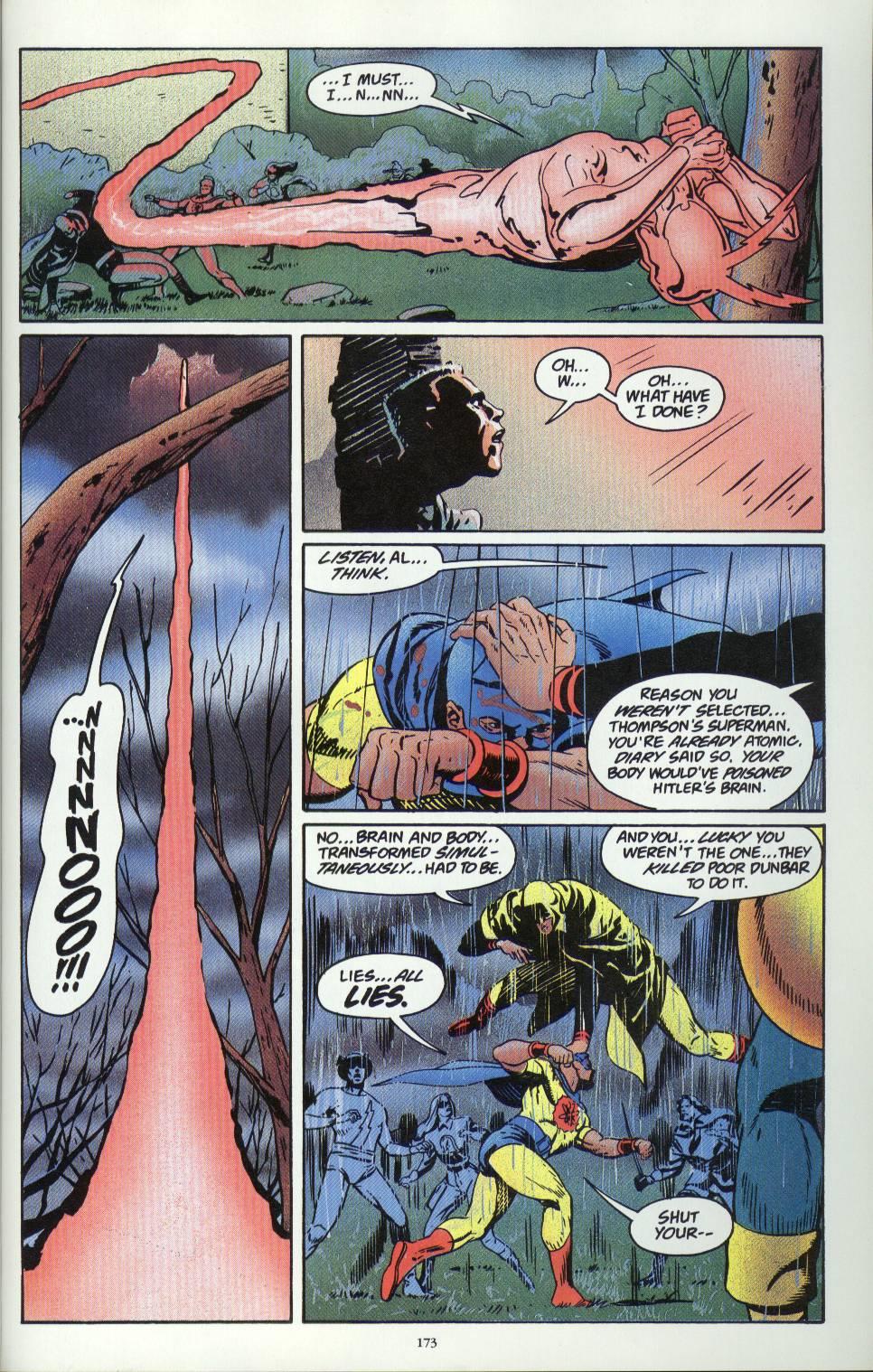
The Ultra-Humanite, running low on cards in this high-stakes, high-powered game of poker, pulls a pair of kings. Just like all the demagogues of the ages, the Ultra-Humanite uses misdirection and manipulation to create rifts between friends and heroes.  Johnny Thunder and The Atom, recruits in the Ultra-Humanite’s wave of the future, have fallen victim to him and his lies.  Of course, who could blame them?  As the outcasts of the JSA, they felt like they found a place to belong under Ulta-Humanite, and so they fight.

They fight their own family, as families do on occasion.  Some would say families only stop fighting when they have someone else to fight, but here, even though the JSA has plenty on its hands now, The Atom and Johnny Thunder fight.  Thunder even commits an act so despicable that I find it shocking; his pet Thunderbolt finds it even more so…

The Golden Age #4 - Page 19 The Golden Age #4 - Page 20 The Golden Age #4 - Page 21

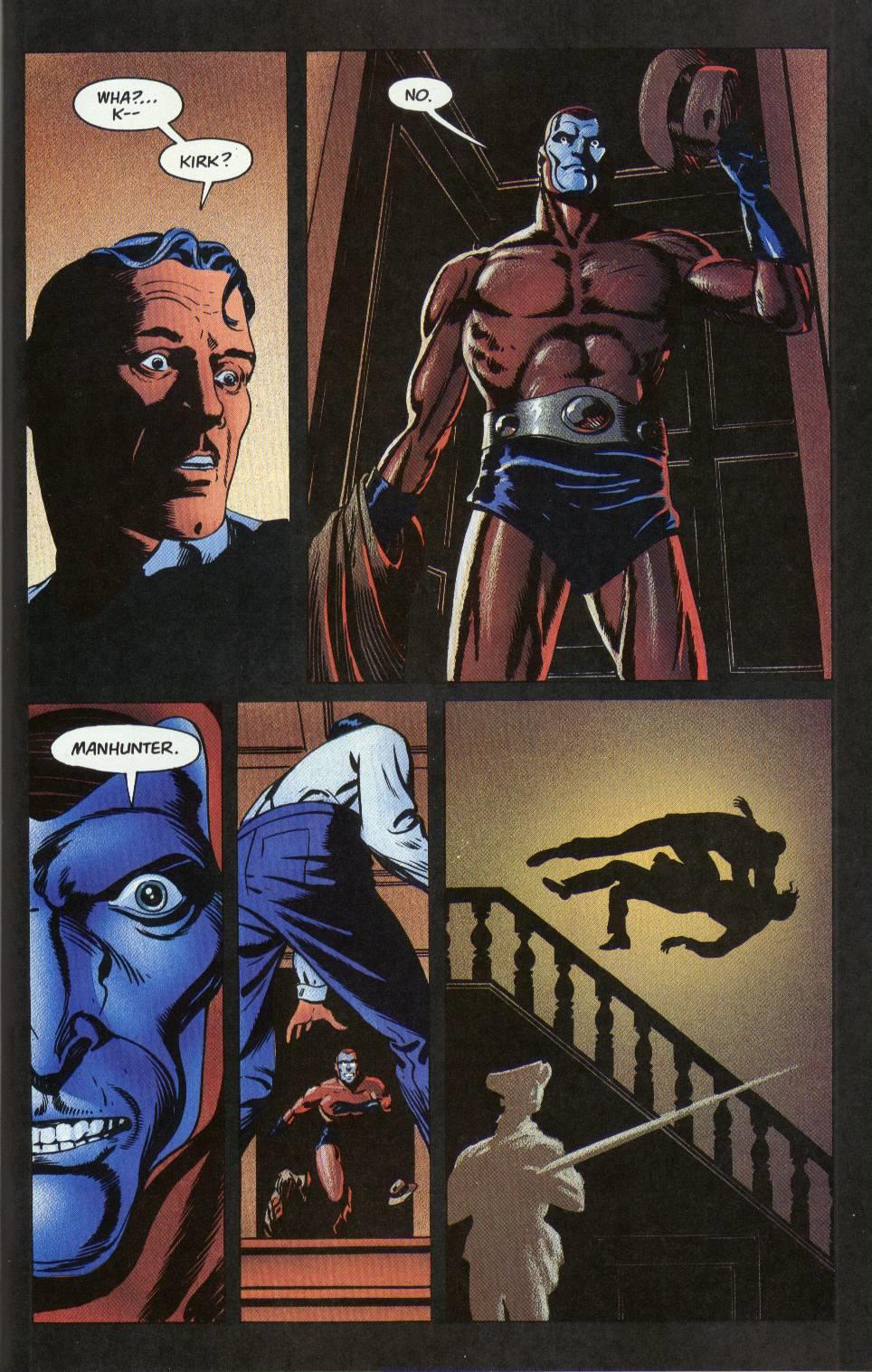
The family makes up and unites against a common foe, but certain parts of the family remain apart from the rest, engaging in the tasks that make others in the tribe cringe.  Vengeance once again shows up, as Paul Kirk finds Ultra-Humanite, and he is going to get revenge for his friend, Tex Thompson!

The Golden Age #4 - Page 24

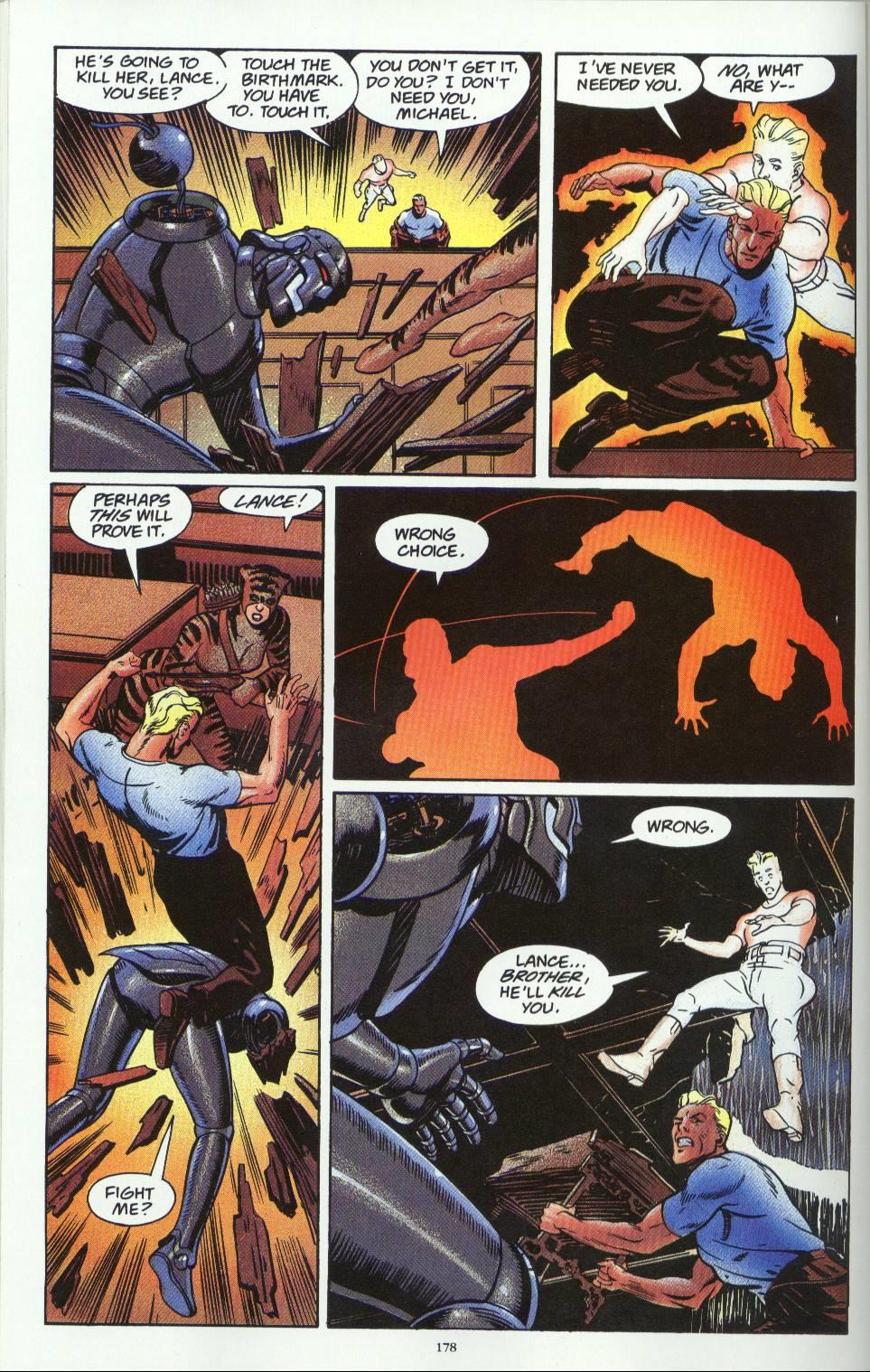
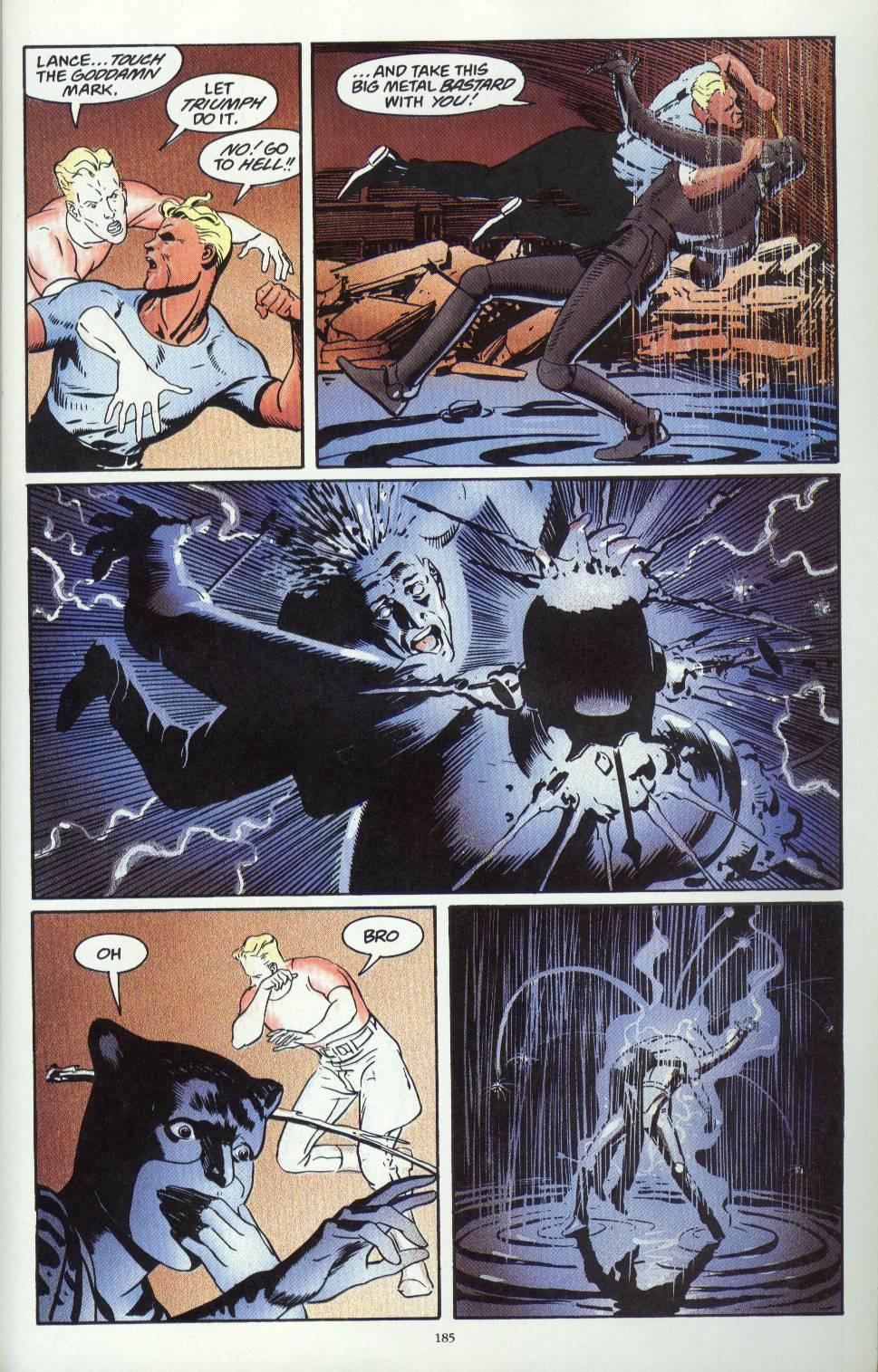
Still the Tigress and Captain Triumph struggle against Robotman, searching for a way to honor their fallen friend, Miss America.  Captain Triumph also struggles against the ghost of his brother, and whether he wins or loses said struggle, is really up to the reader.  One thing is for sure, he wins the struggle with Robotman…

The Golden Age #4 - Page 25

The Golden Age #4 - Page 31 The Golden Age #4 - Page 32

Captain Triumph will no longer be bothered by his brother.  Other heroes attack Dunbar in waves, one at a time, or from afar.  None of it seems to matter, as the death toll climbs and climbs.  At least Captain Triumph and his brother won’t be lonely as Dunbar sends so many to greet them…

The Golden Age #4 - Page 26 The Golden Age #4 - Page 30

Wouldn’t that be awful?  To see one’s moral opposite showing more courage than one’s self?  Especially if one was supposed to be a hero, and had looked down on his opposite with such disdain.  Surely, Alan Scott has no choice but to join the battle, because if he was willing to come out of retirement to stop Sportsmaster, now he has to come out to avenge his death…and to prove he has the courage he has been showing in standing up to HUAC, this time in another arena.

And it is a good thing he does arrive, as the heroes keep falling, including Johnny Quick.  Green Lantern hits Dunbar with a right fist that not only removes a few of Dunbar’s teeth, but it also instills something the JSA has lost a lot of very quickly…hope.

The Golden Age #4 - Page 33

The Golden Age #4 - Page 34 The Golden Age #4 - Page 35

Even Alan Scott falls, however, and the heroes last hope against Dunbar appears to be Starman, mental illness be damned. We see Johnny Quick rushing off to grab him above, and this echoes one of the best things about superheroes to me, which is that no matter how down things look, there’s always one last chance.  This is why so many sports appeal to me as well.  Your team’s down a touchdown with 0:03 on the clock?  Maybe they can hit that Hail Mary pass to the end zone.  Down one run in the 9th?  Maybe your team will score two.

The JSA is down a lot more than touchdown, however, and unfortunately, it will take more than the bipolar genius of Ted Knight to win this day…

The Golden Age #4 - Page 40

Just when it seems that all is lost, the forgotten weapon of this story, the young man who wanted to be a hero at the start of this tale, joins the fray, and while he may not be the one who delivers the killing blow, his demeanor in the face of what appeared to be absolute defeat lives on in the minds of his world.  For if only each and every one of us were to stand up to those whose tyranny we are told is inevitable.

And let’s not discount Liberty Belle and her role in the victory.  Her ingenuity and resourcefulness save the day, and isn’t that how it usually goes?  Youth, in combination with the defiance that goes along with it and the ingenuity of a lady with very few powers in comparison to many of the heavy hitters who had tackled Dunbar prior, saves the day.  More importantly, it saves the future…but you will have to get the book to see that and to see how Paul Kirk dealt with the Ultra-Humanite.

The Golden Age is unfairly overlooked.  I truly wish that these characters and their reality were as embraced as other critical darlings of the era, such as Kingdom Come or Marvels.  I wish that with all of the hullabaloo at DC right now in regards to their “Multiversity” that Grant Morrison or someone of that ilk would look back to The Unspoken Decade for a universe that is ever so real and hurtful in so many ways, with so many delightful characters to incorporate into “Greater DC.”

Or they could at least bring Dynaman back.

You’re doing yourself a tremendous disservice  if you do not go buy this right now. This is truly a masterpiece. If this had come out in 1985 or 2005, it would be revered.  Since it came out in the 90’s, it is tossed aside and possibly even reviled.  That’s more than a damn shame, as James Robinson and Paul Smith truly capture the horror, wonder, and charm that is superheroes.  Perhaps, that’s the same horror, wonder, and charm that is America…