Hello there, Legions of the Unspoken! It’s that time again for a meeting of the minds with the other fantastic members of the Super-Blog Team Up! Make sure you click through and read all the great articles!
For our go-round, we decided to do an episode of The Spoken Decade, which is our term for the podcasts we do. This go round, Dean Compton & Emily Scott tackled THE RISE OF THE MIDNIGHT SONS!!!!! Have a listen, enjoy, and comment, people!
Super Blog-Team Up:
The theme for this Super Blog Team-Up is Magic! Take a look at these magical blogs!
Greetings, Legions! As you may have noticed in the past, the Halloween season is one of our favorite times of year, for many reasons, but especially because it gives us an excuse to delve into some of the more horror-based titles of The Un-spook-en Dead-cade. (If there’s a better way to scare people than with bad puns, I don’t know what it is.) Just before Halloween, Dean Compton (this site’s proprietor) and I will be bringing you another edition of The Spoken Decade, where we’ll take a look at The Rise of the Midnight Sons. Right now I’ll be digging into one of the Midnight Sons better known members, your favorite dhampir and mine, Blade!
Blade, created by Marv Wolfman and Gene Colan, first appeared in 1973 in Marvel’s The Tomb of Dracula. (I read some of The Tomb of Dracula, and when I first saw Marv Wolfman’s name, I thought they had given themselves spooky names, like the crew of The Simpsons on Treehouse of Horror episodes.) The character popped up in a number of other titles throughout the subsequent years, including Vampire Tales, Nightstalkers, and the aforementioned Midnight Sons, before getting his first solo title, Blade: The Vampire-Hunter, in 1994. The series ran for 10 issues, which were penciled by Doug Wheatley, and the first eight of which were written by Ian Edginton. (I tried to make up spooky versions of their names without success. Suggestions welcome.)
The series wastes no time not only in letting the reader know who the Big Bad is going to be but also in going straight for the Biggest Bad:
I am so used to associating the Wesley Snipes’ movie with this character that my first thought about this cover was, “Damn, he’s so fancy.”
One of the best parts of any vampire property is seeing which parts of vampire mythology they use or discard, embrace or mock, and this title also wastes no time showing us what it looks like when Blade takes down a bloodsucker. I have mostly come across vampires either bursting into flames when destroyed or getting dusted like on Buffy, so I must say this is, hands down, the coolest visual representation of a vampire eating it that I have ever seen:
It’s like his soul is a Lisa Frank cheetah.
This image is the first part of a vision being had by one John Carik, former professor and current psych hospital patient covered in scarred sigils and marks known to the doctors as Bible John. He sees the fight to defeat Varnae, First Lord of the Vampires, which took the lives of Blade’s Nightstalker companions, Hannibal King and Frank Drake. John also sees Blade struggling under the weight of his survivors guilt, but what he sees next causes him to break out of the hospital to warn Blade — the return of….DRACULA! (I hope I’m not the only one who reads that name in their head in the bad Transylvanian accent every time. Also, never look up what real Transylvanian accents sound like because it is woefully and disappointingly NOTHING like what Count Chocula sounds like.)
After the deaths of his colleagues, Blade tries to make a new start in his old New York stomping grounds. We learn through some incredibly expository dialogue that Blade is hoping to make his new life a fairly normal one and that he is earning his keep by renovating the house his landlady, Julia Suarez, received from her ex-husband in the divorce settlement. Blade tells Julia he has no interest in talking to a reporter who calls asking about the Nightstalkers, or anyone else for that matter. He also decides to go by the name Hannibal Francis Blade to honor his fallen brothers.
This “normal” life lasts for about ten minutes till Bible John catches up to Blade, tells him he can’t deny his heritage, which he knows a surprising amount about, and gives him the not-as-cool-looking-as-it-sounds Witch Compass. The compass will point to negative energy, and Blade must not be as ready as he pretends for a quiet existence because all it takes for him to bust out the blades again is a twitch of the compass’s needle and the fact that Bible John DID know a thing or two about him.
Blade hates evil AND hydration.
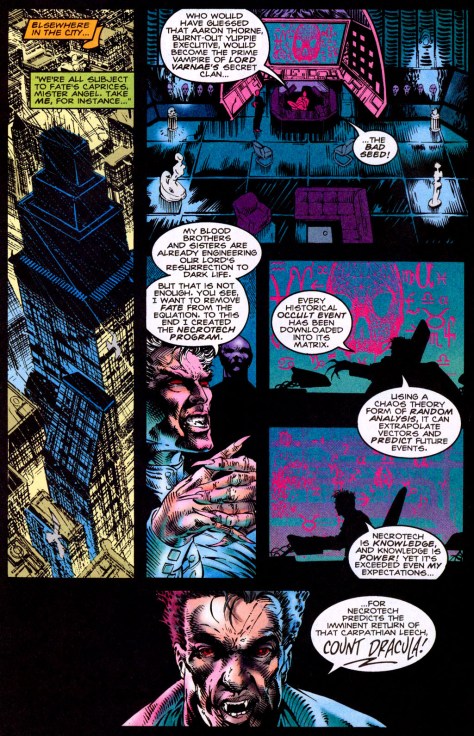
The compass leads Blade to the lair of Aaron Thorne, the new leader of Lord Varnae’s secret cult, the Bad Seed. Thorne is hatching a plan to essentially enslave the entire country with a drug that has been mixed with his thralls’ blood. Once loyal to him, everyone will therefore also be loyal to Varnae, whom the Bad Seed intend to bring back to un-life. Blade is not the only one who might interfere with their plans, though, a fact Thorne discovers with his Necrotech program. (I’m just going to let him tell you about Necrotech, since there is no way I can improve on this explanation.
Blade, of course, does indeed interfere, and takes on Thorne, who wastes no time in telling Blade that he thinks he’s useless. Thorne gains the upper hand and mocks Blade with the idea that his anger and obsession have made him inhuman. And because the 90’s were a beautiful and strange time when a vampire comic could also have a touch of the TGIF sitcom, that accusation strikes a chord with Blade when he remembers what his landlady told him earlier: “It’s only human to grieve and be angry, but don’t let it eat you up.” Those simple words allow Blade to give focus to his anger and relieve Thorne of some of his own Lisa Frank cheetah spirit energy. In the process, Blade delivers some words that would stick with me if he were my sitcom friend (and are also good advice to anyone taking on a vampire): “A nice fat ego makes an easy target.”
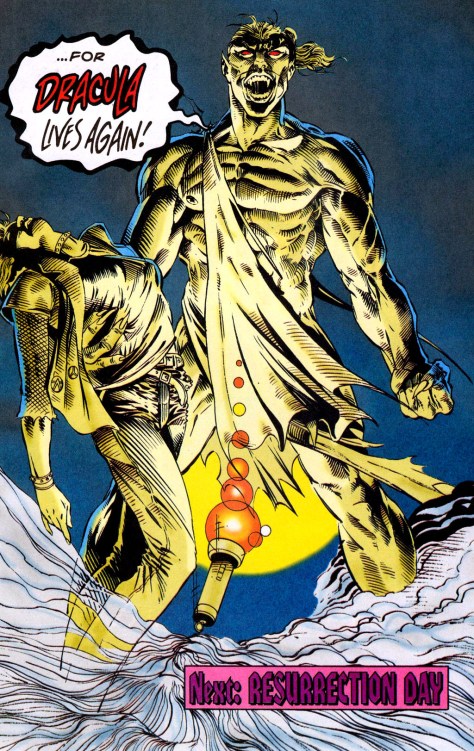
Thorne’s minions do much of Blade’s work for him in destroying the drug blood farm (three words that feel weird to type in that order) when they shoot barrels full of chemicals they were explicitly told not to shoot. Blade accepts that he is still in this fight, but this time with a renewed perspective and on his own terms. Thorne is somewhat less pleased with the outcome of the fight and swears revenge on Blade. The reporter looking for Blade earlier goes looking for information on the Nightstalkers but finds more than she bargained for. In fact, she finds…DRACULA!
I’m just going to type it like that every time I have to type the name of…DRACULA!
Thorne puts out the word that he is looking for Blade, who is fulfilling his domestic duties to Julia. Some bats show up on the search, and Blade is suddenly concerned about the fact that Thorne might have survived the explosion after all. He also laments that he may have doomed them both by not bringing his knives into the house as a concession to trying to live a normal life. (I’m not sure I understand his logic here, since it seems like the useful concession would be, you know, keeping the knives and NOT hunting vampires. Then people would just assume he is a mall ninja.) There is no reason to fear, though, as Julia saves the day again, this time with her mop instead of her wisdom. Bible John has the terrific timing to show up just then and warn Blade about his vision, and the two agree that together they will stop…DRACULA! before he can manifest.
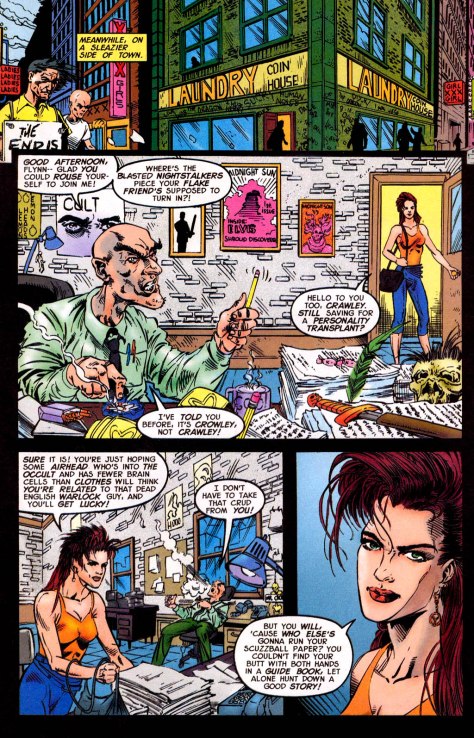
Little do they know that he is already back, having turned the reporter into his thrall and using her to lure in her friend, a fellow reporter at the world’s sleaziest newspaper. Seriously, this place doesn’t really seem to be essential or even particularly important to the plot (at least for this story arc), but this is a 90’s comic site after all, and this newsroom is the 90’s-ist. I would love to watch the 90’s HBO sitcom based on this newspaper. It could come on after Arliss.
I kept coming up with cheesy names like The New York Slimes, but it would just be called Press and not get picked up for a second season.
Anyway, vampires.
So Blade and Bible John follow the compass to the Body Hammer, but once they arrive, they realize they are too late to stop…DRACULA! He has already enthralled what seems to be the entire club, and they must fight their way through them all before getting to the big boss himself. Once again Blade gets mocked by a vampire for hunting vampires, a task they understandably don’t see the value of, despite the number of vampire asses it seems Blade has kicked. Blade tells…DRACULA! that he can’t kill him if he wants to know where his wife and son are, but…DRACULA! just finds that claim amusing, reasoning that he can turn Blade and have the information from him willingly.
This is as good a time as any to heap some praise on the artists of this book, who manage to create something that reminds me, in a good way, of things I already like but still has its own aesthetic. The fight scenes all have dynamism to them that I don’t always notice or appreciate in other comics, so in addition to looking beautiful, it was easier for someone like me, who doesn’t necessarily have the visual vocabulary that comes with a lifetime of reading comics, to follow what was actually going on. I have already mentioned penciler Doug Wheatley, but I want to make sure to mention colorist Tom Zuiko and inker Chris Ivy as well for helping to put together a comic I just really enjoyed looking at.
Dracula would make one hell of a wide receiver.
…DRACULA! goes for the bite and attempts to turn Blade, apparently having forgotten that he is a dhampir and can’t be turned. This lapse in memory confuses Blade, who wonders if something didn’t go according to plan when…DRACULA! was brought back. Since Blade is immune to the bite of a vampire, Bible John is next on the menu, but the sigils he has carved into his flesh protect him and burn…DRACULA! Meanwhile, Blade has received assistance from a strange source, Thorne’s crony Angel. Since Blade’s…blade was broken in the fight, Angel bestows a knife on him, and for a moment, it seems Blade is much invigorated and….DRACULA! more susceptible to harm. Thorne watches the wings, hoping his two enemies take each other out.
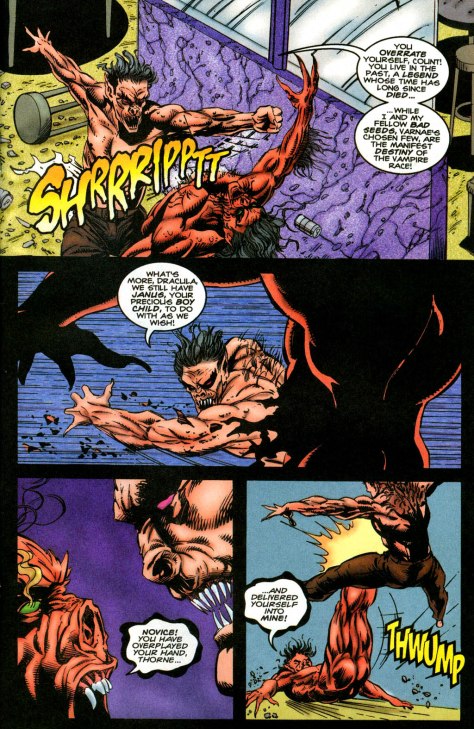
Blade quickly realizes he has been had and that the knife has put him under Thorne’s influence. He refuses to participate in the charade any longer and throws the knife at Thorne. The two vampires finally get around to paying attention to each other, and the bloodsucker brawl begins!
I like to entertain the idea that Dracula has a home theater in his castle and strong opinions about different actors’ portrayals of him.
I suppose since I included two pages of a newspaper office, I should probably include at least that many of two vampires fighting each other.
I suppose this is more exciting.
While Thorne and…DRACULA! duke it out, Blade and Bible come up with a plan involving one of my least favorite vampire weaknesses, running water, but use it in a way I enjoy. Blade fights his way past Angel to the sprinkler release valve and douses the lot of them. Thorne thinks it’s some trick of…DRACULA!’s right up to the point that the water starts to burn him, and…DRACULA! mocks Thorne for not knowing his own weaknesses while he mildly smolders. Thorne calls for Angel to carry him away, foiled for the time being. Calling it a skirmish rather than a true battle…DRACULA! does his usual parlor trick of turning into mist once a fight has reached a standstill, and Blade tells him that he’ll be ready for him, any time, anywhere.
This first story arc does a pretty great of setting up a title, giving us plenty of potential for future conflict, interesting antagonists, and a solid supporting cast, including a super hardcore landlady. If all of those elements weren’t enough to keep me reading, this trip-tastic cover to Issue #4 might just do the trick.
Dude got ripped in the psych ward.
I hope you’ve enjoyed this look at Blade: The Vampire-Hunter! Join us next week for Rise of the Midnight Sons, and I scare up and down– er, swear…that I will do my best to keep the Halloween puns to a minimum.
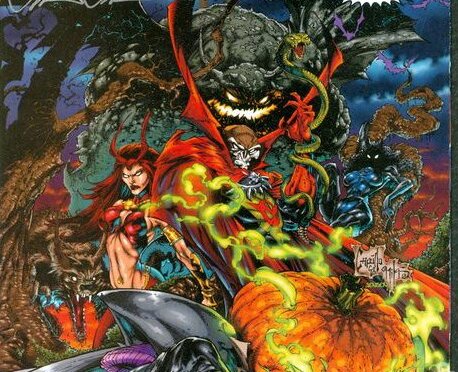
Greetings, boils and ghouls! Tis’ your old pal, the Symbi-Keeper, with a tale from a Marvel Universe much like the one we know, yet somewhat….altered. This yarn begins in the distant land known as Louisiana….(Cue the maniacal laughter!) Whew! I bet reading that in your best HBO “Crypt-Keeper” voice really wore you comic fans out! Not to worry, I think I got most of that out of my system now. I guess it’s just the season. Halloween just seems to bring out your inner monster. That brings me back to the subject of this month’s article, Marvel Comics’ Supernaturals 4-Part miniseries.
The story begins with action. The first panel shows two young African-American boys standing in the center of a creepy graveyard in the middle of the night. They stand within a circular arcane symbol with a strange dagger. The elder boy, Daniel, slashes his hand, dripping his blood within. His younger brother Jericho is more unsure. But he does the same after promises that this ritual will bring their deceased mother back to them. As you can imagine, the whole thing goes horribly awry as there is a blast of fire. Nearly blinded by the inferno, Jericho opens his tear-filled eyes to see the bloody dagger hit the ground. Daniel is gone! At this moment, all non-mystically powered superheroes around the globe simply disappear! The story picks up again 13 years later, near Halloween. A now-grown Jericho Drumm awakens in his bed, screaming the name of his sibling. Jericho is soon to find out that now, nearing the anniversary of that fateful night (Dubbed the Chaos Event.), the remaining mystical heroes of the planet are now starting to turn up missing! He immediately takes on the guise of his super alter ego, Brother Voodoo, and seeks out the Sorcerer Supreme himself, Dr. Strange. But, upon reaching the good doctor’s home, it is discovered that he as well is now gone! Not to worry, though. Sensing his impending doom, Strange set up a failsafe. A relic meant to seek out five other “chosen” individuals to prevent another Chaos Event. Of course the relic I speak of is the Eye of Agamotto. Wasting no time, Brother Voodoo searches out the others: Black Cat, Ghost Rider, Satana, Gargoyle, and Werewolf By Night!
The problem? Another has risen and is rallying the forces of darkness into an army. His name is Jack O’ Lantern and he knows of the “chosen” as well. In fact, while Voodoo was busy at Strange’s, all of them have been under attack! But, using the powers at his disposal, Brother Voodoo teleports to each one in turn, snatching them from the clutches of evil. All but one are taken to sanctuary….except Werewolf By Night. No, Voodoo was too late to save this poor beast. While the group gets to know each other a bit better (and squabble about even joining this band of supernatural misfits!), the villainous Jack O’ Lantern has our good friend, the Werewolf By Night, chained in a strange dimension. While there, he uses his incalculable arcane abilities to separate the werewolf from its human host! Meanwhile, the others are finally convinced that the time has come to use their powers against the coming threat. (Oh, and the recently resurfaced Werewolf By Night joins them as well. Convenient, eh?) That is when N’ Kantu, the Living Mummy, and other evil creatures choose to attack the unsuspecting city! Led by their master, there seems to be no stopping them! Who will save the day?! The Supernaturals, baby! Or they would, if Jack O’Lantern hadn’t blasted Brother Voodoo into a coma and separated the others throughout time!
As the heroes confront monstrous adversaries in different times, they must also confront their own fears. Ghost Rider and Black Cat face crazed witch-hunters, Headless Horseman, and the Scarecrow in Salem during the witch trials. Gargoyle goes it alone against a horde of zombies, and the Chupacabra. Satana and Werewolf By Night take on Dracula, Frankenstein’s Monster, and an army of vampires and werewolves in old Transylvania. As the heroes battle on they all fall, one by one, to the forces of evil. But, in the Transylvanian past, a shocking event (yeah, right!) occurs. The Werewolf betrays Satana by knocking her out and delivering her to Jack O’Lantern! All of this, along with Brother Voodoo being mentally tortured by memories of the night his family perished!
As Halloween night fast approaches and our heroes are underpowered and chained, Jack O’ Lantern is given a mystical horn by his minions upon his request. Upon blowing it, the giant monsters from Marvel’s past arise all over the world: Grottu, Droom, Gruto, Gorgorilla, Moomba, Grogg, Roombu, and Groot! (I am Groot. Sorry. “Guardians” flashback.) Meanwhile, Jack O’Lantern reveals that he just requires the blood of an innocent to complete his goal of Hell on Earth. To do this, he chooses Satana’s human counterpart. But as he raises a familiar looking dagger into the air, Brother Voodoo recognizes it from that fateful night, 13 years ago, with his brother at the cemetery in Louisiana! Jack O’ Lantern is his missing brother! Voodoo snaps out of his catatonic state and attacks.
At the same time, Werewolf By Night reveals himself to be on the side of angels and frees Satana! (Shockers abound, right?!) As the Supernaturals all fight for the future of the universe and their very lives, other mystically-powered superheroes appear around the planet defeating the menace of the titanic conjured monsters! While this is going on, Brother Voodoo seems to be failing in his battle against his evil sibling! Sensing this, the Supernaturals all grasp the Eye of Agamotto and channel their combined might into Voodoo. Empowering him he uses all of this, plus his own might, and sends the now depowered Jack O’ Lantern into a void, never to return! But, as he falls into nothingness, he warns that only he has the power to return the other heroes of Earth! The end. Quite a climactic ending huh kiddies? Too bad the series was never picked back up to tell us what happened next. But I’m sure that the as long as there was a mighty team like the Supernaturals out there, the day was eventually won. Well, that’s it for me fellow comic fans. But before I leave you….Happy Halloween from all of us at the Unspoken Decade! (‘Nuff said!)






 Greetings, boils and ghouls! Tis’ your old pal, the Symbi-Keeper, with a tale from a Marvel Universe much like the one we know, yet somewhat….altered. This yarn begins in the distant land known as Louisiana….(Cue the maniacal laughter!) Whew! I bet reading that in your best HBO “Crypt-Keeper” voice really wore you comic fans out! Not to worry, I think I got most of that out of my system now. I guess it’s just the season. Halloween just seems to bring out your inner monster. That brings me back to the subject of this month’s article, Marvel Comics’ Supernaturals 4-Part miniseries.
 The story begins with action. The first panel shows two young African-American boys standing in the center of a creepy graveyard in the middle of the night. They stand within a circular arcane symbol with a strange dagger. The elder boy, Daniel, slashes his hand, dripping his blood within. His younger brother Jericho is more unsure. But he does the same after promises that this ritual will bring their deceased mother back to them. As you can imagine, the whole thing goes horribly awry as there is a blast of fire. Nearly blinded by the inferno, Jericho opens his tear-filled eyes to see the bloody dagger hit the ground. Daniel is gone! At this moment, all non-mystically powered superheroes around the globe simply disappear! The story picks up again 13 years later, near Halloween. A now-grown Jericho Drumm awakens in his bed, screaming the name of his sibling. Jericho is soon to find out that now, nearing the anniversary of that fateful night (Dubbed the Chaos Event.), the remaining mystical heroes of the planet are now starting to turn up missing! He immediately takes on the guise of his super alter ego, Brother Voodoo, and seeks out the Sorcerer Supreme himself, Dr. Strange. But, upon reaching the good doctor’s home, it is discovered that he as well is now gone! Not to worry, though. Sensing his impending doom, Strange set up a failsafe. A relic meant to seek out five other “chosen” individuals to prevent another Chaos Event. Of course the relic I speak of is the Eye of Agamotto. Wasting no time, Brother Voodoo searches out the others: Black Cat, Ghost Rider, Satana, Gargoyle, and Werewolf By Night!
 The problem? Another has risen and is rallying the forces of darkness into an army. His name is Jack O’ Lantern and he knows of the “chosen” as well. In fact, while Voodoo was busy at Strange’s, all of them have been under attack! But, using the powers at his disposal, Brother Voodoo teleports to each one in turn, snatching them from the clutches of evil. All but one are taken to sanctuary….except Werewolf By Night. No, Voodoo was too late to save this poor beast. While the group gets to know each other a bit better (and squabble about even joining this band of supernatural misfits!), the villainous Jack O’ Lantern has our good friend, the Werewolf By Night, chained in a strange dimension. While there, he uses his incalculable arcane abilities to separate the werewolf from its human host! Meanwhile, the others are finally convinced that the time has come to use their powers against the coming threat. (Oh, and the recently resurfaced Werewolf By Night joins them as well. Convenient, eh?) That is when N’ Kantu, the Living Mummy, and other evil creatures choose to attack the unsuspecting city! Led by their master, there seems to be no stopping them! Who will save the day?! The Supernaturals, baby! Or they would, if Jack O’Lantern hadn’t blasted Brother Voodoo into a coma and separated the others throughout time!
 As the heroes confront monstrous adversaries in different times, they must also confront their own fears. Ghost Rider and Black Cat face crazed witch-hunters, Headless Horseman, and the Scarecrow in Salem during the witch trials. Gargoyle goes it alone against a horde of zombies, and the Chupacabra. Satana and Werewolf By Night take on Dracula, Frankenstein’s Monster, and an army of vampires and werewolves in old Transylvania. As the heroes battle on they all fall, one by one, to the forces of evil. But, in the Transylvanian past, a shocking event (yeah, right!) occurs. The Werewolf betrays Satana by knocking her out and delivering her to Jack O’Lantern! All of this, along with Brother Voodoo being mentally tortured by memories of the night his family perished!
 As Halloween night fast approaches and our heroes are underpowered and chained, Jack O’ Lantern is given a mystical horn by his minions upon his request. Upon blowing it, the giant monsters from Marvel’s past arise all over the world: Grottu, Droom, Gruto, Gorgorilla, Moomba, Grogg, Roombu, and Groot! (I am Groot. Sorry. “Guardians” flashback.) Meanwhile, Jack O’Lantern reveals that he just requires the blood of an innocent to complete his goal of Hell on Earth. To do this, he chooses Satana’s human counterpart. But as he raises a familiar looking dagger into the air, Brother Voodoo recognizes it from that fateful night, 13 years ago, with his brother at the cemetery in Louisiana! Jack O’ Lantern is his missing brother! Voodoo snaps out of his catatonic state and attacks.
 The Unspoken Decade: 90's Comic Book Blog Extraordinaire