Tag Archives: Marvel

HE CALLS HIMSELF CABLE – José Ladrönn and Joe Casey on the Man Out of Time

Warren Worthington: Before you go any further, you need to ask yourself… is any story really worth dying for?
Irene Merryweather: Depends on the story.

No theme this month at “The Unspoken Decade” so I have taken this opportunity to look back at José Ladrönn’s run on Cable that helped close out the nineties.

Irene Merryweather is a reporter, a storyteller. She acts as Cable’s chronicler and as the reader’s way to understand the man and his world. She provides a way for the plot devices and conflicting motivations of such a popular character to be examined and contextualized in a much needed way.
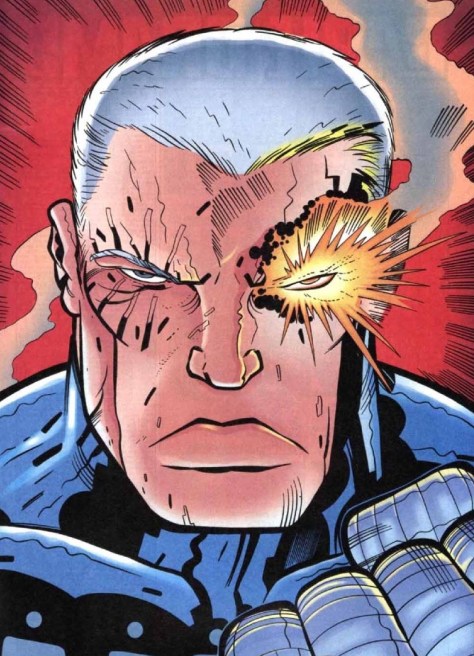
“Sometimes, there's a man. And I'm talkin' about the Askani’son here… He's the man for his time and place. He fits right in there.”
“Sometimes, there’s a man. And I’m talkin’ about the Askani’son here… He’s the man for his time and place. He fits right in there.”

Who is Cable? What is he? Why does he call himself that? Maybe in 1990 when the character was first introduced this was considered a suitably sci-fi term. The modern equivalent of calling a character “Plastic Man” in an era before that was a household name. Did this name say something about the character that was deep and meaningful? Was it the name of one of his weapons, maybe an artistic way of describing his method for traveling through time?

No, of course not.

Cable is what you would call yourself if you had been raised two millennia into the future. This is the same reason his arch-foe (and one of several clones) is known as “Stryfe.” These people are as separated from “today” as “today” is from the beginning of the Common Era. Cable is a character that everyone recognizes, comic fan or not, even though he has avoided the Silver Screen for seven X-Films and counting. For me there is no more interesting take on the character than his extended tour of the Marvel Universe in the artistic styling of Jack Kirby.

The energy radiates from the center, reaching out at the reader and almost into their world. The mark of the King.

The Hellfire Hunt is a story from 1997 written by James Robinson. Halfway through, after issue #50, scripting duties switch to Joe Casey. From then until issue #70, in August of 1999, Casey and artist José Ladrönn put their mark on the Man With Many Names. The run was bookended by extended crossovers with the plethora of other X-Titles, from Operation: Zero Tolerance (itself spinning out of Onslaught) to the Apocalypse centered The Twelve soon after its end. In between was an attempt to define the character of Cable in a way that made him grounded and believable, or in other words, in the Marvel way.

In addition to the extended X-Family (for the most part) there is no appearance by X-Force, the child soldiers that Cable usually drags into dangerous war zones, or Rob Liefeld, Cable’s self-appointed ‘sole creator.’ The Rob would eventually bring back the expected trappings of the franchise but in his absence Casey, and especially Ladrönn, build a supporting cast unique to Cable including re-introducing Nate’s own personal Yoda, Blaquesmith, and the aforementioned former gossip columnist Irene Merryweather, as well as the brand new love interest, and confidante, diner waitress Stacey Kramer.

Every Kirby story is a love story. He co-created the Romance Comic because he understood that having someone to fight for was the only thing that mattered.

Over the course of these twenty issues Ladrönn’s depiction of Cable, and the world he inhabits, comes to resemble one drafted by Kirby. The King himself passed away in 1994 so this type of tribute would not be uncommon except that Cable, and the Modern X-Men in general, had nothing to do with what he had come to stand for. This appears to be envisioning what Cable would have been if Kirby had created him at the peak of his career.

A time-traveling, cyborg with a Messiah Complex, locked in an Eternal Struggle with a being destined to conquer the world and subjugate its people. That feels as if it could have been a pitch for a story Kirby never got around to putting down on paper in the years after he left Marvel in search of the greener pastures he never found.

For reasons none too important to the overarching plot Cable finds himself in the nation of Wakanda fighting Ulysses Klaw alongside the Black Panther. A few issues later he engaged in the defining conflict of the run in a fight against Jack Truman, Agent 18 of SHIELD. An appearance by the newly revitalized Mighty Avengers closes out the run featuring Kirby Classics such as Captain America and Thor. This resembled a comic done in the Mighty Marvel Manner at a time when nothing else the company put out really did. Even non-Kirby, but classic nonetheless, vintage characters such as Zzzax and the Tinkerer make appearances. They are not furthering the plot, but rather showing how rich and imaginative a world Cable occupies.

If you touch your chest, hear a “tek” sound, and begin spewing acid from your fingertips then you were probably not invented by someone who left to create Brigade.
If you touch your chest, hear a “tek” sound, and begin spewing acid from your fingertips then you were probably not invented by someone who created “Brigade.”

A year and change after the bankruptcy that nearly buried Marvel, and comfortably before the movies would start to shape what the company would become, Cable takes a tour of an older version of the Marvel Universe, one not seen in some time. He himself gets a streamlined, shoulder-pad-less redesign that allows, as all Kirby characters must, to be in constant motion and bristling with power. The tons o’ guns are stripped away as this Heroic Quest sees Cable wield the Psimitar, a future-tech spear capable of focusing his advanced telekinetic abilities into Kirby Krackle. The static, cold images that had come to define the character up until this point are forgotten as Cable genuinely struggles with whether or not he can really save the future, a fight that seems u winnable and a task that seems unsurmountable, even though he can remember what happens if he fails.

Kidding. We all know what happens if he fails: Everyone is slowly murdered by the Mutant Robo-Pharaoh. Why has anyone ever wondered why we enjoy these comics?

I am not sure whose idea it was to go down this road but it does not happen all at once. Ladrönn had been involved with the title before Casey arrived and the latter went this route again with his later Image series Godland (I am not putting a “0” there, but you may need one if you want to research the series). Does the fact that no one else was doing overt Kirby homages on a regular basis make the issues worth seeking out, or picking-up discounted at least?

Yes and no.

This is one of the few full runs of Cable I have read but was by far the most rewarding. The aesthetic got me in the door, so to speak, but the character does not keep me there. Ladrönn clearly has a love for these particular layouts and design work. There are ways of presenting a story and moving events forward that only ever seem to appear in those older books. Figures in motion stride through scenes of intense action oblivious to “cool” poses and the constraints of the page. Not to say that the genre as a whole does not pull plays from the same book but these are specific, and in some cases too much so, references the work of a single man.

Ladrönn at one point, before the Kirby homages are overt, places a panel of only Cable’s foot in motion in the midst of an action scene. This warrants a caption box, with a message from the editors, stating that “we’re not really sure why Ladrönn put this panel here, but it was too fun & wacky to take out.” Fun. Whacky. These things have no place within our comics, clearly. This is how far the expected conventions had moved. Panels are mere recommendations to the characters and the Kirby Krackle is everywhere. This constant love and affection is also how they begin to lose their appeal.

…in the pages of Deathlok if I am not mistaken. “M-Tech” was an odd publishing line but at least it had a techno-organic monkey.
…in the pages of “Deathlok” if I am not mistaken. “M-Tech” was an odd publishing line but at least it had a techno-organic monkey.

There is a love here, but is there an understanding? Casey’s name is attached to many beloved runs in superhero comics as well as under the radar projects that remain fan favorites. The main pitfall I have come across that prevents me from embracing his work is that he never quite seems able to keep up with his own ideas. Superhero comics can be dense. Packed full of characters, ideas, and images that combine through the act of reading to form entirely new experiences. They should not be stagnant and they cannot to waste space. Casey does not seem to spend the time giving Cable, or any of the other characters, enough to do. He is not very imaginative when it comes to creating new ideas or concepts and he certainly does not seem to maintain the primary rule of a Kirby Comic: Create!

Jack Kirby created at a rate that far outstripped his peers. Physical number of pages (at one point Kirby was personally responsible for more titles per month than the Liefeld’s Extreme Studios), concepts, characters, and plots. Not only are the Marvel Age works with Stan Lee responsible for most of what we still read today but each of Kirby’s series after showed that the act of creation was the most important aspect of the work. A book such as The Demon has new villains and foes each issue, new obstacles to surmount. For good or bad (and many are not going to be action figures or cartoons any time soon) they were there. Jack acting as midwife to world after world from some unknowable higher power.

I cannot fault someone for using a Black Bolt pose but the panel to the right features more new character in a single instance than were created over the entirety of this Cable run.

Casey’s primary contribution to the Cable Mythos is the Harbinger of Apocalypse, whose origins are actually steeped in Robinson’s final story (he was also responsible for Merryweather). The otherwise unnamed Victorian Era waif (he has a strange origin that still manages to feel unoriginal) provides the primary physical threat that hangs over the main story. No motivation, or real defining characteristics, just something for the hero to rail against. Another character, Blockade, is introduced as a MacGuffin for Cable’s Titanic Team-Up with his former beau Domino. I never got the feeling that this team could not create new characters but rather would not. I am not sure why as this was not the X-Market of today where all the good characters have their movie rights absorbed by 20th Century Fox.

There is also not a constant stream of creativity reflected with the use of classic characters. This is the SHIELD exactly as Kirby drew it back in the day. Same line work, same designs. The same goes for Klaw, Black Panther, and even the Master Man (in a Golden Age flashback story). I applaud the revisiting at a time when everyone else seemed to have no interest (had I read these at the time they would have been my first introduction to Kirby’s aesthetic) but I mourn the loss of opportunity. Who knows how much more enjoyable, and re-readable, this run on such an otherwise uninspired title would have been had the creators channeled the spirit of the man they honored instead of merely what they saw in his work?

My favorite parts of this run are the exclamations. Paramilitary guerrilla fighters from the Fiftieth Century shout “Oath!” and swear “By the Bright Lady!” more than you would think.

Part of this is shown in the use of Apocalypse. Throughout the run there are vague allusions to a time, coming soon, when “Dayspring” will have the chance to complete his mission by ending the potential future reign of terror in the here and now. Presumably this was supposed to tie-in with The Twelve but if you remember reading that story you will probably also remember not caring all that much about what happened in it. Here Apocalypse haunts the background, hinting at a Master Plan and moving pieces into position. Anywhere else this would be just one more subplot but here the regularly overt character is reimagined as a subtle dark-skinned man in a suit. He arrives, seemingly from nowhere, with the reader and heroes knowing nothing of what he has planned.

When something similar to Apocalypse’s traditional form makes an appearance it is as a flashback (to far in the future) or when a character is describing him, as a threat hiding just out-of-sight waiting to usher in an eternal darkness from whence there is no escape. This teases a character who had been around for over a decade and lays the groundwork for an actual arc. Apocalypse, though never in on the action, appears as a genuine threat that Cable, heavy-hearted, must face or else face the doom of every single person he meets as well as each and every descendant they cannot possibly be aware of. For a character with more conflicting backstories than Hawkman, and an opponent that had been more Action Figure than realized person up until this point, this presentation made me genuinely interested in what would and could have happened next.

Kirby missed out on his chance to design Apocalypse (he did not stay on the original “X-Men” title, that he co-created, long enough to work on most of what is associated with that franchise) but here we see what may have been. If nothing else this is a version of a popular villain reimagined based on how Kirby approached his work in general, with the incredible scope of an endless world. There is a sense of dread permeating the way characters discuss Apocalypse that cannot be matched by all the times he has been shown monologuing about a Middle Schooler’s conception of Darwinism. Apocalypse (a character I love no matter what I seem to be indicating here) is often drawn as this mishmash of different concepts, none of which stand on their own.

From the future? Yes. From Ancient Egypt? Yes. A mutant? Sure. Access to unlimited Celestial technology? Appears to be the case.

Here we have a rather mundane man you would not look at twice and a walking natural disaster on par with any of the Cosmic Threats of old Marvel. The sense of scope has been retained and the character never risks becoming mundane. Bruce Banner and the Hulk, Jason Blood and the Demon. The works inspires your mind to fill in the gulf between the two and therein lies the beauty of what Kirby always did: Making the reader see the world for what it could be regardless of how it actually was. Joe Casey and José Ladrönn understood that more than most and while they worked with Nathan Summers they showed us what could be.

At one point a character refers to him as “The King of All Lies.” Looking upon this visage convinces me that we may still not have seen his true form.

AlieNation: Skrull Kill Krew by Emily Scott

Greeting, Legions, and welcome back to Madness Month here at The Unspoken Decade! I don’t know that I truly understood the meaning of the word “madness” until I experienced a certain ongoing basketball tournament Dean Compton-style, complete with days of games on multiple screens and more junk food than anyone in their right mind would ever consume, but now I am well prepared to take a look at some lunacy in the comic book realm. If you haven’t already, I strongly encourage you to take a glance at Dean’s take on Ghost Rider #33 and Darry Weight’s Venom: The Madness, but if you’re in the mood for madness of a slightly more irreverent nature, there’s no better place to turn than 1995’s Skrull Kill Krew.

Created by writers Grant Morrison and Mark Millar and artist Steve Yeowell, Skrull Kill Krew was published under the short-lived Marvel Edge imprint, which included many established Marvel titles like Ghost Rider, Punisher, and Daredevil. As the name would suggest, and since it was practically the law in the mid-90’s that things be made more extreme, Marvel Edge trafficked in edgier fare, and Skrull Kill Krew is nothing if not on the fringes of normalcy. From the first cover, it’s obvious this comic is going to have some fun and not be too concerned with how it goes about doing it.

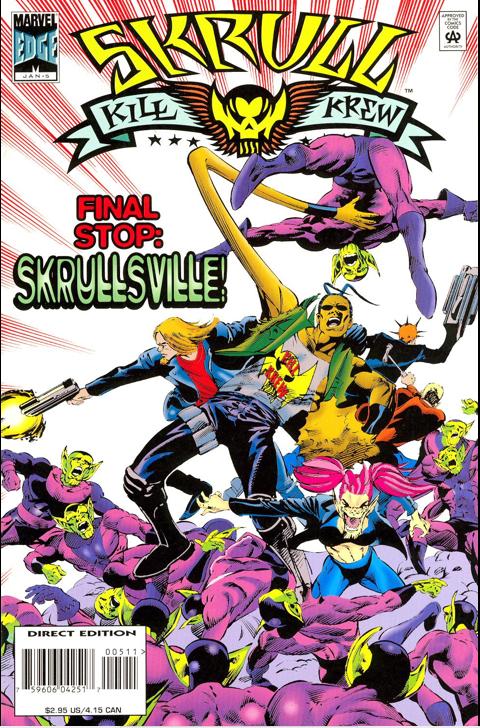
Skrull Cover
This is a great cover for this book – it perfectly captures its tone and content…but I can’t stop fixating on there only being two ellipses. WHY? If I ever stop being bothered by things like that, it will be the first indication I have been replaced by a Skrull.

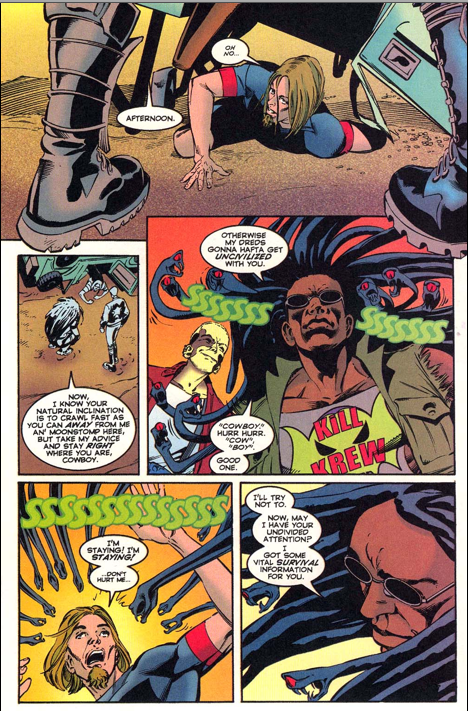
We first meet Krew members Ryder and Moonstomp, who bust in on a history class, blow away the teacher, making the “she’s history” joke you totally see coming but would be disappointed if it weren’t there, take out a student, announce they were aliens, and dismiss class more flamboyantly than anyone since Alice Cooper. It’s a fitting introduction for this motley Krew because it’s exactly what you’ll get a lot more of in the rest of the books. Not to say that there is no depth to this series, but it doesn’t deviate far from the pattern of find Skrulls – make snarky quips – violently dispose of Skrulls. It’s entertaining, but anyone looking for something more probably wasn’t paying much attention to the cover up there when they picked this up.

One other thing the Krew does is recruit new members, but considering their recruitment techniques don’t look terribly different than their Skrull extermination techniques, their potential members can be a little reluctant. Dice, a surfer dude who has been experiencing strange visions and mood swings, runs from them, quite understandably so, as the Krew has shot his girlfriend after announcing themselves as “two seriously violent individuals” and started chasing him down with all the subtlety you would expect from people who mow down alien infiltrators in crowded public places.

Skrull Dread
I’d like to read the issue where they just can’t figure out why they aren’t meeting their recruitment goals.

The smarmy blonde British guy is Moonstomp, who we learn is a white supremacist who likes to deal out his violence with a claw hammer even though he could morph himself into any weapon. The black guy is Ryder, who we infer hates Skrulls enough to work with a white supremacist to take them out. The title doesn’t last long enough for them to get much character development beyond that, but the story doesn’t particularly demand any more of them.

Their partnership exemplifies some of the best and worst of humanity, something simultaneously beautiful and ugly. One on the one hand, it’s comforting to think that if there were an outside threat, we would put aside our differences and work together as a species to ensure our own preservation. On the other, it’s disheartening that it might take something decidedly more foreign than people of other races to make us finally set aside those prejudices and come together as one human family. I said that this story was not without depth, but this is the sort we get – not really examined in any meaningful way but there if you care to look for it.

Skrull Depth
The only depth they’re concerned about is how deep they’re burying these Skrulls, amirite??

In the second issue, we get an explanation of the Krew’s origin and powers. The gist is that in the 60’s, the Fantastic Four defeated some Skrulls impersonating them. Reed Richards, demonstrating what Ryder rightfully calls a “highly idiosyncratic sense of humor,” hypnotizes them into thinking they are cows and left them to graze. (You know you’ve read too much Greek mythology, when you find yourself wondering if Mr. Fantastic planned on boning any of the bovine.) During the Kree-Skrull War, they were changed back into Skrulls, but this time when they were defeated and turned back into cows, the Alien Activities Commission decided to do something weird and gross and send the cows to the slaughterhouse.

Skrull PETA
PETA would have a field day with this.

Those cows were turned into burgers, and some of the people who ate them died, some were unaffected, and some, our protagonists, were infected by the Skrull meat in a way that gave them powers like shape-shifting, ability to detect Skrulls, and near indestructibility, as well as an increasingly violent and irrational urge to off the Skrulls. The unfortunate side effect, though, is a bad case of dying soon, as the virus eats all of someone’s brain tissue in a few years. (This comic was created at the height of the Mad Cow Disease scare in the UK, and while it doesn’t necessarily have anything profound to say about media-induced panic or the horrors of mass food production, it capitalizes well on that panic, and using the cows was a clever way to integrate an older, fairly minor idea into the modern world.)

Just as the Fantastic Four all got different powers as the result of their exposure to cosmic rays, so too do the Skrull Kill Krew get unique powers from their Skrullovoria Induced Skrullophobia that reflect their personalities. Spiky haired punk rocker Riot, named because she is a Riot Grrrl and this is the super 90’s, transforms into a huge prickly insect. Dice’s powers manifest at random. Catwalk, the supermodel, turns into a giant cat. The most compelling affect of their powers, though, belongs to Moonstomp, who appears to be the only one exhibiting any of the degeneration yet. He has multiple dark patches on his body that are spreading, and it would have been interesting to see if a fairly flippant book would have handled a white supremacist turning black with any kind of subtlety.

Skrull Spread
Who would have thought that the most controversial thing about this would end up being the mention of Bill Cosby?

It’s not just playing on the idea of Mad Cow that makes this comic feel so much like a product of its time. In fact, of all the 90’s comics I have looked at for The Unspoken Decade, this might feel the most 90’s of all. It’s more than the “edginess,” the over the top violence, or the fact that the Krew all look like they stepped straight off the set of Hackers. There’s something about the anything goes, nothing-to-lose, nihilistic tone that transported me straight back to the mid-90’s, but it’s hard to separate how much of that is the comic, about a group of invincible feeling young people, and how much of it is a product of the fact that the height of my own invincible feeling growing up took place in the mid-90’s watching movies like Natural Born Killers and talking about how nothing really mattered.

Skrull Hackers
In addition to Moonstomp and Ryder, our Krew is rounded out by Baby Spice, Annie Lennox after she stuck her finger in a light socket, and…an amalgam of every character Matthew Lillard has ever played.

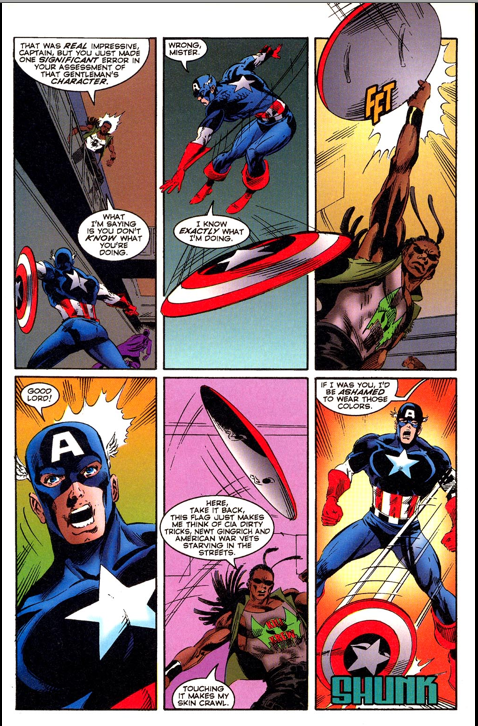
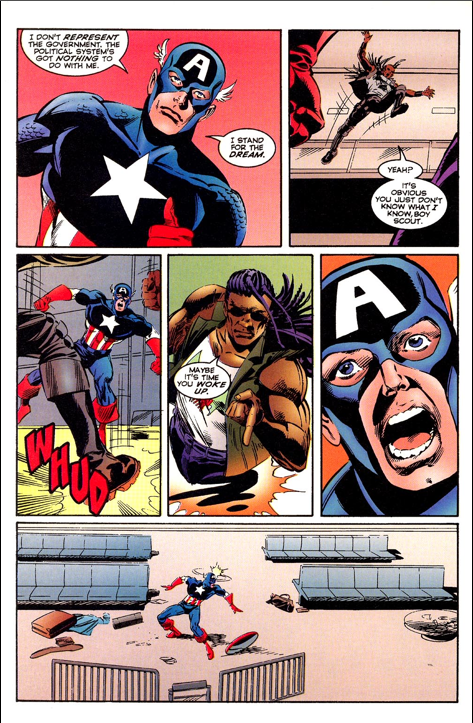
Something decidedly un-90’s in this comic is an appearance by the Man out of Time himself, Captain America, which feels incongruous for a number of reasons other than time. Not only does Captain America have a completely disparate mood from Skrull Kill Krew, but, as Dean pointed out when we were puzzling it over, if they were trying to use a big hero to sell more books, someone like Wolverine would have been a better option in 1995. It’s possible they used Cap just because he would have been such a random choice. It’s also possible they use him specifically because he represents an old-fashionedness and supposed conformity they were trying to flout.

The last reason would make the most sense to me because it would explain the diatribe below by Ryder that doesn’t really fit into the rest of the book otherwise. I can tell I’m no longer my younger cynical 90’s self because instead of thinking, “Yeah, you tell that old jingoistic bastard!” I just wanted to yell at Ryder not to talk to Captain America that way. I also want to balk at the idea that he could handle Cap so easily, but I suppose this is his comic and all.

Skrull Cap 1

I can tell I'm no longer my younger cynical 90's self because instead of thinking, "Yeah, you tell that old jingoistic bastard!" I just wanted to yell at Ryder not to talk to Captain America that way.
…then Ryder stormed off to blast Rage Against the Machine and talk on the phone about how Cap just doesn’t, like, get it, man.

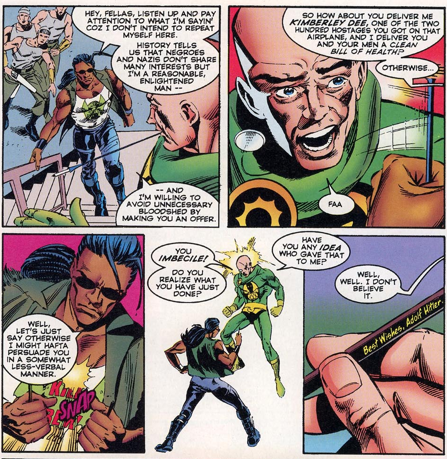
The actual storyline involving Captain America doesn’t seem especially important, but the book gives the impression that it might have led to something significant had it continued. Basically, the President of Slovenia is flying into America, and Cap is at the airport to greet him. Baron von Strucker has other plans, though, and intends to take the president, and Slovenia, for himself. The Krew show up looking for Catwalk, who happens to be on the same plane, and realize the president is a Skrull. Strucker buggers off when he sees how many superpowered people are about, and the Krew, realizing the president is Skrull, tussle with Captain America, who thinks he is just protecting an important person. Oh, those wacky superhero shenanigans! Cap tells Nick Fury what happened, and Fury divulges that he knows exactly who Ryder is.

That revelation seems to be the most important part of the whole story, since it teases an even bigger reveal about Ryder, but I suppose that reveal will have to forever reside in Speculation City. At least we get this great moment with Strucker. Take that, fascist:

I feel like that impersonal message is the Nazi equivalent of Hitler writing "Have a nice summer" in your yearbook.
I feel like that impersonal message is the Nazi equivalent of Hitler writing “Have a nice summer” in your yearbook.

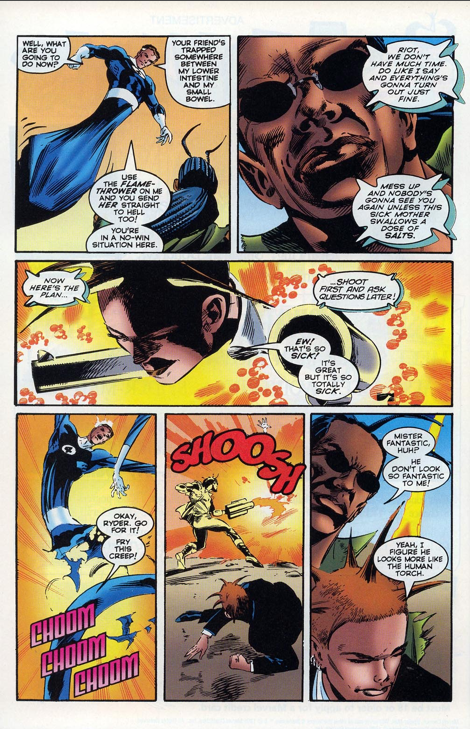
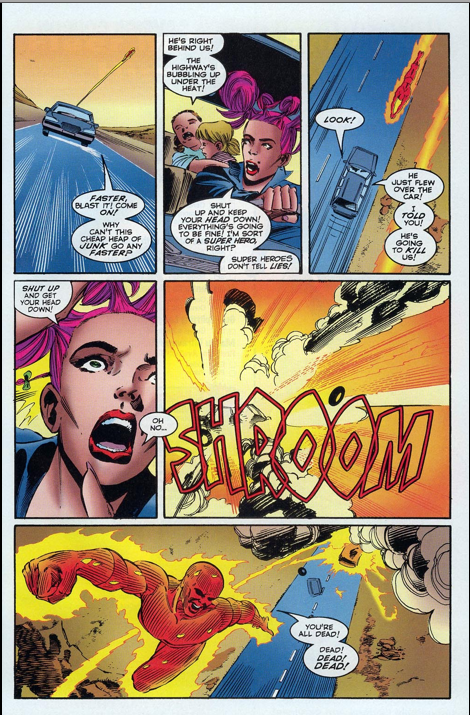
The other big cameo in these issues is the Fantastic Four, which makes sense, since Reed Richards’ actions caused this whole chain of events in the first place. The only problem is that it’s not the Fantastic Four at all; once again, those menacing Skrulls have impersonated them. There is some nice Twilight Zone-esque stuff at the beginning of the comic as we see a town completely get taken over by Skrulls from the perspective of a traveling salesman, but otherwise, there isn’t much in the way of plot to get in the way of multiple pages of the Krew beating up on the Fantastic Four replacements.

Skrull Four 1Skrull Four 2

Even for an evil alien, that Skrull Human Torch is just way too stoked about them being dead.

Once the Krew have dispatched with the Fauxtastic Four, they turn their attention in the last issue to the town, which has been entirely replaced with Skrulls. This title was originally meant to be ongoing, but when it was cancelled, editor Tom Brevoort convinced Marvel for one more issue, making it into a mini-series. While it’s always nice when series get a resolution, Skrull Kill Krew has so little going on in terms of plot or character arcs that it’s really a resolution in name only. But when the majority of its action involves the killing of as many aliens as possible, I suppose there could be no better resolution than the all out mayhem that accompanies the mass slaughter of an entire town of them.

Skrull Kill
Pictured: the entire comic. Seriously, nothing happens in this issue except this gang killing an entire town of Skrulls. That’s it. It’s all variations on a theme.

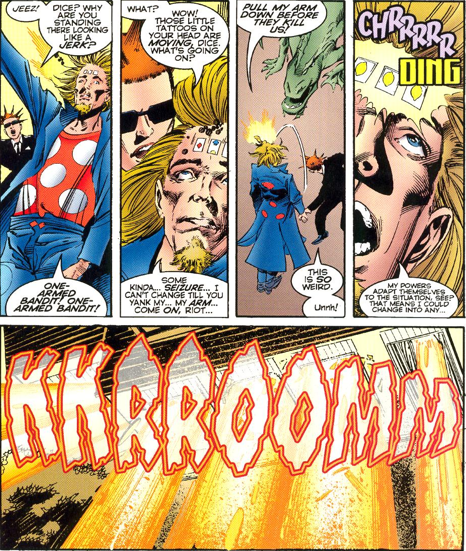
I hope when I keep saying that there isn’t much going on plot-wise that it doesn’t come off too disparagingly because the other thing completely lacking in Skrull Kill Krew is pretense. It never once tries to be something it’s not, not for a moment, so while it’s most decidedly not a masterpiece, it most certainly is what it sets out to be, which is a rollicking good time. The sort of comic where you can kick back and enjoy some wanton destruction and not bat an eye because someone’s powers, which they acquired by eating ground up alien, cause them to turn into a human slot machine whose jackpot is becoming pure energy. Yes, that happens:

I would never joke about something like this.

It might not be a huge letdown that the series didn’t go on longer like some other comics I’ve read recently, but it is nice to know the Krew made a reappearance in Secret Invasion and got a second mini-series in 2009. What was even more intriguing, but also slightly disappointing, was learning that there was talk of making a Skrull Kill Krew television show, which would be the perfect medium for this bunch of freaks. Had it been made, I’m sure it would have held a plum spot on the list of shows from my adolescence that were cancelled too soon.

I hope you’ve been enjoying Madness Month here at The Unspoken Decade, which will conclude with the maddest thing yet! Dean Compton will be allowing an interloper into our midst, one Mr. Paul O’Connor from Longbox Graveyard, to discuss his view on 90’s comics. If you don’t know some of Dean’s thoughts already, you might have forgotten what website you’re currently on, but Paul is a Bronze Age guy, so opinions may vary wildly! You don’t want to miss it!


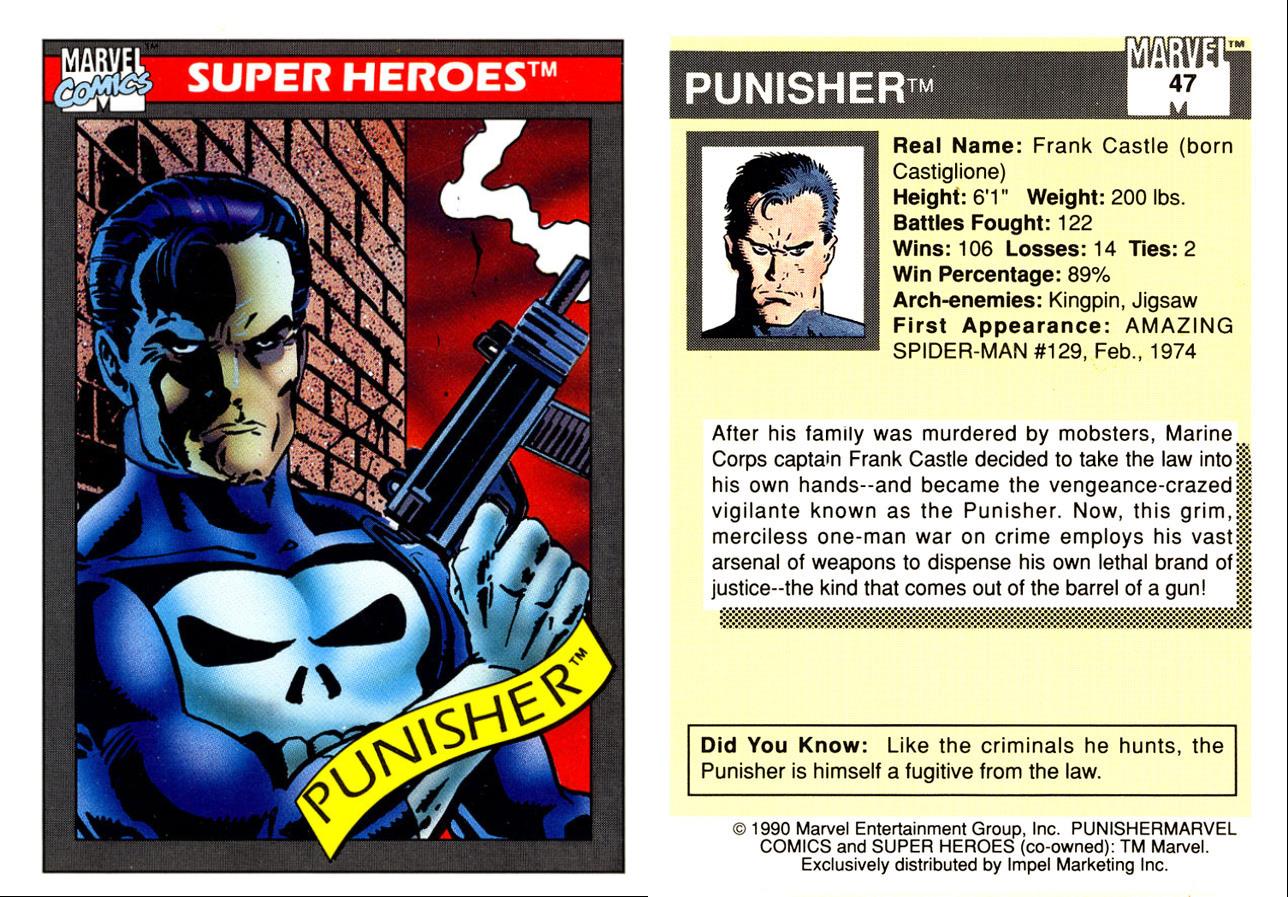
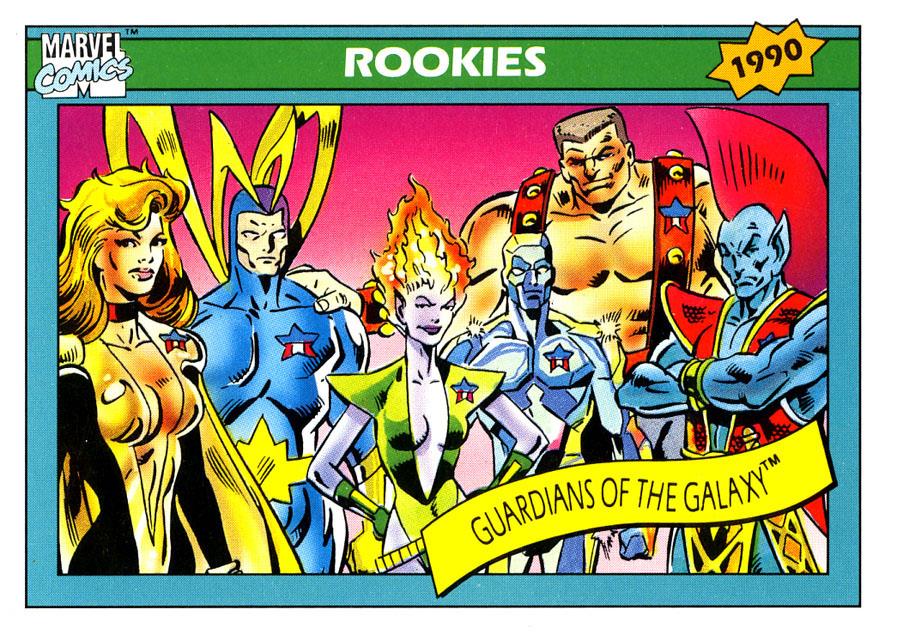
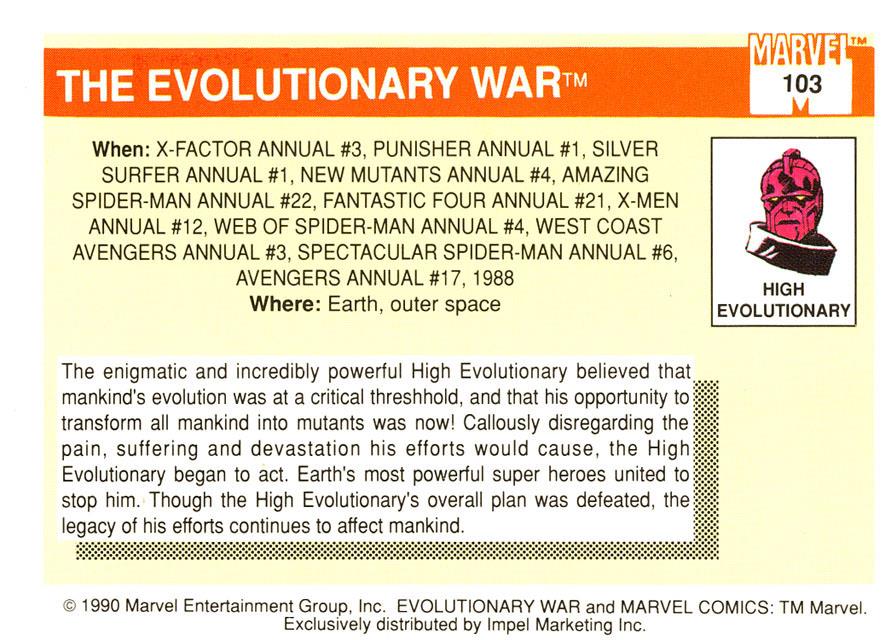
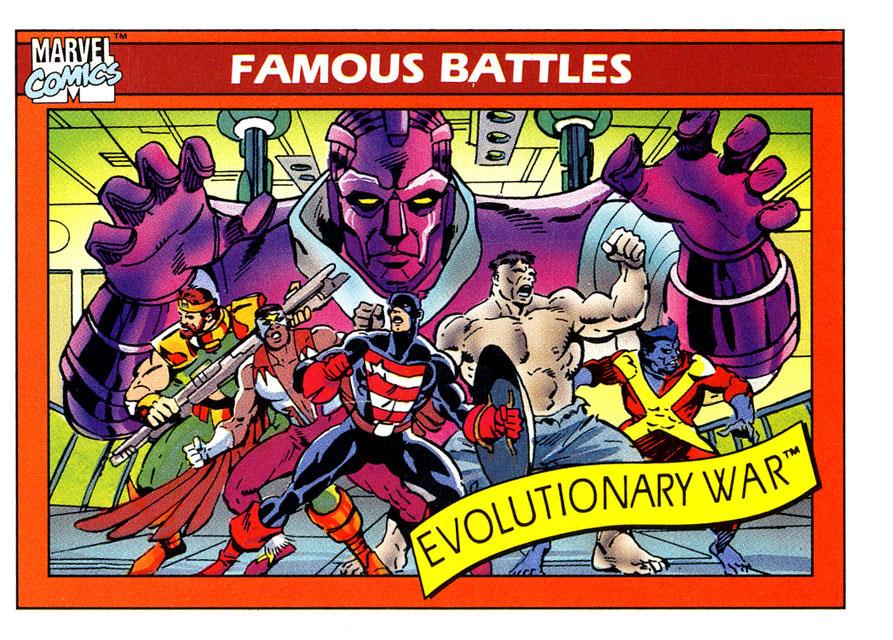
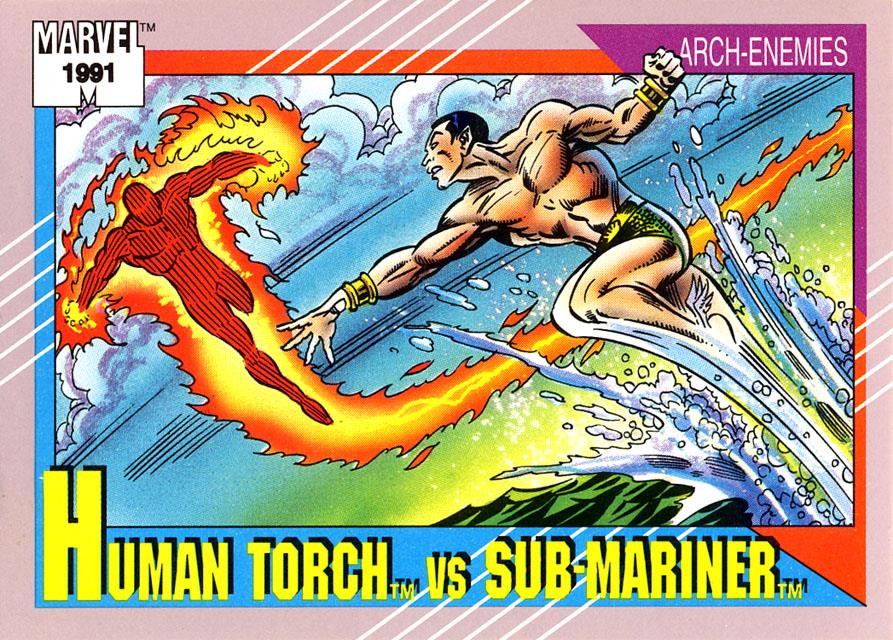
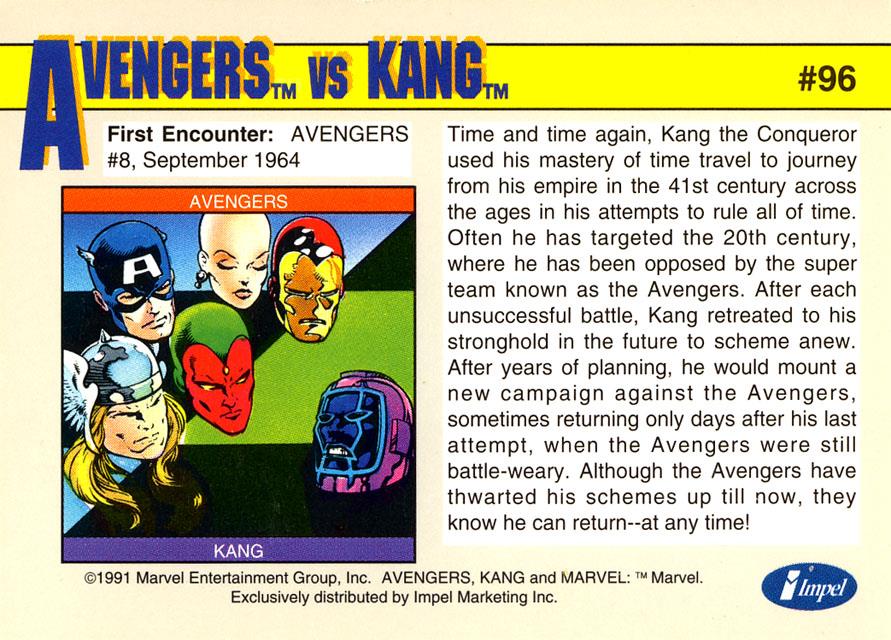
Marvel Trading Card Gallery!

Hey there everyone!  We have had some issues here at The Unspoken Decade.  As most if you follow me on Facebook are aware, my Grandma has been in the hospital for a few weeks, and I have been up and down the highway to see her.  I was going to start a summer long project in today’s entry, but as it is, I just have not had the time to give you guys the article you deserve.

The good news is Grandma’s health is looking up, and so I can get started on a terrific summer project, as The Unspoken Decade invites you to enjoy The MC2 Summer!  Spider-Girl, J2, A-Next, Fantastic Five, and Wild Thing will all get looked at in a 5-part series!  That’s in addition to Angel Hayes continuing her great works here, and we can expect to see an article from Emily Scott about once every six weeks!  The Unspoken Summer starts next week, but don’t leave it unspoken, tell everyone about it!

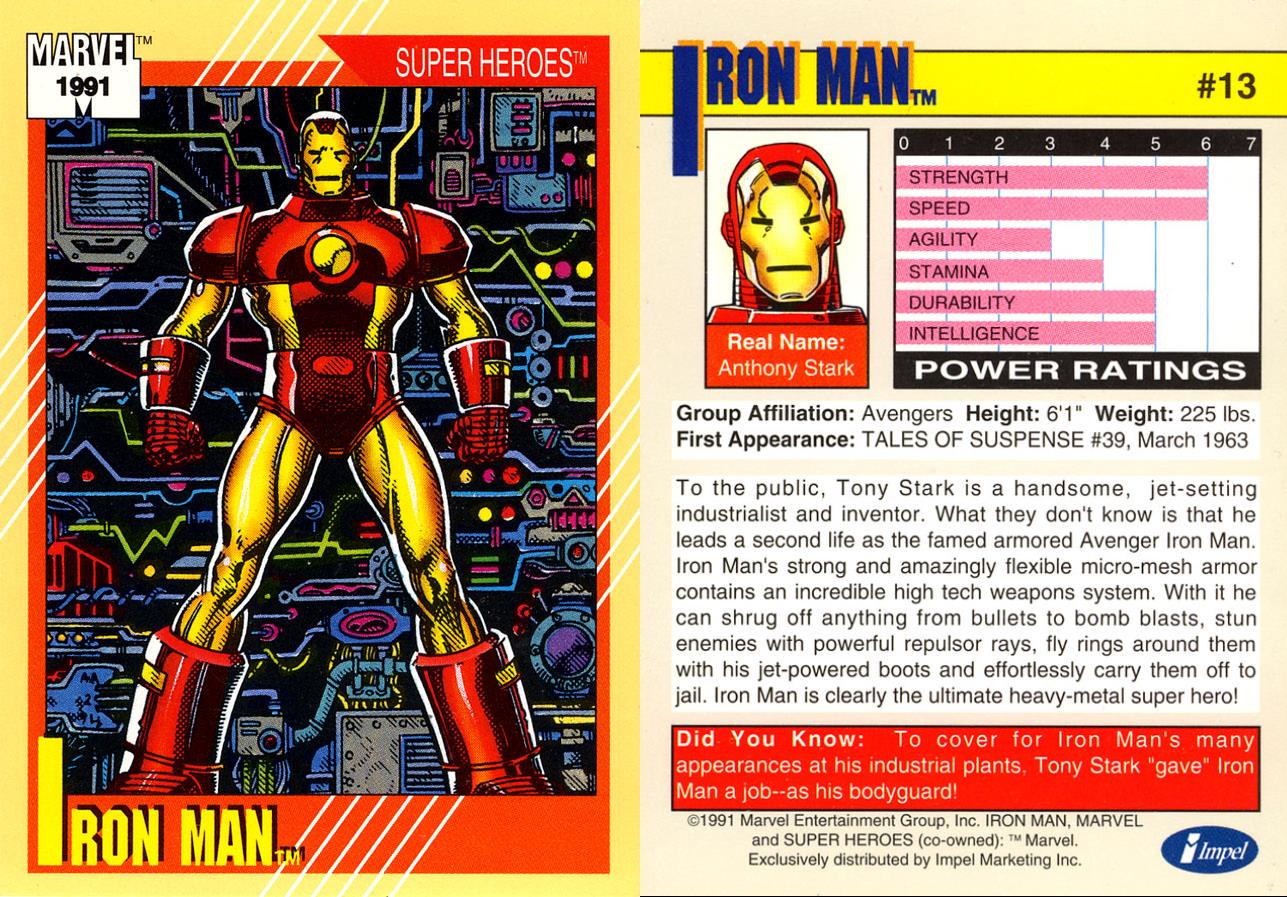
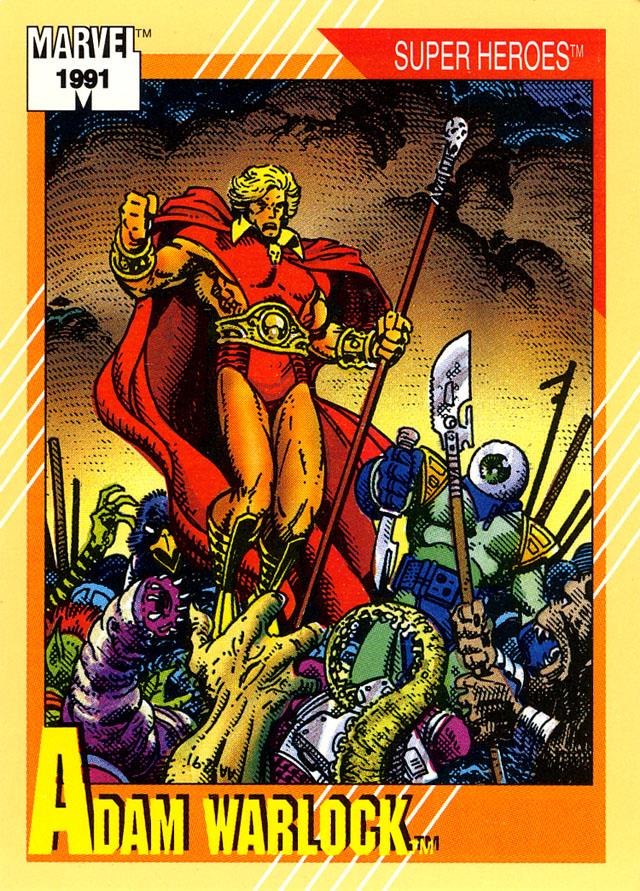
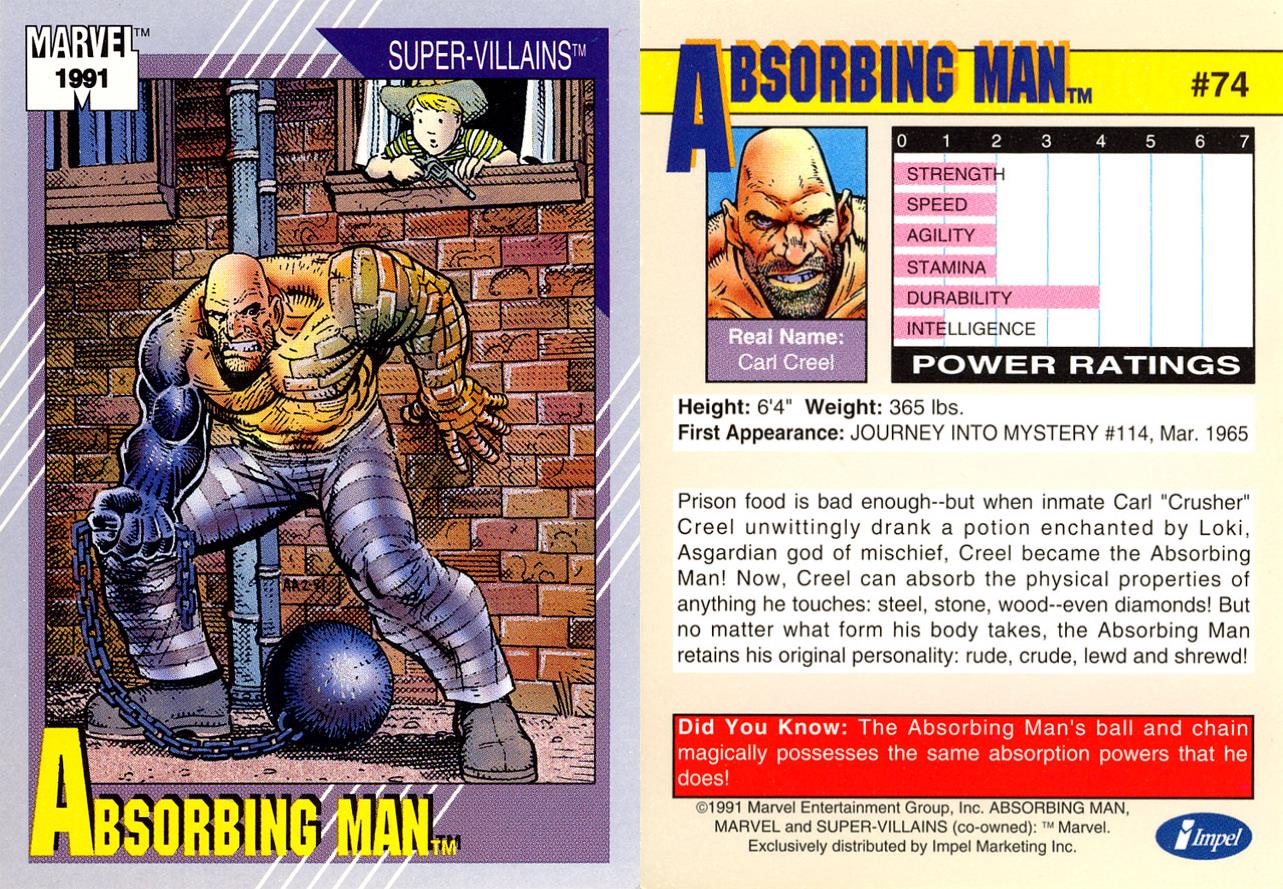
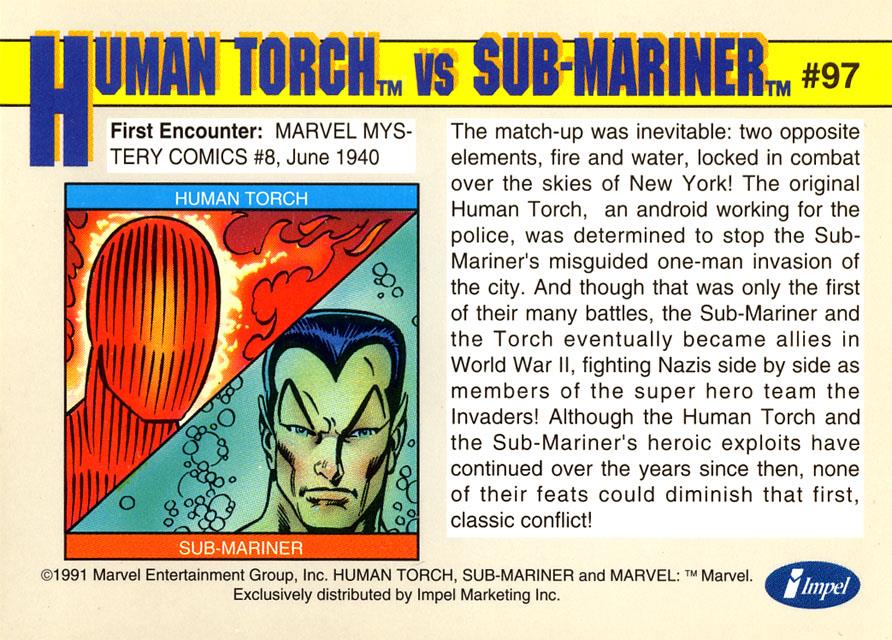
In the meantime, enjoy a cool gallery of some random Marvel Trading Cards!  We’ll see you next week folks!

Marvel Universe Trading Cards - Series I (1990) - Page 59 Marvel Universe Trading Cards - Series I (1990) - Page 61 Marvel Universe Trading Cards - Series I (1990) - Page 93 Marvel Universe Trading Cards - Series I (1990) - Page 173 Marvel Universe Trading Cards - Series I (1990) - Page 167 Marvel Universe Trading Cards - Series I (1990) - Page 206 Marvel Universe Trading Cards - Series II (1991) - Page 7 Marvel Universe Trading Cards - Series II (1991) - Page 11 Marvel Universe Trading Cards - Series I (1990) - Page 157 Marvel Universe Trading Cards - Series I (1990) - Page 153 Marvel Universe Trading Cards - Series I (1990) - Page 149 Marvel Universe Trading Cards - Series I (1990) - Page 137 Marvel Universe Trading Cards - Series I (1990) - Page 195 Marvel Universe Trading Cards - Series I (1990) - Page 196 Marvel Universe Trading Cards - Series I (1990) - Page 205 Marvel Universe Trading Cards - Series II (1991) - Page 169 Marvel Universe Trading Cards - Series II (1991) - Page 153 Marvel Universe Trading Cards - Series II (1991) - Page 77 Marvel Universe Trading Cards - Series II (1991) - Page 25 Marvel Universe Trading Cards - Series II (1991) - Page 27 Marvel Universe Trading Cards - Series II (1991) - Page 87 Marvel Universe Trading Cards - Series II (1991) - Page 99 Marvel Universe Trading Cards - Series II (1991) - Page 41 Marvel Universe Trading Cards - Series II (1991) - Page 57 Marvel Universe Trading Cards - Series II (1991) - Page 115 Marvel Universe Trading Cards - Series II (1991) - Page 129 Marvel Universe Trading Cards - Series II (1991) - Page 59 Marvel Universe Trading Cards - Series II (1991) - Page 65 Marvel Universe Trading Cards - Series II (1991) - Page 147 Marvel Universe Trading Cards - Series II (1991) - Page 199 Marvel Universe Trading Cards - Series II (1991) - Page 194 Marvel Universe Trading Cards - Series II (1991) - Page 193 Marvel Universe Trading Cards - Series II (1991) - Page 192