The World You Have Always Known is Born Part 5-MC2 Universe featuring Fantastic Five!!!


Welcome back, folks, to the greatest 90’s comic book blog you’re gonna find on the interwebs!  I hope you have enjoyed Emily’s work on Enigma the past two weeks.  Enigma happens to be one of my all-time favorite comic books, but a few of you are probably ready for lighter fare, seeing as how Enigma makes David Lynch films look like Jennifer Aniston romantic comedies!  Picture Perfect, anyone?  Emily really brought it home on this one!  Enigma is a tough subject, but she handled it with aplomb, wit, and humor.  (Toss her a kudos when you can!) So now that your soul and mind have been permanently scarred by entities like Enigma’s Envelope Girl and the Interior League, I bet that you are ready for a return to the MC2 summer, and this week, I bring you Fantastic Five!

This title is honestly best known for being a continuation of Tom DeFalco’s less than heralded 1990’s run on Fantastic Four.  Many of his supporting characters are in play, including the villain Hyperstorm, Franklin Richards as a character named Psi-Lord, and Lyja, the Skrull that Johnny Storm married when she was impersonating Alicia Masters.  His run is almost universally reviled, except for the issues that introduce the New Fantastic Four, which are classic 90’s gold that we will definitely cover soon here at The Unspoken Decade!

I read DeFalco’s Fantastic Four when I first started collecting comic books, and to be honest, while I was not a fan, I did always find them entertaining.  Fantastic Four might be the most difficult book to work on in the entire industry.  Do the same thing over and over again, and you’ll be accused of plagiarizing Kirby and Lee; go too far way and you’ll be accused of not carrying on in the right vein.  DeFalco, even when he struck out, seemed to be one of the least intimidated by those ghosts.  He did what he wanted with the characters, and it always worked for me just a little bit better than his work on Thor.

That having been said, I have been more tired than a guy who has driven 1500 miles in one day of the MC2 Universe formula thus far, which has centered around three books about teenagers attempting to find their way in heroism.  It’s gold with Spider-Girl, silver with J2, and then tin with A-Next.  Certainly, A-Next has its moments, but it’s as tiresome as going to Wal-Mart on a Saturday afternoon by that third book.  Thankfully, this FIRST ISSUE’S COLLECTOR’S ITEM breaks away from that!

Surely by 1999 no one believed that a blurb bragging of a comic's collectability could be telling the truth?  I bet someone fell for it though, and I laugh as I picture them carefully putting away their copy of Fantastic Five as they dream of a giant Uncle Scrooge bank vault full of cash that they shall never have.
Surely by 1999 no one believed that a blurb bragging about a comic’s collectability could be telling the truth? I bet someone fell for it though, and I laugh as I picture them carefully putting away their copy of Fantastic Five as they dream of a giant Uncle Scrooge bank vault full of cash that they shall never have.


Man, Uncle Scrooge bank vault jokes are always funny.  What is it with them?  I hope they never lose that appeal because they’re a big part of my shtick!  Those jokes aside, I was prepared to really dislike Fantastic Five, but I was surprised.  This book isn’t going to set the world on fire or anything, but the first thing it does to make me enjoy it is that it gets away from that teen hero trope that has been dominating MC2.

The second thing it does is a really good job introducing the Fantastic Five to us.  Somewhere in the 90’s superhero comic books started taking it for granted that everyone who picked one up would just know who everyone was. Perhaps that’s because of the growing insular nature of the hobby – there were few impulse buys, save the already initiated, due to only being able to access comic books via the direct market…but I digress.  DeFalco takes nothing like this for granted:

Fantastic Five #1 - Page 2
I wonder if anyone ever got blinded by Human Torch’s signal and then caused a wreck. Do you think there are lawyer commercials for those hurt in accidents like this in the Marvel Universe?
Fantastic Five #1 - Page 3
How could this work? She’s a Skrull pretending to be a human. I bought a car earlier this year, and it took 7888 hours. They demanded all sorts of ID and income verification. She is not even human and pretending to be someone else; no way they can sell her a car.
Fantastic Five #1 - Page 4
Do bands practice in Gas Stations? Is that a thing? I have never been in a real band, so I need someone who has to tell me.
Fantastic Five #1 - Page 6
I like how the robot avatar of Reed is showing something that resembles brain matter because hey, he’s smart, and don’t you forget it!

So we have our heroes, folks!  Oh wait, I guess there’s one more we need to meet…

Oh Thing, always obsessed with your aesthetics.
Oh Thing, always obsessed with your aesthetics.  Also, that lady with the grey hair REALLY hates celebrities.  She looks like she had plastic surgery so her face would permanently sneer with disdain.

One thing that DeFalco always got right, both here and during his earlier Fantastic Four run, is the characterization of The Thing.  Ben Grimm is one of the most beloved characters in comic books for his fortitude, endurance, and cool looks, but I think we love him the most for his character, which is instantly instilled in us via his tough guy dialogue.

It’s easy to forget the fact that Ben Grimm is a smart guy.  He constantly deflects the intellectual challenges to Mr. Fantastic the way the manager of the high school basketball team never touches the rock without the permission of the star.  Permission I bet he never gets!  High school is unfair, and if you don’t believe me, you have plenty of MC2 books to check out that will back up this cliche.  I’d appreciate it if you’d wait to dive into those until after this article is over, though!  That’s not too much to ask at all! Besides, I’m getting back to Ben Grimm in a moment.

As I was saying before I so rudely interrupted myself, Ben Grimm’s dialogue may be the best in comic book history. With just a few sentences, this rock creature comes to life as whatever charmingly cantankerous role strikes your fancy.  Perhaps he is your uncle, your father, your grandfather, or a neighbor, but one way or another, you feel like you know The Thing.  No matter how much crazy cosmic stuff he gets exposed to, he always reacts just like that older guy in your life would!  I dare you to imagine your dad/uncle/grandpa/neighbor saying “What a Revoltin’ Development This Is” and not laugh.  I’ll wait.  So will Ben.

I guess you shouldn't wait too long or else we are going to see Ben kill Reed.
I guess you shouldn’t wait too long or else we are going to see Ben kill Reed.

The other thing that really makes Fantastic Five worth a look is a serviceable but interesting subplot about what happened to Reed and Sue Richards.  After all, this is causing lots of gossip in the science community.

I am very sure that one of the scientists speaking is a cuckold.  He's very obsessed with Reed's self-image as a man.  Just focus on the science, you skeevy weirdo!
I am very sure that one of the scientists speaking is a cuckold. He’s very obsessed with Reed’s self-image as a man. Just focus on the science, you skeevy weirdo!

Damn!  We’ve seen the Fantastic Four take on everyone from Mole Man to Galactus and come out more or less unscathed, so whatever happened to Reed and Sue must be serious business.  The craft on display on this page is subtle, yet brilliant.  By having the scientists discuss this, no matter how skeevily, it feel less like an infodump and more like two scientists just shooting the breeze about one of their colleagues.  If you have ever had a job or gone to school, you are more than aware about how gleeful it can be to just riff on the folks around you, and you are also more than aware about how awesome it can be just to OVERHEAR a good conversation between people about the weirdos.  Of course, few things hurts more than stumbling into that conversation and finding out it is about you.  That feels like a thumbtack point to the underside of your eyelid.  (I should apologize for that one; it hurt me just typing it.)

This conversation also recounted the original FF’s origin fairly naturally, so kudos to this one for bridging the past and the present so well:  two birds, one stone!  Unfortunately, other than Thing being Thing and this subplot, the series is full of villains that the FF (especially now that it stands for FIVE members on the squad) could defeat more easily than the Yankees could beat a little league squad.  Take this guy for instance:


Jesus, thank God most of the other Nice Guys from Ok Cupid don't know anything about super-tech doomsday devices.
Jesus, thank God most of the other Nice Guys from Ok Cupid don’t know anything about super-tech doomsday devices.

Am I really supposed to believe that this guy who can’t even conquer A DATE is going to defeat the Fantastic Four  Five?  And I don’t mean conquer as in make that lady bend to his will via his mastery of violence or hypnosis, but I mean conquer as in, you know, have one and know how to act on one.

That crime pays joke has to be a crime in and of itself as well, and I wish the FF would bust him for that alone.  For real, though, there’s just nothing about this guy or his smog monsters that screams threat to me, and if it does to you, I am not trying to mean, but you’re a wuss.  You can overcome that, and the first step is probably not letting wishes-he-could-date-a-supermodel-Ichabod Crane-looking-motherfucker intimidate you.

Despite his utter lack of ability to do anything, he actually manages to capture the FF at one point, and their only recourse is to allow Big Brain (what Reed is called now) to sacrifice his body to free them.  No worries, though, because Reed is a supra-genius who will just whip up another one.

That house ad at the bottom of the page seems to lack sincerity.  Are they trying to convince us or them that there will be another issue next month?
That house ad at the bottom of the page seems to lack sincerity. Are they trying to convince us or them that there will be another issue next month?

I would think Reed would have less trouble building better robots.  I mean, he’s smarter than God with one of those GIANT Texas Instrument calculators.  Remember those?  They had all those buttons, but all you ever did was play Snake and Tetris on them.  I did too, so no judgement from me.  Point being, Reed is super mega smart, even for a comic book character.  Maybe it ties into the subplot of what happened to Sue and him!  Even if it does, we have more easily-defeated villains to deal with first!

No one ever cared about the Wizard, right?  I hope not because I am about to really savage this guy, and I'd hate to hurt the feelings of BOTH of the folks who like The Wizard.
No one ever cared about the Wizard, right? I hope not because I am about to really savage this guy, and I’d hate to hurt the feelings of BOTH of the folks who like The Wizard.

I have never gotten The Wizard.  The first time I ever saw the guy was during the Acts of Vengeance crossover, and I wouldn’t see him again until this crappy game.  Don’t get me wrong, though, the arcade version of Captain America & The Avengers was awesome.  There is no version of The Wizard you could say the same about.  He’s just such a second stringer, and that second stringer is now multiplied by five.  I guess that’s appropriate because there are four five in the Fantastic Four Five, except that any member of any incarnation of this team could easily defeat The Wizard of this time.  I am even counting Fantastic Force members as having the ability to kick the hell out of The Wizard any time they wanted; I am even counting you, Vibraxas!

There is no way a guy named Vibraxas wearing that get-up gets to look that smug at anyone.  Let's all judge him back!
There is no way a guy named Vibraxas wearing that get-up gets to look that haughty at anyone. Let’s all judge him back!

Still, despite his shortcomings, Vibraxas could beat The Wizard so badly that “Wizarding” would become a gerund in The Official Dictionary of the Marvel Universe. (TRADEMARKED)  I just wish they could have used anyone in the Fantastic Four besides these guys.  Wizard and his flunkies just scream “guys the FF will have no trouble defeating.”

Wizard does help advance the subplot that is keeping this series interesting, though, so I guess he has that going for him.

Fantastic Five #2 - Page 22
What’s the deal with this “Wingless Wizard” nonsense? I have never seen this guy with wings. Did wizards at large have wings once? What the fuck does this mean?

Fantastic Five #2 - Page 23


Now we’re talking!  The Negative Zone!!!!  It doesn’t get more Fantastic Four Five than that!  Unless we are talking Galactus.  Which we aren’t…today.  The Wingless Wizard stuff still bothers me, and I think it will forever.  But before I wind up eternally mired in the bog of this comic book nonsense, I think it would be nice to note that Spider-Girl shows up in this short-lived series as well, which makes me happy.  Tom DeFalco does a pretty good job intertwining the MC2 Universe, especially when it comes to Spider-Girl and The FF.


Spider-Girl and Franklin Richards are butt-touch dancing!  Is this a disco?
Spider-Girl and Franklin Richards are butt-touch dancing! Is this a disco?

Unfortunately, Franklin Richards takes on Wizard’s Warriors with Spider-Girl. (I keep wanting to call her Spidey, but I am unsure if that’s allowed or not.  Someone who is a bigger fan of both Spider-Man and Spider-Girl should really let me know.  Please?) I have already proven the Warriors pack all the punch of an armless 2-year old.  I won’t go on again about how much I detest The Wizard and these minions of his, but I will say that I would have rather had Paste-Pot-Pete as a villain.  At least one of these jerks who are dressed like Wizard has a paste gun, evoking memories of the villain so awful he is awesome. Come on, how do you not like this guy?

That hat looks like he deflated a hot water bottle and then stretched the neck out.  I find it amazing, and if you're cool, you do too.  If you're not cool, GET OUT OF MY BLOG IMMEDIATELY!
That hat looks like he deflated a hot water bottle and then stretched the neck out. I find it amazing, and if you’re cool, you do too. If you’re not cool, GET OUT OF MY BLOG IMMEDIATELY!


Less of a threat than Wizard, but lots more fun to see for sure.  Also in the book where Our Gal Spidey (see what I did there?) teams against Wizard’s Warriors with Franklin Richards (who I will never call Psi-Lord, no matter how much he, this book, Marvel, or Tom DeFalco wanted me to because it’s just such a shitty name), we get to see a thinly veiled sex joke in a book that was part of a line aimed at kids to get them interested in comic books again.  First, though, the greatest chef’s apron of all time:

There's no need for me to make a joke here because you are still chuckling from reading that apron.
There’s no need for me to make a joke here because you are still chuckling from reading that apron.
Now you can imagine Skrull/Human sex.  Finally, someone who gets it.
Now you can imagine Skrull/Human sex. Finally, someone who gets it.


Aside from attempting to figure out how old is too old for a human to be to date and marry a Skrull, we also hearken back to a time when Skype was a technology for the far future that we may never see for at least 11 years. But the Fantastic Four Five’s Cyborg Thing can just whip out his laptop and get right on there to discuss his kids with his ex-wife, another subplot that you just know would have appealed to that kids market!

I don’t have an issue with these subplots so much as I think they belie what I understand was the ostensible reason of the line, which was to get kids to read comics without a lot of modern continuity baggage.  I just find the Human Torch/Lyja joke, while not terrifically offensive, just past the edge of a book for this stated purpose.  The Thing having custody issues isn’t going over that edge so much as I don’t think that kids, even kids of divorced parents like me, would find it interesting.  It is well done, though, and it gives us a different angle on the everyman nature of Ben Grimm that we love and adore so very much.  Perhaps this was just a subplot slipped in there for older readers to enjoy.  Superhero comic books, when at their best, appeal to readers of all ages, and this certainly would be something for a slightly older crowd.

The secret of why Reed is beaming his thoughts to an automaton and what happened to Sue Storm is revealed in the fourth issue of Fantastic Five (you get it already, so no more strikethrough), and it is quite a doozy to say the least.  Doozies always seem to be “quite a”.  Is there ever a doozy that doesn’t measure up?  I know one, and I will introduce you to him right after showing you the snazzy cover to Fantastic Five #4!

Fantastic Five #4 - Page 1
That’s one creepy looking Eyes Wide Shut stalker guy.

The creepy looking guy staring blatantly at Reed and Sue Richards is Hyperstorm, a Tom DeFalco creation from his earlier run on The Fantastic Four, and he is obviously named from one of those dual lists where one picks a word from each side and makes a compound word to form a name.  I am not knocking Tom for this, as I used the same thing to name characters in the 90’s.

Hyperstorm is a mutant from the Days of Future Past storyline, and beyond that, the character gets incredibly complicated and somehow becomes the reason for Fantastic Force and that godwawful Psi-Lord name.  Don’t believe me?  It’s canon, baby!

While I find Hyperstorm to be about as epic as a Juicy Fruit commercial without the catchy tune that reminds us all the taste is indeed going to mooooooooove you, at least he does something epic by TEARING A HOLE IN REALITY.  Also, The Fantastic Five has awesome space scooters.  These two things are only sort of connected.

Fantastic Five #4 - Page 18
Unfortunately the answer is yes, your mother will have to use her powers to save reality; also, your father’s face is melting.

Fantastic Five #4 - Page 2 Fantastic Five #4 - Page 3

Unfortunately yes, your mother will have to use her incredible power to save reality at great cost to herself; also, your dad's face is melting.
Unfortunately yes, your mother will have to use her incredible power to save reality at great cost to herself; also, your dad’s face is melting.

To save us all, Sue Richards gave up her freedom, and she basically gets stuck in a cosmic MRI forever.  Don’t believe me?

Fantastic Five #4 - Page 20
Just how angsty would all those angsty kids in the MC2 Universe be if they knew their entire reality is on the precipice of utter annihilation? They’d probably have feelings and stuff about it.

There’s nothing to top that.  This is a nice reveal, and it really shows the character of Sue Richards.  I enjoy the idea of her sacrifice, and I like this as a device that they could have come back to had this series lasted more than five issues.  She truly is the most powerful member of the Fantastic Four.

I wish we had a moment or two like that with Lyja, who feels flat for more of the series. She does fool that car salesman, though, so what can you say?  I imagine we would have seen more of her had the series gone on.

We leave Issue #5 for another blog, as that takes place after the millennium changed!  All in all, Fantastic Five is a quaint sort of charming, and like most of the MC2 line, while not great, is a fun little read.  The more I say that, the more it makes me believe that the line could have succeeded if it had been marketed as intended.  This could have been the kind of comic book that you could give to an 8-year old (sans Human Torch sex joke) to hook them on the industry for life!  Alas, it was not to be.

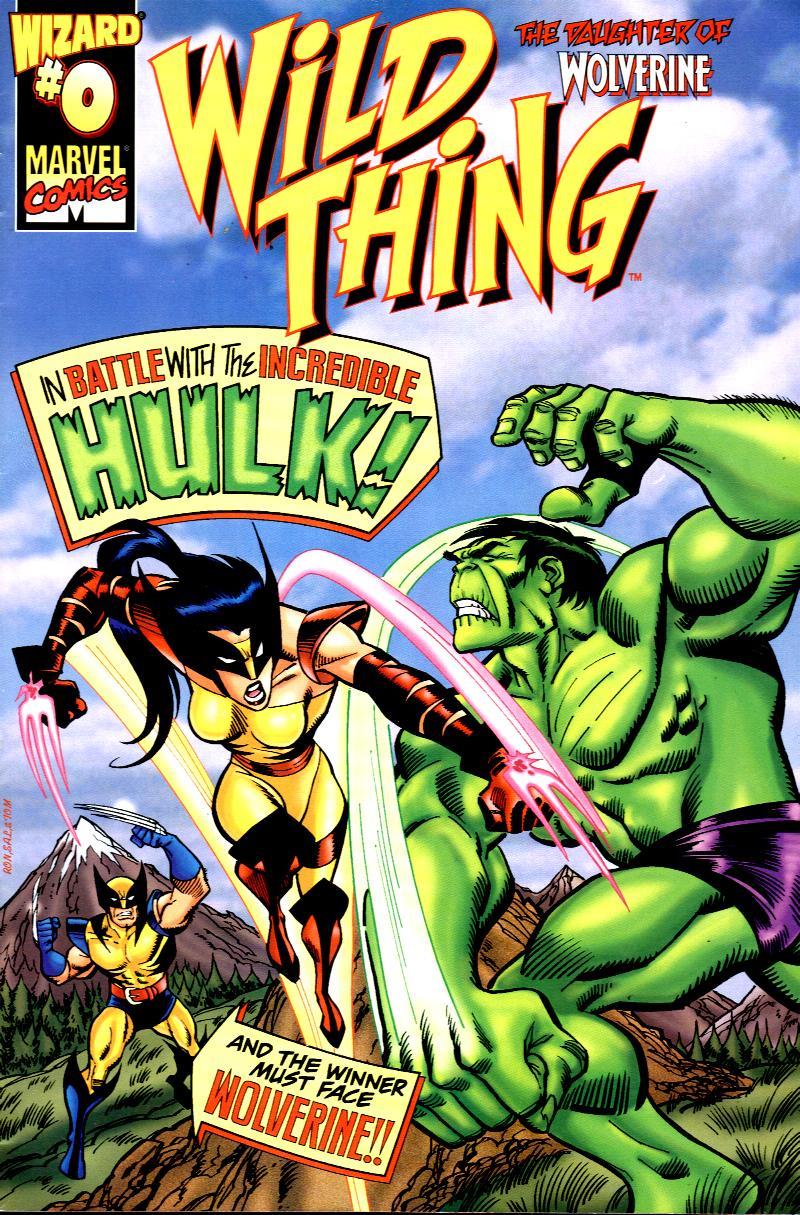
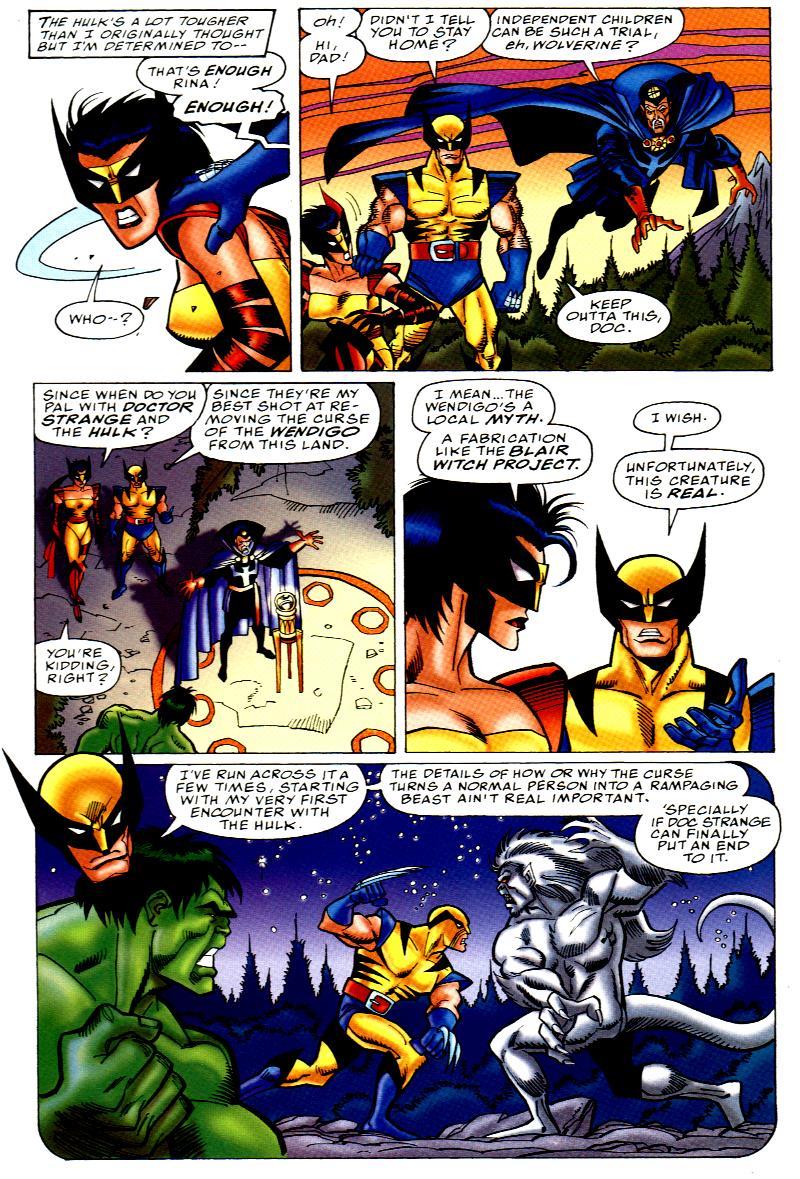
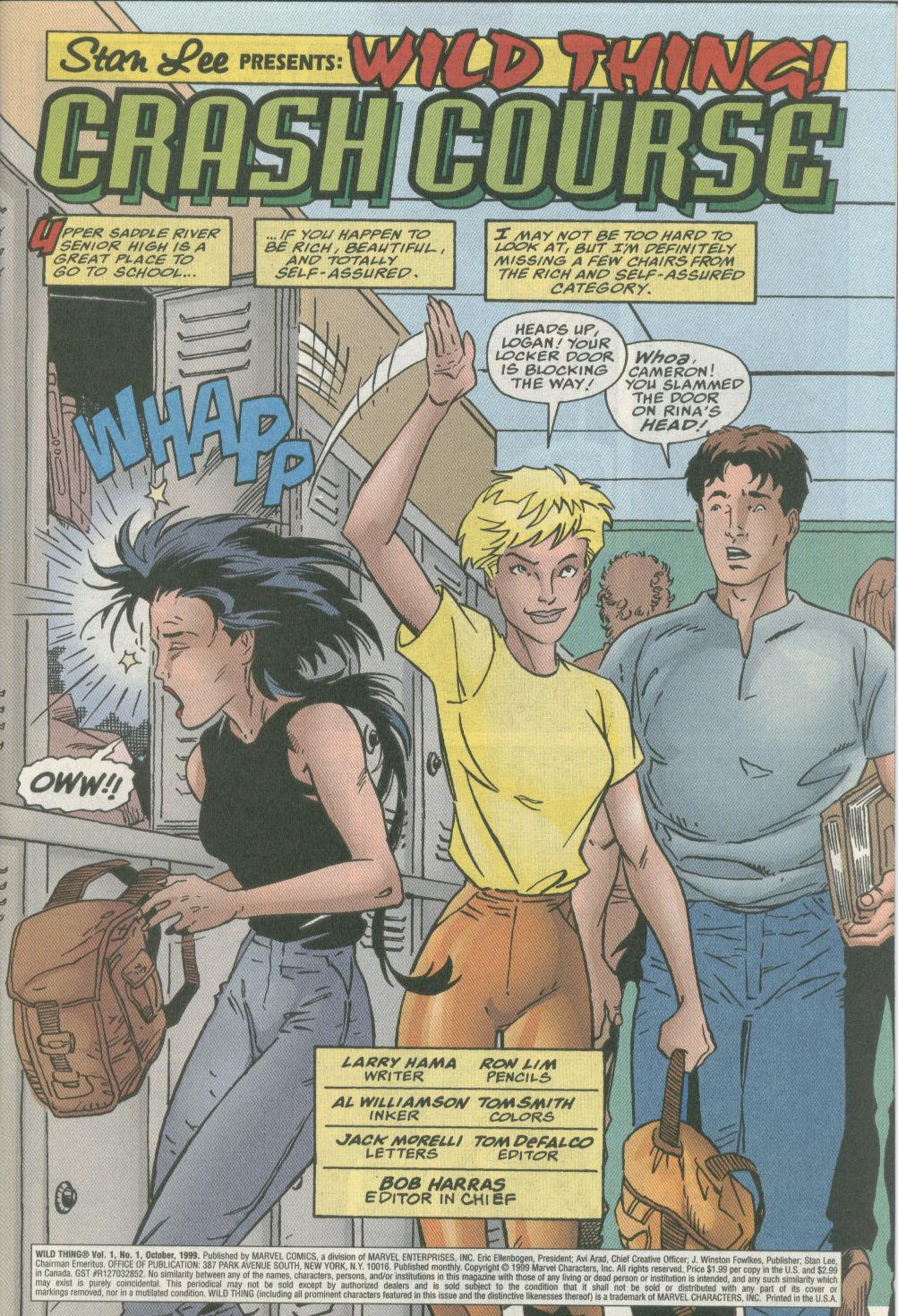
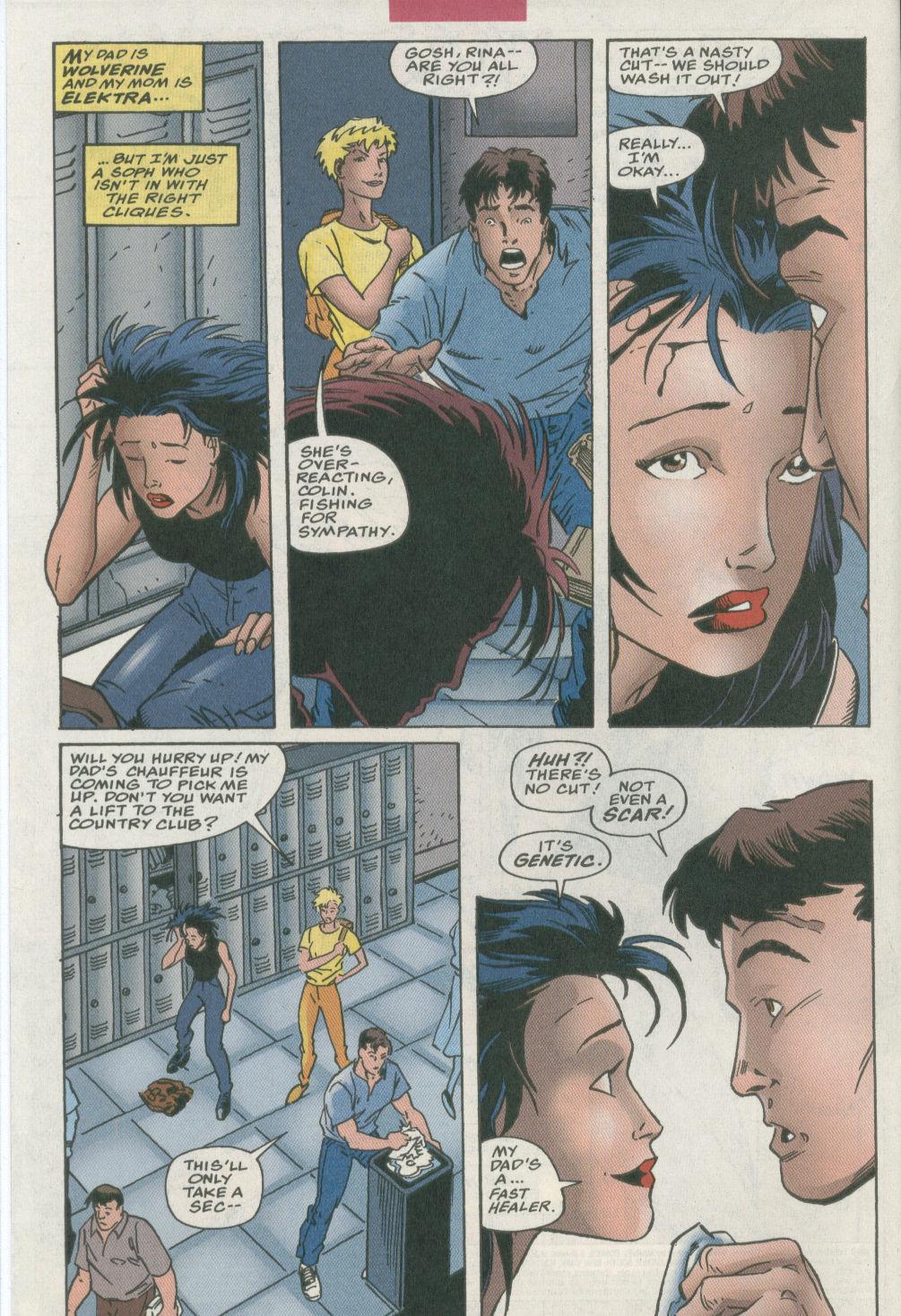
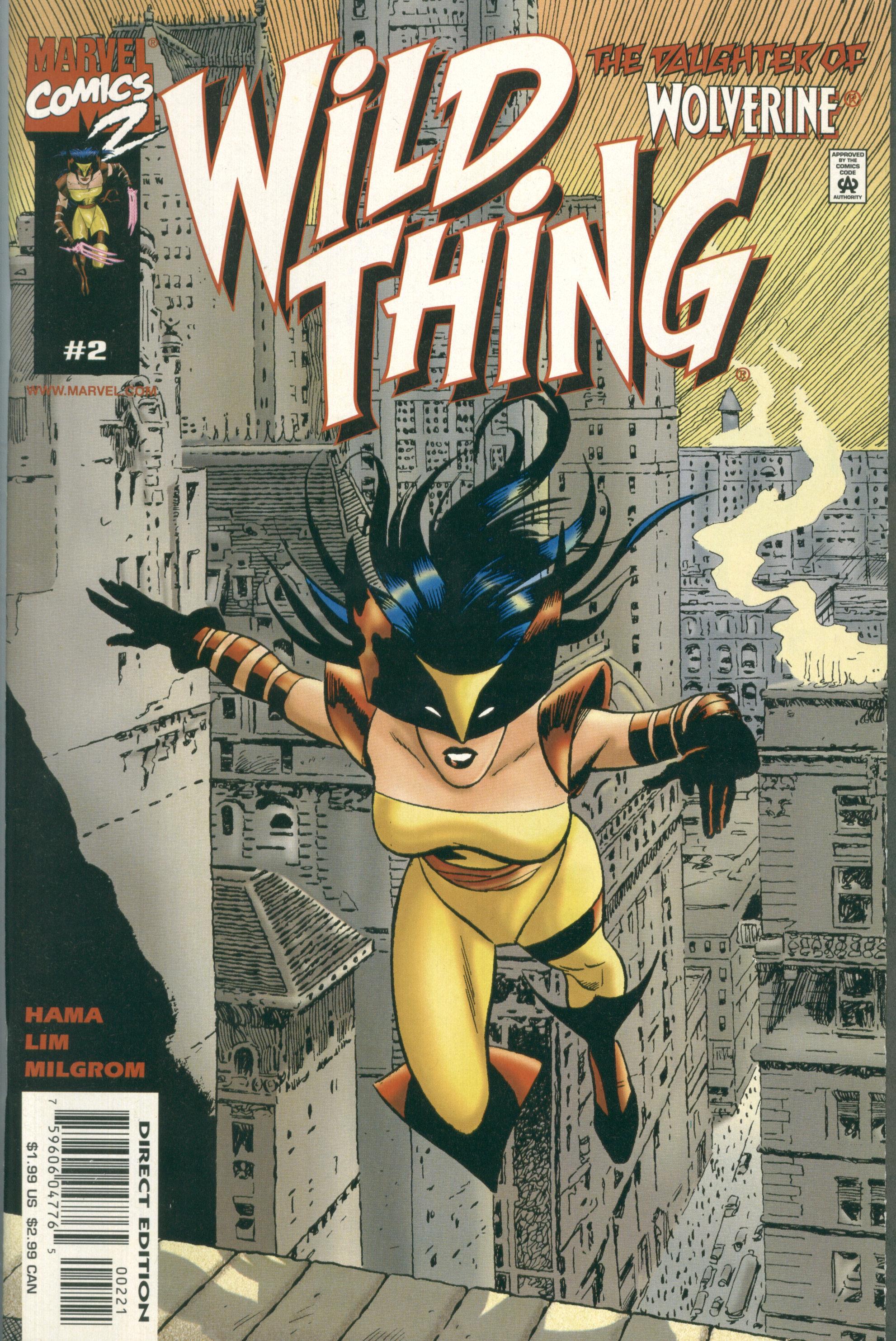
We’ll wrap up the MC2 summer next week when we look at Wild Thing!  We already saw her in our look at J2, but now we’ll see the daughter of Elektra and Wolverine in her own title!  The kids are back in school, and the summer has to end, but there’s one chance for fun right here at The Unspoken Decade!  See you next week, folks!

Lizards and Mothers and Wells, Oh My: Enigma Part II by Emily Scott

Greetings! Before we get down to business, I’d like to thank Dean, The Unspoken Decade’s incomparable proprietor, for letting me come back and talk a little more about the wonder that is Peter Milligan’s Enigma. I’d also like to thank you fine readers for coming back for more after Part I. If you missed Part I, everything I’m about to say will make zero sense; if you read Part I, well, you’ve probably already figured out it will make only a little sense. Like one sense, two sense tops.

I have done and will continue to do my best to impose some order on this brilliant comic’s chaos, but a good portion of its beauty lies in many of its mysteries never being thoroughly teased out. Answers are given, but they grant no true resolution, and each one has the potential to beg a thousand more questions. This is definitely a comic where what happens is not nearly as important as why it happens, which is my justification for trying to get as much exposition as I could out of the way in Part I. Laying all the groundwork to put all of this comic’s many pieces into place seemed essential because the picture only starts to become clear when viewed all together. Halfway through, say, a Batman comic you could probably articulate what is going on, where the story is likely headed, and why it’s headed there; the best you could do with Enigma is shrug, if you’re honest, and be a blowhard if you’re not. Enigma must be viewed from a bit of a distance, and even then, like a twisted Magic Eye picture, you still have to squint and bullshit a little to make heads or tails of it.

Seriously, though, has anyone ever actually seen anything in one of these pictures? I have never even come close, and I've been convinced since the 90s that they're all just one big prank on me. I have rarely identified with anyone more than that guy in Mallrats.
Seriously, though, has anyone ever actually seen anything in one of these pictures? I have never even come close, and I’ve been convinced since the 90s that they’re all just one big prank on me. I have rarely identified with anyone more than that guy in Mallrats.

Let’s get the rest of this silly action out of the way, shall we, so we can to the fun stuff: the in-depth analysis. When we last left our protagonist, Michael, he had just left his old life of anal retention and once-a-week sex behind. While his city is filling up with dead bodies due to a sudden rash of villains sprung to life from his favorite comic book, Michael has never felt more alive as he investigates how he is connected to the mysterious masked man who battles these foes. Brains have been eaten, lizards have flown, and grown men have been mailed through a lady’s stomach. With me so far?

With a little good ol’ fashioned bribery, Michael learns that the 25-year-old murder in Arizona that frames the story is connected to one of the Enigma’s foes and makes up some of his bribe money in saved airfare by traveling to the farm via Envelope Girl Mail. It is there he realizes why the Interior League seemed familiar to him, the pattern on a costume a match for the wallpaper of his childhood home, which was destroyed and buried in an earthquake, his father buried along with it. Upon returning to his destroyed home, Michael discovers Enigma, who, rather than actually explaining anything useful, takes Michael to Envelope Girl, attacking and attempting to kill her before Michael intervenes.

Why is she bleeding Rainbow Brite's blood?
Why is she bleeding Rainbow Brite’s blood?

Michael tries to explain to Enigma why it’s distasteful to wantonly kill anyone you feel like; Enigma has no idea what he’s talking about and insists that Enigma’s gotta Enigma. They are his foes, his creations, and taking them out of the world he brought them into is what he does. We finally reach the ‘tell’ portion of history’s weirdest Show and Tell, and Enigma reveals he was abandoned down a well by his mother. When it’s Michael’s turn, we learn that despite his recently decking a guy for hitting on him, he shortly thereafter let another guy take him home, lending credence to the notion that the fastest way to prove you’re closeted is to lash out at a gay person.

Michael also admits to having a thing for Enigma, which leads where you’d expect, though it’s nowhere I would have expected this comic to end up when I started reading it. If you’d told me that the comic that starts out with a brain-eating monster and some floating lizards would turn out to be a heavily symbolic and nuanced exploration of identity and sexuality, I would have had zero idea how it could get from Point A to Point B, but it’s nonetheless earned. It’s like boarding a random train in Pittsburgh and ending up on Pluto: you weren’t sure where you were going, but it sure as hell wasn’t where you ended up, and you appreciate the destination all the more for its unexpectedness.

They yada yada'd over the best part! (Here at The Unspoken Decade, we strive to bring you not just the best analysis of 90s comics, but also the finest in 90s references.)
They yada yada’d over the best part! (Here at The Unspoken Decade, we strive to bring you not just the best analysis of 90s comics, but also the finest in 90s references.)

After fulfilling a fantasy he didn’t even know he could let himself have, Michael finds that sharing physical intimacy with Enigma has done little to help his lover understand emotional intimacy or empathy, further demonstrated when he can’t comprehend why Michael would want him to use his powers to undo the damage he has done to the former Envelope Girl. Neither sex nor guilt may move him, but the impending arrival of his mother is enough to finally get a real reaction, along with the rest of his backstory, out of Enigma.

Just goes to show that straight or gay, regular person or godlike manifestation, men are still men.

It turns out that the well Baby Enigma was dropped into was his mother’s reward for using his powers of manipulation on his father’s face, which caused his mother to shoot said face so many times it was unrecognizable. Mama Enigma went insane while Baby Enigma thrived in his well, what could have been a prison becoming a god’s playground where he can eat and befriend and give consciousness to as many lizards as he likes. His world is perfect till it is shattered by his discovery by the world outside. When Enigma finds he can no more relate to the people in that world than his smartened up lizard can to regular lizards, he retreats to the closest thing to his well he can find, the subterranean former home of Michael Smith.

Enigma finds Michael’s old comic books and decides that since life is beyond absurd, he might as well base his around these absurd stories. (For Michael this has got to be like finding out your favorite Star Fleet Captain thinks science fiction is dumb.) Since any good hero needs adversaries, he creates his foes from ordinary people his mind seeks out, but his greatest foe is the one seeking him. Enigma senses that his leaving the well has awakened a terrible echo of his power in his institutionalized mother. Knowing that his own power will eventually destroy him, Enigma throws his mind out to influence and entice the man who was once the boy whose beloved comics became the basis of his existence. It is his hope that Michael’s love will make him more human and in turn manifest that humanity in the creature who gave him life and give her cause to grant him life once again.

Huh, trying to explain this story makes me feel the opposite.

Michael is understandably perturbed that his new lover has manipulated his mind, but when Enigma offers to put him back the way he was, Michael refuses. Whatever he was before, Michael likes who he is now, so whether Enigma fundamentally changed him or merely awoke something already there is a moot point, as moot as what does or doesn’t happen to resolve the conflict with Enigma’s mother. Our story ends on Titus, Michael, and Enigma, mask now discarded, going to face her, but we never learn of their fate, as our mystery narrator, revealed to be the changed lizard, is not privy to such information. (If there is a more perfect way to end this comic than an ambiguous outcome relayed to us by a supernaturally enhanced raving messiah lizard, I can’t think of what it could possibly be.)

I have been promising for two weeks and thousands of words that when the whole story was laid out, I could make something resembling sense out of it for you. Something else I can promise is that it made very little sense to me when I finished. I felt like I was in a fugue state. It has taken me multiple readings and an article and a half’s worth of stalling to tease substantial meaning out of it, but the more I pick apart all its different threads, the more it weaves new and unexpected patterns rather than unravel. My final promise is that this comic has been worth every bit of me wanting to clutch my head like a Monty Python Gumby and bellow, “My brain hurts!”

Last week I snuck the Punisher in for Dean; this week it's Monty Python for me!
Last week I snuck the Punisher in for Dean; this week it’s Monty Python for me!

Enigma has so much going on that it’s not immediately obvious how its many disparate elements fit together, abandonment and idealization, identity and sexuality, the dangers of truth and secrets all vying for attention and analysis, a story in a story in a story. If it were any more layered, it would be a cake. What makes it all come together is keeping in mind that no matter how complex or meta or just flat out bizarre, this is a story about a man coming to terms with what happened to him in the past, discovering who he wants to be, and letting that past go so he can embrace that new identity. Everything else is window dressing, just the sort of window dressing the Interior League might subtly shift: beautiful to look at but liable to drive you crazy if you contemplate it too long. So let’s not stab anyone with a table leg as we proceed, all right?

In the research I did for this article (That’s right, research. I don’t just wing these things.), I was hard pressed to find an essay about Enigma that didn’t at least mention Alan Moore’s inestimable Watchmen. (And yet of the many things I’ve read about Watchmen, not a single one mentions Enigma. I wonder why.)  It’s easy to understand why they would be part of the same conversation, as they are both comics that deconstruct comics, but one is macro, the other micro. Where Watchmen looks at the impact superheroes would have on a realistic world, Enigma is really only concerned with their effect on one man. Our glimpse beneath the mask in Watchmen shows us that sometimes they are worn for good reason. In Enigma whether the mask disguises unpleasant truths or comforting lies, it is most detrimental to the one wearing it.

Another example of how these comics differ: To this day, I think the fake alien monster Ozymandias makes in Watchmen is too ridiculous looking and strains credulity to the point that it takes me out of the comic and is its lone fault. If this thing showed up in Enigma, I wouldn't bat an eye. (If you are livid at me for profaning Watchmen, you are not alone. Dean and I have exchanged many strong words on this very issue. Agree with him how wrong I am in the comments.)
Another example of how these comics differ: To this day, I think the fake alien monster Ozymandias makes in Watchmen is too ridiculous looking and strains credulity to the point that it takes me out of the comic and is its lone fault. If this thing showed up in Enigma, I wouldn’t bat an eye. (If you are livid at me for profaning Watchmen, you are not alone. Dean and I have exchanged many strong words on this very issue. Agree with him how wrong I am in the comments.)

Watchmen is also more focused on the hero part of the superhero idea; Enigma is far more concerned with the super. Both Dr. Manhattan and Enigma posses godlike abilities, but only the former evidences any struggle with that responsibility. Dr. Manhattan, whether through retention of a small part of his lost humanity or not, can contemplate the consequences of his actions and initiates a conversation about the rightness of his choices; Enigma wouldn’t even understand there is anything to discuss. We don’t know the fate of the life Dr. Manhattan eventually leaves to create, but I would wager it’s kinder, whatever that might mean, than that of the lizard Enigma leaves to rant for the rest of his days on uncomprehending ears. However selfish or vain the motives the various Watchmen have for taking up the mantle of hero or questionable the morality of the results, they often pay more than lip service to that role. Enigma is an idea who takes up a role because it is there.

Ultimately, though, Enigma’s motives or character development or lack thereof are only important as they pertain to Michael’s. Early on in their investigation, Michael and Titus entertain the notion that Michael is projecting all the strange happenings from his favorite childhood comics into the real world, and while that’s not literally what is happening, it might as well be. Enigma and all the rest of the motley comic crew are segments of the struggles Michael has gone through his whole life and must make peace with to come to a peace within himself. The Truth can be deadly to those like Michael who hide behind layers of self-deception and repression. The Interior League demonstrates that even a small shift in your safe haven can have devastating consequences, much like the literal seismic shift that tore Michael’s world asunder. Envelope GIrl, who Michael does not fear, attracts unconditional adulation from those who would seek to crawl back into the womb until that womb is ripped to shreds by Enigma’s nightmare mother creature, who Hulks out even upon hearing the word ‘mother,’ a manifestation of his own worst fears about the mother who left him waiting on a curb, signifying that Michael must let go of the idealized version of his mother to truly let his abandonment go.

I'm not sure where the Head fits into this. At this point, I'm so full up of theories and symbolism that I'm fine saying that brain eating is just cool, no matter how much the Head himself thinks there's more to it.
I’m not sure where the Head fits into this. At this point, I’m so full up of theories and symbolism that I’m fine saying that brain eating is just cool, no matter how much the Head himself thinks there’s more to it.

While these are all meaningful themes to explore, they all culminate in that moment when Michael declines Enigma’s offer to undo his influence on his mind and essentially de-gay-ify him. While it still comes across as a monumental decision for a character to make, I can only imagine how strong a statement that must have been over 20 years ago, when this comic was released. In arguments about whether sexuality is a choice, when all of my appeals to common sense have been exhausted, I have sometimes fallen back in frustration on one point: why would anyone chose to be gay? Why would anyone chose what is inarguably a harder life, where something as fundamental to life as who you love can be used as an excuse to ridicule you, exclude you, even harm or kill you, when it would be the easiest thing in the world not to? Why, unless that is the truth of who they are and therefore no choice at all? It can be quite stirring when we see analogies for these ideas played out, such as mutants in X-Men comics deciding they’d rather not be “cured,” thank you very much, but it is that much more powerful to see it is as a literal choice. While I believe Enigma should be a little less unsung for many reasons, for this moment alone I am surprised I do not hear Enigma mentioned more. Perhaps it was ahead of its time, but when we discuss art, all that really means is it was necessary regardless of the time it was created.

So did I keep my promise to make some sense of this daring and different piece of work? If you think you need to work through it a little more, it would be completely understandable, but this time I’ll let my pal the lizard have a crack at it.

Enigma End

What the Hell Did I Just Read? Enigma: Part I by Emily Scott

Let me just get this out of the way to start – Peter Milligan’s Enigma is an aptly named comic. I know I will be tempted as this article goes on to make a lot of mystery-based puns, but maybe if I just say that right from the beginning, I can save myself some undeserved pats on the back and you lovely readers some groans. Dean, proprietor of this fine blog, who was kind enough to let me come back to talk about this brilliant and unique piece of work, kept asking what I thought of Enigma as I was reading it, and I kept responding, “It’s weird.” He wasn’t sure if that was good or bad, and at the time I couldn’t have said, no more than I mean it as praise or criticism when I tell you now that all I could do when I finished was stare at nothing in particular and mumble, “The hell did I just read?”

Before someone wants to throw the Internet equivalent of rotten vegetables at me, I will reuse two words from the previous paragraph: brilliant and unique. This comic is a staggeringly original and daring work of art, and I’ve honestly never read anything like it, but it is challenging and not always pleasant to read, and the pieces of the puzzle don’t all quite fit together till the end. Even then, it still takes some mental gymnastics to make sure you’ve put them all together, and even after multiple reads, you can never quite be sure. It defies easy categorization or summation. I could list all the things that happen in this comic, but it would be like saying Picasso painted a lot of pictures of people; it would be an accurate, but by no means adequate, way to get at the heart of the work.

Incidentally, painting superheroes in Picasso’s style must be a big thing because a Picasso Google Images search is chock full of them. This one’s for you, Dean.

In emphasizing just how out there and occasionally disturbing this comic is, I by no means want to detract from it truly being a masterpiece, but I feel like it’s important to establish right away that is no ordinary fare, even for a comic. I say even for a comic because, well, let’s face it: weird things happen in comics. We take a lot of them for granted because they have had ubiquity our whole lives, but come on, a guy who has the powers of a spider and a man-beast with metal claws who can’t die are a little surreal. And yet there are reasons why Spider-Man and Wolverine are on lunchboxes around the world and I had never even heard of Enigma till Dean asked me to read it for this blog.

Enigma will never be mainstream, and that might be the highest compliment I could pay it. (I may be refraining from patting myself on the back for mystery-related puns, but you guys who’ve like this comic for a long time go ahead and give yourselves one now. You know you like feeling smug about liking stuff other people don’t like. I do too. We all do.) This is not a comic for kids, and not just because it contains “adult” content. So much happens in its eight issues, not just in terms of plot, but in issues addressed, themes like identity and sexuality explored, and mindfuckery conducted that I’m starting to wonder if I’m not stalling as I write this because it’s hard to know where to even start.

Already you have to be wondering where this could possibly be going. I was worried it would be like the Phantom of the Opera...yeah, it’s not like the Phantom of the Opera.
Already you have to be wondering where this could possibly be going. I was worried it would be like the Phantom of the Opera…yeah, it’s not like the Phantom of the Opera.

Enigma opens on a farm in Arizona, the sort of place, we are told by a narrator whose identity only becomes more mysterious as the story progresses, “where you’d have sexual relations with your parents and end up shooting someone.” We are told something very bad happened on this farm 25 years and then are immediately taken to the present day and introduced to Michael Smith, the most boring man in the world. (Once again fiction teaches us that if you want something supernatural or fantastical to happen to you, the best thing you can do is be as ordinary as possible.)

Michael is the sort of guy who has to have a certain number of bath towels and only has sex with his girlfriend on the same day every week. These are our first clues exciting things will happen to him. He goes to work, which on this day is fixing the phone of a famous actor. The actor says he bets Michael wishes he were him, which is our first clue something terrible will happen to the actor.

Seriously, who the hell says that? Of course, the narrator is not being much kinder to our protagonist. What’s the point of YOU, buddy?

Next we spend a bit of time with our Phantom of the Opera and are given a glimpse into his mind in ways that make absolutely no sense on a first read. Seriously, it does not matter how observant or analytical you are, much of this material defies even speculation until you know everything that’s going on, which is fine because this comic is like a Lay’s potato chip: I challenge anyone to be satisfied with just one reading. Part of what makes a second or a third read so enticing is that there are so many “a-ha!” moments, where the lines you either skimmed or puzzled over (and whichever you did will tell you a lot about yourself as a reader) finally fit neatly into place. This applies to pretty much everything you see involving the character Enigma until several issues in.

Also, someone is eating people’s brains. Unlike so much else in this comic, that’s fairly straightforward. Michael finds himself drawn to the scene of the latest brain consumption for reasons he can’t explain, though it doesn’t seem like anyone would be interested even if he could articulate them. His girlfriend may not care why he feels linked to the brain eater or the strange masked man, but she does care that it’s Tuesday, and the two engage in their usual weekly amorous activities in an unusual place.

I liked it better when I could tell myself guys just thought about baseball during sex.

Already it is obvious that one of the prominent themes in this comic is Michael trying to suss out his own identity. When we hear about someone committing a gruesome act, it might be natural for any of us to wonder if we are capable of such things ourselves, but someone whose sense of self is as shapeless as Michael’s is that much more more susceptible to contemplating what monsters might lurk inside. His search for his true nature is something I will by needs discuss at greater length in the second part of this article, but it’s worth noting now how much it’s a driving force in Michael’s actions and how he only seems to feel anything when in pursuit of the mystery of the brain eater and the masked man. He is compelled to seek out the truth and yet, as we will discover later, unprepared to face it when confronted by it. (None of us can identify with that, right?)

His curiosity causes him to follow a floating lizard (just go with it) to another crime scene, where the Head, also known as the thing nomming on everyone’s brains, has just supped on another victim and is contemplating dessert when the Enigma makes an appearance. Michael gives chase, feeling less like himself and more alive than ever before. So of course he promptly gets his brain slurped out.

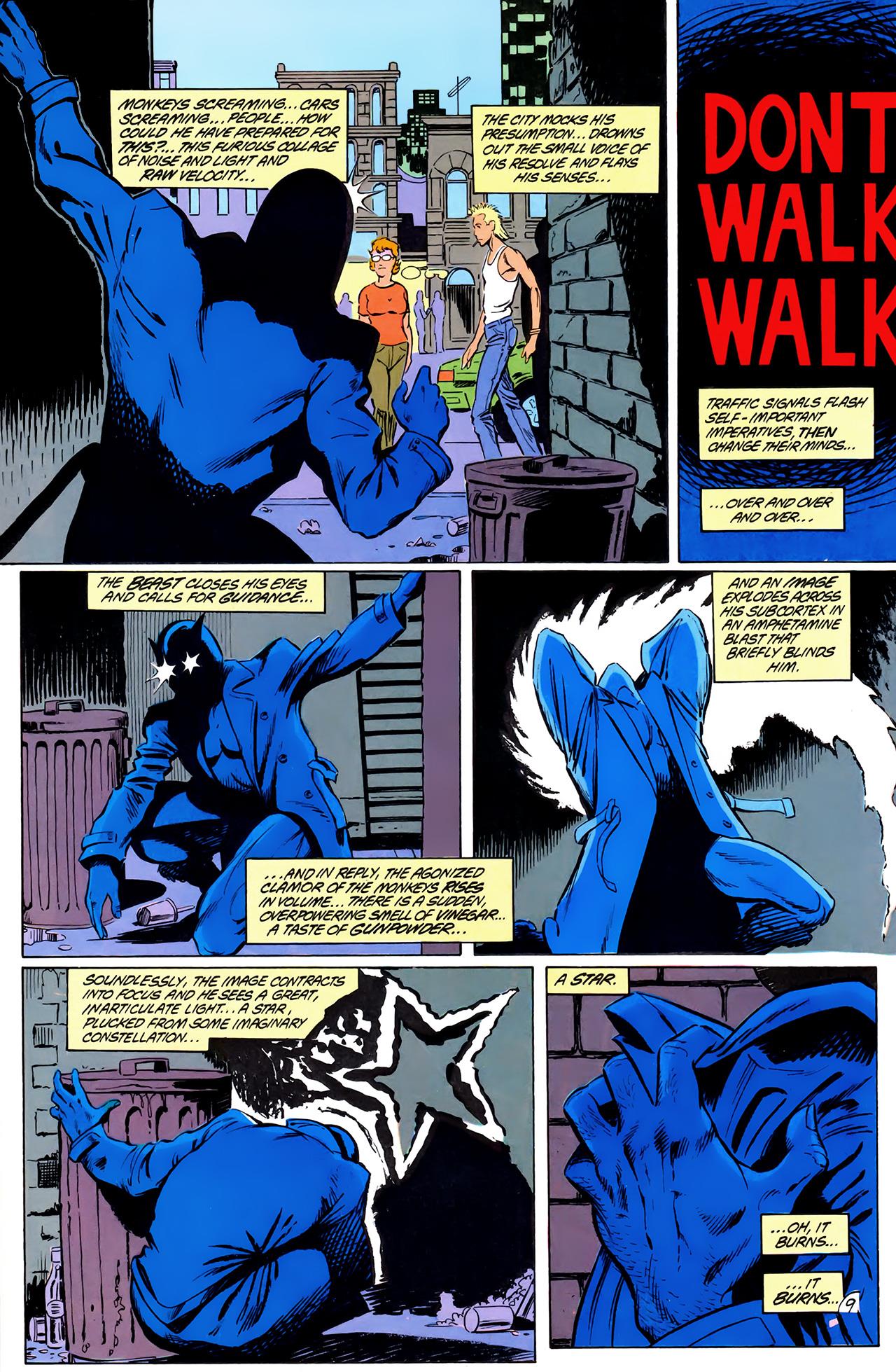
In case I haven't used enough synonyms for weird yet in describing this comic, perhaps it will serve as a helpful visual aid when I tell you that this is a fairly typical looking couple of panels.
In case I haven’t used enough synonyms for weird yet in describing this comic, perhaps it will serve as a helpful visual aid when I tell you that this is a fairly typical looking couple of panels.

This might be as good a time as any to bring up Duncan Fegredo’s art and Sherilyn Van Valkenburgh’s colors, something I normally wouldn’t discuss at length, not because they’re unimportant but because I have not taken enough art history or art appreciation classes to feel like I have any idea what I’m talking about. The images in Enigma work in such pitch perfect synergy with the words, though, that I can’t imagine one without the other.

In lesser artistic hands, I honestly don’t know if this comic would have worked half as well, no matter how amazing the script. There are a lot of ways to draw someone’s brains being sucked out, you know? Not all of them would have permanently seared themselves onto my retinas the way the above page and many others did. Fegredo’s art allows Milligan’s script to achieve maximum effectiveness.

Then he took them to a midnight screening of The Rocky Horror Picture Show.

What that often means is art that is in turns disturbing, nauseating, confusing, and beautiful, sometimes all of those things simultaneously. Just as the story is told in an off kilter and intentionally puzzling manner, the world as shown by Fegredo can be disorienting, and I found myself having to stare for a bit at some pages to figure out just exactly what it what it was I was looking at. As appropriate as that is, it also serves the dual purpose of making you pay careful attention to a work that deserves it.

The colors add another note to the harmony that is Enigma, the muted palette grounding the world in which it takes place and serving as a basis on which to contrast the surreal happenings and images. You will find no bright primary colors that comic books typically traffic in, which is further highlighted when we are introduced to the comic-within-the-comic Enigma, from which Michael recognizes the strange creatures who have been appearing. (Yes, there is a whole other meta layer to this. I told you there’s a lot going on. It’s like a clown car of concepts – no matter how much you unpack, there is always more.) The colors by no means render it dark or bleak looking, though, instead intensifying what is already intense imagery.

If the person who drew this has not done copious amounts of hallucinogens, I'll just eat my hat.
If the person who drew this has not done copious amounts of hallucinogens, I’ll just eat my hat.

While it might seem like I am harping on about how much happens in a scant eight issues, I promise if anything I’m underselling it. Look no further than the impressive rogues gallery Milligan creates, which is more thought provoking and memorable than those some super heroes accumulate over decades. In addition to the Head, we are introduced to the Truth, the gentleman in the corset above, formerly the actor with the world’s most inflated self-image. Oh, the irony. (I told you something bad was going to happen to him.) You can probably infer from his name what he does.

While it’s all deftly handled, as expected, I don’t know that the Truth requires much deep analysis. No matter how originally done, the idea that people do not care to hear the honest truth about themselves, even to the point that it is fatal, is nothing new to us. (My favorite example is Buffy’s musical episode Once More With Feeling. What’s yours?) Michael, however, perhaps not particularly pop culture savvy, remains determined to seek out the truth, both with a lower and upper case T, and discovers that no matter what else he might be, he is as human as the rest of us.

What did he think was going to happen if he went in there? That he would learn the truth about the Colonel's secret recipe or where Jimmy Hoffa's body is buried? Come on, man.
What did he think was going to happen if he went in there? That he would learn the truth about the Colonel’s secret recipe or where Jimmy Hoffa’s body is buried? Come on, man.

We are also introduced to my favorite, The Interior League, an idea that sounds ludicrous, almost laughable, at first but grows more insidious the more you think about it. Basically, they break into houses and rearrange the furniture in such a way that a member of the household goes insane and kills everyone. (Someone who is really into feng shui is nodding solemnly right now.) Home is an increasingly important concept in Enigma, and there are few things more profoundly distressing than the idea that someone would violate such a sacred space as your own home, not necessarily destroy it, just fundamentally alter it, make it not yours anymore.

Rounding out the rogues gallery is Envelope Girl, a character who does not grow any less ludicrous the more you contemplate her but is an awesome concept nonetheless. In the simplest terms possible, she mails people somewhere else. They approach her, are enveloped by her (*wink*) and end up in a box in a completely different location from where they started.

In slightly snootier terms, I believe Envelope Girl illustrates some of the maternal abandonment issues that will later be addressed in ways that go even more off the rail that a lady who mails people from her abdomen. (I keep telling you, so much to unravel. So very much.) We learn that Michael was Punky Brewstered by his mother, and much like he faithfully waited on a curb for her for days, people give themselves over completely to Envelope Girl, entrusting their fate to her completely through a sort of reverse birth, back into the womb act.

Do you think Envelope Girl gets mad if people ask her to send their regular mail, like their gas bill or grandkid's birthday card?
Do you think Envelope Girl gets mad if people ask her to send their regular mail, like their gas bill or grandkid’s birthday card?

So what is this all adding up to? So far we have a lot of dead guys, some lizards, and a protagonist who only feels alive now that he is seeking the comic book characters sprung to life all around him, who he may or may not be summoning forth with his mind. What’s a guy to do but seek out Titus Bird, writer of said comic-within-the-comic, rescue him from his new throng of unwanted followers, decide to move in with him while you investigate his creations, and deck him in the face when he makes a pass at you?

Say, remember how in very recent memory, you could punch a guy for having the audacity to find you attractive and HE was the one who had to apologize to YOU?

If this comic is a puzzle, Michael’s questioning of his sexuality is, I promise, the last edge piece we need to identify before we can begin putting them together in any discernible fashion. This was the last place I expected this comic to go when I started it, but its ability not just to surprise but to pull so many disparate elements into a sort of highbrow Exquisite Corpse is one of its greatest strengths. (For those who don’t know, Exquisite Corpse is a drawing game, not a necrophilia thing. It is possible thinking too long on this comic has made me feel that disclaimer is necessary.)

…and then what?


And then what? Come back next week to find out!

The Gimmick Era Has Never Been Covered So Well.