Category Archives: Uncategorized

Non-non-non-non-NON-heinous: Bill and Ted’s Excellent Comic Book by Emily Scott

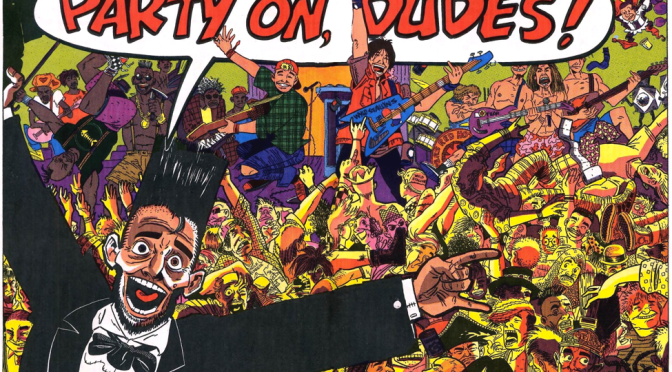
Greetings, most excellent Legions of the Unspoken! I’m Emily Scott, and I am here to tell you all about a totally outstanding 1991 publication from Marvel, Bill and Ted’s Excellent Comic Book! *air guitar* This triumphant comic may have had bogus sales and only lasted 12 issues, but its short run is in no way indicative of how non-heinous this interpretation is of two beloved characters. Anyone who enjoys either movie would totally love these books, so prepare to be fully informed, and…PARTY ON, DUDES!
…Ok, I think I’ve got the bulk of the Bill and Ted speak out of my system, at least for the purposes of this article. I don’t really remember a time when my own vocabulary didn’t include some Bill and Ted-isms, and to this day I refer to things as being non-non-non heinous more often than any reasonable person should. Reading a dozen issues of their vernacular, though, has left me even more susceptible than usual to adding ‘most’ before every adjective and exclaiming, ‘Whoa!’ with hushed awe.

Bill and Ted Loquacious
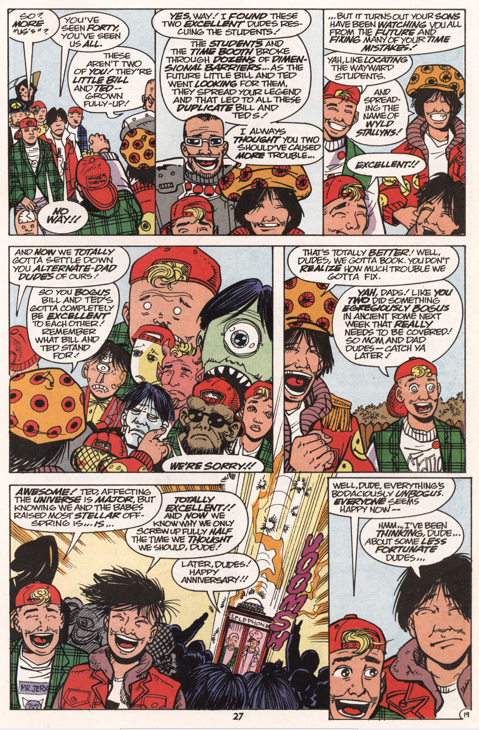
How is it possible that these two panels squeeze in so much Bill and Ted slang that they sound translated straight from an English-to-Bill and Ted dictionary and yet sound so natural?

With a new comic book release, chatter about a third movie louder than ever, and the fact that it’s one sequel after a long hiatus that everyone actually seems fine with, there’s no better time to ponder why we’re so eager to be excellent to two dudes we first met over a quarter of a century ago. Their language is a major factor in what still endears us to Bill and Ted and a prime example of the movies’ greatest strengths, taking something that could be pedestrian like late 80’s/early 90’s surfer/stoner/Valley bro talk and making it most atypical. (Sorry that I can’t stop with the Bill and Ted speak…NOT!) You know exactly who these characters are immediately upon hearing them, but they don’t sound quite like anyone else you’ve ever heard.

As the above two panels from the first issue ably demonstrate, writer/artist Evan Dorkin nails Bill and Ted’s verbal eccentricities, a feat made all the more impressive when you learn that he had not seen either movie when he started writing this title. Dorkin, a five-time Eisner Award winner best known for his works Milk and Cheese and Dork, gets just about everything else right too, from the lighthearted tone of the humor to the happy-go-luckiness of the titular characters. One of the comic’s greatest strengths is that if you know Bill and Ted, you know exactly what you’ll be getting. This comic feels the most like the source material just drifted into another medium than almost any other adaptation I’ve ever seen.

Am I the only one who wants to hear the rest of Death's joke?
Am I the only one who wants to hear the rest of Death’s joke?

Not only does the comic sound just right, but it looks spot on too, with art that is colorful, fun, and busy. Dorkin gets a lot of comedic mileage out of great expressions, and he can make an already zany universe that much zanier by drawing faces so exaggerated not even Keanu Reeves could actually make them. The art is also better than it has any right to be for an adaptation of a comedy about two dudes who travel through time in a phone booth, with an eye for movement and action that flows seamlessly and images that are surreal and vivid, evocative and at times bordering on nightmarish. (In case you were wondering, yes, it does feel incredibly strange to attempt a serious critique of the art in a Bill and Ted comic. It’s so damn good,though, that it deserves to be taken seriously.)

Bill and Ted Surreal
As a chronic procrastinator and habitually late person, this is what every clock looks like to me.

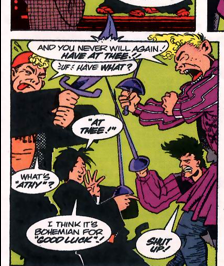
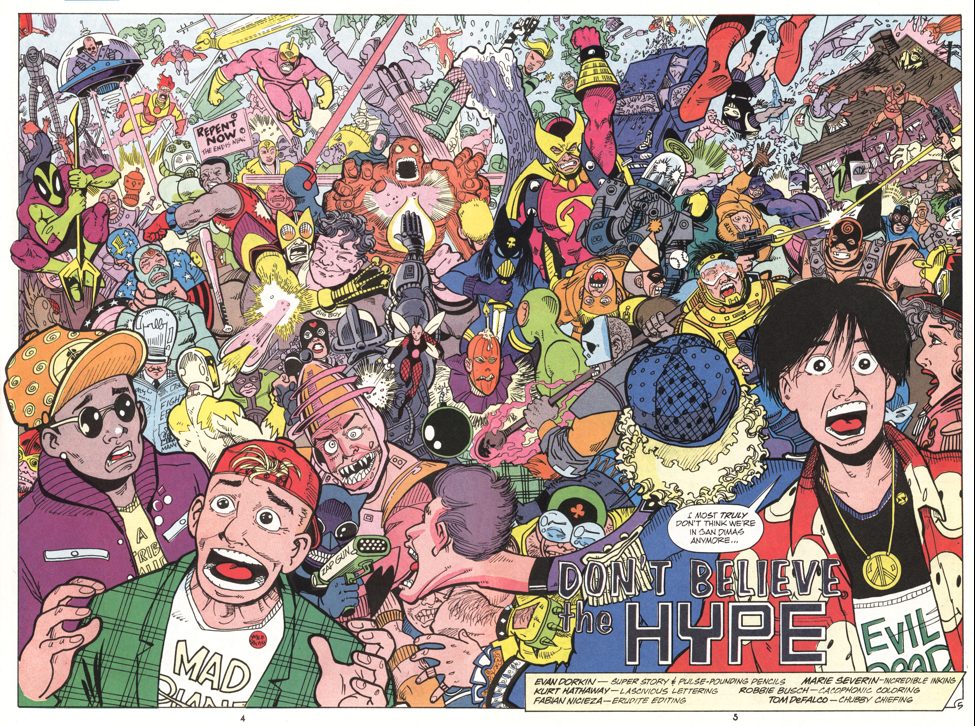
One of my favorite aspects of the entire run is just how much stuff Dorkin manages to squeeze into every panel. From the band shirts and buttons on background characters to random appearances from people like the Red Hot Chili Peppers, I found myself staring at pages for a long time to catch every little detail. Dorkin makes the most of every centimeter of page space, capitalizing on every opportunity to squeeze in another joke or bit of whimsy, from guest letter columns from characters like Station and DeNomolos to something simple like a sword piercing a word balloon:

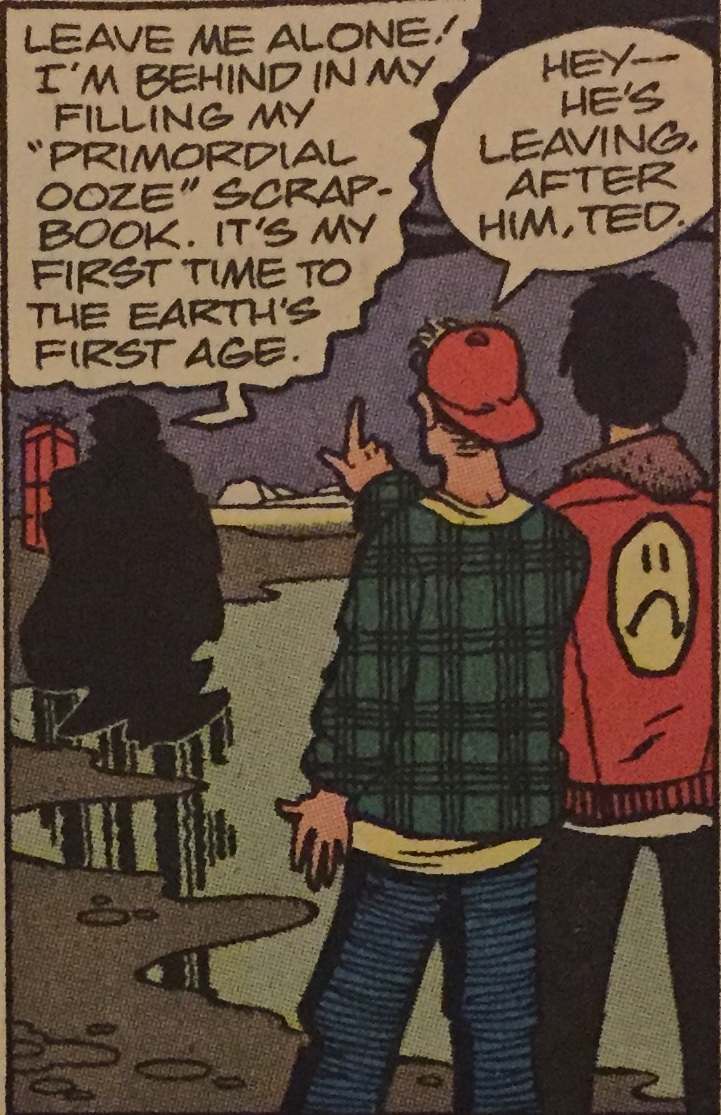
B&T Piercedto a running gag in which the smiley face on the back of Ted’s jacket changes expressions to match the situation:

Bill and Ted Face 4 Bill and Ted Face 1 Bill and Ted Face 2

I call this one Charlie Brown  Mouth.
I call this one Charlie Brown Mouth.

Just as their speech takes slang we’ve heard coming from a million different mouths and strings it together in most memorable ways,  Bill and Ted take pretty well worn character templates, two doofy but lovable dudes, and give them a contagious enthusiasm and hearts so big they cause a moon boot-filled future utopia I sometimes daydream I live in.  A lot of similar characters are like cats who always land on their feet because they’re too dumb to know the ground is there. Bill and Ted are the cats who always land on their feet because it wouldn’t even occur to them that the ground would do that to them.

Bill and Ted may be the sort of guys who would never pass a history exam without George Carlin and a magic box, but as Ted reminds us in the clip above, they are well aware of their intellectual shortcomings and more than make up for it with that relentless optimism, allowing them not to be intimated by anyone regardless of their smarts, power, or prowess. These are two dudes who can hang with God, give Satan hell, and even melvin Death. When someone can face that lineup and not be cowed, they can be placed in just about any setting against any foe and believably come out victorious, and Dorkin takes advantage of that versatility by telling stories everywhere from the past to the future to the nexus of time to the Dimension of Utter Boredom. (You can guess how much they love Wyld Stallyns in that last one.)

To be fair, the effects in 2001 are really good.

The Bill and Ted universe has a pretty deep bench, which is unsurprising, considering it could potentially include anyone from any time, and everyone’s favorite characters make an appearance in the comics, from Missy (I mean Mom…) to So-crates to my personal favorite, the Duke of Spook, the Doc of Shock, the Man with No Tan, Death himself. I’ve always had a soft spot for Death as a character, from Death of the Endless to the Grim Reaper in Monty Python’s The Meaning of Life (if you don’t laugh during this scene, I’m sorry that you were born with no sense of humor), but none approach my fondness for the version of Death with no luck at board games. His portrayal by William Sadler in Bogus Journey makes the movie ten times greater, and even though Death is his skeleton self here, his presence accounts for a surprising amount of the humanity and pathos in the comic, as well as some of its wackier plots.

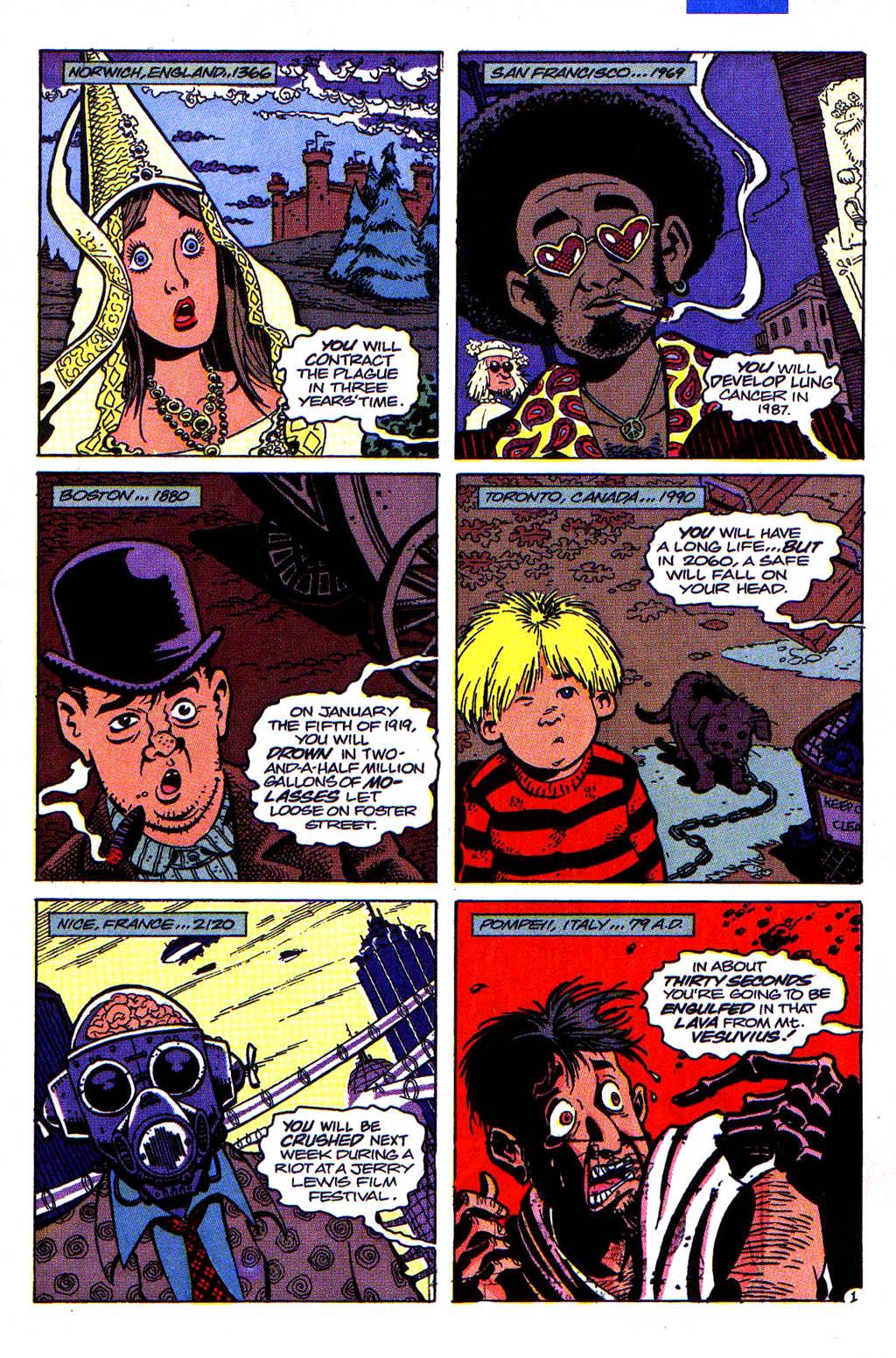
While there are a few ongoing stories, including a seeming inevitability where Bill and Ted stand trial for their interference with time, most of the issues stand alone, and two of the best revolve around Death, one in which he quits and the other where he is replaced. In Death Takes a Most Heinous Holiday, instead of searching for the true value of life or exploring what it means to be mortal or any of that other sentimental nonsense, Death treks through time to places like Pompeii and the crash site of the Hindenburg to revel in the mortality of others. Depending on your perspective, he is either the best or worst tourist of all time.

Bill and Ted Tourist

199201 Bill and Ted's Excellent Comic Book V1 #2 - Page 2
If anyone was curious, the molasses thing was a real disaster. (Here at The Unspoken Decade, we entertain AND educate.)

Bill and Ted convince Death to return to work, but in It’s a Living, he has become too concerned with worldly matters and is replaced by a foul mouthed, bad tempered pipsqueak of a reaper named Morty. Odd as it feels to say, this issue demonstrates that Death, constant and immutable, is actually the character who changes the most over the course of the comics. He tries occupations from fast food worker to comic book writer (we’ll come back to that one), makes new friends, and learns a thing or two about compassion from his kindly landlord. I would not have expected to get a little choked up over a story involving a Reap-off and a midget skeleton wearing a Flava Flav clock, but it bears reiterating in case I haven’t made it plain enough yet: this comic is far, far better than it has any right to be. And this is coming from a self-proclaimed big Bill and Ted fan.

Bill and Ted Death Off
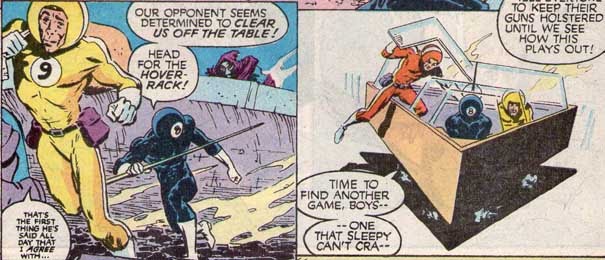
I have been enamored of the Sleepwalker villain 8-Ball since I learned of his existence (and the fact that he flies around in a hover rack), but Fate here may have just topped him as my favorite anthropomorphic billiard ball.

Two characters who don’t undergo much change are Bill and Ted themselves, but would anyone really expect them to? Would anyone even want them to? The fact that they can die more than once, experience their own personal Hells, get attacked by evil robot versions of themselves, etc. and still remain the same cheerful dudes is kind of what we love about them in the first place, and the comic rightfully has them stick to what they do best: dealing with the oddity of time travel with the greatest of ease (this time with the addition of a time traveling roller coaster), being excellent to each other, and getting out of precarious situations by waiting for their friends or future versions of themselves to show up in a phone booth and save the day.

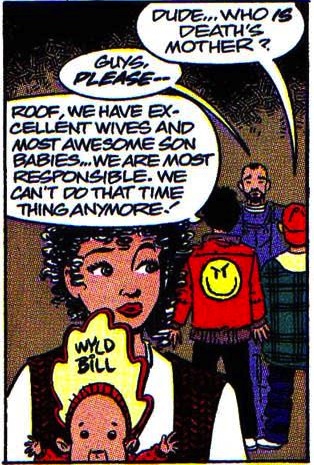
The comic does preserve the idea that Bill and Ted get married to the babes and have babies, but these events rarely impact the plot in any significant way. The kids are sort of there a lot, but these issues are free of whacky shenanigans involving Bill and Ted learning fatherly responsibility from Gengis Khan or how to change a diaper from Abraham Lincoln. I assume Little Bill and Ted are there because they existed at the end of Bogus Journey, but even more so because they reinforce the charmed, idyllic lives Bill and Ted lead and the notion that they totally “have it all.”

Bill and Ted Idyllic
It speaks volumes about the quality of these comics that one of my only criticisms is that people are wearing hats like Ted’s about 1000x more than I remember anyone actually wearing them in the 90’s and I find it distracting.

That the movie marries off and makes fathers of two overgrown adolescents so quickly has always seemed odd to me, but I suppose at least it’s atypical to see male protagonists subscribe to the marriage+kid=happy ending romantic comedy variety of wish fulfillment? I’m glad Dorkin made the kids little more than cooing luggage, but I would have liked to have learned slightly more about Mrs. Bill S. Preston, Esquire and Mrs. Ted “Theodore” Logan because all we know is that 1. they are princesses 2. they are from the past and 3. they are “most chaste” pre-nuptials. I suppose, though, there’s only so much one can expect in terms of character development when the protagonists themselves can tout a lack of emotional complexity as a main endearing quality. If Bill and Ted can basically share one personality, I suppose their wives can too.

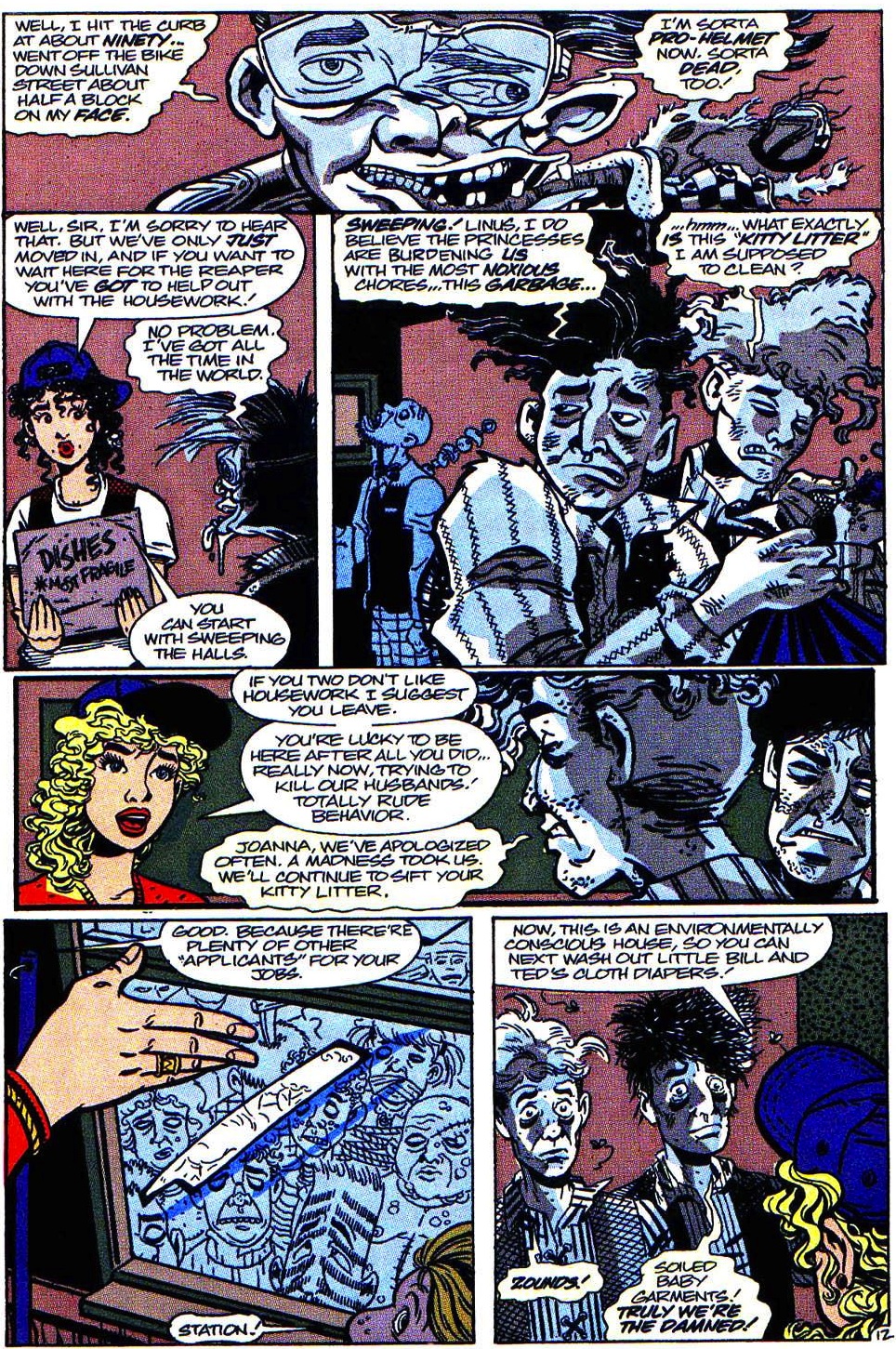
Joanna and Elizabeth are at least given several good moments, such as simultaneously knocking out their would-be suitors with their crowns (violence is always better when synchronized), rounding up a rescue party for Bill and Ted when they are on time trial, and, my personal favorite, making zombies do housework for them while they wait for Death to take their souls. They end up seeming like a slightly more assertive female version of Bill and Ted (not to be confused with the alternate reality female Bill and Ted who show up with many other doppelgangers at the end of the last issue), and since we already like Bill and Ted, the more the merrier.

Bill and Ted Zombie Clean
Kitty litter? Now I just really want to know what Bill and Ted’s cat’s name is.

If there is one pattern that has emerged from all the 90’s comics I have read for this site, everything from the more meta Enigma and Satan’s Six  to Mr. Hero, it is this: comic books love talking about comic books. I’m really not sure why this is, but Bill and Ted’s Excellent Comic Book is no exception. Both titular characters love a comic called Fight Man (this list of his sidekicks and villains demonstrates why Dorkin was the perfect person to write for Bill and Ted), and, as mentioned earlier, Death briefly moonlights as a writer for an awesome sounding comic called Major Violence:

Bill and Ted Major Violence
Pictured: what a lot of comic book fans seem to think of 90’s comics. (Thankfully, we are here to set the record straight.)

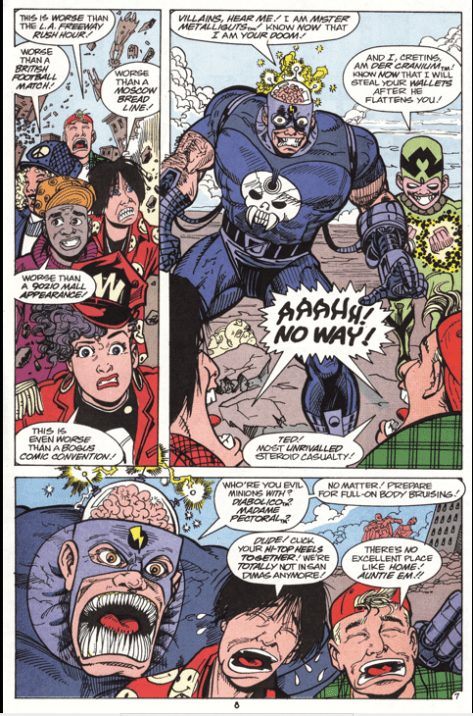
A whole issue is even devoted to Wyld Stallyns accidentally ending up on a world entirely populated by superheroes and villains. No biting commentary on the state of comic books occurs, but it does give Dorkin a chance to have some fun with the over the top-ness of both superheroes and Bill and Ted, who object to having to wear costumes at one point even though they dress like, well, how they dress.  The best parts of the issue, unquestionably, are the names and character designs he comes up with for these alternate reality heroes and villains.

Bill and Ted Madame Pectoral
I am going to lobby Marvel for a Madame Pectoral solo title.
Bill and Ted Amalgam
Let’s see in the comments who can spot the most homages.

I could go on and on about how much fun these comics are, but the longer I do, the more likely I am to start talking like Bill and Ted, and that would be bogus for everyone. (See?) I really can’t think of anything Dorkin could or should have done differently to make a better Bill and Ted adaptation, and while they might not exactly be essential reading, they’re the perfect distraction to tide us over till the third movie actually films. Speaking of films, we’ll be celebrating the release of Avengers: Age of Ultron with Avengers Month here at The Unspoken Decade, so be sure to check that out, and in the meantime, be excellent to each other!


One Hand, Two Heads, All Heart: Neil Gaiman’s Mr. Hero the Newmatic Man by Emily Scott

How best to judge an unfinished work? Is it fair to contemplate what might have been and fill in what you can imagine the artist would have done next, or is that too presumptuous? Is it better only to discuss the parts that actually have been finished, even to the ultimate detriment of that work?

These are the questions I wrestled with while planning out this article on Neil Gaiman’s Mr. Hero the Newmatic Man, and I never really came to a satisfying decision. Sure, I went on some mental tangents about how da Vinci maybe meant to paint some eyebrows on the Mona Lisa and never got around to it, but as far as figuring out the best way to analyze art that never got the chance to fulfill its potential, I was torn.

Mona Lisa
Clearly what da Vinci intended all along.

It can be tricky to apply the concept of completeness to a comic book, which, by its very nature is usually meant to be ongoing, but Mr. Hero, published in 1995 by the short-lived Tekno Comix, has to be one of the most frustrating experiences I’ve had reading anything because of just how incomplete it is versus how much potential it had.  This book posed so many questions, set so many mysteries in motion, and it stopped having resolved exactly zero of them. Of course, reading it 20 years after it was first published and facing an ever dwindling number of issues, I knew it would end before I found out everything, but what made me want to punch a wall instead of just shake my fist, was how close to some of those answers it came.

Seriously, if the whole company hadn’t stopped putting out comics, I would be convinced Mr. Hero stopped when it did just to aggravate me as much as possible. Like me personally. That’s how it felt. The last issue even says The End, even though it ends in the most cliffhanger-y way possible.

What I saw.
What I saw.
What it felt like.
What it felt like.

Of course, the reason it bothers me so much that I’ll never find out what happens is that I was genuinely invested in the comic and intrigued by its premise and characters.  If it were terrible, I wouldn’t have spent several paragraphs ranting about how there isn’t more of it. In that light, I suppose I could tell you more about the things that actually happen in this comic rather than the things that never will. Let’s cleanse the palate with a page of a moustachioed robot beating people up and then dive right on in, shall we?

Hero 1Meet Mr. Hero, the robot best friend you and I and every other person in the world have always wanted. (If you say you’ve never wanted a robot best friend, you are either lying or a self-hating robot.) Mr. Hero was one of a line of comics conceptualized by some very big names in science fiction, including Gene Roddenberry, Isaac Asimov, and Leonard Nimoy, for Tekno Comix, which, this being a 90s comic website, I feel compelled to point out is the most 90s sounding name a company could possibly have.  Neil Gaiman created Mr. Hero,  and the book definitely has some Gaiman-y trappings to it, but it was Eisner Award winning writer James Vance who entertainingly brought the metal man to life and built something unique around him.

From the very first page, it’s obvious that Mr. Hero the Newmatic Man will defy easy categorization, as we are introduced to a hellscape called Kalighoul run by a giant evil lizard named the Teknophage, who seems to be building an army of Victorian-era robots powered by melted souls. Or something. The specifics on how the automatons are created are a little fuzzy, one of many aspects of this world I was disappointed not to see fully explored. So right away, we get a little science fiction, a little steam punk, and some metaphysics, which will soon be joined by healthy doses of action, adventure, and comedy, all rolled in  a shiny metal package.

Mr. Hero 2
I could actually tell that this comic would be quite funny from this page too, but now that I look at it, and myself, critically, that just might mean there is something seriously wrong with me.

Mr. Hero is shipped off by the Teknophage to Earth to be of future use to  in taking it over, but in the meantime he becomes a part of a magician’s act, learns boxing, accidentally punches a punter, gets boxed up, and does not reemerge until he is discovered decades later, sans head and one hand, by our human protagonist, a young mime/aspiring magician/museum worker named Jennifer Hale. Credit where it’s due to artist Ted Slampyak (pencils), both for having an amazing last name and for being insanely prescient in drawing the location of the missing head, a piece of artwork that doubles as a bike any modern hipster would trade a significant portion of his vinyl collection for.

Forget Mr. Hero, or even Mr. Fix-it; meet Mr. Fixie.

When Jennifer puts the head back on Mr. Hero and essentially brings him back to life, a whole host of the Teknophage’s baddies come to reclaim him, but, as evidenced in the page above, Mr. Hero is more than adept at giving some rapscallions what for. Much of the earlier issues is devoted to such skirmishes and the schemes of these minions, but the specifics aren’t particularly important, not because they are bad, but without resolution, much of the meat and potatoes of the plot seems random, and a “throw it all at the wall and see what sticks” vibe is pervasive. I attempted to lay out just the basic plot points for my own use, but it sounded so convoluted that I abandoned any notion of describing the comic that way. If I found myself muttering, “Why exactly is this happening?” to myself while actually reading it, I can only imagine how erratic it would sound to someone who didn’t.

What is important are the antagonistic characters themselves, a very motley crew working in various capacities for the Teknophage, everything from genetically modified men who can camouflage themselves with any background to actual monsters to sniveling bureaucrats.  One of my favorites is a man named Mr. Kingman who is sent to Earth to oversee the capture of Mr. Hero. He does exactly what I would do if I were sent away from a hellscape to a relatively cushy planet, which is not give a shit about anything I was supposed to be doing and enjoy some earthly comforts for a while. Did I mention he thinks dressing like Elvis will help him fit in?

It never occurred to me that those metal ball things could be played like a game, but now I really want to sneak into some middle manager's office to try that out.
It never occurred to me that those metal ball things could be played like a game, but now I really want to sneak into some middle manager’s office to try that out.

Considering Mr. Kingman’s fascination with Elvis and video games and the fact that one of the main antagonist plots revolves around subjugating Earth’s population through their TVs, I assume that there was much more pop culture satirization planned for future Mr. Hero issues. As it stands, in addition to all the other genres intermingling in these comics, Vance finds some room for comics’ favorite genre, the superhero. Two of the Teknophage’s genetically modified goons are introduced to Kingman’s comic, and they do pretty much what anyone with superpowers and a newfound knowledge of superheroes would do: demand costumes and cool names:

Mr. Hero Creampuffs
From now on, I will find any excuse to say, “Grab the cryin’ towels, creampuffs – it’s blubberin’ time,” and there’s nothing you or anyone else can do to stop me.
If every comic book cover looked like this, I would have started reading them a lot sooner.

If the letters pages of these issues can be taken as an accurate representation of how readers felt about these characters, fans were decidedly split over whether Deadbolt and Bloodboil were great additions to an already great comic or bad enough alone to ruin them outright. For my part, they were a great injection of humor at a point in the story that could have easily been bogged down by exposition leading to no satisfying resolution. (Something to do with a group of rich guys who are against technology and a plan to take over the world using a Sasquatch-y looking character, who seems neither to be human or one of the Teknophage’s experiments, as a mouthpiece. I’m not sure how this storyline would have fit into an overarching plot, but it does give me an excuse to mention of my favorite classic Dr. Who stories, which it reminded me of, Invasion of the Dinosaurs. Watch it and thank me later.) I enjoy how they ably demonstrate that superpowers alone doth not a superhero make, and I appreciate how they add yet another layer to an already complex universe, but their most valuable asset is the amount of just plain fun they bring.

Some of the best genre-mashing Vance pulls off in Mr. Hero combines the grotesque with a dash of humor, particularly when it comes to satirizing corporate culture. A revolving door of terrified cronies come to cower before their big boss man, and the slightest infraction or failure is met with swift and horrific retribution. The Teknophage maintains an air of etiquette and refinement, all while committing unspeakable acts, and I’m sure the conspiracy theorists who believe the upper echelons of society are lizard people would read this and think that there isn’t even any satire involved.

Mr. Hero Tekno 1

Pictured: Events happening in real time.

The Teknophage is a tricky character for me because a big dinosaur who has conquered countless worlds, subjugated untold numbers of people, and harnessed pure soul power is an antagonist who sounds downright terrifying on paper. The problem is that I see the big toothy smile and the proper suit, and it just looks a bit, well, silly. Almost, dare I say…cute? He’s handing out man cubes, and I’m having a hard time not going, “Tee hee!” Is it my fault dinosaurs wearing clothes are adorable? (side note: so are snakes wearing hats).

I do not intend that comment to be a criticism of the character itself so much as a criticism of my own ability to sometimes take things seriously. The Teknophage is a fascinating specimen, juggling many schemes and machinations at once, always one step ahead of his adversaries. Any time they think they have gained an advantage over him, he reveals they have been playing into his hand all along, and you get the impression you have yet to see the limits of his power. He is formidable. It is one of my biggest disappointments in the premature end of this title that we don’t find out more about his plans and motivations, though some of the answers I seek might be found in the solo title I’m thoroughly unsurprised the Teknophage received.

Mr. Hero Ad
TEKNO COMIX…more than just exploding heads….but also, exploding heads.

There are so many things I could say about this ad, but it so thoroughly speaks for itself that it would feel almost disrespectful to add anything. Just bask; just take it all in.

Some of the Teknophage’s plans are more well thought out than others, and one that doesn’t lead the places I thought it might is a plot to corrupt Jennifer Hale. The basic idea is that they will give her a lot of money, let it corrupt her, and then take it all away. I like that the Teknophage is convinced the best way to take over the Earth is through corruption, but using her as a trial run doesn’t make much sense since he already seems well aware of the corrupting influence of wealth. He also doesn’t let her keep the money long enough for it to have much of a corrosive influence on her, but they still consider the plan a success, even though the worst thing she does is use a grade school insult on a boss who’s being a bit of a prick.

Mr. Hero Lottery
This is just a more polite version of what ANYONE who came into a large sum of money would say to their boss.

While we don’t delve deeply into the Teknophage’s corruption and subjugation of Earth, later scenes on Kalighoul give us a frightening glimpse into what centuries of his dominion look like. More disheartening  than his sadistic tyranny itself is the affects it has on his subjects, many of whom would rather worship old revolutionary legends than be their own heroes. The ease with which people will accept, and then come to depend on, being ruled is not one of the more flattering sides of humanity, but it is well worth exploring.

Many stories examine what exactly it is that makes us human,  and some of those stories contain robots, but Mr. Hero may be the first I’ve encountered that does so without using the robot as the vehicle for that philosophizing. For as many aspects of this comic as I have touched upon, the one part of Mr. Hero you may have noticed conspicuously absent is, well, Mr. Hero. The biggest reason for his absence in my retelling of his own story is that his role in it is mostly reactionary. He fights because he is attacked; he seeks answers because those around him pose questions. Even when he discovers that he was once a flesh and blood man, with a wife and children and a rebellion to lead, there is not time for even a moment of introspection. He just kind of goes, “Blimey!” and everyone goes on with their day in a hell world.

Just because he is not given the opportunity to develop a great deal of emotional complexity, though, does not mean he is a shallow character. For starters, this is one automaton with not one, but TWO heads, one for ol’ timey boxing and one for thinky times:

Normally I would complain there's no reason he can't just have one head that's good at fighting AND thinking, other than his creators thought it was cool, but when the results are this cool, who am I to argue?
Normally I would complain there’s no reason he can’t just have one head that’s good at fighting AND thinking, other than his creators thought it was cool, but when the results are this cool, who am I to argue?

Granted, the heads aren’t normally on his body at the same time, but we still get some nice Jekyll/Hyde by way of the Odd Couple bickering between the two even when we only get them one at a time. The pipeless head is the one you want to show up to your party, quick to defend his friends, endearing in his simplicity, an all around good bloke. The head with the pipe, who goes by the Ratiocinator, is the one who will come to your party only to recite poetry, then insult you when you ask if he could just not. I think it goes without saying that this is a character who is easy to like and to want to know more about (I mean, did you look at that picture?), but the only time he takes initiative is setting out to find his missing hand, which we never find out the story behind!

I know I have sounded like a broken record about all the things that don’t happen in this comic, but I’m no less torn at the end of this article than I was at the beginning when it comes to how to discuss it. How do you assess, critique, recommend, etc. something that promised so much but never made good? On the one hand, I think it would be yet more tragic if this comic were to be forgotten, but on the other, can I really suggest anyone should read something that will ultimately lead to frustration? (I mean, to be fair, I do still recommend Firefly…screw it, read the comic.)

Perhaps if you do read Mr. Hero, it will wet your whistle for later this year when we take a closer look at Tekno Comix!

Mr. Hero CrossoverSomething a little closer to look forward to, though, is the rest of Madness in the Month that happens to be March here at the Unspoken Decade! Next up is Darry Weight’s look at Venom: the Madness!

The Road to Hell is Paved with Good Intentions: Satan’s Six by Emily Scott

Welcome back to Indie February here at The Unspoken Decade! If you missed Dean Compton’s great look at Exiles in Part 1, I suppose you’ll just have something to look forward to once you’re done with this, Part 2, which delves into Topps Comics’ Satan’s Six! This comic is part of the Kirbyverse, made up of multiple titles released simultaneously that develop unrealized designs and concepts of the King himself, Jack Kirby. Darry Weight’s look at the whole of the Kirbyverse is coming up next in Indie February, so hopefully this glance in will whet your appetite for the whole enchilada!

Of course, that endeavor would probably be more likely if I had more positive things to say about Satan’s Six…

Before any fans of this work go reaching for their torches and pitchforks, as thematically appropriate as it might be for this comic, I should make the disclaimer that I won’t be wholly critical. There’s a lot of fun to be had reading Satan’s Six, and it injects a lot of humor into a traditionally horror setting. It’s got a great premise. All of the good so far, sure, but even from the first few pages, I would swear Satan’s Six is actively trying to get me to dislike it. For example, the word I kept coming back to in describing the art is abrasive:

Abrasive
I hope your eyes have not been too seared to continue reading.

The color palette is loud and garish, proportions distorted and grotesque. Much of the action is so heavily stylized that I can barely tell what is depicted in multiple panels. I’m sure some of the off-putting effect is intentional to reinforce the hellish subject matter, but the comic is so, well, just unpleasant to look at that I spent most of my time reading it going, “Gaaaaah” in my head.

My impulse to make that noise is helped not at all by the fact that of the three or four facial expressions characters make in this comic, one of them looks exactly like they are making that noise too. Seriously, this face:

Face 5appears over….

Face 4and over…

Face 3and over again.

Face 1

The whole comic, however, does not look like this. Several pages were drawn by Kirby himself, which would be great (both because well, it’s Jack Kirby, and because they’re the only pages that don’t feel like the top layer of my eyes are being scrubbed off) if it weren’t for how awkwardly they are shoehorned in: the narrator basically just says not to mind the style change, this being hell and all.

This is not the only instance where the comic suffers from what I can’t decide is either lazy writing or attempts to be more clever than it actually is. The narrator herself, a Guardian Angel First Class of the Comic Book Division, is problematic in this vein, but before I get too deeply into those shortcomings I should probably, you know, say what the comic is about. I will kill two birds with one stone by showing some of Kirby’s work on the project and getting the premise across:

I will let you decide if that's lazy writing or cleverness.
I will let you decide if that’s lazy writing or cleverness.

Pretty great premise, right? Being raised in a Pentecostal church, a denomination big on the fire and brimstone, I have always been fascinated by depictions of Hell and demons and different takes on the afterlife in general. The idea of a group of people trying to make it out of Limbo by winning souls for Hell is a great twist (made doubly great by them constantly messing up because they’re not evil enough), and the comic works best when it hews closest to this simple but brilliant idea. Where it starts to lose me is when they reach for the heavens.

I told you that the narrator, Pristine, is a guardian angel from the Comic Book Division, but what I can’t tell you is what purpose it actually serves to make her so meta, unless it is to highlight the gimmicky nature of the comic. She could just as easily be the guardian angel to these characters without explicitly telling you they are comic book characters, and I kept waiting for this breaking of the fourth wall to have a greater payoff than, say, allowing writer Tony Isabella to use the first six pages of Issue #2 to recap Issue #1 through Pristine.

I chose this page because this is a 90s comics site, and what could be more 90s than a beeper?

None of this criticism is to say that the character doesn’t work at all. When the winking at the reader is toned down and she is merely meddling with our anti-anti-heroes’ plans, she is quite entertaining. For instance, while the Six are assisting a professor who has sold his soul to stop an ancient archaeological find of his from breaking free and taking over the world, Pristine reminds Frightful that if any of the Six should die saving someone, they’d likely go to Heaven, forcing him to intervene. There’s something sinister behind her wide grin, the inversion of the angelic and demonic does its best to add back a satisfying layer of complexity that the meta-ness subtracts.

Had this comic gone on longer, these two would totally have been someone's OTP.
Had this comic gone on longer, these two would totally have been someone’s OTP.

The rest of the characters would have benefited greatly from a longer run, since they are thoroughly one-note in their introduction, but that doesn’t stop Satan’s Six from having some legitimately emotionally affecting moments. The third issue centers on one of Dezira’s old flames, everyone’s favorite hunchback Quasimodo, cutting loose from Limbo to save her from the Devil’s trickery. His own penance was almost up, and his act of self-sacrifice earns him an automatic ticket to Heaven, a sweet ending in a place I didn’t expect.

Of course, that sweetness is somewhat tempered by other weirdness going on in this issue, including a plot in which Quasimodo becomes a movie star after running into Lloyd Kaufman from Troma Entertainment. It’s a completely random-feeling and wonderful cameo, and the story gets in some nice satire of Hollywood, but like a lot of things in this comic, its many disparate elements feel like they were tossed in a blender, mixed up, and thrown at the wall to see what stuck rather than carefully thought out. There’s a haphazard feel to these proceedings that sometimes work and sometimes don’t but always make me feel frantic.

Just to further illustrate how many inconsistent parts make up this Frankenstein’s monster of a comic, I’ll mention, but not go into any great detail about an unfortunate incident involving Dr. Mordius drinking a potion of his own concocting and turning into a dog. On its own, that transformation wouldn’t be so bad, but the “what the fuck?” quotient is upped when he is chased around by another, amorous dog. Yeah, that’s all I’ve got to say about that…

Doge
Yep, that happened.

How about we look at another page of Jack Kirby’s, just to cleanse the ol’ palate?

Kirby Cleanser
That’s better.

The fourth and final issue in its initial run also tells a pretty emotionally satisfying story in which Harrigan schemes to negate a former colleague in crime’s contract with the Devil, but once again, the sweetness is undercut by a pretty silly gimmick. This time it’s another cameo, one that could actually make more sense, given the hellish backdrop of the story, but is somehow integrated worse into the story than freakin’ Lloyd Kaufman.

JasonThe gist is that Odious Kamodious, the demon who made the deal to send the Six back to Earth, is unhappy with Freightful’s performance as Team Leader and threatens to replace him with Jason Vorhees. Everyone fights for a bit and then Odious sends Jason back to Hell, but not before hanging a lampshade on the gimmick. Once again, I don’t know if this is supposed to be clever, but it just feels half assed. They could have legitimately inserted Jason into a story a million better ways, which I know to be true because one of Dean’s favorite things to do is talk about Jason showing up to machete irritating people, and it’s always more entertaining than this diversion.

Sigh
I should not be this inclined to call a comic named Satan’s Six cutesy.

I feel like I’ve spent a lot of time criticizing Satan’s Six, but the more I’ve written about it and read sections of it again, the more I actually like. It’s worth reading for its premise and humor alone, and given more time, I think it would have suffered less from its gimmicks, since the non-gimmicky stuff seems so outweighed in only four issues.  It’s frustrating to read something that doesn’t live up to its potential, but its flaws make it almost more intriguing than if it were just good, which is probably why I took up so much space discussing them. I can honestly say I’ve never read anything like Satan’s Six, and sometimes that’s the most ringing endorsement I can give.

Something else I enjoyed about this comic were the mini comics that closed out each issue, my favorite being one from Wolff and Byrd, Counselors of the Macabre. (Such a great name.) Wolff and Byrd turn up again in the main story of Issue #4, and at the end of Issue #1 they defend a demon summoned and abused by a professor. I’ll leave you with one of my favorite context-less panels ever and remind you one more time to be sure to come back for more of the Kirbyverse as Indie month continues!

Tenure