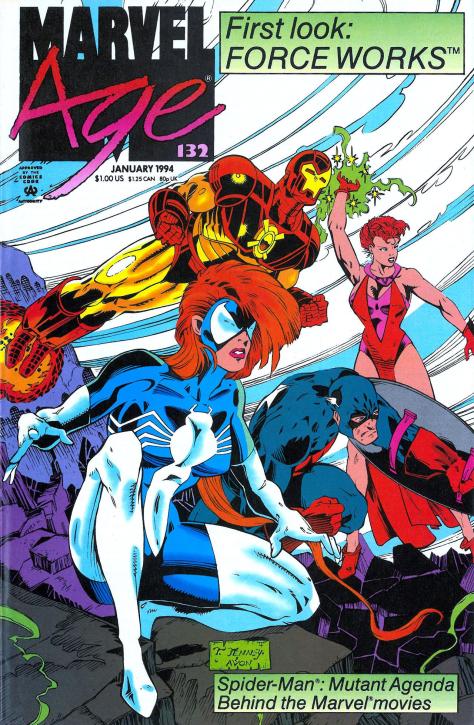
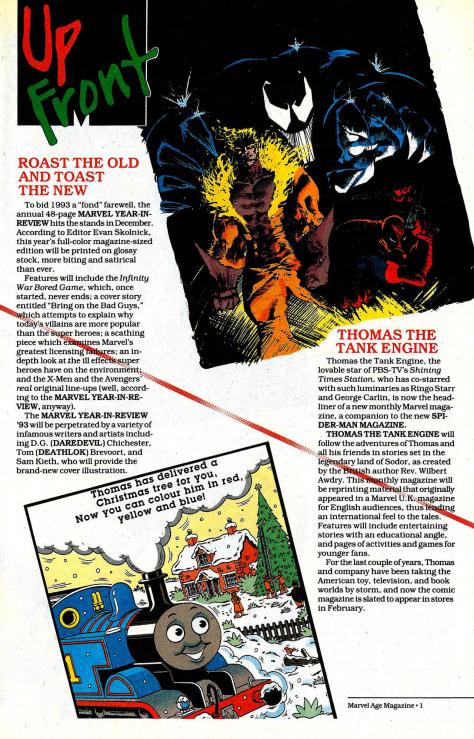
Hope you’re getting ready for the holidays in style! In the meantime, take a look at a few excerpts from Marvel Age #132 (Jan 1994)! I am sure all of you recall the Marvel hype magazine that was on seemingly every newsstand in the 90’s, but I could never find it at my local comics shop!
We’ve got news here on an NFL/X-Men team-up, new revelations for the X-Men, a Spider-Man magazine for the younger folks, and even THomas the Tank Engine!
I’m also tossing in the December checklist! Let us know what you would have been picking up in the comments!
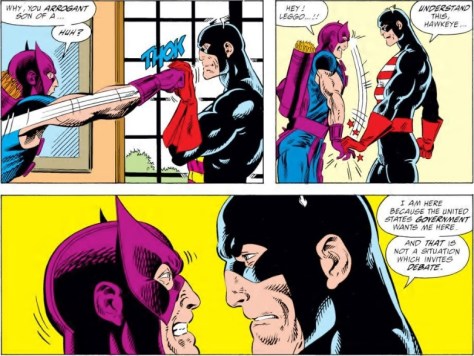
“Boyoboy, a pointless scuffle. Just like old times…” – Hawkeye
Have you seen “Marvel’s The Avengers: Age of Ultron”? I assume you have. We here at the Unspoken Decade have. This month we want to share our boundless enthusiasm for all things Avengers with you and are taking a closer look at some of our favorite Avengers’ stories.
In 1995 Peter David wrote his first and only (aside from the “Season One” OGN) Avengers’ story, “The Last Avengers Story,” featuring the first American work of Argentinian artist Ariel Olivetti. Seeing print alongside such avant-garde alternate reality stories as Warren Ellis’ “Ruins” and Garth Ennis’ “Punisher Kills the Marvel Universe,” it is a trip through the bleak wasteland of the far future of 2016. It is also the story of the “last” Avenger, the man, the myth, and the legend himself, Hank Pym.
Everyone believes the universe singles them out; only failed entomologist Hank Pym has proof that the universe cannot stand him, although said universe has good reason.
This is not a comic about hope. It is not a comic about why you would want to be a superhero. This is a comic about what happens when you are a superhero, even if you cannot help it. Most importantly, this is a comic about family. “The Last Avengers Story” features cameos and appearances by many notable Avengers and some members who were, at least at the time, candidates from some weird future. This includes Cannonball, the Nigh-Invulnerable Man (sort of like “The Human Rocket” except with even more innuendo), so we can assume Jon Hickman was a fan. One notable absence is Tony Stark.
At no point during the two issue, prestige-format limited series does anyone acknowledge the fate of the team’s longtime benefactor or his “armored bodyguard.” Instead the story focuses on and shows the fruit of the Pym family tree. As if the entirety of what the Avengers are had been focused through the lens of Hank Pym, the doughy, porn-‘stached form of Hank Pym.
Have you ever had to acknowledge anything sadder than that?
In a world without the Avengers (it has been about two or three decades since we last saw the originals “in action”), things merely moved on. The Avengers became a poorly run franchise full of unlikable, younger heroes that are (since this was 1995) promptly “nuked” from existence.
High Tide, we hardly knew ye. Maybe you will return, along with your teammates Sequoia, Gestalt, and Super-Ego in an ongoing series featuring “The Just.”
When we first meet Hank (again) he is retired (again) and desperately trying to repair things with Jan van Dyne (again). The difference here is that this is the beginning as opposed to most Hank stories, where the failure comes later. Years after he first provided superpowers to a young woman in hopes of having her like him, the Wasp has begun to shrink, about an inch a year, and it is not to enhance her abilities. One of Hank’s only unobstructed accomplishments is killing the one person he loves more than life itself, and, as far as we are shown, Hank is no closer to solving the dilemma after a decade of constant work.
Hank has grown fat and watched the world slowly become unrecognizable. There are references made to Greenwich Village becoming an unlivable hellhole, while the South Bronx has become trendy and fashionable. If you are not intimately familiar with the various neighborhoods in and around New York this is not that important, but if you are, well, then I guess we could have worse instances of world-building. If nothing else, these issues escaped Peter David’s incessant obsession with puns. The heroes never made the world better. No grand change was made to how man and superman live together and without the constant focus of monthly adventures to distract our heroes they slumped into the same mediocrity that we ourselves can one day expect.
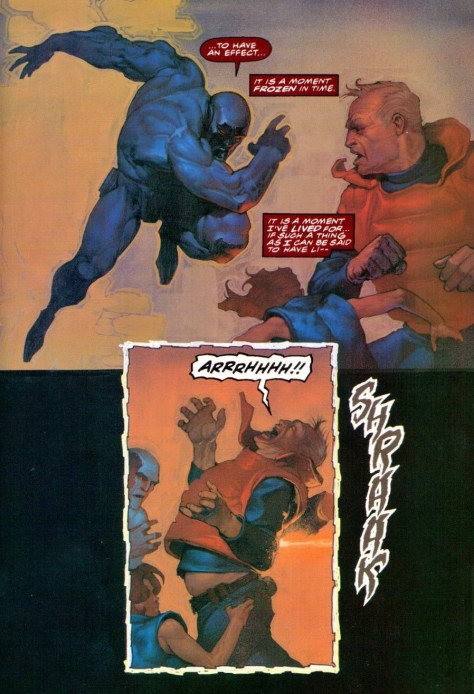
This scene does not appear in “The Last Avengers Story,” which is a shame. Any time a carnie punches a man dressed in a flag while still believing he has the moral high ground is cause to celebrate.
My favorite Avenger, Clint Barton (referred to as “Cliff” at the beginning of the second issue because either Mockingbird has some undiagnosed memory issues or no one cared enough about the Avengers to copy edit) is retired and blind, lamenting the loss of the good old days. Bobbi Morse, his wife, hates everyone because Kirby-forbid that character ever to be likable. As another reminder that the world became worse, we are told that President Captain America was assassinated some time ago, under mysterious circumstances that remain unsolved.
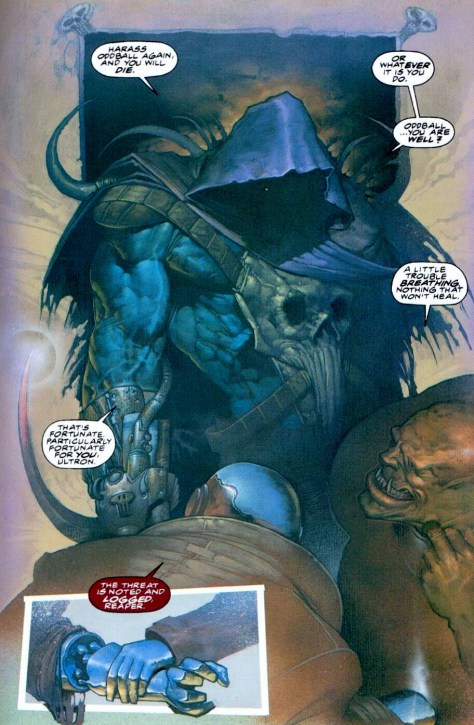
Next is Ultron-59, scion of the House of Pym, who has come to issue a challenge: Whatever heroes Hank can muster (the “real kind,” not these “pale imitations of today,” sounding similar to more than one aged fanboy I have met) versus the surviving forces of evil. This, we are told, will be for all the marbles but is one more instance of a child acting out for attention. Not only was he the one who annihilated the New Avengers in one fell swoop, but, to really drive home the point, he pulls out a cigarette and lights it with his eye beams. Take that, Dad! I can choose to smoke, even though I am an unconquerable killer robot. Alongside him is the Grim Reaper, this time played by Billy Maximoff about a decade before, and a world over, becoming Wiccan of the Young Avengers.
More Death Dealer than cosplayer, as if he were the genuine Grim Reaper, barely subsumed in mortal form, ready to usher in the end of all things.
His twin brother Tommy is also around, apprenticing as the Sorcerer Supreme. Their father, the Vision, makes an appearance as we are shown why the Scarlet Witch and Quicksilver are no longer around. This is Hank’s extended family. The wife he could never quite figure out how to love, the son he never intended to have, the grandson he could never have fathomed, and the two great-grandchildren he now must simultaneously fight against and lead into battle.
Reaper is joined by Kang the Conqueror and a shapechanger named Oddball. “The Last Avengers Story” is a story within the story as well, used by Ultron-59 to lure Kang back to this decade because reasons. The nature of Oddball’s relationship to Grim Reaper, which is portrayed as important, is never explained. I like to believe he is the first, non-canonical appearance of Teddy “Hulkling” Altman. In a world apparently constructed around Hank, everyone suffers and no one is truly happy. Even a character that had yet to be created, such as Hulkling, appears to be retroactively sucked into this void. Instead of the Next Generation of Heroes there is a homicidal maniac (Billy), an indecisive shut-in (Tommy), and a pile of nonsense molded to look like a Simon Bisley drawing (Teddy).
Tell me that does not look as if it should have been a cover to “Heavy Metal.”
The cinematic world of the Avengers is one built by and around Tony Stark. In some cases the fact that he flies around as Iron Man is secondary. He built Ultron, gets credit for bringing the Avengers together, and is in the center of all those group-shot movie posters, inexplicably not wearing his helmet even though they are in the heat of battle. The world of “The Last Avengers Story” eschews Cocktail Shaker Man and focuses on the parts of the Avengers that stem from Hank Pym, a character who has yet to appear in any movie.
Part of that is not his fault; my understanding is that the Ant-Man film was green-lit way back when the first Iron Man film was getting made, so those characters were sequestered away. Still, I cannot imagine Tony Stark being that upset if Ultron-59 came to his door and demanded a Final Battle to get over his Daddy Issues. Tony, unlike Hank, will have moved on, and an Ultron built by him may not end up as needy as one built by Hank. With each reread I am surprised how dark the world presented here is.
Wonder Man’s finest story, dying to take down the Hulk, the only foe the Avengers never truly defeated. If you have any recommendations otherwise, post below!
This story is a tragedy but it is also funny, the humor coming from the absurdity of the situations these also-rans find themselves in. Wikipedia tells me that this comic was written in 1986 and was shelved until the powers that be decided to temporarily replace the “What If?” brand with the darker, and more expensive-per-issue, “Alterniverse” brand. That means that instead of being a contemporary of “The Crossing,” the much maligned Avengers event that shipped merely two months before this far better remembered story, this should actually be considered a peer of Peter David’s own “The Death of Jean DeWolff” and the other boundary pushing stories of the eighties. This is not a parody of the era it found itself in, but is really one of its precursors. I am not sure what of David’s original scripts made it onto the page. There is a reference to the also much-maligned reveal of Alicia Masters as a Skrull from a few years before (She and Johnny Storm, also a former Avenger, have an adult child that Pym attempts to enlist).
This story felt as if it could have been the future that the Marvel eighties promised, an era of Jim Shooter, Frank Miller, and a slow transition from Bronze to Dark. It was not a place of hope, and the noble tended to be ground down. Pym tells his motley crew that he wishes Captain America was there, to lead them, inspire them, and most of all to tell them what to do. Thor, Hercules, and other mythic characters have all perished in a separate, unrelated great disaster. This leaves the team constantly wondering why they should bother, which encapsulates what the Avengers are, both as a team and a franchise. They are not the Justice League. They are not the best of the best, they are the other guys. They constantly change their lineup and most of their greatest foes are former teammates. They occupy a pronounced space in popular culture that can be uniquely self-defeating.
To watch them flounder with existential despair while in the midst of their last great struggle shows that maybe this is what being a hero is. Fighting for what you believe in, no matter the odds, and hoping against hope that your faith in your friends will be enough to see you through. Except if you are Hank “Seriously, I went back to using the name Yellowjacket even after that Salvation-1 business (but that may have actually been a Skrull)” Pym. Then you wait until things get heated, grab your wife, and try to hightail it to the Microverse. My single favorite moment in this comic, possibly in all of Avengers fiction, is the look on Jan’s face as she realizes what Hank is proposing and that he is ready to go, no questions asked. He has thought about this. Amid the carnage and bloodshed of their friends and superpowered children fighting for their lives against a monster Pym himself created, Hank is ready to run away and hide. In fact, that was his plan all along.
I have always imagined Ultron as voiced by Chris Latta, actor behind Starscream and Cobra Commander from back in the day. Constantly manic and angry for no apparent reason.
Hank’s not the noble, inspirational figure of the story, at least not this one. He is not supposed to be. Those who are wear capes, gives speeches, and maintain even heart rates as they calmly tell mad gods to go ☠☠☠☠ themselves. Hank is the one who makes those people shine brighter by comparison. Captain America is a great man in story, but is he an interesting character? When he has something to fight against, sure. When he is disillusioned and coming up against something that makes him question what he believes in or how those beliefs are portrayed in the world. Hank does not have ideals; he just tries to follow those who do. You cannot write compelling fiction about a person who only does good. The writers of “Action Comics” for the last thirty or so years can tell you that.
“The Last Avengers Story” is about the legacy of a man who was there at the beginning of an idea and who sees it through to the end. Hank is murdered by a time traveling former pharaoh who may have once banged his “niece” (again, in another world). His has been a weird life made all the more strange by the fact that he never once made a decision he could really be proud of and that said decisions come back to haunt him in his twilight years. This is not “The Dark Knight Returns,” and the hero does not prove everyone else wrong. Hank, potbelly intact and with only a few flaccid devices at his disposal, can only defeat his villainous son (who should have been Hank’s legacy considering he created AI alone in his basement) by being murdered by an underling.
Hank falls, Ultron slaughters Kang, the man responsible for stealing his victory. Fearing that Ultron will now never know his true purpose he is then murdered by his own son, the barely coherent Vision, moved to action by the death of his “grandfather.” A vicious, awful cycle comes to an end, the dead are buried, and the survivors are left to wonder whether any of this was worth it. There are no celebrations and as far as I can tell Jan is still shrinking, slowly but surely, into eventual oblivion.
I always imagine Hank Pym with a mustache because of course he grows that particular poor decision right before passively asking for dispensation.
This comic is in many ways a precursor to DC’s “Kingdom Come.” That story featured a generation of morally vacant, superpowered young people causing more harm than good until their shenanigans reach a boiling point and Superman must be convinced to step in. He assembles together the remaining adult heroes, spanks the children, and ultimately leads to the deaths of an untold number of civilians. Momma Kent’s Lil’ Boy did not have a good time during the nineties is what I am saying. In a similar fashion, Captain America is revealed to have been watching as the world grew steadily worse. Watching the last of his friends taken down by their own inabilities.
Years before, Cap had come forward to lead the nation in light of rampant bureaucratic abuse of his superpowered peers (a government orchestrated “Villain Massacre” is mentioned). He could not have known that in this world the rules of the narrative would not allow for things to end well. He is shown to now be in a regenerative chamber. He is, inexplicably, clad in his full uniform and mask. Hawkeye, still blind, tells a mourning, doubtful Jan that “He” will return. There is a promise of glory to come but none is shown. We are never told how or if Cap has been healed or if something else has occurred to allow him to return. In this story Cap is reduced to a hollow shell, not a real person. His story, if there will be one, is hinted at as the primary story closes, with no acknowledgement if something better is just around this corner.
In this world, where all things apparently stem from Hank Pym, Cap is unable to save the day. He cannot do much of anything because he only exists as the one dimensional caricature he is remembered as. Hank thinks back to him as the father figure he never had, and even then Cap is portrayed only as an example of unyielding heroism. We have been shown in this story what happens to heroes, so why are we to believe now, at the worst of times, that one will change the fundamental nature of things? I do not buy it, and while the first time I read this, I was invigorated by the idea of Cap coming back to deal with all of the nonsense that the future had wrought, I think now of Superman in KC. Maybe Cap would have a titanic battle with Iron Man (our Captain Marvel stand-in) that corrects the indignities heaped on their dead comrades, but more than likely, based on what we have seen, more people would perish in the worst way leaving a still blind Hawkeye proselytizing to no one in particular.
This team went on to include Otto Octavius and even he did not dwell on his shortcomings as much as Pym. Most shown have done far worst; they just moved on.
Hank could never get out of his own way. This makes a certain kind of sense when you consider that he is an outcast from a different genre than someone like Cap. “The Man in the Ant-Hill,” Hank’s first story, was published in those early, just barely Marvel stories. His peers are giant monsters and unknowable invaders from beyond. He was widowed and traumatized beyond repair before he ever met anyone wearing a brightly colored costume. He belongs in a Chuck Palahniuk novel, not standing alongside Earth’s Mightiest Heroes. Regardless, Hank represents what the Avengers are: what happens when normal people try to make sense of all the incredible crap that they come across while living in a place such as the Marvel Universe.
The Avengers are the number one box office draw in recent history. They have even eclipsed their peers and mass media precursors, the X-Men. There is a different “Last Avengers Story” waiting to be told today. That story will have glory and heroic sacrifice, and it may even have Cannonball. It will not have Hank Pym. It does not need to. The franchise outgrew him. All that he was died unceremoniously in a fight that could have been avoided altogether if he had been better at anything he had tried to do earlier in life. “The Last Avengers Story” is just that, the final tale of a team at a certain point and what that could have meant. So much has changed since then that the franchise is almost unrecognizable by comparison, but that is also its greatest strength. The Avengers endure, no matter what, which is what makes this story as enjoyable as any blockbuster film featuring all the pretty people.
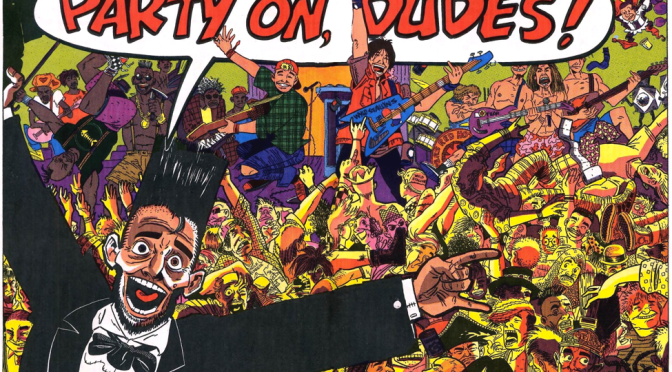
Greetings, most excellent Legions of the Unspoken! I’m Emily Scott, and I am here to tell you all about a totally outstanding 1991 publication from Marvel, Bill and Ted’s Excellent Comic Book! *air guitar* This triumphant comic may have had bogus sales and only lasted 12 issues, but its short run is in no way indicative of how non-heinous this interpretation is of two beloved characters. Anyone who enjoys either movie would totally love these books, so prepare to be fully informed, and…PARTY ON, DUDES!
…Ok, I think I’ve got the bulk of the Bill and Ted speak out of my system, at least for the purposes of this article. I don’t really remember a time when my own vocabulary didn’t include some Bill and Ted-isms, and to this day I refer to things as being non-non-non heinous more often than any reasonable person should. Reading a dozen issues of their vernacular, though, has left me even more susceptible than usual to adding ‘most’ before every adjective and exclaiming, ‘Whoa!’ with hushed awe.
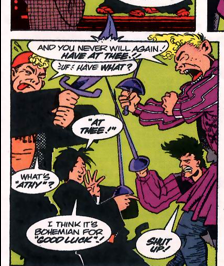
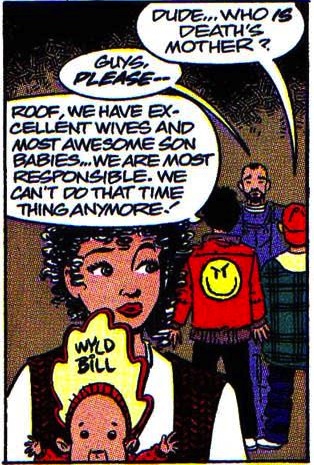
How is it possible that these two panels squeeze in so much Bill and Ted slang that they sound translated straight from an English-to-Bill and Ted dictionary and yet sound so natural?
With a new comic book release, chatter about a third movie louder than ever, and the fact that it’s one sequel after a long hiatus that everyone actually seems fine with, there’s no better time to ponder why we’re so eager to be excellent to two dudes we first met over a quarter of a century ago. Their language is a major factor in what still endears us to Bill and Ted and a prime example of the movies’ greatest strengths, taking something that could be pedestrian like late 80’s/early 90’s surfer/stoner/Valley bro talk and making it most atypical. (Sorry that I can’t stop with the Bill and Ted speak…NOT!) You know exactly who these characters are immediately upon hearing them, but they don’t sound quite like anyone else you’ve ever heard.
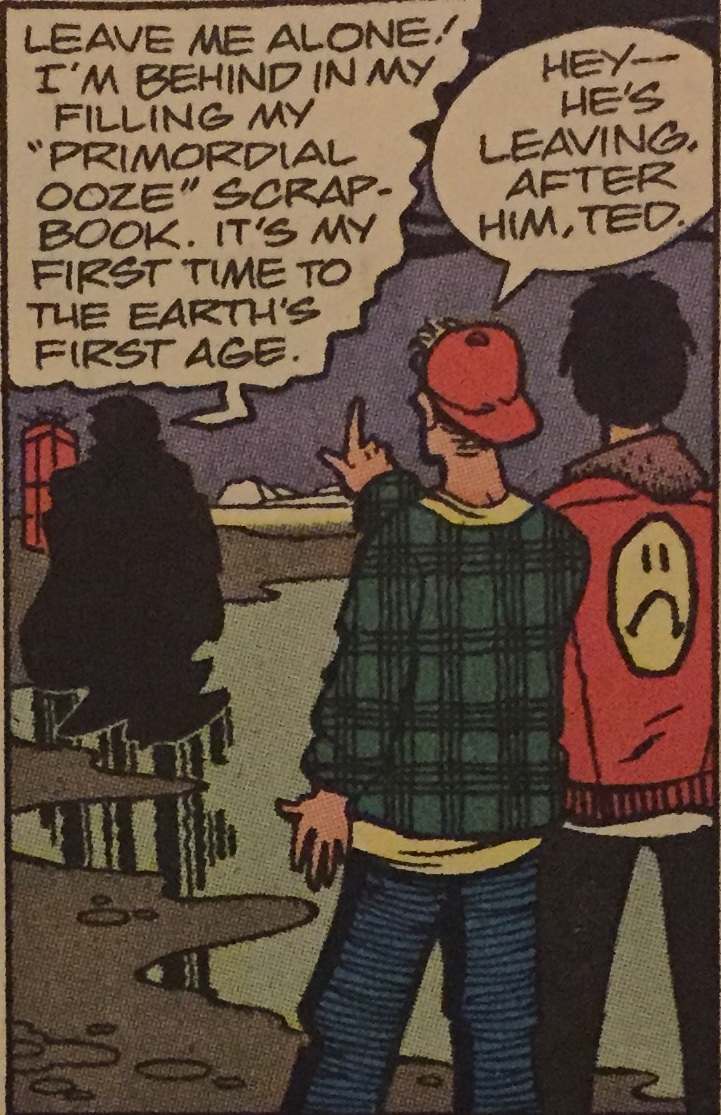
As the above two panels from the first issue ably demonstrate, writer/artist Evan Dorkin nails Bill and Ted’s verbal eccentricities, a feat made all the more impressive when you learn that he had not seen either movie when he started writing this title. Dorkin, a five-time Eisner Award winner best known for his works Milk and Cheese and Dork, gets just about everything else right too, from the lighthearted tone of the humor to the happy-go-luckiness of the titular characters. One of the comic’s greatest strengths is that if you know Bill and Ted, you know exactly what you’ll be getting. This comic feels the most like the source material just drifted into another medium than almost any other adaptation I’ve ever seen.
Am I the only one who wants to hear the rest of Death’s joke?
Not only does the comic sound just right, but it looks spot on too, with art that is colorful, fun, and busy. Dorkin gets a lot of comedic mileage out of great expressions, and he can make an already zany universe that much zanier by drawing faces so exaggerated not even Keanu Reeves could actually make them. The art is also better than it has any right to be for an adaptation of a comedy about two dudes who travel through time in a phone booth, with an eye for movement and action that flows seamlessly and images that are surreal and vivid, evocative and at times bordering on nightmarish. (In case you were wondering, yes, it does feel incredibly strange to attempt a serious critique of the art in a Bill and Ted comic. It’s so damn good,though, that it deserves to be taken seriously.)
As a chronic procrastinator and habitually late person, this is what every clock looks like to me.
One of my favorite aspects of the entire run is just how much stuff Dorkin manages to squeeze into every panel. From the band shirts and buttons on background characters to random appearances from people like the Red Hot Chili Peppers, I found myself staring at pages for a long time to catch every little detail. Dorkin makes the most of every centimeter of page space, capitalizing on every opportunity to squeeze in another joke or bit of whimsy, from guest letter columns from characters like Station and DeNomolos to something simple like a sword piercing a word balloon:
to a running gag in which the smiley face on the back of Ted’s jacket changes expressions to match the situation:
Just as their speech takes slang we’ve heard coming from a million different mouths and strings it together in most memorable ways, Bill and Ted take pretty well worn character templates, two doofy but lovable dudes, and give them a contagious enthusiasm and hearts so big they cause a moon boot-filled future utopia I sometimes daydream I live in. A lot of similar characters are like cats who always land on their feet because they’re too dumb to know the ground is there. Bill and Ted are the cats who always land on their feet because it wouldn’t even occur to them that the ground would do that to them.
Bill and Ted may be the sort of guys who would never pass a history exam without George Carlin and a magic box, but as Ted reminds us in the clip above, they are well aware of their intellectual shortcomings and more than make up for it with that relentless optimism, allowing them not to be intimated by anyone regardless of their smarts, power, or prowess. These are two dudes who can hang with God, give Satan hell, and even melvin Death. When someone can face that lineup and not be cowed, they can be placed in just about any setting against any foe and believably come out victorious, and Dorkin takes advantage of that versatility by telling stories everywhere from the past to the future to the nexus of time to the Dimension of Utter Boredom. (You can guess how much they love Wyld Stallyns in that last one.)
To be fair, the effects in 2001 are really good.
The Bill and Ted universe has a pretty deep bench, which is unsurprising, considering it could potentially include anyone from any time, and everyone’s favorite characters make an appearance in the comics, from Missy (I mean Mom…) to So-crates to my personal favorite, the Duke of Spook, the Doc of Shock, the Man with No Tan, Death himself. I’ve always had a soft spot for Death as a character, from Death of the Endless to the Grim Reaper in Monty Python’s The Meaning of Life (if you don’t laugh during this scene, I’m sorry that you were born with no sense of humor), but none approach my fondness for the version of Death with no luck at board games. His portrayal by William Sadler in Bogus Journey makes the movie ten times greater, and even though Death is his skeleton self here, his presence accounts for a surprising amount of the humanity and pathos in the comic, as well as some of its wackier plots.
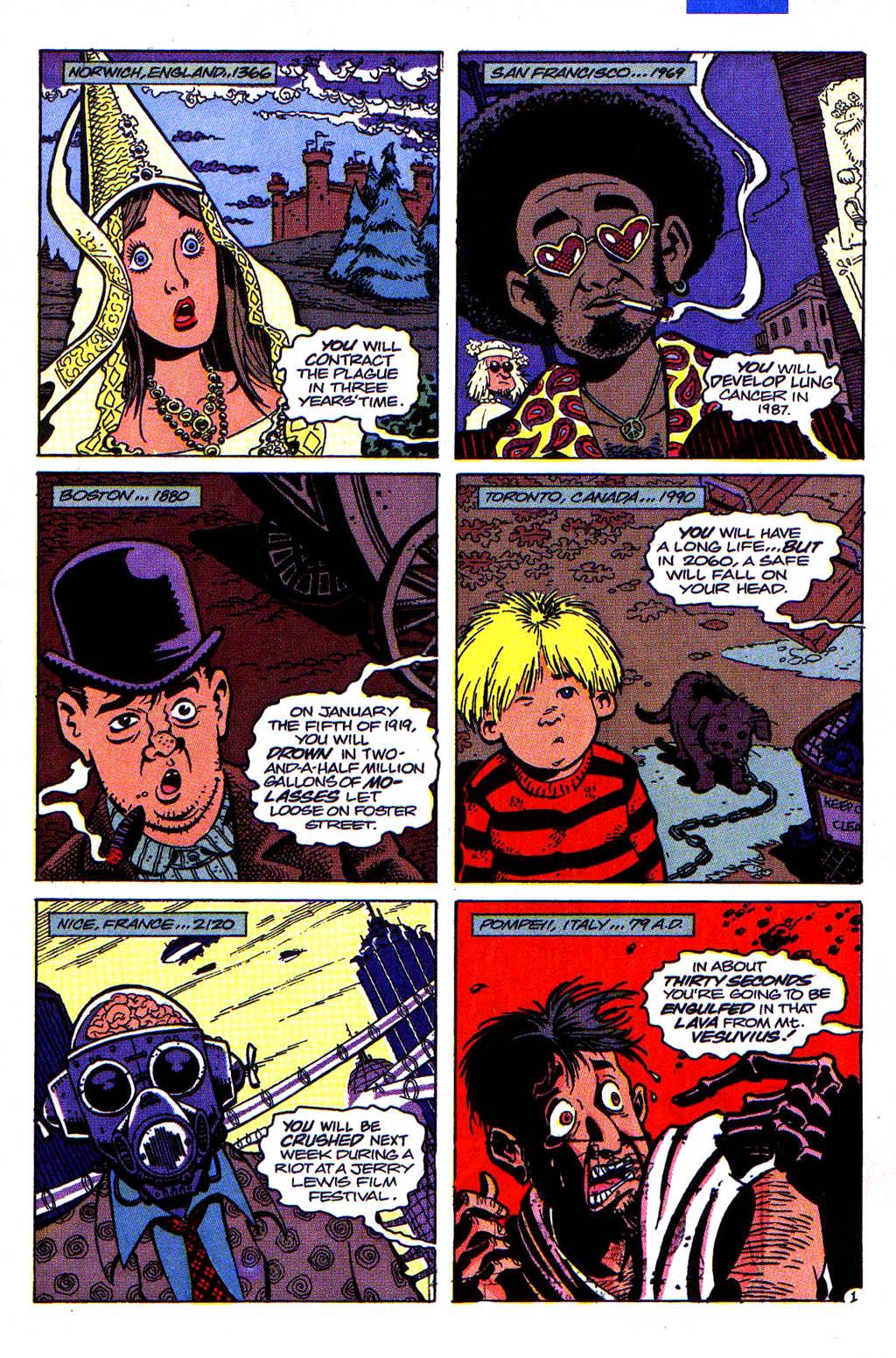
While there are a few ongoing stories, including a seeming inevitability where Bill and Ted stand trial for their interference with time, most of the issues stand alone, and two of the best revolve around Death, one in which he quits and the other where he is replaced. In Death Takes a Most Heinous Holiday, instead of searching for the true value of life or exploring what it means to be mortal or any of that other sentimental nonsense, Death treks through time to places like Pompeii and the crash site of the Hindenburg to revel in the mortality of others. Depending on your perspective, he is either the best or worst tourist of all time.
If anyone was curious, the molasses thing was a real disaster. (Here at The Unspoken Decade, we entertain AND educate.)
Bill and Ted convince Death to return to work, but in It’s a Living, he has become too concerned with worldly matters and is replaced by a foul mouthed, bad tempered pipsqueak of a reaper named Morty. Odd as it feels to say, this issue demonstrates that Death, constant and immutable, is actually the character who changes the most over the course of the comics. He tries occupations from fast food worker to comic book writer (we’ll come back to that one), makes new friends, and learns a thing or two about compassion from his kindly landlord. I would not have expected to get a little choked up over a story involving a Reap-off and a midget skeleton wearing a Flava Flav clock, but it bears reiterating in case I haven’t made it plain enough yet: this comic is far, far better than it has any right to be. And this is coming from a self-proclaimed big Bill and Ted fan.
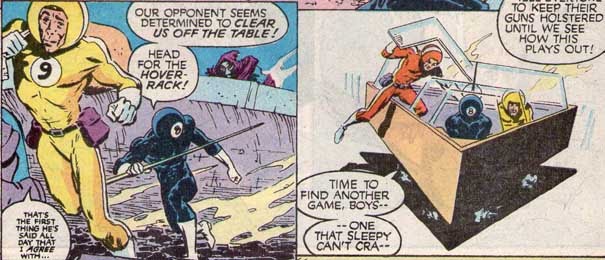
I have been enamored of the Sleepwalker villain 8-Ball since I learned of his existence (and the fact that he flies around in a hover rack), but Fate here may have just topped him as my favorite anthropomorphic billiard ball.
Two characters who don’t undergo much change are Bill and Ted themselves, but would anyone really expect them to? Would anyone even want them to? The fact that they can die more than once, experience their own personal Hells, get attacked by evil robot versions of themselves, etc. and still remain the same cheerful dudes is kind of what we love about them in the first place, and the comic rightfully has them stick to what they do best: dealing with the oddity of time travel with the greatest of ease (this time with the addition of a time traveling roller coaster), being excellent to each other, and getting out of precarious situations by waiting for their friends or future versions of themselves to show up in a phone booth and save the day.
The comic does preserve the idea that Bill and Ted get married to the babes and have babies, but these events rarely impact the plot in any significant way. The kids are sort of there a lot, but these issues are free of whacky shenanigans involving Bill and Ted learning fatherly responsibility from Gengis Khan or how to change a diaper from Abraham Lincoln. I assume Little Bill and Ted are there because they existed at the end of Bogus Journey, but even more so because they reinforce the charmed, idyllic lives Bill and Ted lead and the notion that they totally “have it all.”
It speaks volumes about the quality of these comics that one of my only criticisms is that people are wearing hats like Ted’s about 1000x more than I remember anyone actually wearing them in the 90’s and I find it distracting.
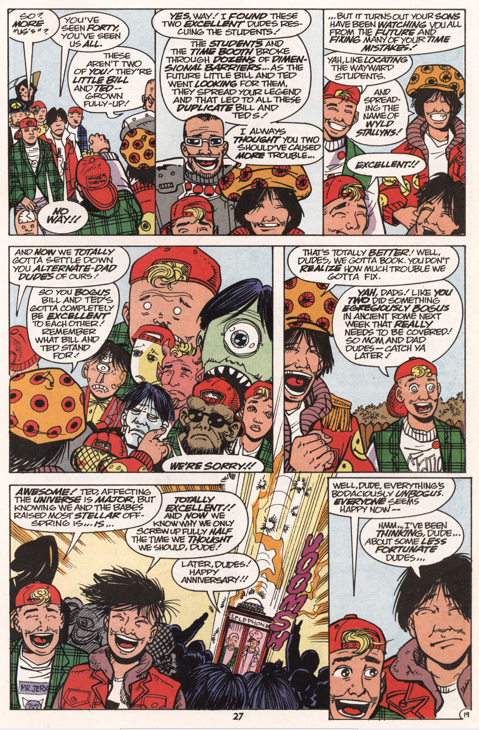
That the movie marries off and makes fathers of two overgrown adolescents so quickly has always seemed odd to me, but I suppose at least it’s atypical to see male protagonists subscribe to the marriage+kid=happy ending romantic comedy variety of wish fulfillment? I’m glad Dorkin made the kids little more than cooing luggage, but I would have liked to have learned slightly more about Mrs. Bill S. Preston, Esquire and Mrs. Ted “Theodore” Logan because all we know is that 1. they are princesses 2. they are from the past and 3. they are “most chaste” pre-nuptials. I suppose, though, there’s only so much one can expect in terms of character development when the protagonists themselves can tout a lack of emotional complexity as a main endearing quality. If Bill and Ted can basically share one personality, I suppose their wives can too.
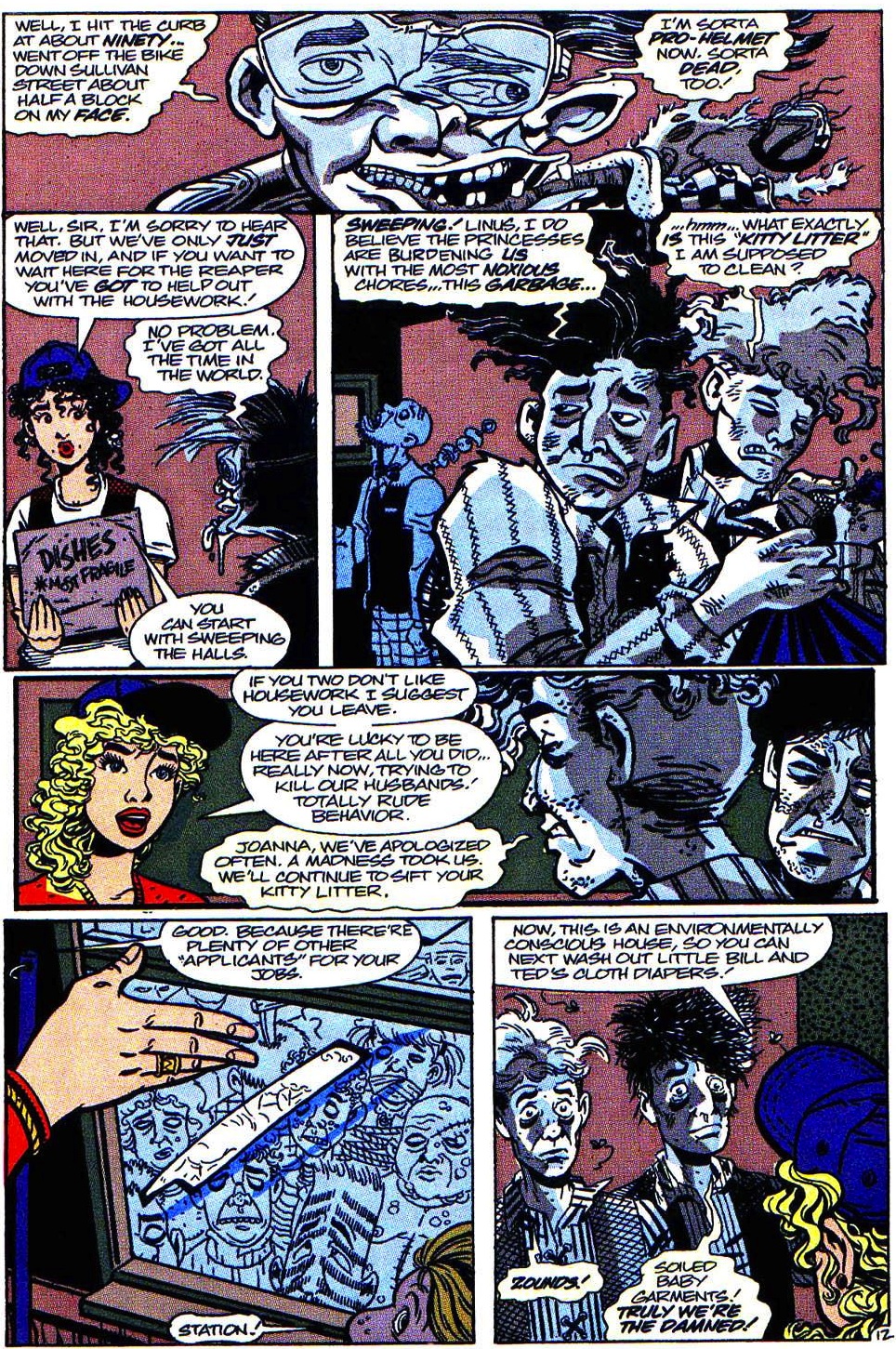
Joanna and Elizabeth are at least given several good moments, such as simultaneously knocking out their would-be suitors with their crowns (violence is always better when synchronized), rounding up a rescue party for Bill and Ted when they are on time trial, and, my personal favorite, making zombies do housework for them while they wait for Death to take their souls. They end up seeming like a slightly more assertive female version of Bill and Ted (not to be confused with the alternate reality female Bill and Ted who show up with many other doppelgangers at the end of the last issue), and since we already like Bill and Ted, the more the merrier.
Kitty litter? Now I just really want to know what Bill and Ted’s cat’s name is.
If there is one pattern that has emerged from all the 90’s comics I have read for this site, everything from the more meta Enigma and Satan’s Sixto Mr. Hero, it is this: comic books love talking about comic books. I’m really not sure why this is, but Bill and Ted’s Excellent Comic Book is no exception. Both titular characters love a comic called Fight Man (this list of his sidekicks and villains demonstrates why Dorkin was the perfect person to write for Bill and Ted), and, as mentioned earlier, Death briefly moonlights as a writer for an awesome sounding comic called Major Violence:
Pictured: what a lot of comic book fans seem to think of 90’s comics. (Thankfully, we are here to set the record straight.)
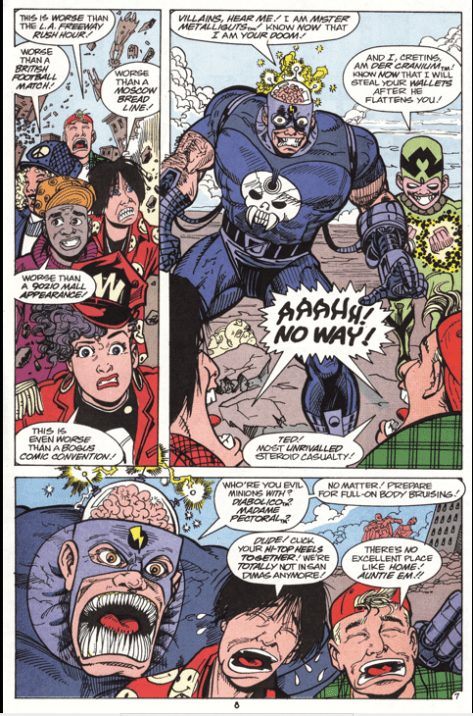
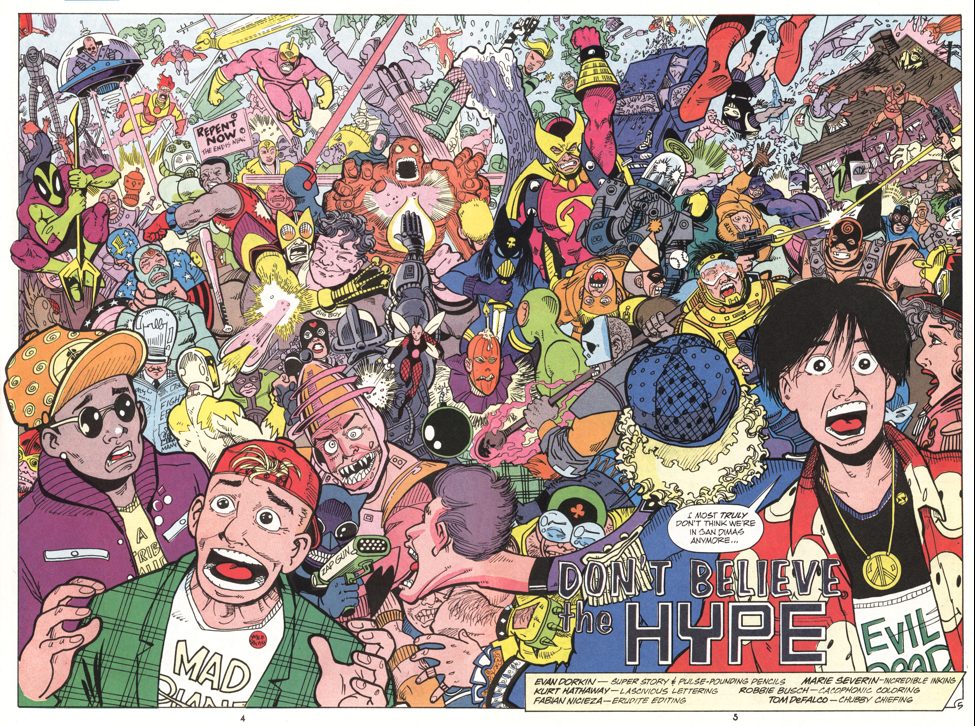
A whole issue is even devoted to Wyld Stallyns accidentally ending up on a world entirely populated by superheroes and villains. No biting commentary on the state of comic books occurs, but it does give Dorkin a chance to have some fun with the over the top-ness of both superheroes and Bill and Ted, who object to having to wear costumes at one point even though they dress like, well, how they dress. The best parts of the issue, unquestionably, are the names and character designs he comes up with for these alternate reality heroes and villains.
I am going to lobby Marvel for a Madame Pectoral solo title.Let’s see in the comments who can spot the most homages.
I could go on and on about how much fun these comics are, but the longer I do, the more likely I am to start talking like Bill and Ted, and that would be bogus for everyone. (See?) I really can’t think of anything Dorkin could or should have done differently to make a better Bill and Ted adaptation, and while they might not exactly be essential reading, they’re the perfect distraction to tide us over till the third movie actually films. Speaking of films, we’ll be celebrating the release of Avengers: Age of Ultron with Avengers Month here at The Unspoken Decade, so be sure to check that out, and in the meantime, be excellent to each other!