
Hey there, Legions of The Unspoken! I hope you enjoyed Emily’s entry last week as Punisher temporarily became a black man! Check it out right now if you haven’t! I find that story to be that perfect amalgam of 90’s silliness and 90’s coolness (which sometimes are one and the same) that excited me then and excites me now! Of course, the fact that Punisher is the main character certainly won’t hurt it in my eyes since, as you all well know, Punisher is my favorite character.
What you may not know is how much I love the Justice Society of America. Punisher is my favorite character, but the JSA is easily my favorite superhero team. Bar none. The difference between the JSA and second place IN MY HEART is the difference between a Martin Scorsese movie and the local community theatre performing Raging Bull. I have to admit I’m incredibly interested in an awful local community theater production of Raging Bull, so if any of you have any videos of that, send them my way.
Of course, if you’re an elder member of the Legion of the Unspoken, (and we appreciate you greatly if you are), you know how much I love the JSA because you read my earlier article about how much I love the Strazewski/Parobeck 90’s Justice Society of America; The Golden Age, though, ain’t about that JSA.

Already you can see stark differences between the world of the JSA with which we are familiar and the world here. The dark tones of the cover, the burning image of a Life Magazine cover featuring the JSA, and even the embossed cover would lead you to believe that this ain’t your Daddy’s JSA. It isn’t even the JSA we had loved a short time prior.
Of course, this is an Elseworlds tale, which is basically a tale involving DC’s characters in a different light that won’t affect continuity. I think the Elseworlds tale most non-hardcore comic book fans are familiar with is Batman/Dracula: Red Rain, where Batman becomes a Bat-Vampire, but anyone who only knows that comic is missing out. DC put out some fine tales under this banner and even centered their annuals around the imprint in 1994. We got to see everything from Superman landing on Earth and getting adopted by the Waynes instead of the Kents to Samurai Robin! Ok, some of it was better than others, but most of it was fun and really good. Very little of it ascended to masterpiece status, though. The Golden Age is one of those exceptions.
Since this isn’t your JSA, and this JSA story takes place in a non-canonical situation, what exactly is it? It’s the story of what happened to the JSA in a post-WWII world. It’s the story of what happens when folks grow from the impudence of youth into the responsibility of adulthood. It’s about the difference between your early to mid-20’s and your mid-30’s. It’s about the difference between 1940’s America and 1950’s America. It starts out, however, about the disappearance of the JSA, and the prominence of the lone “mystery man” that America still seems to care about.

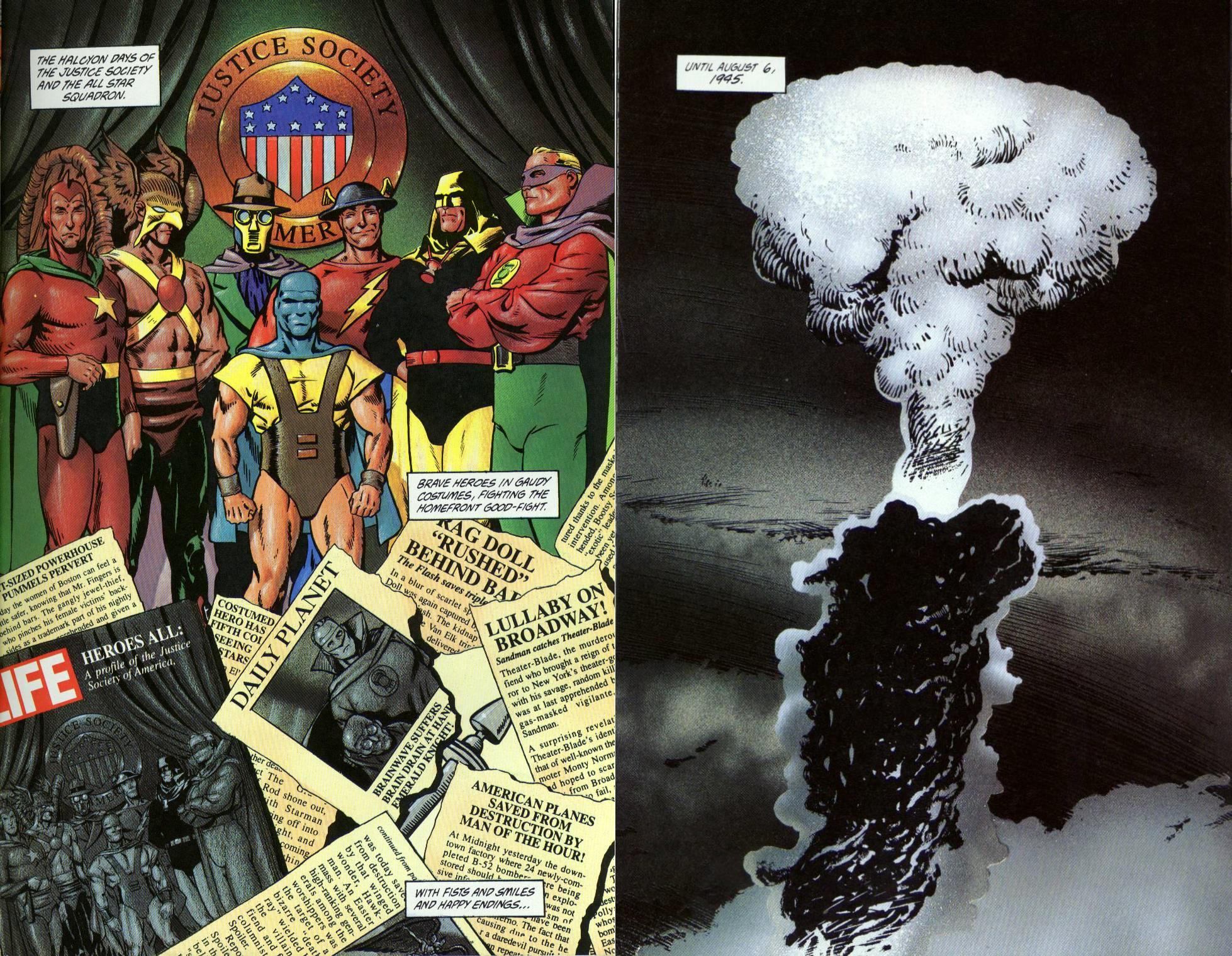
The dichotomous juxtaposition of the Atomic Bomb, the JSA, and the other mystery men of the era is perfectly encapsulated by Paul Smith’s art and James Robinson’s words. This series was my first elongated exposure to Smith’s work, and I was a fan from the first page. I was more familiar with Robinson’s work at this point, but I was still blown away. Many folks love his Starman series and rightfully consider it a masterpiece, but I think that the love and reverence for that series, no matter how richly deserved, sometimes crowds out the love and reverence that should exist for this series. Perhaps that’s because Starman was an ongoing while this was a four-issue mini-series. Whatever the reason, it’s a travesty.
I really enjoy the idea put forth about the “mystery men,” as superheroes were called then, vs. THE BOMB. Few instances in history are as jarring or as brutal as the unleashing of atomic weapons on Japan at the end of WWII. The JSA, All-Star Squadron, and their superhero compatriots at various publishers must have seemed silly in an instant to many in our world, as their brightly colored costumes clashed with the newly grey overtone of a world where tens of thousands of non-combatants could die in an instant, and the world itself could be destroyed in a torrential downpour of radioactive fire. That’s our world, you know? Now imagine how useless many of the superheroes would have felt in a world where they and the bomb existed. After all, what’s the point of being a super strong person or being able to glide on wings if a Head of State could turn all of that ability into a mushroom cloud in an instant?

That’s harsh, except for The Flash. I’m a huge fan of The Golden Age Flash. There’s something about his happy-go-lucky attitude that endears him to me. Even a quickly darkening world can’t diminish his smile. I think it is because he always comes across as though he thinks of himself as “Jay Garrick, Flash”, rather than “The Flash”. It’s something Jay Garrick DOES, not something Jay Garrick IS. The difference is subtle, yet powerful.
The others seem to be going nuts, growing old, growing mean, or all three in Johnny Quick’s case. Hawkman is mostly on the going nuts side, but I find Mr. Terrific’s tale to be the most depressing thus far, as Terry Sloane literally emblazoned Fair Play across his chest as a mantra, only to turn his back on it in the name of capital gains. Johnny Quick just seems to be growing old, and as we all might when growing older, gets increasingly tired of who he is without knowing what to do about it.
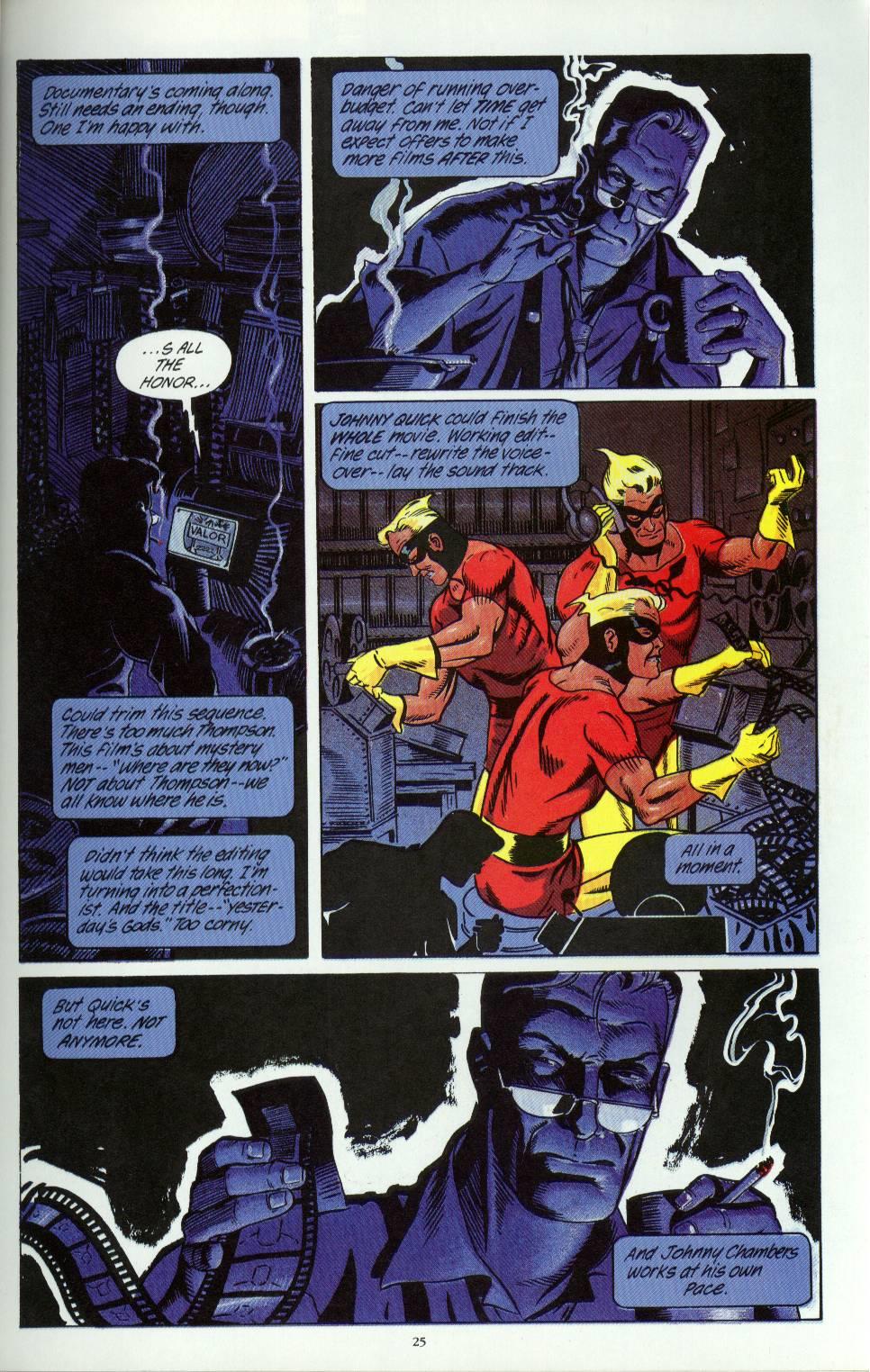
And I bet you are asking, “Who’s Tex Thompson? What’s all this Americommando nonsense?” But a less casual superhero fan might also be asking, “Why didn’t the JSA just go end WWII?” They’re both valid questions, and they’re both equally important to the tale.
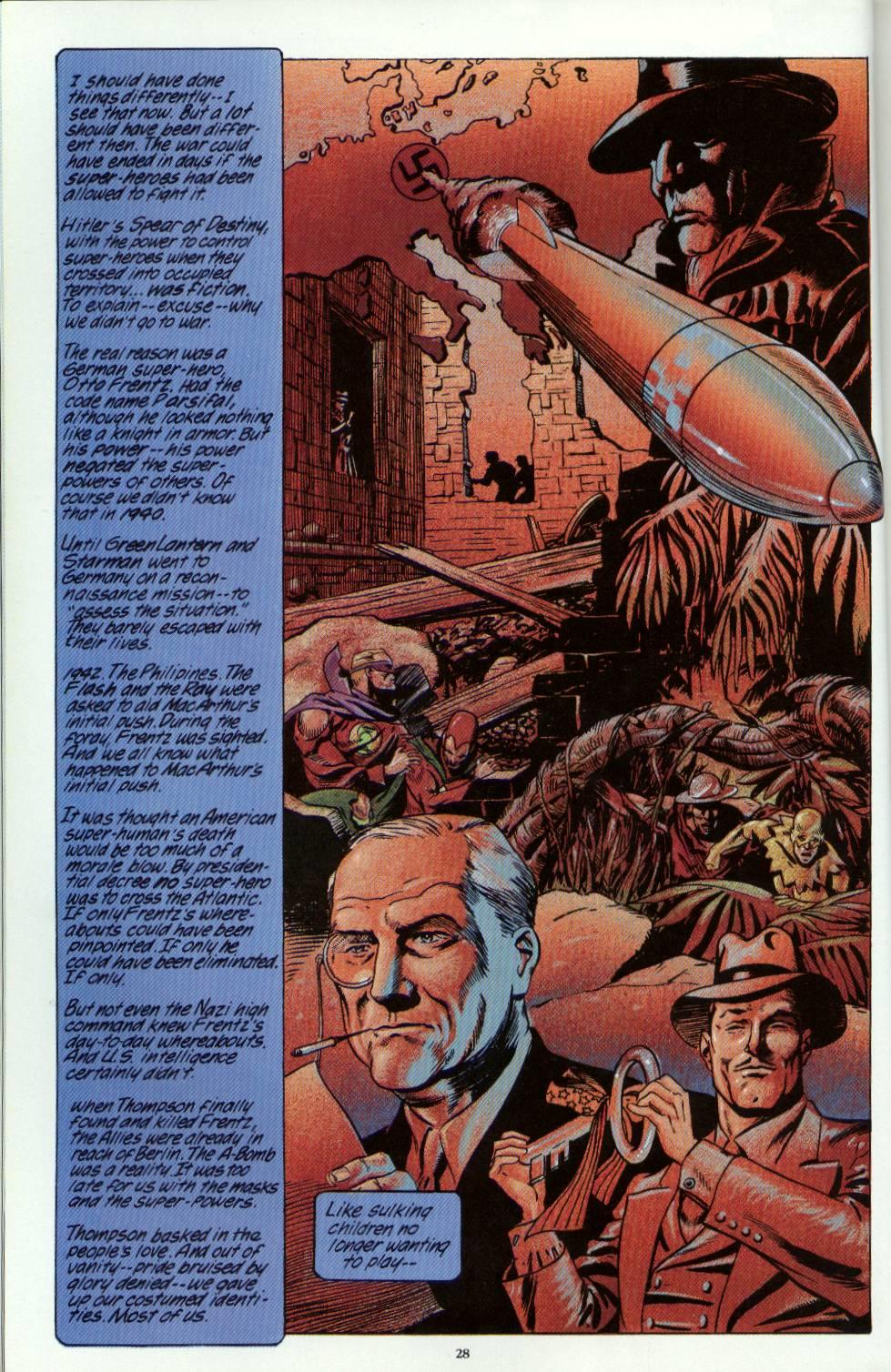

So despite having been ineffectual stateside in the eyes of Johnny Quick and many other heroes, Tex Thompson, the Americommando, apparently saved the USA and the rest of the Allies during WWII by killing Parsifal, who negated super powers. Parsifal is a cool name, and again, Paul Smith does a fantastic job making him look ominous, but not necessarily powerful. Of course, as evidenced by the inability of the American superheroes to enter into the Second World War, sometimes being able to keep others from being powerful is the most effective power of all.
The heroes we have seen thus far, save Flash, have all been mired in insanity or vice. Most of the heroes we will see in the rest of the issue will be the same. One example to the contrary, however, is Alan Scott, Green Lantern. As a paranoid post-WWII era is emerging, Tex Thompson does his best to stoke the fires that fuel the Second Red Scare. Alan Scott is standing by his employees, and even in post-emerald days, he remains a noble gladiator dedicated to those depending on him.


Even Green Lantern is cracking under the pressure of this era, and how could he not be, as he intends to stand by his men while Tex Thompson spews forth nonsense like this:
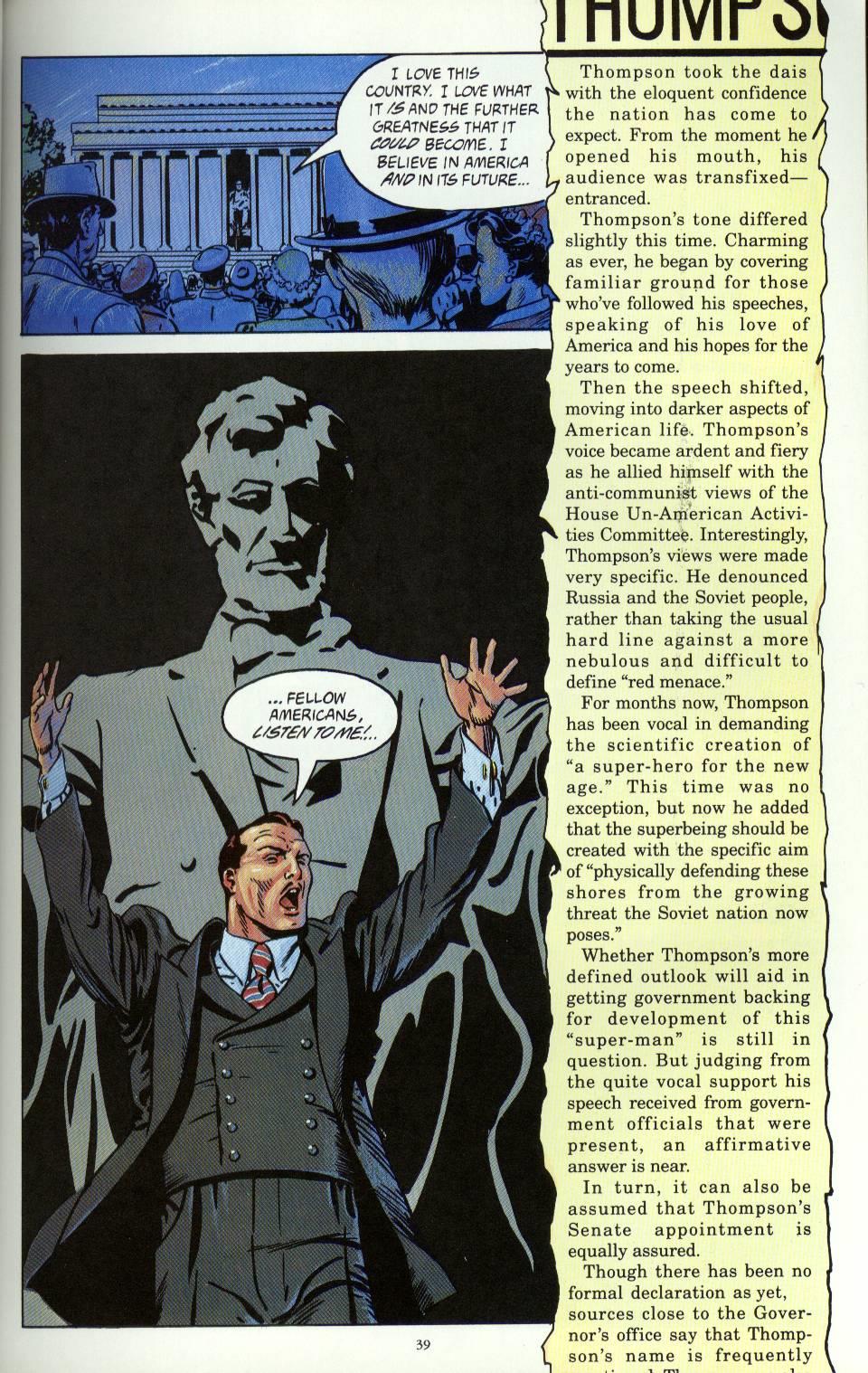
James Robinson does a great job painting a time when America transformed from a nation fighting against fascism to a nation that had been frightened into accepting witch hunts and book burning. It was a quick turnaround, no doubt exacerbated by the Cold War, the Korean War, changing social post-war mores and the like, and Robinson paints it as the scary time it had to have been.
Possessing radical viewpoints myself, I too often feel as though I am stymied and stifled for my beliefs (I’m a Libertarian Socialist/Anarchist), but what I face is nothing compared to the 50’s, with government committees looking into what people believed, what organizations they had belonged to, and how that could impact America. Regardless of beliefs, people have the right to possess them without the government infringing upon them, and many people were deprived of these rights during the 50’s. This is very well documented, as is the impact the climate had on our beloved comic books, with Congress looking into the impact comic books had on juvenile delinquency. This social climate first led to comic book burnings and the manipulation of children to turn in comic books and boycott establishments that sold “questionable” material. Eventually, the industry would self-censor by forming the Comics Code. I suggest reading a book called The Ten-Cent Plague and also taking a look at the 1950’s volume of American Comic Book Chronicles.
Back to the 90’s! Or back to the 50’s, I suppose! I mentioned Paul Smith’s art being beautiful, but I have to say that it carries an especially peculiar air of beauty when things get grisly for our heroes. Take Robotman, for instance, who is struggling mightily with his humanity. I imagine it is hard to be a human trapped in a robot’s body. Imagine how odd it must be to sense, but not truly feel. Imagine being able to recall what it was like to be hungry without having to eat. Imagine how everyone treats you like you like you are a robot, when you are actually a person just like them. It would probably make you snap, and then you’d probably snap some people like Robotman does here.
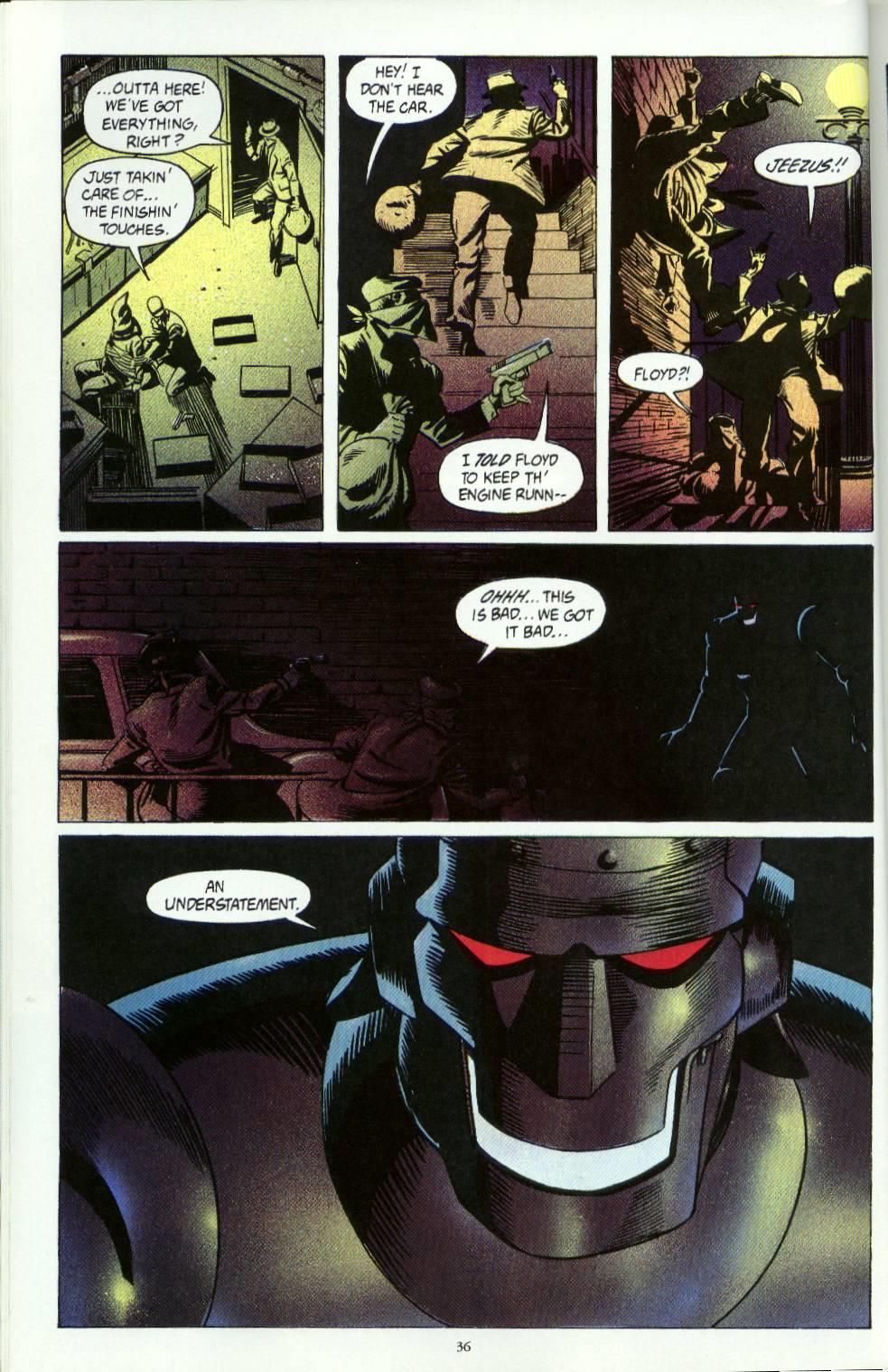

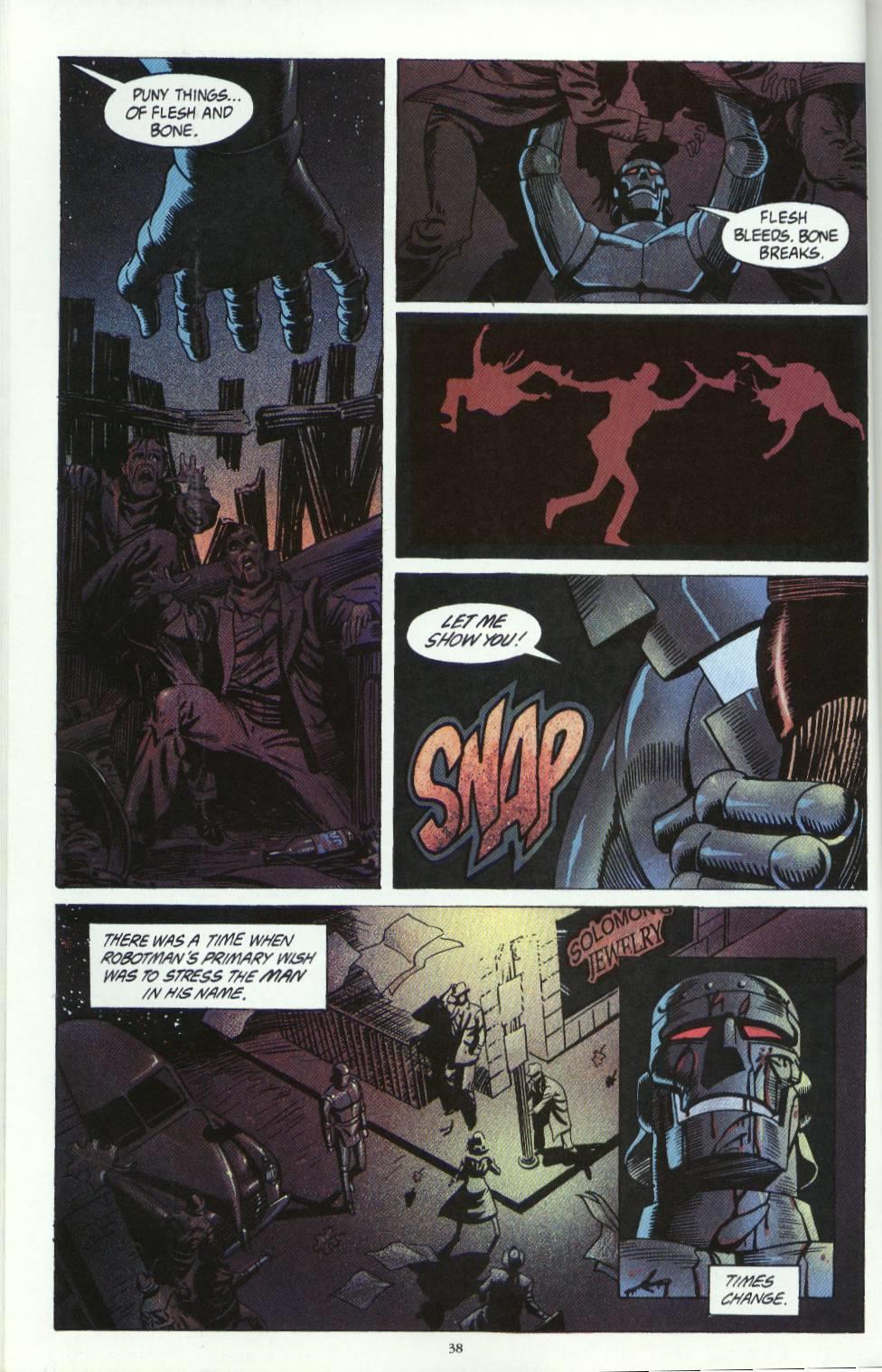
Paul Smith’s somehow beautifully depicts this moment of Robotman snapping. Some folks draw so beautifully that the visceral nature of certain images gets lost in a sea of aesthetic appeal, but Paul Smith somehow manages to turn his refined beauty into an amazing depiction of brutal ugliness. The blood on Robotman’s face following this farce of a fracas appropriately looks like tears after he breaks these mooks, along with possibly breaking what is left of his humanity.
Need more proof Paul Smith can bring the beautifully horrendous like no one else? Take a look at the bizarre hallucinatory dream Paul Kirk, Manhunter is having as, in the irony of ironies, he has become the hunted. Oh, and this dream occurs just before he wakes up to everyone in the shelter he is in GETTING BLOWN AWAY.
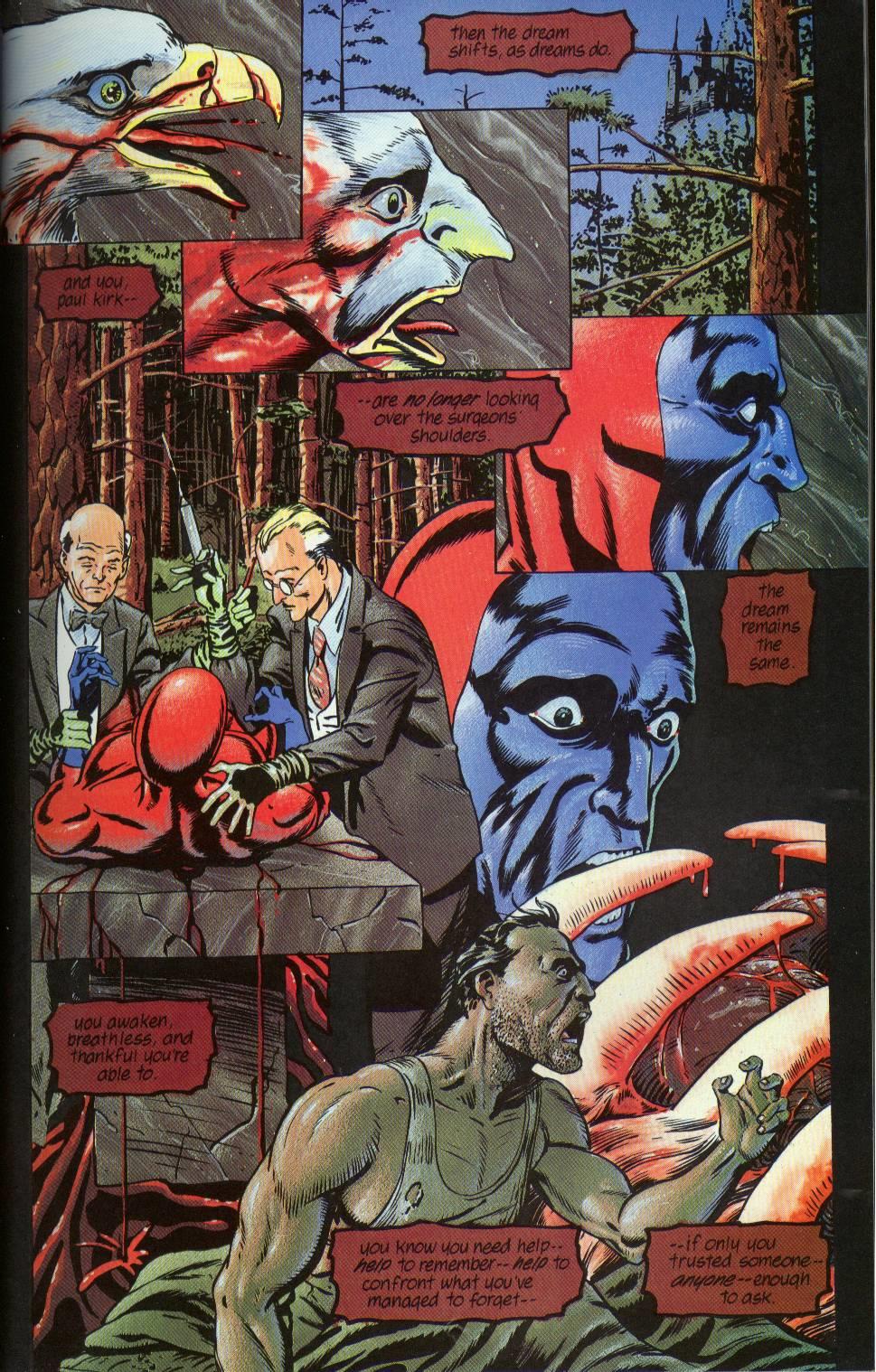
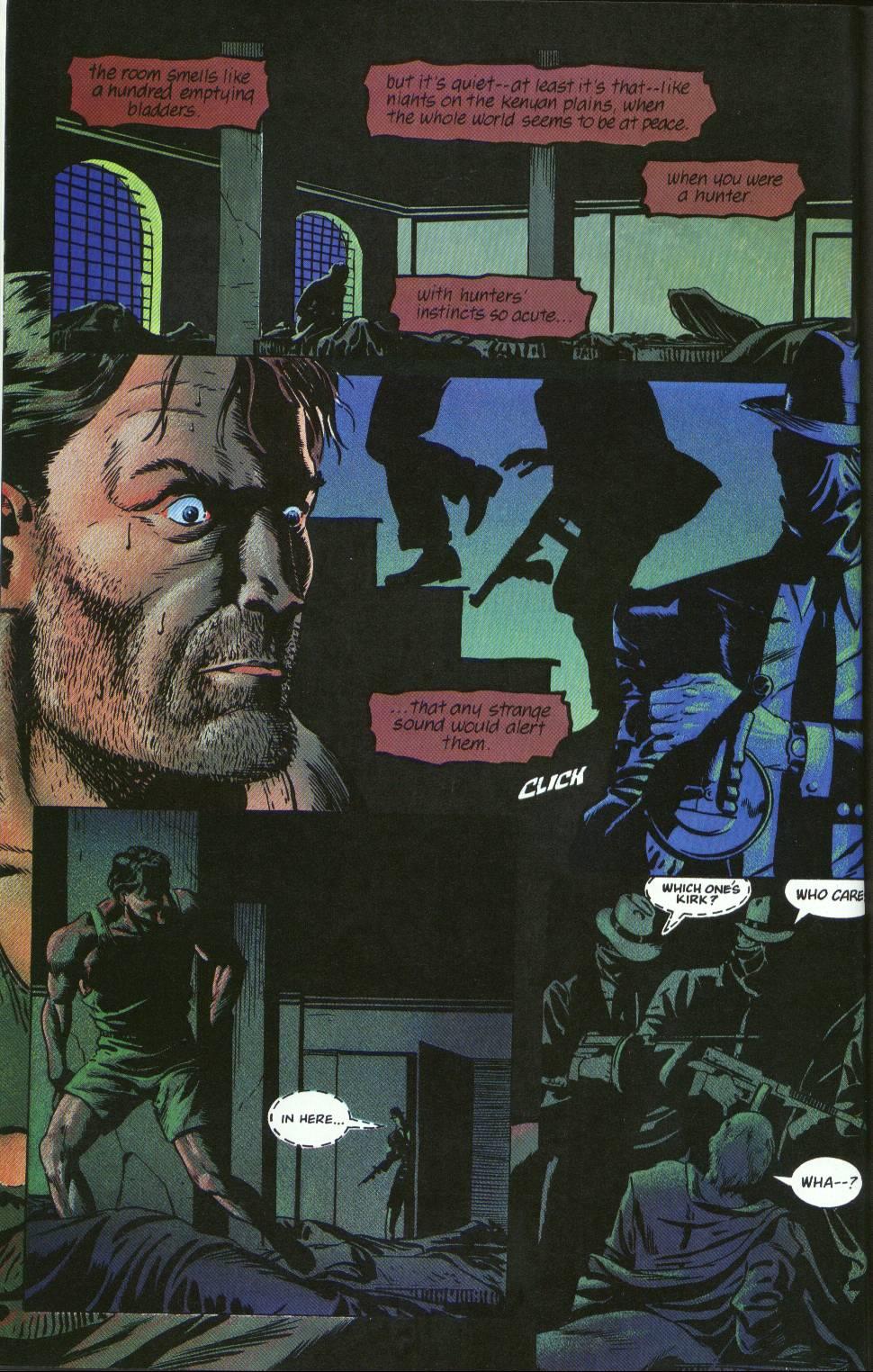

It should not be, but it is a little funny when that priest gets it, as though he was going to wade into this firefight with a rosary and a shrill rebuke and reflect bullets. I admire his bravery, but it seems like his best bet would have been to stay put; as a general rule, one cannot negotiate with a cadre of folks brandishing Tommy Guns.
Again ,though, I beg you take heed when I point out just how sparkling yet depraved these scenes are. Madness, fear, and paranoia have never looked so amazing, and somehow, they are also more poignant now that they are beautiful.
Speaking of sad yet beautiful madness, we also see Ted Knight, Starman, in this issue. Ted blames himself for everything. He blames himself for the superhero explosion, but he also blames himself for influencing Einstein to create The Bomb. Johnny Chambers goes to see out favorite Cosmic Rod inventor, and since he goes during the day, he does not like what he sees. How could anyone enjoy talking to the world’s foremost mind in a state so neurotic?

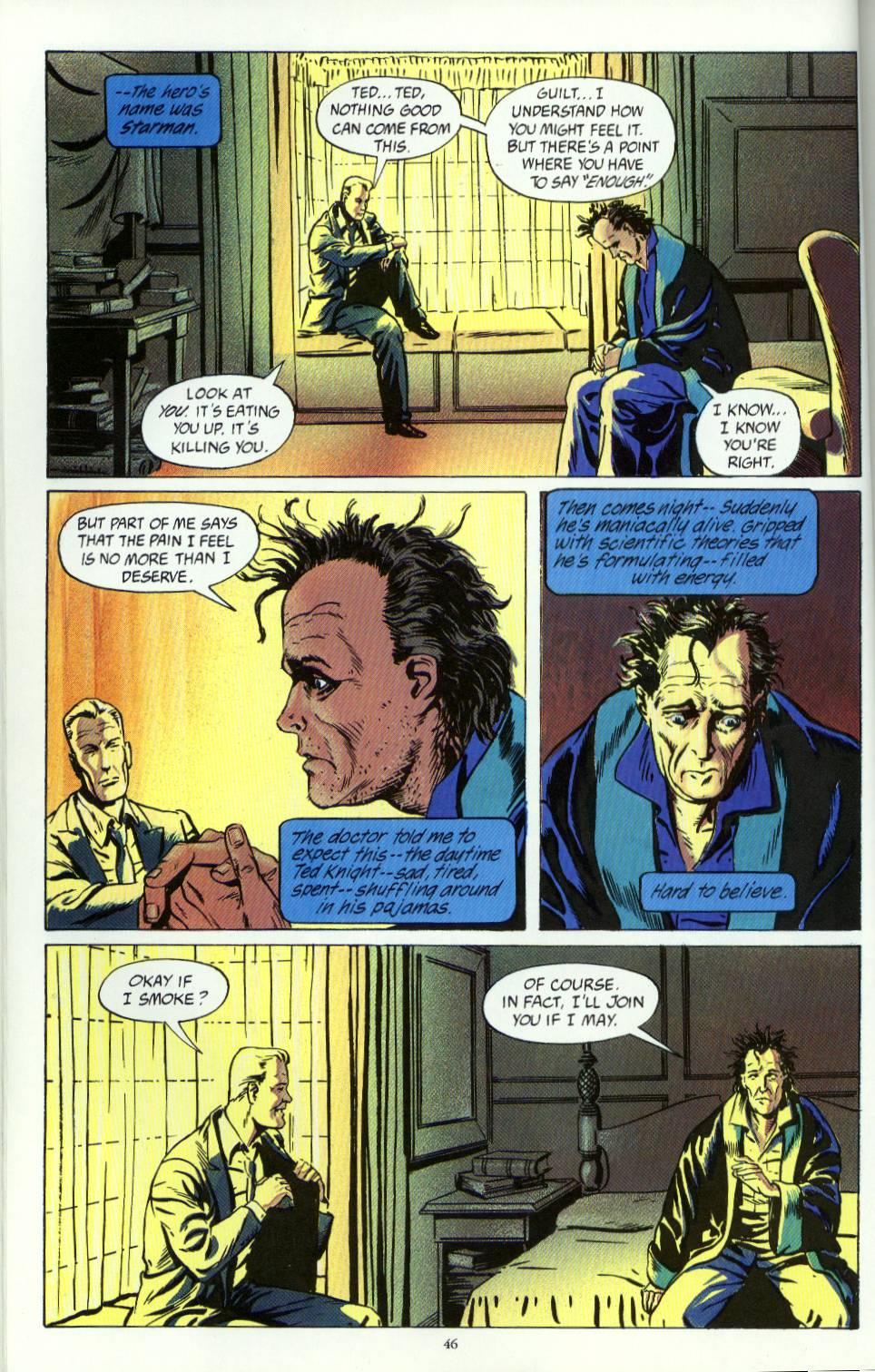

Of course, had Johnny Chambers come to see Starman at night, when he thrives, the picture would have been harrowing and frightening in a different way, as Smith and Robinson get across what it is to be a frenzied, driven, and highly intelligent man who can only break free of his neuroses at certain times.

The Golden Age isn’t shining so brightly, and that’s what makes this a masterpiece. Often, works that take a darker spin on beloved characters fail due to contrivance. We see character flaws, but they are flaws that make sense with what we previously know about a character. In The Golden Age, James Robinson had a grip so tight on these characters that you can almost hear them gasping to breathe as he chokes wonderfully depressing tales out of them, as he forces them to acknowledge their own dark sides, making these characters seem real. Combine that with beautiful, yet starkly real depictions from Paul Smith, and I find myself unable to put this book down.
I believe that a man who ran fast for years would be tired of it as he faces the 35th year of his life. I believe that a genius who created a rod to harness the energy of the stars themselves has a weird bipolar nocturnal, and that the desperation over the negative impact of his genius weighs him down just as much as the elation over the positive impact must lift him up. I believe in Alan Scott’s troubles and worries as he presides over his broadcasting business in the best and most noble way he can.
But we are barely scratching the surface here!There’s still so much more to tell you about issue #1! What happened to Libby Lawrence, Johhny Quick’s ex-wife? Where is Hourman and what is going on with his powers? Why is The Atom working with Tex Thomson, and what are those experiments the government is doing on Al Pratt. The Golden Age Atom?
I tell you what, Legions of the Unspoken, what say we pick up with The Atom’s story next week, with Golden Age #2! Be here!







 The Unspoken Decade: 90's Comic Book Blog Extraordinaire