Category Archives: 90s Comics

The Original Man in Black – James Robinson’s reinvention of “The Shade”

“A villain? Oh yes, it’s a badge I wear with some degree of pride. But not this hour. I must say it’s nice to play Errol Flynn for a change, instead of Basil Rathbone.” – The Shade

In honor of the MLB All-Star Game the Unspoken Decade has decided to take a look at a few of our favorite “All-Star” characters from our favorite decade. Being the contrarian that I am I have chosen to examine the Shade, reintroduced by James Robinson and Tony Harris during their historic run on Starman.

SHADE10
I am not sure if this image is canon after the events of “Flashpoint” but really that is their loss.

Starman is one of the great success stories of comics during the nineties. Not only did it reinvigorate a property that had grown stale, it properly introduced the world to its creators, and, most importantly, did so from one month to the next.

Unlike many well remembered comics from that time Starman was not a limited series or a one-shot event. It was a “Top of the Pile” book that came out month after month and it got people to go to comic stores. It built community and told a long form story in a way few other titles have done up until, or since, then.

I am a fan of Garth Ennis and John McCrea’s Hitman. I would, at times, place this similar work of nineties’ long form storytelling ahead of Starman but I believe that I may be in the minority. Starman is a beloved series and if you have never had the chance to read it, or if you began but never finished, do yourself a favor and see it through. It is not the most readily available series but it is worth tracking down.
SHADE01
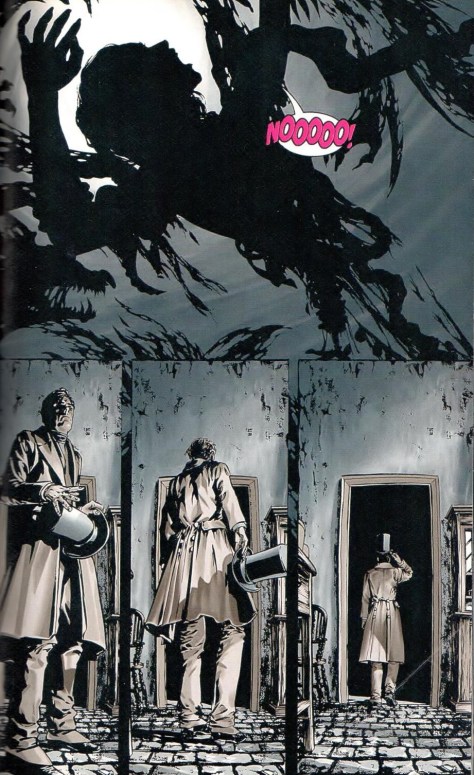
Now that is an origin story. All silhouettes and reserved acceptance.

I enjoy, and appreciate Starman but rarely because of Jack Knight, the star and heir apparent to the legacy of Starman. He was never why I choose to reread the series long after it had concluded. For me it was all about the Shade.

Originally introduced by writer Gardner Fox, during the forties, to bedevil the Jay Garrick version of the Flash, the Shade (or Richard “Dickie” Swift as he was eventually revealed to be named) is an unlikely cult favorite. He is a British dandy from the 1830s with roots in the work of Charles Dickens as opposed to the pulp adventure or sci-fi stories of most supercharacters.

His abilities range from the generic “darkness manipulation” to the disturbing implication that he accesses a realm at the root of all evil, somewhere the Old Gods or Many-Angled Ones call home. When he is conjuring shadow-demons and blades I prefer to believe that he is accessing the same Darkforce Dimension that others have been accessing since before there was a name for it. From the Shroud and Darkstar, to Obsidian and Nightshade, and even Jackie Estacado.

If that is the case then why is Shade immortal? Why does he no longer age? Why does he appear to be haunting the background of the shared DCU as if he were no more than one of his own, ever present shadows? If you know anything about Fox, a devout fan of HP Lovecraft, the answer may be lurking somewhere deep beneath the surface.

SHADE02
Her own shadow, above his bowed head, as she is committed to the pit by her own hand.

Before Shade, Fox introduced the very concept of the superteam with the Justice Society and was asked to revive the concept years later as the League. Have you ever wondered why the Justice League fought weird, mystical characters at the time that they were introduced? Tell me that Starro does not appear as if it should come from the same place as Cthulhu.

As a fan of “weird fiction” I assume that it informed most of Fox’s work, not just where the influences are explicit. You may not find much stygian darkness in the Golden Age stories as Shade is mostly a Green Lantern knockoff at that time. When fans were reintroduced to the character after the events of Zero Hour the disturbing implications seem to surface.

Darkness comes from him though he never seems to be distressed. He is not dark or mopey but always looking for the next adventure even if one is as mundane and revealing as a long walk on an autumn night. His powers take the form of living, murderous shadows or even cephalopod tentacles but this never means that he is a dreary man.

Shade could be keeping the darkness at bay with all of the blood he has shed, feeding it if you will, but I choose to believe that he simply accepts what he is and that having darkness powers does not mean that you need to be dark.

Shade haunts the stories of Starman. He provides context for the events going on in the Knight family’s beloved Opal City (a character as much as a setting) and introduces Jack to the unending weirdness of the DCU. Shade is a man of style who makes a point of commenting on how people dress and he aids in grounding the story to its time, including when he narrates a story set in the far past.
SHADE03
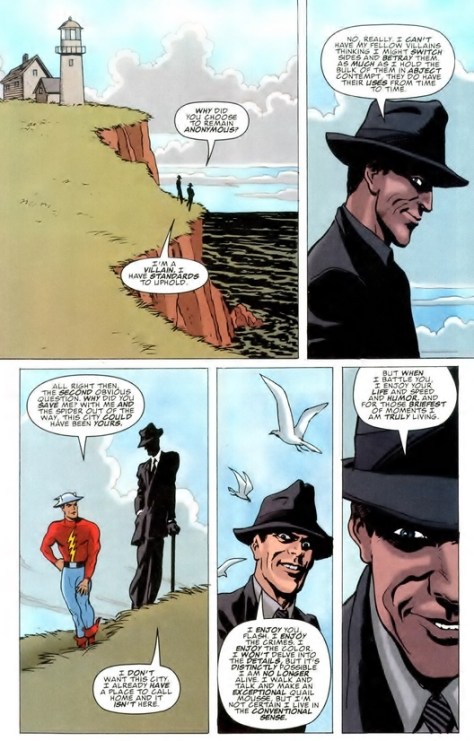
Just think of how many Dibneys could have been saved if Brad Meltzer had read this before writing “Identity Crisis.”

Sometimes a criminal or a murderer, sure, but “Dickie” is never boring or without comment. He is unflappable and refers to “The Shade” as his stage name. You almost feel as if the going-ons of superherodom are just the distraction he needs from being something he fears.

He mentions having honed his abilities over his century and a half with them and acknowledges the readiness at which he disconnects from people. This last bit is a favorite of mine because when Shade does connect with someone it is not easily won by either party.

His friendship with former DC mainstay, the Scalphunter, is often referred to and at least once I found myself wondering if a simple hero had swayed Shade from being a greater menace to the world just by happening upon a situation where he could be nice to him.

In 1997 Robinson wrote a four issue Shade miniseries. Each issue featured a different artist though I am partial to the first issue’s work by Gene Ha. Issue two has JH Williams III but I am afraid that I am not familiar with the final two artists enough to speak to their work. It certainly seems as if Robinson also favored the earlier issues as there is noticeably fewer run-on captions featuring narration by the Shade though that could be because of the nature of the tale.

The Shade keeps journals. This is a fact crucial to his role in Starman and it is explored here as he tells the readers about the Ludlow Family, who has a longstanding, one-sided blood feud with him that he dearly wishes they did not.

Minor point, but if James Robinson happens to read this (Hi, Jimmy! I loved League of Extraordinary Gentlemen the movie.) please rerelease these issues without the fancy script font for the Shade’s scribblings. That gets tiring quickly.
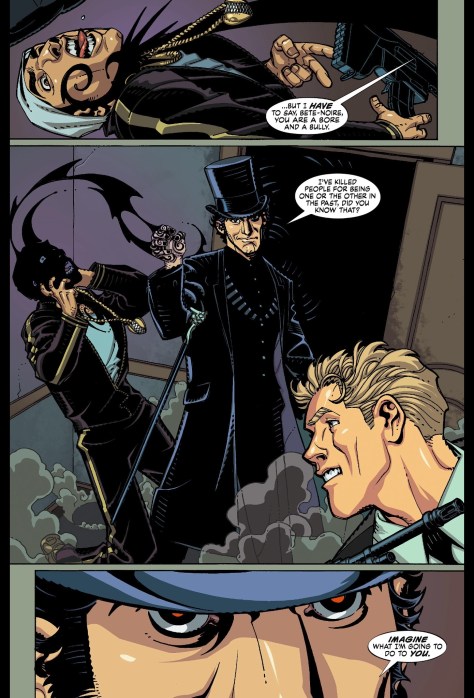
SHADE04
Not from the original series but literally the only full body shot I could find “in costume.”

We are presented with bits of Dickie’s origin though for more on that I highly recommend the 2011 Shade series, written by Robinson and featuring a variety of exceptionally talented artists during the course of its 12 issue run, including Cully Hammer, Darwyn Cooke, Frazer Irving, and a final issue by Ha.

For the most part we are shown how much of a contradiction the Shade is. This is, I would wager, much the same as with any real person. We do things we want and cannot always explain why. We may be afforded the time, and incentive, to attempt to understand them later on but often we fail to recognize that. Dickie is comfortable with his murders (which are primarily in self-defense or of bad men) but there is no finer connoisseur of food in wine in superhero fiction than he.

Few panels are wasted on explaining what Shade can do. He is the narrator and main character but the plot is put into motion by others. Shade is the threat, the boogeyman, and the excuse for superpower to enter into stories of familial betrayal and corruption.

For all of his stygian prowess Dickie is a surprisingly upbeat man with a desire to enjoy the life he leads at a pace of his choosing. His interactions with the Flash and Starman (of both eras) are presented as what he does because he chooses to do so. He is above the desires of petty villainy and is actually shown to be doing quite well for himself.

Could he be an arch-mage, foe of luminaries such as the Sentinels of Magic (another nineties’ concept no one ever did anything with), commanding an army of shadow demons in an attempt to revert the world to darkness for the glory of his own personhood? Sure, but you can only tell that story once and other have done a better job at it.
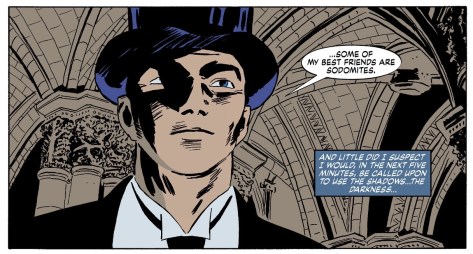
SHADE05
This line needs to be uttered by Jon Pryce in a movie version before it is too late.

Shade prides himself on the quality of his coffee and technically had Oscar Wilde as a sidekick. He is the immortal who keeps the DCU in perspective, both for himself and others (hence all of the journaling) as opposed to measuring his worth by the influence he can have in directing the course of events throughout the world.

He is not Ra’s al Ghul, Vandal Savage, or any of the other long-lived, crazy people superheroes usually fight. Maybe this is because he was a content person before gaining great, poorly defined, superpowers and that did little to change what he wanted out of life. Maybe the trick to avoiding superpeople battles in the future is to only give powers and abilities to those who are already not hurting for their place in the world.

Dickie does not seem to concern himself with the future. When asked if the feud with the Ludlows is at an end he all but shrugs. He is not a detective, he is the mischief maker. He writes down his observations, his travels, and his adventures as he attempts to reconcile them. He takes thing slow and he enjoys all that he can.

SHADE07
Lines such as this make me appreciate this character more than whoever it was that starred in “Man of Steel.”

He does not dwell because he does not have to. As far as he can tell he will be around forever. His immortality, more than any other attribute (including his penchant for dark clothes and smoked sunglasses), is what he relies on. What other character can boast an arch-rival as interesting and complex as the seemingly never-ending string of descendants from a perverted British family that predates the American Civil War?

Not only do the Ludlows lend themselves to the telling of a variety of different types of stories (most of which are at least hinted at during this series) but they prove to be the one aspect of the Shade’s life that he cannot take in stride.

They reappear from beneath the veneer of supposed friends and lovers, more often than not harming the Shade’s few friends instead of himself. For the man who only wants to enjoy life, seek thrills, and not be bothered with the moroseness that he should, by all rights, be enveloped by, it is something incredibly mundane (at least by comparison) that often hurts him the most: People raised to hate something they know nothing about.

Dickie outlasts Robinson within the DCU and has continued to appear. Maybe not having created him in the first place meant that he could not be put into the same “do not touch” box as Jack Knight and the other extended family cast members. Or maybe it is that no one has tried.

Either way, the Shade continues to haunt the periphery of the world that the superheroes operate in. He has yet to suffer a direct setback because of his powers. By that I mean that unlike other heroes, it has yet to be proven that his powers are killing him or the world he lives him. In all likelihood he will outlive the current crop of heroes and be around to remind the next exactly which struggles they should learn from and which they should put behind them.

What story is there for a man who takes almost no active part in the world? The beauty of the Shade is that the world he finds himself in becomes the story. Timelines, and bloodlines, can be played with and Dickie himself is quick to hint at untold tales and adventures that he played a part in but can only barely recall now. Or so he claims.

The Shade does not want your crossovers or your ridiculossness but business is business when it must be done.

The Shade allows for worlds to be built and his callous nature means that more often than not he is at the center of attention of someone looking for retribution. He is not against involving himself and does so sometimes only to his own detriment. He also has a friend named Bobo.

I have no idea what the current state of the DCU is. Continuity, for whatever that word is worth, is apparently different after Convergence but I remember a time when a monthly book was allowed to shape an ongoing story more than what was happening in the books published alongside it. Starman was a semi-obscure character, out-of-publication for decades, who became one of the most well-regarded superhero comics of all time.

The Shade should never have been anything other than a rogue, trotted out to fight the Justice Society occasionally, but instead I rank him as one of my favorite characters. His name alone is one of the few that will get me to pick up a title, though hopefully that means Robinson is along for the ride because they certainly seem to bring out the best in each other.

Slaying the Dragon #1: “The 1990’s Killed Comics”

Welcome to the first installment of a new, irregularly published column here at The Unspoken Decade. Slaying the Dragon exists solely to dispel half-truths and outright misconceptions about the most prolific decade in comic book history, the 1990’s.

In 1991, when I was 10 years old, I bought my first comic books from a spinner rack at a grocery store. The 1990’s were MY decade. I love everything about the 1990’s comic scene, even what I hated about it at the time. To say that I’m a 1990’s comics fanatic is an understatement. But to say I’m a 1990’s comics fanboy would be erroneous. By my own definitions, a fanatic is someone who loves everything about a specific topic; a fanboy is someone who loves it to the point of losing objectivity.

While I love everything about the 1990’s comic scene, I am able to separate facts from oft-repeated and unfounded opinion. Some geek blogger who dislikes the 1990’s uses the horse-laugh fallacy to win the approval of the current generation of comics fans, and that personal opinion gets regurgitated endlessly as actuality.

When I sat down to write this first edition of Slaying the Dragon, it didn’t take a lot of thought to decide which dragon I should attempt to slay first. Remove the head, and the body dies, they say. I’ll start with the biggest false notion—that the 1990’s are responsible for the current plight of the comic book industry.

Comic book films are making previously unheard of amounts of money at the box-office, meanwhile sales figures for books featuring iconic characters such as Batman, Spider-Man, and the other titans of the comics multiverse are still at a fraction of what they had been, not only in the 1990’s, but in most other decades as well. I’ve seen countless comics’ fans post on social media about how the 1990’s market crash has forever crippled the hobby we all love. False.

CRASH

It is absolute fact that the biggest industry crash in comics history occurred in the mid-1990’s. I would never argue against that. The only local comics shop (LCS) to ever exist in my tiny hometown opened during the boom year of 1993—a time when more comics were being published in a given month than even in the 1940’s. Then the bottom fell out of the market. There was more product being published than the market could support. My town’s LCS folded by 1996, never to be replaced. That’s reality. That is truth.

The comic book market has yet to even return to the sort of sales it enjoyed in the 1990’s, or even in the 1970’s for that matter, a time when industry insiders were predicting the demise of the entire industry. That is also truth.

But to blame the current state of the industry on something that happened 20 years ago is a simple explanation for a complex problem. I care far too much about 1990’s comics, to allow them to take the blame for a decline that started decades earlier.

While the 1990’s crash was the biggest in terms of the sheer number of publishers, distributors, shops, and titles forced to fold, it was just one of many crashes. It happens most every decade. In the 1940’s sales dropped following the end of WWII. In the 1950’s censorship and Seduction of the Innocent hysteria lead not only to a crash, but to public comic book burnings in communities around the nation. In the 1960’s, oversaturation inspired by the Marvel Comics revolution and the popularity of the Batman ’66 TV show lead to a crash. In the 1970’s, both Marvel and DC Comics were almost shut down by their parent companies thanks to the decline of the newsstand distribution system. In the 1980’s, an explosion of mostly forgettable black and white comics looking to imitate the success of Eastman and Laird’s Teenage Mutant Ninja Turtles caused a young, gullible direct market to crash, resulting in hundreds of new comic shops disappearing along with a gaggle of publishers. Yet, after each crash, the comic book industry has risen from the grave, much like a phoenix, or for that matter, almost every Marvel Comics character to ever die a sales-spiking death.

So why hasn’t the industry resurrected itself? Why hasn’t it returned to its previous heights? There are lots of reasons, and hardly any of them are a direct result of the 1990’s.

I believe it all started the 1970’s. When the big two were almost shut down by their respective corporate entities, their woes were largely the result of a failing distribution system. Cheap “funny books” turned a minuscule profit for both newsstand outlets and distributors, so huge amounts of comics were returned untouched in order to create shelf space for money making magazines. Then in the late 1970’s, the direct market appeared. Upstart distributors convinced comics companies to sell product to comic book specialty shops. This was the savior that comics had been looking for, or so everyone thought. Publishers were making big profits once again, and the direct market opened the doors for creator-owned comics and freed creators from the shackles of Comics Code Authority censorship, allowing for books that appealed to adults as well as children.

Then came the 1980’s crash, but no big deal. Publishers were still making some money on newsstand sales, and the direct market rebounded quickly thanks to speculators who came over to the comics market when the baseball card market experienced a crash of its own. These speculators were hoarding huge amounts of first issues, first appearances, and, later, gimmick books similar to gimmick “chase cards” found in random packages of sports cards. These greedy newbs were banking on their Spider-Man #1 (with a print run close to 1 million copies) eventually being worth hundreds of thousands of dollars, much like Spidey’s first appearance in Amazing Fantasy #15 was at that point in time (now worth millions of dollars). What these speculators failed to comprehend was that Amazing Fantasy #15 came out at a time when kids treated their comics like toys, reading, folding, and trading them until they disintegrated, rather than placing them in acid free bags and boards, and storing them in acid free boxes, all while having a much, much smaller print run.

17sw99o8wuejbjpg

Then the bottom fell out, like anyone might have figured it would. Speculators fled, dumping their gluttony of “collectibles” into the market, causing prices to crash. True fans became disenfranchised as the value of their favorite books plummeted. Comics shops closed. Many who weren’t soured to the hobby simply out grew it or developed new interests. More shops closed. But there would be new readers to take their place, eventually right? It all worked out the other times, right? Well, apparently not. Today most comic book fans are 30 or order, meaning that they lived through the 1990’s crash and stuck with it, or they’ve returned after a long absence. These days, comics newbs are a minority (although a very vocal one).

New readers simply aren’t there, even though hundreds of millions of people see the latest Marvel or DC blockbuster in theaters. If only a fraction of them started buying comics, we’d have a new industry golden age. Why isn’t that happening? I believe it’s because the industry is relying nearly exclusively on a direct market that can’t produce enough new readers to replace the ones who inevitably tire of reading serialized entertainment. When the newsstand system failed, comics lost something the direct market hasn’t been able to replicate. Comics are no longer available at every corner drug store, gas station, toy store, candy show, bus station, or grocery store, the latter of which being where I first discovered the joys of comics. Many children (and adults) live hours from a comics shop. Even if a kid lives relatively close to one, a young comics fan needs to be in walking distance to have access to comics, and even then, they have to brave a shop littered with 30-somethings bitterly complaining about how the Scarlet Witch from Avengers: Age of Ultron wasn’t wearing the exact costume she wears in the comics. It’s difficult for most kids to convince their parents to make a special trip for comics. For me, it was next to impossible. The only kids I see in comic shops also have a parent that is there for comics. A kid lacking a parental geek is highly unlikely to discover the medium. Of course, all the blame can’t be put on comics becoming a niche market. There’s also the astronomical cover price. In 1991, $20 (not that I ever had that much money back then) could buy you 16 comics!  Now it barely gets you 4 comics. The 1990’s can take the blame here, as it was during the mid-1990’s when everyone followed Image Comics’ lead and began using ultra-expensive glossy paper.

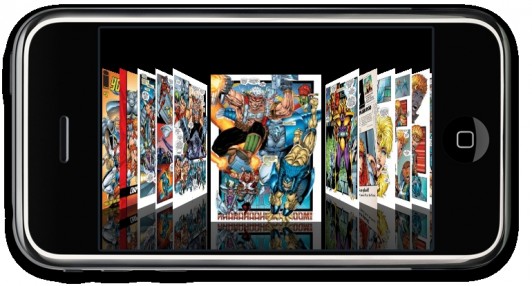
I hope the industry savior is digital comics. Most kids have access to tablets, e-readers, or smart phones. Digital books can be significantly cheaper than paper and ink as well (even though most digitals currently cost nearly as much as the physical books, which makes little sense to me). These digital comics can be obtained by new readers young and old with just a few finger swipes. But we’ll see if the publishers figure out how to attract them.

1212237-m12comics_youngblood_2_iphone_532x286

Mind you, this piece is no dig at comic shops or paper-and-ink comics. I love my current LCS, and hardily recommend everyone support their local shops. I myself much prefer physical comics to digital ones. Comic shops are what keeps the industry afloat, and that’s not a bad thing. The bad thing is that after almost 40 years of existing, the direct market hasn’t been able to attract the same amount of new readers the long dead newsstand industry once managed. So what the hell is the solution to this problem? I don’t know. If I did, I’d probably be some comics industry bigwig instead of a fan with an Internet column. But I hope the industry improves, or at least sticks around at its current level. A world without comics would be a dreary place. Just don’t blame my beloved 1990’s if it all disappears.

HE CALLS HIMSELF CABLE – José Ladrönn and Joe Casey on the Man Out of Time

Warren Worthington: Before you go any further, you need to ask yourself… is any story really worth dying for?
Irene Merryweather: Depends on the story.

No theme this month at “The Unspoken Decade” so I have taken this opportunity to look back at José Ladrönn’s run on Cable that helped close out the nineties.

Irene Merryweather is a reporter, a storyteller. She acts as Cable’s chronicler and as the reader’s way to understand the man and his world. She provides a way for the plot devices and conflicting motivations of such a popular character to be examined and contextualized in a much needed way.

“Sometimes, there's a man. And I'm talkin' about the Askani’son here… He's the man for his time and place. He fits right in there.”
“Sometimes, there’s a man. And I’m talkin’ about the Askani’son here… He’s the man for his time and place. He fits right in there.”

Who is Cable? What is he? Why does he call himself that? Maybe in 1990 when the character was first introduced this was considered a suitably sci-fi term. The modern equivalent of calling a character “Plastic Man” in an era before that was a household name. Did this name say something about the character that was deep and meaningful? Was it the name of one of his weapons, maybe an artistic way of describing his method for traveling through time?

No, of course not.

Cable is what you would call yourself if you had been raised two millennia into the future. This is the same reason his arch-foe (and one of several clones) is known as “Stryfe.” These people are as separated from “today” as “today” is from the beginning of the Common Era. Cable is a character that everyone recognizes, comic fan or not, even though he has avoided the Silver Screen for seven X-Films and counting. For me there is no more interesting take on the character than his extended tour of the Marvel Universe in the artistic styling of Jack Kirby.

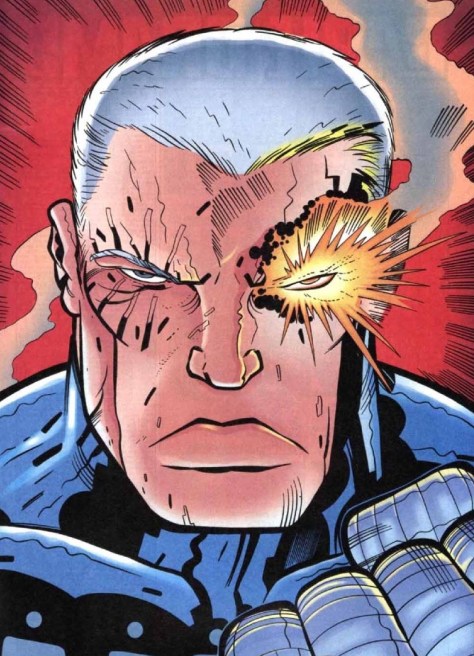
The energy radiates from the center, reaching out at the reader and almost into their world. The mark of the King.

The Hellfire Hunt is a story from 1997 written by James Robinson. Halfway through, after issue #50, scripting duties switch to Joe Casey. From then until issue #70, in August of 1999, Casey and artist José Ladrönn put their mark on the Man With Many Names. The run was bookended by extended crossovers with the plethora of other X-Titles, from Operation: Zero Tolerance (itself spinning out of Onslaught) to the Apocalypse centered The Twelve soon after its end. In between was an attempt to define the character of Cable in a way that made him grounded and believable, or in other words, in the Marvel way.

In addition to the extended X-Family (for the most part) there is no appearance by X-Force, the child soldiers that Cable usually drags into dangerous war zones, or Rob Liefeld, Cable’s self-appointed ‘sole creator.’ The Rob would eventually bring back the expected trappings of the franchise but in his absence Casey, and especially Ladrönn, build a supporting cast unique to Cable including re-introducing Nate’s own personal Yoda, Blaquesmith, and the aforementioned former gossip columnist Irene Merryweather, as well as the brand new love interest, and confidante, diner waitress Stacey Kramer.

Every Kirby story is a love story. He co-created the Romance Comic because he understood that having someone to fight for was the only thing that mattered.

Over the course of these twenty issues Ladrönn’s depiction of Cable, and the world he inhabits, comes to resemble one drafted by Kirby. The King himself passed away in 1994 so this type of tribute would not be uncommon except that Cable, and the Modern X-Men in general, had nothing to do with what he had come to stand for. This appears to be envisioning what Cable would have been if Kirby had created him at the peak of his career.

A time-traveling, cyborg with a Messiah Complex, locked in an Eternal Struggle with a being destined to conquer the world and subjugate its people. That feels as if it could have been a pitch for a story Kirby never got around to putting down on paper in the years after he left Marvel in search of the greener pastures he never found.

For reasons none too important to the overarching plot Cable finds himself in the nation of Wakanda fighting Ulysses Klaw alongside the Black Panther. A few issues later he engaged in the defining conflict of the run in a fight against Jack Truman, Agent 18 of SHIELD. An appearance by the newly revitalized Mighty Avengers closes out the run featuring Kirby Classics such as Captain America and Thor. This resembled a comic done in the Mighty Marvel Manner at a time when nothing else the company put out really did. Even non-Kirby, but classic nonetheless, vintage characters such as Zzzax and the Tinkerer make appearances. They are not furthering the plot, but rather showing how rich and imaginative a world Cable occupies.

If you touch your chest, hear a “tek” sound, and begin spewing acid from your fingertips then you were probably not invented by someone who left to create Brigade.
If you touch your chest, hear a “tek” sound, and begin spewing acid from your fingertips then you were probably not invented by someone who created “Brigade.”

A year and change after the bankruptcy that nearly buried Marvel, and comfortably before the movies would start to shape what the company would become, Cable takes a tour of an older version of the Marvel Universe, one not seen in some time. He himself gets a streamlined, shoulder-pad-less redesign that allows, as all Kirby characters must, to be in constant motion and bristling with power. The tons o’ guns are stripped away as this Heroic Quest sees Cable wield the Psimitar, a future-tech spear capable of focusing his advanced telekinetic abilities into Kirby Krackle. The static, cold images that had come to define the character up until this point are forgotten as Cable genuinely struggles with whether or not he can really save the future, a fight that seems u winnable and a task that seems unsurmountable, even though he can remember what happens if he fails.

Kidding. We all know what happens if he fails: Everyone is slowly murdered by the Mutant Robo-Pharaoh. Why has anyone ever wondered why we enjoy these comics?

I am not sure whose idea it was to go down this road but it does not happen all at once. Ladrönn had been involved with the title before Casey arrived and the latter went this route again with his later Image series Godland (I am not putting a “0” there, but you may need one if you want to research the series). Does the fact that no one else was doing overt Kirby homages on a regular basis make the issues worth seeking out, or picking-up discounted at least?

Yes and no.

This is one of the few full runs of Cable I have read but was by far the most rewarding. The aesthetic got me in the door, so to speak, but the character does not keep me there. Ladrönn clearly has a love for these particular layouts and design work. There are ways of presenting a story and moving events forward that only ever seem to appear in those older books. Figures in motion stride through scenes of intense action oblivious to “cool” poses and the constraints of the page. Not to say that the genre as a whole does not pull plays from the same book but these are specific, and in some cases too much so, references the work of a single man.

Ladrönn at one point, before the Kirby homages are overt, places a panel of only Cable’s foot in motion in the midst of an action scene. This warrants a caption box, with a message from the editors, stating that “we’re not really sure why Ladrönn put this panel here, but it was too fun & wacky to take out.” Fun. Whacky. These things have no place within our comics, clearly. This is how far the expected conventions had moved. Panels are mere recommendations to the characters and the Kirby Krackle is everywhere. This constant love and affection is also how they begin to lose their appeal.

…in the pages of Deathlok if I am not mistaken. “M-Tech” was an odd publishing line but at least it had a techno-organic monkey.
…in the pages of “Deathlok” if I am not mistaken. “M-Tech” was an odd publishing line but at least it had a techno-organic monkey.

There is a love here, but is there an understanding? Casey’s name is attached to many beloved runs in superhero comics as well as under the radar projects that remain fan favorites. The main pitfall I have come across that prevents me from embracing his work is that he never quite seems able to keep up with his own ideas. Superhero comics can be dense. Packed full of characters, ideas, and images that combine through the act of reading to form entirely new experiences. They should not be stagnant and they cannot to waste space. Casey does not seem to spend the time giving Cable, or any of the other characters, enough to do. He is not very imaginative when it comes to creating new ideas or concepts and he certainly does not seem to maintain the primary rule of a Kirby Comic: Create!

Jack Kirby created at a rate that far outstripped his peers. Physical number of pages (at one point Kirby was personally responsible for more titles per month than the Liefeld’s Extreme Studios), concepts, characters, and plots. Not only are the Marvel Age works with Stan Lee responsible for most of what we still read today but each of Kirby’s series after showed that the act of creation was the most important aspect of the work. A book such as The Demon has new villains and foes each issue, new obstacles to surmount. For good or bad (and many are not going to be action figures or cartoons any time soon) they were there. Jack acting as midwife to world after world from some unknowable higher power.

I cannot fault someone for using a Black Bolt pose but the panel to the right features more new character in a single instance than were created over the entirety of this Cable run.

Casey’s primary contribution to the Cable Mythos is the Harbinger of Apocalypse, whose origins are actually steeped in Robinson’s final story (he was also responsible for Merryweather). The otherwise unnamed Victorian Era waif (he has a strange origin that still manages to feel unoriginal) provides the primary physical threat that hangs over the main story. No motivation, or real defining characteristics, just something for the hero to rail against. Another character, Blockade, is introduced as a MacGuffin for Cable’s Titanic Team-Up with his former beau Domino. I never got the feeling that this team could not create new characters but rather would not. I am not sure why as this was not the X-Market of today where all the good characters have their movie rights absorbed by 20th Century Fox.

There is also not a constant stream of creativity reflected with the use of classic characters. This is the SHIELD exactly as Kirby drew it back in the day. Same line work, same designs. The same goes for Klaw, Black Panther, and even the Master Man (in a Golden Age flashback story). I applaud the revisiting at a time when everyone else seemed to have no interest (had I read these at the time they would have been my first introduction to Kirby’s aesthetic) but I mourn the loss of opportunity. Who knows how much more enjoyable, and re-readable, this run on such an otherwise uninspired title would have been had the creators channeled the spirit of the man they honored instead of merely what they saw in his work?

My favorite parts of this run are the exclamations. Paramilitary guerrilla fighters from the Fiftieth Century shout “Oath!” and swear “By the Bright Lady!” more than you would think.

Part of this is shown in the use of Apocalypse. Throughout the run there are vague allusions to a time, coming soon, when “Dayspring” will have the chance to complete his mission by ending the potential future reign of terror in the here and now. Presumably this was supposed to tie-in with The Twelve but if you remember reading that story you will probably also remember not caring all that much about what happened in it. Here Apocalypse haunts the background, hinting at a Master Plan and moving pieces into position. Anywhere else this would be just one more subplot but here the regularly overt character is reimagined as a subtle dark-skinned man in a suit. He arrives, seemingly from nowhere, with the reader and heroes knowing nothing of what he has planned.

When something similar to Apocalypse’s traditional form makes an appearance it is as a flashback (to far in the future) or when a character is describing him, as a threat hiding just out-of-sight waiting to usher in an eternal darkness from whence there is no escape. This teases a character who had been around for over a decade and lays the groundwork for an actual arc. Apocalypse, though never in on the action, appears as a genuine threat that Cable, heavy-hearted, must face or else face the doom of every single person he meets as well as each and every descendant they cannot possibly be aware of. For a character with more conflicting backstories than Hawkman, and an opponent that had been more Action Figure than realized person up until this point, this presentation made me genuinely interested in what would and could have happened next.

Kirby missed out on his chance to design Apocalypse (he did not stay on the original “X-Men” title, that he co-created, long enough to work on most of what is associated with that franchise) but here we see what may have been. If nothing else this is a version of a popular villain reimagined based on how Kirby approached his work in general, with the incredible scope of an endless world. There is a sense of dread permeating the way characters discuss Apocalypse that cannot be matched by all the times he has been shown monologuing about a Middle Schooler’s conception of Darwinism. Apocalypse (a character I love no matter what I seem to be indicating here) is often drawn as this mishmash of different concepts, none of which stand on their own.

From the future? Yes. From Ancient Egypt? Yes. A mutant? Sure. Access to unlimited Celestial technology? Appears to be the case.

Here we have a rather mundane man you would not look at twice and a walking natural disaster on par with any of the Cosmic Threats of old Marvel. The sense of scope has been retained and the character never risks becoming mundane. Bruce Banner and the Hulk, Jason Blood and the Demon. The works inspires your mind to fill in the gulf between the two and therein lies the beauty of what Kirby always did: Making the reader see the world for what it could be regardless of how it actually was. Joe Casey and José Ladrönn understood that more than most and while they worked with Nathan Summers they showed us what could be.

At one point a character refers to him as “The King of All Lies.” Looking upon this visage convinces me that we may still not have seen his true form.