All posts by Darry Weight

THE KIRBYVERSE! AN UNLIKELY SEQUEL TO THE HUNTING OF THE SNARK BY DARRY WEIGHT

“…a bunch of guys trying to get into Hell but the Devil won’t let ‘em, ‘cause they’re not all bad. So they try to go out and do bad things, which turn out to be good!”

That is Jack Kirby (on March 14, 1993) speaking about his new series, Satan’s Six. Not that there is any problem attributing that quote. Who else but the King of Comics could sell a premise like that? For more on that particular series see Emily Scott’s article focusing on these “rejects from Hades… because they couldn’t do anything bad!” This is “Indie Month,” so let us discuss the rest of the line that proved to be the last major work from the medium’s greatest creator and the chrome-foiled cards that came packaged with it.

KIRBYVERSE01
Can you tell this came out during the Gimmick Era? If you cannot then look agai- Wait, what…?
KIRBYVERSE02
THEY COINED THE TERM! I already respect this comic line more than the New 52.

This is one of the few occasions such synergistic marketing made sense, as the publisher was Topps, the trading card company, still in business today years after “Fleer” and “SkyBox” went the way of the Hologram Card. I was confused after learning that the King’s long reign ended at this company, but that was his greatest gift, always leaving the reader with no idea what would happen next.

Jack Kirby passed away in 1994. I imagine it was not just The New Gods’ Black Racer that greeted him but all of his characters, lined up to send off their curmudgeonly father figure. You have seen the movies, you have bought the toys. You know his work even if you have never seen it before. If you found this blog by accident and have decided to stick around, you probably have at least one friend who corrects you when you say, “Stan Lee created all of these characters, right?”

KIRBYVERSE03
“Look at Mr. Smiles over here. Where’s your wife, old man? What a Class A pre-vert.”

After years of toiling away for everyone else, Jack made his move. Topps Comics was the new guy on the scene, during the height of the comics boom, and they wanted to see what designs and characters the King had squirreled away during the years that came after he realized Marvel and DC were never going to cut him in on the real action. You may remember this tactic as exactly what is happening right now, more than two decades later. Every time you read Avengers or X-Men and realize that it has been a while since you have seen anything truly new, jot down the date and look at what that same creator had coming out from a company where they took home the rights to the books. I imagine the headspace was the same.

What did Topps get to spend all of that hard earned trading card money on? The Secret City Saga! The sprawling, four-colored epic that would usher in the next era of superhero comics. Or at least that is what everyone hoped. The end product itself is remarkable but not for the reasons it should be. Comprising a five issue mini-series (beginning with a #0, which I imagine someone had to explain to Jack without coming across as Funky Flashman) and three one-shots, each of which introduced a new character of Jack’s own design, the saga is one complete story with the promise of more that, technically, never came. Kurt “Maximum Security” Busiek (because of that book I own every single Marvel issue from December 2000) attempted a few follow-ups including, “in the tradition of the X-Men,” the “TeenAgents” and Dynamite’s “Kirby Genesis” from a few years back.

The original issues boast talent on an unprecedented scale. Though the designs (and most importantly the copyrights) are Jack’s, the first thing you see is Walt Simonson’s cover for the inaugural issue. He is joined by Roy Thomas’ script and Steve Ditko’s pencils. They were not just successors in the industry that were honoring the work of their hero but were Jack’s peers getting another shot at storytelling in the way they knew how, an oasis amidst the grime n’ grit that we all recall fondly. Even the next generation gets in on the action with the daughters of Marvel Bullpen regulars Artie Simek and Sol Brodsky showing up in the credits. This thing reads as if it were a pitch for a series about the Third Act of the greatest creators from the Age of Marvel Comics that are not Stan Lee. Even “The Man’s” presence was felt in the form of Jim Salicrup, the series’ editor, doing his best Stan impression on every non-story page. Have to fill those pages somehow and there certainly were no outside advertisers in these things. Plenty of house ads though (I may hunt down Jurassic Park before I watch Star-Lord take down Devil Dinosaur next Summer).

So why did it fail so miserably?

To say that the Secret City Saga detonated on the launch pad would not be fair, but when the first character we meet in 1993’s Bombast #1 is a black teenage junkie running from “The Crack Man,” you can see why this does not appear on anyone’s Top Ten Lists for the decade in question (not that it has ever been collected). He is joined by the manipulative, careerist newscaster, one of two female characters, and the heroes themselves, who are as white (and in at least one case, as blonde) as any of their European descended super-peers, regardless of the fact that they are from Chicago 15,000 years ago (a fact we are reminded of again and again in case that is something you are likely to forget). Glimmers of what could have been show through with Glida, the Nightglider, drawn and dressed more practically than her peers at any other company at the time.

KIRBYVERSE04
Not “The Crack Man” but I am pretty sure someone grabbed one of the reimagined NFL designs Jack did in the seventies. At least I hope they did.

Here is where the reach of the King is felt. I am not sure where the line between Thomas and Jack’s contributions is, but some of the ideas feel quite familiar. Every fifteen millennia the Human Race is replaced. We men of today are the Tenth Men and the superpeople of the story are of our forebears, the Ninth Men. No civilization yet has been spared the ravages of “The Darkstorm,” but the last one at least tried to save whatever came after. Without getting too muddled in the nonsense, the Greatest Military Heroes and the Finest Scientific Minds were sequestered away, in a Secret City built far beneath what is now Chicago, to wait for the next inevitable collapse. Big ideas, sprawling across the page, with more new characters and gimmicks than you even realize upon first read? That’s Jack Kirby. This story sits on my shelf next to “The Fourth World” and “The Eternals” where it feels right at home. There is a sense of grandeur, a broadening of scope, on display here that most superhero stories simply do not bother with (either because their creators cannot or will not for fear of leaving us poor readers behind). To explain what I mean, I should begin with my entry point, Captain Glory.

Captain Keltan was an epic warrior of the Last Age. He fought “The Primitives” (by which I think he means whatever we are descended from) and won Glorious Battles! He was, as the Ben Grimm-esque Bombast keeps reminding him, a Commissioned Officer, and so a little of the Lower East Side kid bleeds through once again. Keltan means “glory” in the sing-song language of our garishly garbed antecedents. This is also the name the aforementioned newscaster christens him with. Such discrepancies, the origins of the characters’ names and what exactly they are trying to accomplish in the modern world, are commonplace. I am not sure how tight a ship was being run, but Topps Comics did not survive the nineties, so that may have something to do with it. Keltan is the type of Captain America figure that Jack has been peddling since the forties, and that is not a bad thing. Keltan wants what he wants and that is the best for everyone no matter what the personal cost. He understands the burden of leadership and of wearing that sweet freakin’ mask.

KIRBYVERSE05
If this image had not been the cover to a Jack Kirby Collector magazine I would think that someone had just penciled over an old Captain America cover.

The Ninth Men’s principal city-state was Gazra, a wonderland in complete harmony with the natural world, though in relative isolation. This is not the case for all of the Other Previous Men, some of whom were far more advanced than us. Jack always reminded us how small we can be and how to strive for more. This particular ancient civilization had no time for mechanical or artificial structures. They did just fine without them, providing ongoing conflict when the heroes are thrust into the Modern World. They did have vibrant, beautiful colors that we apparently shun. The type of bold, primary colors that only seem to work in the world of comic book superheroes (even their movie counterparts never seem so bright by comparison).

Glory is a man who is, just about, the last survivor of a way of life everyone he meets from here on in will never understand. He dresses as if he were wrapped in a nation’s flag, its ideals and hopes. He is the best of what was, and even the tone of his voice is enough to sway characters who cannot understand him to his cause. He even has incredible “super” strength from all that time spent in “genetic hibernation.” Jack may not have had the chance to really develop Superman while he was working at DC but some of what he could have done seems to have made its way here. One of the interesting storytelling devices used is that the three main characters never learn English. There is no throwaway line about why the language barrier has been breached nor is it merely ignored altogether. It is acknowledged and dealt with in some creative ways. The alien nature of superpower is retained.

Though this is a new shared universe, Officer “Savage” Dragon makes an appearance, and a few of his early adventures are mentioned in passing. Dragon, for the uninitiated, has met damn near everyone in his long superhero career. Taken holistically, in a St. Elsewhere snow globe kind of way this would mean that a fair chunk of this universe has been witnessed since. Salicrup actually mentions, in one of his off brand Stan’s Soapboxes, that he personally believes there to be only one “uni”verse (hence the name), and as far as he is concerned nothing should bar the Ninth Men from meeting the Justice League or the Avengers. Being an avid fan of The Multiversity, I prefer packing away each world into its own little box. The first brush with superpower this world has comes from a variety of age-old superpeople showering the world with naturally grown super-weapons and technology that dwarfs our own in creativity and brilliance. The characters we are introduced to are only a small cross-section of the ones that have survived, and an entire Super City resides beneath Grant Park.

The potential here is as much a Genesis story as anything in ongoing superhero stories. As much as I would have liked to have seen this world again, either in Image or some expanded Dynamite verse, I wonder what these ideas would have been like had they found their way into an issue of Fantastic Four or Jimmy Olsen. I would never decry Jack and his heirs the chance to profit from the work that, literally, consumed his life, but years later I feel bad that these ideas are unused with no one to speak for them. They could just as easily be ignored by Marvel along with the First Family over in that sandbox. At least there we would have had a chance to see where this would have gone.

KIRBYVERSE06
We hardly knew ye. To think, you could be getting Converged into Battleworld if you had played your cards right!

The Democrat pictured here was revealed to be a shape-shifter (named I-kid-you-not “Shiftor”) who collapsed beneath the burden of having to impersonate a man occupying such a potentially duplicitous job. Shortly after he sacrificed his life in a noble gambit to stave off an awful, prolonged death and get back at the man who cursed him. I imagine this made cover artist, and noted Objectivist, Steve Ditko quite content. This series is a product of its times no matter how much it attempted to call to mind an earlier era and still remain timeless. President Clinton plays a major role in the story and each issue comes packaged with Collectible Trading Cards. I know this because that fact was advertised on each cover. That was the selling point here, as much as the creators and promise of “Action Adventure!” in case you were wondering why this series did not recently celebrate a Milestone Triple Digit Issue Number alongside its peers Spawn and Savage Dragon.

The villains and heroes alike look as if they were designed for a toy line that was never made. Each villainous member of “The Renegades” makes sure to shout his name and remind the boys and girls at home what his special ability is. Bombast can throw things “really well” and even Nightglider has her patented glide-suit. They come off as toy ideas that even Masters of the Universe would have passed on, and I am pretty sure the primary foe, General Ordiz, is supposed to have the lost hidden technology of an eighties recording devices on his chest.

KIRBYVERSE07
He cuts well is what we are saying, and, yes, that is Dave “Watchmen” Gibbons’ sign-off just beneath.
KIRBYVERSE08
Yeah, that is Bill Sienkiewicz. These issues are worth hunting down with their original polybags just to see whose name is attached to the trading cards.

Another problem is that not enough time had passed so that the bad could be forgotten. There are many adaptions of Darkseid’s invasion of Earth and “The Coming of Galactus!” but what we never see is a bold retelling of the time the New Gods went up against Don Rickles or Reed Richards berating Sue Storm for “being a woman.” Context is important because as it enters into its Act 3 the Secret City Saga goes completely off the rails. Not content with merely hinting at the advanced back stories of the characters we meet briefly (more than I have ever seen in an issue of Youngblood), and making sure that I had to read the Wikipedia entry on Mayor Daley, the Secret City Saga decides to plug a longstanding plot hole in Western Literature when it answers, as an issue’s cliffhanger no less, what exactly Lewis Carroll meant by a Boojum.

I cannot speak for the man but I am pretty sure this is the best comic to ever feature his work, though its main competitors are whatever covers Zenescope Entertainment produce and Alan Moore’s Victorian Era fanfic The League of Extraordinary Gentleman (which has devolved into clever tricks to get around paying for the use of copyrighted characters, because why would he of all people have a problem with that?). The intentionally nonsensical creature is actually a mythical creature of the Ninth Men’s age whose sudden appearance shocks them as much as the normal humans watching the spectacle unfold. Someone mentions a famed “Dr. Snark” and his psychic abilities and then, in typical Kirby fashion, an unimaginably powerful shape-shifter speaking gibberish takes down a living machine that has existed since the dawn of time that has transformed into robot named Genetitron.

For all its faults, I will miss this book.

The Secret City Saga is only part of the larger Kirbyverse which went on to include other properties that Jack held onto. Silver Star, late of Pacific Comics, joined the fray as did Captain Victory. You may remember him from such series as that one where the writers involved tried desperately to retain his greatest selling point (he is Orion of New Genesis’ son, Darkseid’s grandson) without incurring the wrath of the Gentr- I mean DC! Silver Star’s new series had one issue see the light of the day, same with the re-titled “Victory,” though both promised more to come. The artwork is a clear departure from the SCS. Maybe this was a move meant to increase sales but I am not sure. To go along with the theme, the latter title even had an honest to goodness variant cover, hallmark of a book that no one will ever regret buying. The artist is one of the few that needs no introduction and can, literally, be recognized instantly from afar.

KIRBYVERSE09
I did not have the heart to remove the watermark as sadly my copy is the standard issue and only that site seemed to be aware of this.

This issue saw print at about the same time that Jack Kirby passed on, leaving behind a richer legacy than any I have ever come across in fiction, regardless of genre or medium. We cannot know how involved he was with any of the “Kirbyverse,” never mind the Secret City Saga, but what we do know is that the last comic the line published had a variant cover by Rob Liefeld. This issue promised “the end” on its cover, but it is a poor one (my favorite sendoff is the Jack inspired portrayal of Dan Turpin in 1998’s “Apokolips… Now!” from Superman the Animated Series). If you can see past the trappings of the series, there are a few gems worth knowing about, but if nothing else look upon these books as a cautionary tale. We have no way of knowing where we will arrive but it is not always a place of our choosing.

HITMAN – TO ALL THE BOYS AT NOONAN’S by Darry Weight

“Come on, a giant space monster ate the sun last year. People get used to stuff.”

Not sure why I start each article with a quote but there are worse places to steal an idea from than The Wire. This time around the words of wisdom are those of your hero and mine, Tommy Monaghan.

Hitman by Garth Ennis and John McCrea ran from 1996 through 2001 with the title character having appeared a few years earlier during Bloodlines. If you are not familiar with that particular crossover please do not Google it. It is not worth it.

The finest use of superpower ever.

Tommy is a stranger in a strange land. He is a hired killer with a heart o’ gold living and operating in Gotham City, but that is not the strange part. The strange is that Hitman was a DC comic with 60+ issues and no “Vertigo” banner. It was set in the same world as each and every bit of ridiculousness (see the opening quote about The Final Night) that accompanies superhero comics but it was never really a superhero comic.

Tommy has superpowers, though half the stories (thankfully all collected, and you can Google them) do not feature them. I am pretty sure Ennis had given up on them by the time Superman actually makes an appearance in the Eisner award winning issue #34 (dollar bins were created by whatever higher power you believe in just so you can get this issue cheap). He does not have a secret identity and the extent of his costume is the green trench coat. In any other story he would be the guy a member of the Bat-Family beats down for information or name-dropped by Matches Malone.

What Tommy’s adventures did that few other superhero comics do, or superhero stories regardless of medium accomplish, was to reinstate that sense of scope. When something is described as awesome does it really fill with awe? Maybe, but when Tommy and his sidekick/partner, Natt the Hat, are sent back in time to inadvertently hunt the dinosaurs the first thing the reader is shown is the character struck dumb by how magnificent the beast before him is. Time travel is a bit of a trope, but I cannot think of the last time a character acknowledged the limitless potential and wonder of their world.

Yes, that is a dog-eared corner. That's how often this gets read.
Yes, that is a dog-eared corner. That’s how often this gets read.

This used to be the Marvel Method. Throw someone the reader feels as if they know into “The Unknown” and see what shenanigans are had. It is still around today, but for me this is where it was done best. Tommy’s not in the Justice League (though either Grant Morrison or Howard Porter were fans because he makes a blink-and-you’ll-miss-it-wait-that-analogy-does-not-work-in-print appearance in JLA during a membership drive) and he is not likely to fight the Crime Syndicate should they come calling. He does live in a world where those things happen, and he never lets the reader forget that. Tommy also does not occupy a space that says superpower is necessarily a good thing. His ever present sunglasses are not because he is a Scott Summers-ian level prick but rather because his seldom used X-Ray vision has blacked-out his eyes and he does not want to scare off the ladies (which makes Tommy the only gunslinger in Gotham to not openly flaunt his horrible, supernatural disfigurement). He also has a bit of that old staple of 90s comics, Generic Psychic Powers. They tend to give him a headache so if you need him to use them he may tell you “not tonight.”

Fantastic Four, the book that began the Marvel Age, is being canceled and, across the street, the Legion of Superheroes is nowhere to be found. Both are the kind of heady, science fiction adventures that seem to have no place in today’s market. Outer space? Different dimensions? Lost kingdoms? No, thank you. Kids from a semi-utopian future who have conquered time travel? Nah, man, our future is gonna be filled with zombies. Or melting ice caps. Maybe we have just lost perspective and maybe our imaginations cannot function without it. The sharp, beautiful light of New Ideas planting themselves in our mind, amid the collection of fears and uncertainties, expanding what we “know we knew.” If Tommy had been dragged to the Negative Zone he would have found a bar, something familiar amid the weirdness. Maybe inadvertently inciting open revolt against some Generic Threat, if the beer had been warm, but he would never have thought of any of this as commonplace.

I wish John McCrea had drawn this issue, but look! Aztek!

If you are lucky you may have had a friend try and push the series on you. They may have mentioned the bits everyone remembers: Six Pack, the hero whose power comes from alcoholism, and his team Section Either (with Dogwelder and Bueno Excellente as members), the few issues Tommy and his drinking buddies get stuck in the Gotham Aquarium during a George Romero style outbreak, and of course the time Tommy vomited on the Hero Gotham Deserves. Those made this book the Wizard pick of the month! Tommy never forgets that he lives and operates in the DCU even if he is not at the center of the larger action. Tommy’s Heroes were never afraid to call the Powers That Be on their nonsense and point out how the people the world is being saved for might view the goings-on. His adventures are most often what would happen if someone on the sidelines got pulled into the action.

Maybe you have not had anyone recommend this to you. Maybe you also read Future’s End, in which case, I am sorry but there is no treatment that has proven effective. Reading Hitman a decade and a half after it came to a satisfying conclusion shows how far away from good today’s stories can be. The spectacle of interconnectivity has always been the type of go-to cross promotion that superhero comics rely on. Lately both major companies’ narratives seem to be moving frantically toward a deep, dark center that nothing, certainly not compelling character driven stories, can escape. Maybe the singularity births a Brave New World of something we have not seen before but most likely there will just be Movies and TV Shows and nothing of the four color comics we all know and love (well everyone except Rick Remender – that boy seems to have issues and he is taking them out on the poor intellectual properties whose care has been temporarily entrusted to him).

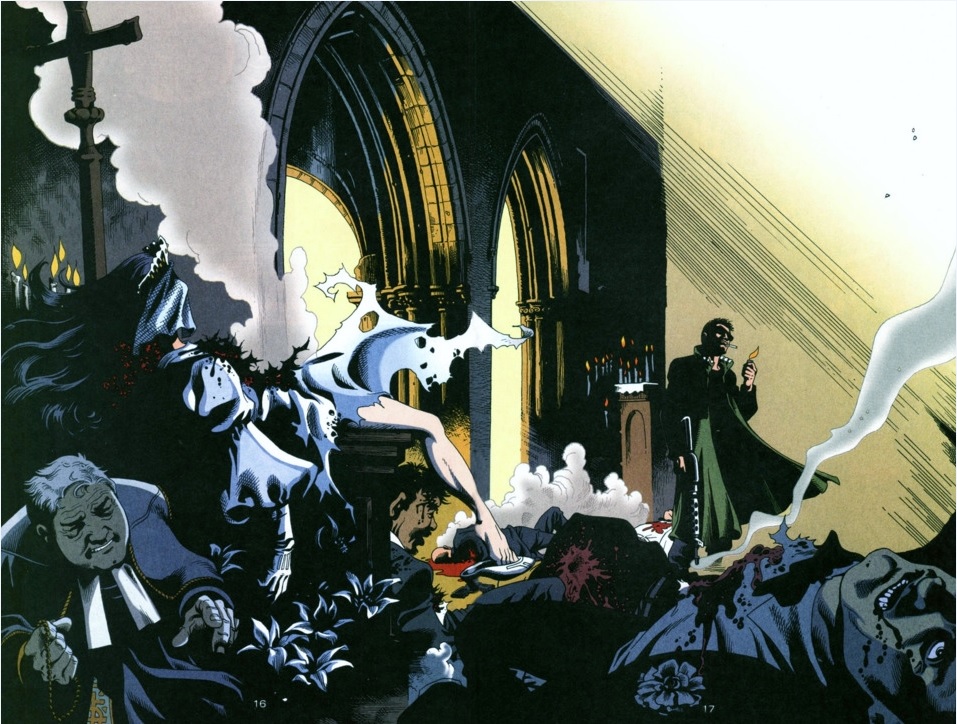
Tommy may have begun life as a supporting character in The Demon (making him closer to being an actual Jack Kirby creation than any of the King’s older titles Dan DiDio keeps headlining), but his stories are mostly about a few guys sitting around drinking. Characters are often drawn lighting cigarettes and one tight little panel follows another to tell stories and deliver dialogue. When there are double-page spreads or splash pages in general there is purpose and meaning that carries the added weight from being used sparingly. My personal favorite story is The Old Dog. I will not spoil it here but the violent, revenge-fueled ending comes in between panels and feels as satisfying as any interplanetary brawl that the Avengers or Justice League have to deal with. What good is this to you? You do not know me (though “I am Baytor” if anyone asks). What is the appeal of being told how good this book was and is and will continue to be if you cannot be shown all the fun little details?

Because when you have read this book you do not forget it. Ever. Through the good, the bad, and the downright heartbreaking. When I speak to a comic fan there is no doubt whether or not they have read Hitman because if they have then we are old friends suddenly reminiscing about all the time spent at Noonan’s Sleazy Bar. If they have not then they have no idea what I am talking about which means that there is still time.

Hitman04
What I think of when someone mentions “Red Wedding.”

The Hero Gotham Does Not Need Right Now never got around to arresting Tommy, no matter how much of Gotham got wrecked. A lesser man would accuse Master Bruce of playing the social status card and never wanting to come down to “The Cauldron,” but I am sure he just had too other things to do (such as all those parent teacher conferences he must attend). If you have ever read a Daredevil comic you know about Hell’s Kitchen. Same idea, different Dark Avenger. Ennis made Tommy’s neighborhood the Worst Part of the Worst City in the World with the twist being that all the lowlifes drank at the same bar and understood how the world worked, “idiots in underwear” and all. The general consensus being that no one thought too highly of “The Justice Club.”

Except for Superman.

You might not be able to tell from the way DC has been treating him lately, but there was a time when Superman really was the one who inspired everyone else to get it together and help their neighbor. He is the New Testament Messiah as envisioned by two Jewish kids regardless of what Zack Snyder has him doing on screen. I mentioned above Ennis, McCrea, and company winning for Best Single Issue at the height of their run. In the days before Brian Michael Bendis, the issue features two guys talking, albeit on a rooftop, and it is the entirety of superhero comics in microcosm. “As above, so below.” When Disney and Time Warner start selling off parts for scrap, the last big crossover is going to be a retelling of Tommy shooting a piece of human garbage through a window with a rifle.

Tommy once claimed that he wanted to corner the market on killing superhumans. That was how he would distinguish himself. He took out the classic 90s anti-hero Nightfist (“He Will Hit You With His Fist!”) and kneecapped the Mad Hatter but he never “put his gun on anyone not in the Game” (to continue the trend mentioned in the opening). Though raised in part by a nun, Tommy does not get his moral code from the good lord, at least not that one. As he tells Superman on the rooftop of a Gotham dive (and the reason he is there is a better World’s Finest team up than anything written by Jeph Loeb), “You can’t help what people are gonna believe about you.” Tommy follows this a few years later at their next meeting with “[and] I guess you can’t help who’s gonna believe in you either.” Tommy is proof that Superman makes his world better. Superman’s lip-service about it being a better place may fall of deaf ears to us here on Earth-33 (though this was before Flashpoint so it may be Earth-Pri… dammit, I stopped caring) but to the people who actually live in the DCU, it makes all the difference. Anyone in the DCU is “One Bad Day” away from being a supervillain, but Tommy, what with his propensity for violence and superpowers, would have been a card-carrying member of the Secret Society (they’re a union, right?) if not for having already seen how the world can be made into a better place: help your fellow man when they are in need.

If you can read this and still think that "Injustice" makes sense then you may have missed something.
If you read this and still think “Injustice” makes sense then you may have missed something.

Normally this is where a story loses me except this time it was delivered by the same author who later had a Superman analogue beaten to death by a crowbar in The Boys and did downright awful things to pretty much every member of the Justice League in The Pro. Garth Ennis is not known for his steadfast devotion to superheroes. As far as I can tell, he considers them to be silly. So why does the Original Superhero get so much respect? Because it is mutual. Tommy can go places that Superman cannot and vice versa. They both live in the same world and they both try to live according to the same basic rules but their lives have turned out very different. Whenever I see a version of the “Man of Steel” that does not work for me I think of what would have happened if Jor-El had landed that rocket gracefully outside of St. Killian’s orphanage in the heart of the Cauldron.

Tommy’s my favorite character to come out of the 90s not wearing a blue hoodie. Ennis made sure I knew what kind of beer, whiskey, and movies he enjoyed. His latter day love interest hightailed it to New York to bother the Punisher, after ruining Kyle Rayner’s Most Momentous Team-Up. His supporting cast is as robust as any of the Major Characters’ in any of their heydays and he once had Lobo sodomized. Hitman’s not just one of the best series to come out of the 90s (having read most of them I feel comfortable making that statement), it is an intensely personal drama with the budget of a Summer Blockbuster and zombie baby seals.

The foulest crime "The Gentry" have committed is keeping Tommy from a cameo in "The Just."
The foulest crime “The Gentry” have committed is keeping Tommy from a cameo in “The Just.”
Hitman07
Pat. Hacken. Ringo. Sean. There’s a book called “Star-Spangled War Stories Featuring G.I. Zombie” out now and yet these guys are no where to be found.

If you have not read it you could do worse than to check it out. If nothing else, one collection, no matter which, is probably going to be more rewarding than anything with Axis on the cover.

Onslaught – A Look Back at the Mutant Menace

“I will kill every hero this universe has ever known.”

This is the pledge of Onslaught during his return appearance in Onslaught Reborn. When I read this recently it struck me because I am a child of 1990 Superhero Comics and I remember when the heroes died.

Onslaught01
Please excuse all of the Liefeld. “It’s coarse and rough and irritating and it gets everywhere.”

Onslaught, at least a reasonable facsimile, is making another, more recent, return in the pages of Axis. I am not reading that book because I am allergic to Rick Remender (for me it was the ending of The End League put prognoses vary). I am still surprised to see that Big Purple Head back in the limelight. Superhero comics are not and should not be BuzzFeed. Empty nostalgia should not serve as both primary creative output and extent of artistic capability. Why is it so important that it is Onslaught who once again bedevils our heroes?

Because he kills superheroes.

I was in Middle School when Onslaught: Marvel Universe came out. I was the “Golden Age” of all speculative fiction: 12. This was it. True progress! Ben Reilly had replaced that sad-sack Peter Parker over in the Spider-Titles (which were effectively shipping weekly not long after Dan Slott completed his true magnum opus Ren & Stimpy) and now these older, “boring” characters were being cleared out of the way. The sprawling, unending X-Men Saga that had raged from time immemorial had reached its climax and the entire world would feel the effects.

How could anyone not understand the significance?

Looking back the first thing I remember is what awful versions of the Avengers and the Fantastic Four died that day. As is if every “true” Marvel, the Stan & Jack ones, had suffered long bouts with irrelevance and were finally being put out of their misery. Shirtless, post-Warren Ellis, Thor. Teen Tony in some mockery of an armor that Robert Downey, Jr. will never wear. Fantastic Force. All went charging into the great unknown basking in Kubert-ian glory. So now, after all these years, why should a new generation of heroes and readers care that Big ‘n Purple is back?

The End of the Age of Marvels and Scott Summers just looks constipated.
The End of the Age of Marvels and Scott Summers can only manage to look constipated.

What is Onslaught? Walking plot device? Scion of the Beyonder? “The Hole in Things”? Yes (I think), but a bit more than that as well. Have you seen The Shining? Seen, not “read”. Stephen ‘Maximum Overdrive’ King’s all well and good but we are a Kubrick-fearing household. The film has a short, frank, discussion about what the people occupying a place do to that place. How the negative energies from the awfulness and petty, bitter lives led can affect the world. This turned a building into a monster that preyed on people using others to do so. What happens when this concept is applied to stories?

We all understand that the X-Men protect a world that hates and fears them. It is the franchise mantra in the same way that great power and great responsibility somehow merit going out there every day in a colorful unitard. Hate and fear are powerful emotions. Red and yellow ones, in fact! What if all that negative energy had a vessel, Ghostbusters style? What if the mob that first chased Kurt Wagner down a European alley and every bigot occupying a seat in Madison Square Garden during God Loves, Man Kills were unknowingly fueling a malicious entity from across spacetime? A bomb shaped like a man. What if it were not just these non-playable characters but the readers and creators as well?

Onslaught03
Art from this period is to “Akira” what unrecognizable tastes are to chicken.

The red and purple always kills me. I do not admit lightly that my favorite superhero is Magneto. Supervillain? Maybe to you, Flatscan, but I know where I would stand if the Revolution came. Seeing his visage warped and exaggerated and draped around nothing more than a pair of menacing eyes and inflated claws is hilarious. Onslaught’s look is the nightmare people in the Marvel Universe would have about Magneto. As the original story progressed there were more spikes, larger claws. He seemed to warp space and gravity around him as his look devolved (the art did not help dispel this). He even dragged Wolverine down with him! At the same time he reflected what had been happening elsewhere in these comics. Years before The Sentry showed us that you cannot have a Marvel version of Superman without the Void coming along to ruin everything, Onslaught seemed to reveal what was really happening behind the scenes.

Poor Logan. Anyone else want to see a "Joseph" solo film starring Michael Fassbender? Just look at that hair!
Anyone else want to see a “Joseph” solo film starring Michael Fassbender? Just look at that hair!

As the armor grew more ungainly and the vaguely human face and limbs became distended it became apparent that Onslaught was not merely the product of Charles Xavier and his arch-enemy’s Fatal Attraction. He was whatever we wanted him to be. Whatever the readers and characters needed him to be. The swirling mass shown briefly beneath the armor is his true form. The obviously padded stories featuring his early appearances provided him time to grow and reinforce the chrysalis. This was the era of “the X” so of course the destroyer would take its form.

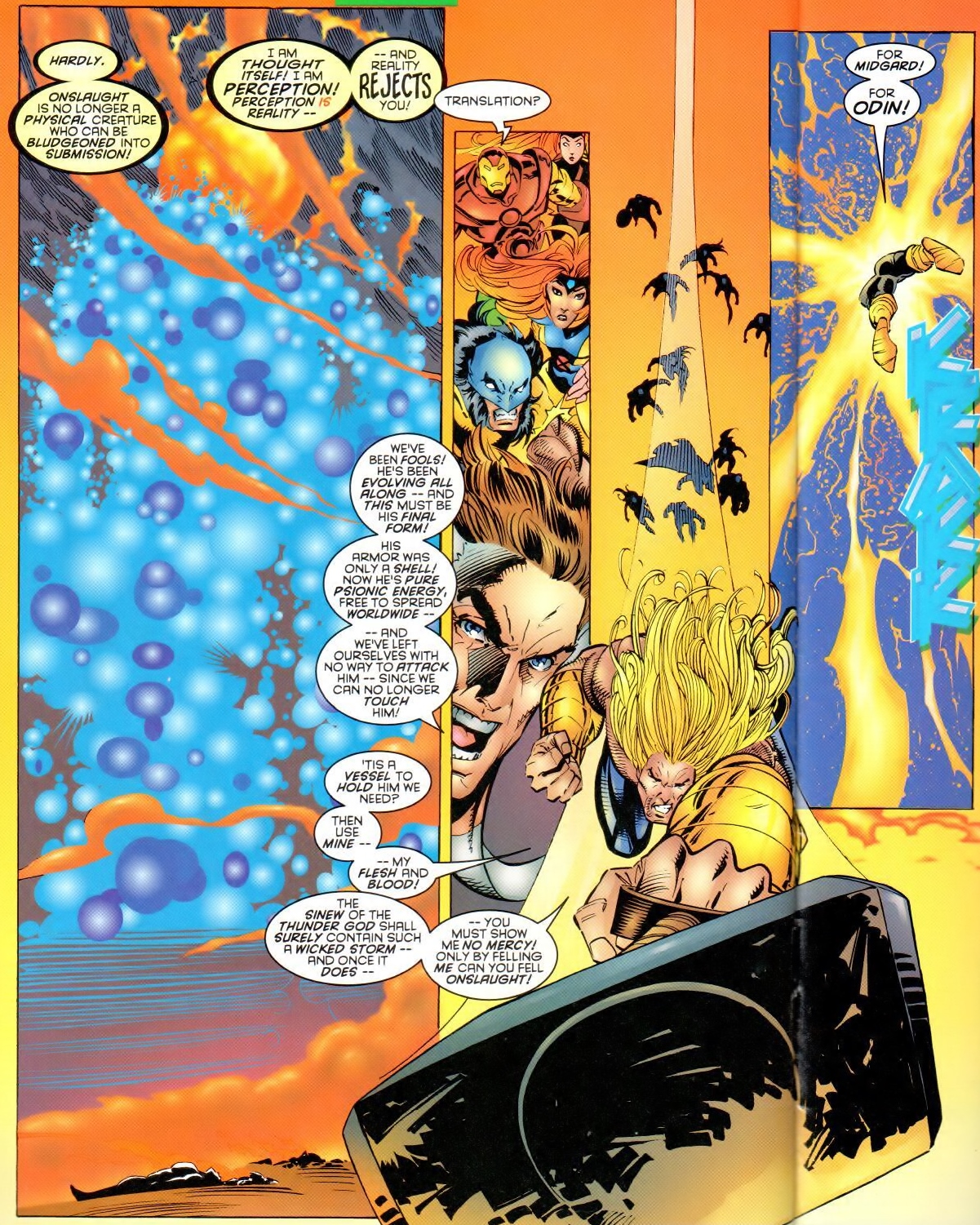
At the close of the story we are shown that he is a being made of pure energy. We are told that this is somehow “psychic” in nature. As with most comics of that period the heroes and villains tended to wield generic, poorly contextualized, coloring effects as offensive weapons. Here we see that that is literally all Onslaught is. The dark, brooding outside that proved to be less than ideally toyetic (full disclosure: I own all four figures from the first wave and each is more disappointing than the next) was merely a shell that allowed the gooey center to gestate. Coming to fruition was the formless void of misshapen energies capable of accomplishing exactly nothing. The heroes “died” to stop him by running at the Big Twinkie and dispersing what ‘was’ using what they ‘had’: themselves. Take this a step further and we have the characters themselves, shoddy and exhausted after so many pitiful attempts at relevancy (The Avengers should not wear leather jackets. Ever.) declaring that they need this. They need to go away, take some time off and maybe, just maybe, come back on their own terms.

That's a big Twinkie.
“That’s a big Twinkie.”

The less said about Heroes Reborn the better but it fit with my worldview. The Old Characters were off in their own little place. The Fantastic Four became, basically, a new X-Team and the Avengers continued to descend into unrecognizability. That this gave way to, among other things, the Kurt Busiek/George Pérez run is a discussion for another day (as I do not think even that provided the audience connectivity that would ultimately be seen with Mark Millar’s take on the characters across two publishing lines).  At home the people the remaining characters had to protect knew that a Mutant Menace, just the type they had always feared, had killed the Real Heroes. Onslaught also left a vacuum that allowed New Heroes to arise. The Thunderbolts was the first title I bought each and every month without fail. Even my beloved Clone Saga had not made me realize different comics came out every month. They just always seemed to be there.

What of “the beast” itself? What was Onslaught to the wider world? His arch-enemy, it would seem, was Franklin Richards. The First Son of the Superheroes. The Konami Code of the Marvel Universe. The kid that no creator could consistently characterize and whose birth was the last time Marvel, universe and company, appeared to move forward. It is easy to convince a child that things are important, they have to take you at your word. The fact that you may have had no idea what was going on is incidental, and can prove to be unimportant. We know Franklin’s important, we were told that. What if he is important because he represents the future? The future of the world, of these characters, and of the stories yet untold. Then Onslaught would have to control him.

I mentioned the Beyonder before. I think of him as the first, true Marvel Crossover Villain. He was the generic-ex-machina that allowed Jim Shooter and Mattel to cobble together Secret Wars. The first, but not the last, crossover. Focus-group tested to death before the first issue arrived on the stands and still unreadable today (it is no Infinity Gauntlet). Think of the scope! He Who is From Beyond! The great, unknowable wrath of the Old Testament. The Hand That Plays with the Toys! Compared to a man who could form Battleworld from occupied scraps of other places what chance did a Mega-Mutant such as Onslaught have at impressing readers? Not a fair comparison, I concede, but an example of how high the threat-bar had been set. What about the greatest, grandest threat that the Marvel Universe has ever faced? Thanos? Galactus? No, no. I’m talking about true, unbridled power: Dark Phoenix.

Thankfully she has that head-sock to make up for the lack of any actual characterization.

Long before Bryan Singer decided that Jean Grey was a physician (though “The Doctor” would make a great supername for her in the films now that Matt Smith has firmly embedded himself in the public consciousness), and long after her disastrous resurrection, she fought alongside her peers in the battle against Onslaught. Not even worthy of a moniker, she trudged her way through, making comments and looking suitably Madureirian. She had to have had a good laugh, remembering the time she ate a star because she was peckish, as she headed to Central Park to stop some Big Armored Bro. How easily we forget how grand our battles have been.

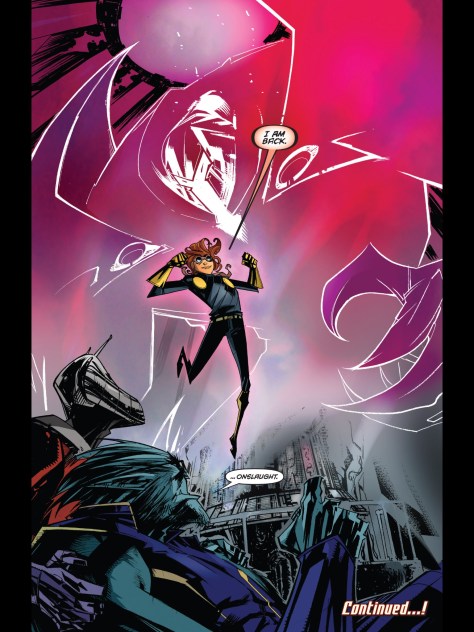
Is Onslaught, as Loeb (via Rikki Barnes) claims in Onslaught Reborn the Biggest Threat the Avengers, FF, and assorted Original Marvels ever faced? No, of course not, but if anyone ever believed that he had been then maybe it was because the story needed that to be true. Because the characters needed him to be that. Because being told something one too many times means that someone, somewhere may start to believe what is said. Not to fault Loeb. I loved the original Onslaught story. It felt important to me and looking back on it now I am happy to have had the experience of reading it when I did.

There have been two different stories about Rikki Barnes fighting Onslaught during the last decade but still no sequel to NextWave.

Does Onslaught’s return matter or are we merely playing with our old toys? Something dark and sinister lurks within that visage. He is not a man but a cipher for hate and fear. Something inhuman that an un-nuanced nut-ball like the Red Skull cannot hope to comprehend. Onslaught kills heroes. He does so with abandon. He is the darkest, basest ambition of every jaded fan and every harrowed creator. Onslaught is the god of the Senseless Spectacle. Maybe he can be controlled and made to serve the needs of a story but mostly he just seems to destroy.