All posts by Darry Weight

THE LAST AVENGERS STORY – The World According to Dr. Henry J. Pym

“Boyoboy, a pointless scuffle. Just like old times…” – Hawkeye

Have you seen “Marvel’s The Avengers: Age of Ultron”? I assume you have. We here at the Unspoken Decade have. This month we want to share our boundless enthusiasm for all things Avengers with you and are taking a closer look at some of our favorite Avengers’ stories.

In 1995 Peter David wrote his first and only (aside from the “Season One” OGN) Avengers’ story, “The Last Avengers Story,” featuring the first American work of Argentinian artist Ariel Olivetti. Seeing print alongside such avant-garde alternate reality stories as Warren Ellis’ “Ruins” and Garth Ennis’ “Punisher Kills the Marvel Universe,” it is a trip through the bleak wasteland of the far future of 2016. It is also the story of the “last” Avenger, the man, the myth, and the legend himself, Hank Pym.

AVENGERS02
Everyone believes the universe singles them out; only failed entomologist Hank Pym has proof that the universe cannot stand him, although said universe has good reason.

This is not a comic about hope. It is not a comic about why you would want to be a superhero. This is a comic about what happens when you are a superhero, even if you cannot help it. Most importantly, this is a comic about family. “The Last Avengers Story” features cameos and appearances by many notable Avengers and some members who were, at least at the time, candidates from some weird future. This includes Cannonball, the Nigh-Invulnerable Man (sort of like “The Human Rocket” except with even more innuendo), so we can assume Jon Hickman was a fan. One notable absence is Tony Stark.

At no point during the two issue, prestige-format limited series does anyone acknowledge the fate of the team’s longtime benefactor or his “armored bodyguard.” Instead the story focuses on and shows the fruit of the Pym family tree. As if the entirety of what the Avengers are had been focused through the lens of Hank Pym, the doughy, porn-‘stached form of Hank Pym.

Have you ever had to acknowledge anything sadder than that?

In a world without the Avengers (it has been about two or three decades since we last saw the originals “in action”), things merely moved on. The Avengers became a poorly run franchise full of unlikable, younger heroes that are (since this was 1995) promptly “nuked” from existence.

High Tide, we hardly knew ye. Maybe you will return, along with your teammates Sequoia, Gestalt, and Super-Ego in an ongoing series featuring “The Just.”

When we first meet Hank (again) he is retired (again) and desperately trying to repair things with Jan van Dyne (again). The difference here is that this is the beginning as opposed to most Hank stories, where the failure comes later. Years after he first provided superpowers to a young woman in hopes of having her like him, the Wasp has begun to shrink, about an inch a year, and it is not to enhance her abilities. One of Hank’s only unobstructed accomplishments is killing the one person he loves more than life itself, and, as far as we are shown, Hank is no closer to solving the dilemma after a decade of constant work.

Hank has grown fat and watched the world slowly become unrecognizable. There are references made to Greenwich Village becoming an unlivable hellhole, while the South Bronx has become trendy and fashionable. If you are not intimately familiar with the various neighborhoods in and around New York this is not that important, but if you are, well, then I guess we could have worse instances of world-building. If nothing else, these issues escaped Peter David’s incessant obsession with puns. The heroes never made the world better. No grand change was made to how man and superman live together and without the constant focus of monthly adventures to distract our heroes they slumped into the same mediocrity that we ourselves can one day expect.
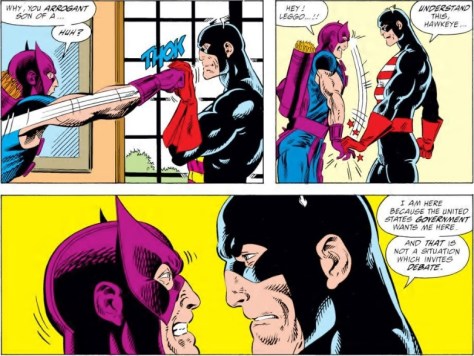
This scene does not appear in “The Last Avengers Story” which is a shame. Any time a carnie punches a man dressed in a flag while still believing he has the moral high ground is cause to celebrate.
This scene does not appear in “The Last Avengers Story,” which is a shame. Any time a carnie punches a man dressed in a flag while still believing he has the moral high ground is cause to celebrate.

My favorite Avenger, Clint Barton (referred to as “Cliff” at the beginning of the second issue because either Mockingbird has some undiagnosed memory issues or no one cared enough about the Avengers to copy edit) is retired and blind, lamenting the loss of the good old days. Bobbi Morse, his wife, hates everyone because Kirby-forbid that character ever to be likable. As another reminder that the world became worse, we are told that President Captain America was assassinated some time ago, under mysterious circumstances that remain unsolved.

Next is Ultron-59, scion of the House of Pym, who has come to issue a challenge: Whatever heroes Hank can muster (the “real kind,” not these “pale imitations of today,” sounding similar to more than one aged fanboy I have met) versus the surviving forces of evil. This, we are told, will be for all the marbles but is one more instance of a child acting out for attention. Not only was he the one who annihilated the New Avengers in one fell swoop, but, to really drive home the point, he pulls out a cigarette and lights it with his eye beams. Take that, Dad! I can choose to smoke, even though I am an unconquerable killer robot. Alongside him is the Grim Reaper, this time played by Billy Maximoff about a decade before, and a world over, becoming Wiccan of the Young Avengers.
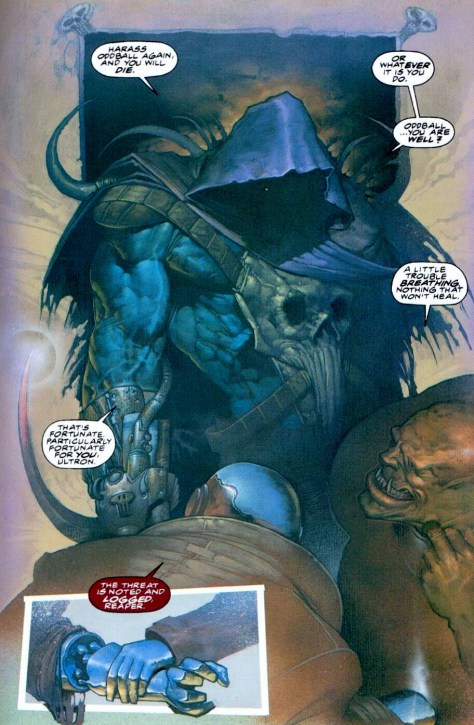
More Death Dealer than cosplayer, as if he were the genuine Grim Reaper, barely subsumed in mortal form, ready to usher in the end of all things.

His twin brother Tommy is also around, apprenticing as the Sorcerer Supreme. Their father, the Vision, makes an appearance as we are shown why the Scarlet Witch and Quicksilver are no longer around. This is Hank’s extended family. The wife he could never quite figure out how to love, the son he never intended to have, the grandson he could never have fathomed, and the two great-grandchildren he now must simultaneously fight against and lead into battle.

Reaper is joined by Kang the Conqueror and a shapechanger named Oddball. “The Last Avengers Story” is a story within the story as well, used by Ultron-59 to lure Kang back to this decade because reasons. The nature of Oddball’s relationship to Grim Reaper, which is portrayed as important, is never explained. I like to believe he is the first, non-canonical appearance of Teddy “Hulkling” Altman. In a world apparently constructed around Hank, everyone suffers and no one is truly happy. Even a character that had yet to be created, such as Hulkling, appears to be retroactively sucked into this void. Instead of the Next Generation of Heroes there is a homicidal maniac (Billy), an indecisive shut-in (Tommy), and a pile of nonsense molded to look like a Simon Bisley drawing (Teddy).

Go ahead, tell me that does not look as if it should have been a cover to “Heavy Metal.”
Tell me that does not look as if it should have been a cover to “Heavy Metal.”

The cinematic world of the Avengers is one built by and around Tony Stark. In some cases the fact that he flies around as Iron Man is secondary. He built Ultron, gets credit for bringing the Avengers together, and is in the center of all those group-shot movie posters, inexplicably not wearing his helmet even though they are in the heat of battle. The world of “The Last Avengers Story” eschews Cocktail Shaker Man and focuses on the parts of the Avengers that stem from Hank Pym, a character who has yet to appear in any movie.

Part of that is not his fault; my understanding is that the Ant-Man film was green-lit way back when the first Iron Man film was getting made, so those characters were sequestered away. Still, I cannot imagine Tony Stark being that upset if Ultron-59 came to his door and demanded a Final Battle to get over his Daddy Issues. Tony, unlike Hank, will have moved on, and an Ultron built by him may not end up as needy as one built by Hank. With each reread I am surprised how dark the world presented here is.

This is Wonder Man’s finest story, by the way. Dying to take out the Hulk, the only foe the Avengers never truly defeated. If you have any recommendations otherwise, post below!
Wonder Man’s finest story, dying to take down the Hulk, the only foe the Avengers never truly defeated. If you have any recommendations otherwise, post below!

This story is a tragedy but it is also funny, the humor coming from the absurdity of the situations these also-rans find themselves in. Wikipedia tells me that this comic was written in 1986 and was shelved until the powers that be decided to temporarily replace the “What If?” brand with the darker, and more expensive-per-issue, “Alterniverse” brand. That means that instead of being a contemporary of “The Crossing,” the much maligned Avengers event that shipped merely two months before this far better remembered story, this should actually be considered a peer of Peter David’s own “The Death of Jean DeWolff” and the other boundary pushing stories of the eighties. This is not a parody of the era it found itself in, but is really one of its precursors. I am not sure what of David’s original scripts made it onto the page. There is a reference to the also much-maligned reveal of Alicia Masters as a Skrull from a few years before (She and Johnny Storm, also a former Avenger, have an adult child that Pym attempts to enlist).

This story felt as if it could have been the future that the Marvel eighties promised, an era of Jim Shooter, Frank Miller, and a slow transition from Bronze to Dark. It was not a place of hope, and the noble tended to be ground down. Pym tells his motley crew that he wishes Captain America was there, to lead them, inspire them, and most of all to tell them what to do. Thor, Hercules, and other mythic characters have all perished in a separate, unrelated great disaster. This leaves the team constantly wondering why they should bother, which encapsulates what the Avengers are, both as a team and a franchise. They are not the Justice League. They are not the best of the best, they are the other guys. They constantly change their lineup and most of their greatest foes are former teammates. They occupy a pronounced space in popular culture that can be uniquely self-defeating.

To watch them flounder with existential despair while in the midst of their last great struggle shows that maybe this is what being a hero is. Fighting for what you believe in, no matter the odds, and hoping against hope that your faith in your friends will be enough to see you through. Except if you are Hank “Seriously, I went back to using the name Yellowjacket even after that Salvation-1 business (but that may have actually been a Skrull)” Pym. Then you wait until things get heated, grab your wife, and try to hightail it to the Microverse. My single favorite moment in this comic, possibly in all of Avengers fiction, is the look on Jan’s face as she realizes what Hank is proposing and that he is ready to go, no questions asked. He has thought about this. Amid the carnage and bloodshed of their friends and superpowered children fighting for their lives against a monster Pym himself created, Hank is ready to run away and hide. In fact, that was his plan all along.
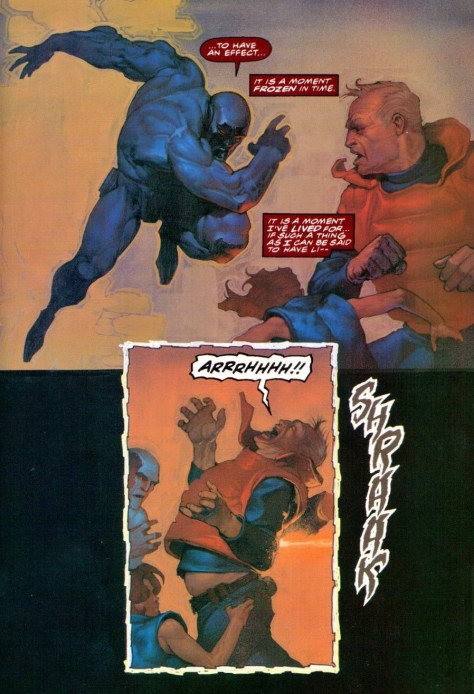
I have always imagined Ultron as voiced by Chris Latta, actor behind Starscream and Cobra Commander from back in the day. Constantly manic and angry for no apparent reason.

Hank’s not the noble, inspirational figure of the story, at least not this one. He is not supposed to be. Those who are wear capes, gives speeches, and maintain even heart rates as they calmly tell mad gods to go ☠☠☠☠ themselves. Hank is the one who makes those people shine brighter by comparison. Captain America is a great man in story, but is he an interesting character? When he has something to fight against, sure. When he is disillusioned and coming up against something that makes him question what he believes in or how those beliefs are portrayed in the world. Hank does not have ideals; he just tries to follow those who do. You cannot write compelling fiction about a person who only does good. The writers of “Action Comics” for the last thirty or so years can tell you that.

“The Last Avengers Story” is about the legacy of a man who was there at the beginning of an idea and who sees it through to the end. Hank is murdered by a time traveling former pharaoh who may have once banged his “niece” (again, in another world). His has been a weird life made all the more strange by the fact that he never once made a decision he could really be proud of and that said decisions come back to haunt him in his twilight years. This is not “The Dark Knight Returns,” and the hero does not prove everyone else wrong. Hank, potbelly intact and with only a few flaccid devices at his disposal, can only defeat his villainous son (who should have been Hank’s legacy considering he created AI alone in his basement) by being murdered by an underling.

Hank falls, Ultron slaughters Kang, the man responsible for stealing his victory. Fearing that Ultron will now never know his true purpose he is then murdered by his own son, the barely coherent Vision, moved to action by the death of his “grandfather.” A vicious, awful cycle comes to an end, the dead are buried, and the survivors are left to wonder whether any of this was worth it. There are no celebrations and as far as I can tell Jan is still shrinking, slowly but surely, into eventual oblivion.

I am going to have a difficult time not imagining Hank Pym with a mustache from now on. Because of course he grows that particular poor decision when he passively asks for dispensation.
I always imagine Hank Pym with a mustache because of course he grows that particular poor decision right before passively asking for dispensation.

This comic is in many ways a precursor to DC’s “Kingdom Come.” That story featured a generation of morally vacant, superpowered young people causing more harm than good until their shenanigans reach a boiling point and Superman must be convinced to step in. He assembles together the remaining adult heroes, spanks the children, and ultimately leads to the deaths of an untold number of civilians. Momma Kent’s Lil’ Boy did not have a good time during the nineties is what I am saying. In a similar fashion, Captain America is revealed to have been watching as the world grew steadily worse. Watching the last of his friends taken down by their own inabilities.

Years before, Cap had come forward to lead the nation in light of rampant bureaucratic abuse of his superpowered peers (a government orchestrated “Villain Massacre” is mentioned). He could not have known that in this world the rules of the narrative would not allow for things to end well. He is shown to now be in a regenerative chamber. He is, inexplicably, clad in his full uniform and mask. Hawkeye, still blind, tells a mourning, doubtful Jan that “He” will return. There is a promise of glory to come but none is shown. We are never told how or if Cap has been healed or if something else has occurred to allow him to return. In this story Cap is reduced to a hollow shell, not a real person. His story, if there will be one, is hinted at as the primary story closes, with no acknowledgement if something better is just around this corner.

In this world, where all things apparently stem from Hank Pym, Cap is unable to save the day. He cannot do much of anything because he only exists as the one dimensional caricature he is remembered as. Hank thinks back to him as the father figure he never had, and even then Cap is portrayed only as an example of unyielding heroism. We have been shown in this story what happens to heroes, so why are we to believe now, at the worst of times, that one will change the fundamental nature of things? I do not buy it, and while the first time I read this, I was invigorated by the idea of Cap coming back to deal with all of the nonsense that the future had wrought, I think now of Superman in KC. Maybe Cap would have a titanic battle with Iron Man (our Captain Marvel stand-in) that corrects the indignities heaped on their dead comrades, but more than likely, based on what we have seen, more people would perish in the worst way leaving a still blind Hawkeye proselytizing to no one in particular.

This team went on to include Otto Octavius and even he did not dwell on his shortcomings as much as Pym. Most shown have done far worst, they just moved on.
This team went on to include Otto Octavius and even he did not dwell on his shortcomings as much as Pym. Most shown have done far worst; they just moved on.

Hank could never get out of his own way. This makes a certain kind of sense when you consider that he is an outcast from a different genre than someone like Cap. “The Man in the Ant-Hill,” Hank’s first story, was published in those early, just barely Marvel stories. His peers are giant monsters and unknowable invaders from beyond. He was widowed and traumatized beyond repair before he ever met anyone wearing a brightly colored costume. He belongs in a Chuck Palahniuk novel, not standing alongside Earth’s Mightiest Heroes. Regardless, Hank represents what the Avengers are: what happens when normal people try to make sense of all the incredible crap that they come across while living in a place such as the Marvel Universe.

The Avengers are the number one box office draw in recent history. They have even eclipsed their peers and mass media precursors, the X-Men. There is a different “Last Avengers Story” waiting to be told today. That story will have glory and heroic sacrifice, and it may even have Cannonball. It will not have Hank Pym. It does not need to. The franchise outgrew him. All that he was died unceremoniously in a fight that could have been avoided altogether if he had been better at anything he had tried to do earlier in life. “The Last Avengers Story” is just that, the final tale of a team at a certain point and what that could have meant. So much has changed since then that the franchise is almost unrecognizable by comparison, but that is also its greatest strength. The Avengers endure, no matter what, which is what makes this story as enjoyable as any blockbuster film featuring all the pretty people.

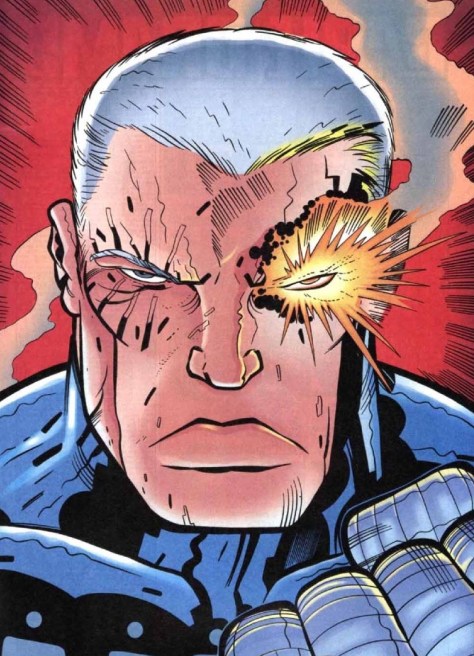
HE CALLS HIMSELF CABLE – José Ladrönn and Joe Casey on the Man Out of Time

Warren Worthington: Before you go any further, you need to ask yourself… is any story really worth dying for?
Irene Merryweather: Depends on the story.

No theme this month at “The Unspoken Decade” so I have taken this opportunity to look back at José Ladrönn’s run on Cable that helped close out the nineties.

Irene Merryweather is a reporter, a storyteller. She acts as Cable’s chronicler and as the reader’s way to understand the man and his world. She provides a way for the plot devices and conflicting motivations of such a popular character to be examined and contextualized in a much needed way.

“Sometimes, there's a man. And I'm talkin' about the Askani’son here… He's the man for his time and place. He fits right in there.”
“Sometimes, there’s a man. And I’m talkin’ about the Askani’son here… He’s the man for his time and place. He fits right in there.”

Who is Cable? What is he? Why does he call himself that? Maybe in 1990 when the character was first introduced this was considered a suitably sci-fi term. The modern equivalent of calling a character “Plastic Man” in an era before that was a household name. Did this name say something about the character that was deep and meaningful? Was it the name of one of his weapons, maybe an artistic way of describing his method for traveling through time?

No, of course not.

Cable is what you would call yourself if you had been raised two millennia into the future. This is the same reason his arch-foe (and one of several clones) is known as “Stryfe.” These people are as separated from “today” as “today” is from the beginning of the Common Era. Cable is a character that everyone recognizes, comic fan or not, even though he has avoided the Silver Screen for seven X-Films and counting. For me there is no more interesting take on the character than his extended tour of the Marvel Universe in the artistic styling of Jack Kirby.

The energy radiates from the center, reaching out at the reader and almost into their world. The mark of the King.

The Hellfire Hunt is a story from 1997 written by James Robinson. Halfway through, after issue #50, scripting duties switch to Joe Casey. From then until issue #70, in August of 1999, Casey and artist José Ladrönn put their mark on the Man With Many Names. The run was bookended by extended crossovers with the plethora of other X-Titles, from Operation: Zero Tolerance (itself spinning out of Onslaught) to the Apocalypse centered The Twelve soon after its end. In between was an attempt to define the character of Cable in a way that made him grounded and believable, or in other words, in the Marvel way.

In addition to the extended X-Family (for the most part) there is no appearance by X-Force, the child soldiers that Cable usually drags into dangerous war zones, or Rob Liefeld, Cable’s self-appointed ‘sole creator.’ The Rob would eventually bring back the expected trappings of the franchise but in his absence Casey, and especially Ladrönn, build a supporting cast unique to Cable including re-introducing Nate’s own personal Yoda, Blaquesmith, and the aforementioned former gossip columnist Irene Merryweather, as well as the brand new love interest, and confidante, diner waitress Stacey Kramer.

Every Kirby story is a love story. He co-created the Romance Comic because he understood that having someone to fight for was the only thing that mattered.

Over the course of these twenty issues Ladrönn’s depiction of Cable, and the world he inhabits, comes to resemble one drafted by Kirby. The King himself passed away in 1994 so this type of tribute would not be uncommon except that Cable, and the Modern X-Men in general, had nothing to do with what he had come to stand for. This appears to be envisioning what Cable would have been if Kirby had created him at the peak of his career.

A time-traveling, cyborg with a Messiah Complex, locked in an Eternal Struggle with a being destined to conquer the world and subjugate its people. That feels as if it could have been a pitch for a story Kirby never got around to putting down on paper in the years after he left Marvel in search of the greener pastures he never found.

For reasons none too important to the overarching plot Cable finds himself in the nation of Wakanda fighting Ulysses Klaw alongside the Black Panther. A few issues later he engaged in the defining conflict of the run in a fight against Jack Truman, Agent 18 of SHIELD. An appearance by the newly revitalized Mighty Avengers closes out the run featuring Kirby Classics such as Captain America and Thor. This resembled a comic done in the Mighty Marvel Manner at a time when nothing else the company put out really did. Even non-Kirby, but classic nonetheless, vintage characters such as Zzzax and the Tinkerer make appearances. They are not furthering the plot, but rather showing how rich and imaginative a world Cable occupies.

If you touch your chest, hear a “tek” sound, and begin spewing acid from your fingertips then you were probably not invented by someone who left to create Brigade.
If you touch your chest, hear a “tek” sound, and begin spewing acid from your fingertips then you were probably not invented by someone who created “Brigade.”

A year and change after the bankruptcy that nearly buried Marvel, and comfortably before the movies would start to shape what the company would become, Cable takes a tour of an older version of the Marvel Universe, one not seen in some time. He himself gets a streamlined, shoulder-pad-less redesign that allows, as all Kirby characters must, to be in constant motion and bristling with power. The tons o’ guns are stripped away as this Heroic Quest sees Cable wield the Psimitar, a future-tech spear capable of focusing his advanced telekinetic abilities into Kirby Krackle. The static, cold images that had come to define the character up until this point are forgotten as Cable genuinely struggles with whether or not he can really save the future, a fight that seems u winnable and a task that seems unsurmountable, even though he can remember what happens if he fails.

Kidding. We all know what happens if he fails: Everyone is slowly murdered by the Mutant Robo-Pharaoh. Why has anyone ever wondered why we enjoy these comics?

I am not sure whose idea it was to go down this road but it does not happen all at once. Ladrönn had been involved with the title before Casey arrived and the latter went this route again with his later Image series Godland (I am not putting a “0” there, but you may need one if you want to research the series). Does the fact that no one else was doing overt Kirby homages on a regular basis make the issues worth seeking out, or picking-up discounted at least?

Yes and no.

This is one of the few full runs of Cable I have read but was by far the most rewarding. The aesthetic got me in the door, so to speak, but the character does not keep me there. Ladrönn clearly has a love for these particular layouts and design work. There are ways of presenting a story and moving events forward that only ever seem to appear in those older books. Figures in motion stride through scenes of intense action oblivious to “cool” poses and the constraints of the page. Not to say that the genre as a whole does not pull plays from the same book but these are specific, and in some cases too much so, references the work of a single man.

Ladrönn at one point, before the Kirby homages are overt, places a panel of only Cable’s foot in motion in the midst of an action scene. This warrants a caption box, with a message from the editors, stating that “we’re not really sure why Ladrönn put this panel here, but it was too fun & wacky to take out.” Fun. Whacky. These things have no place within our comics, clearly. This is how far the expected conventions had moved. Panels are mere recommendations to the characters and the Kirby Krackle is everywhere. This constant love and affection is also how they begin to lose their appeal.

…in the pages of Deathlok if I am not mistaken. “M-Tech” was an odd publishing line but at least it had a techno-organic monkey.
…in the pages of “Deathlok” if I am not mistaken. “M-Tech” was an odd publishing line but at least it had a techno-organic monkey.

There is a love here, but is there an understanding? Casey’s name is attached to many beloved runs in superhero comics as well as under the radar projects that remain fan favorites. The main pitfall I have come across that prevents me from embracing his work is that he never quite seems able to keep up with his own ideas. Superhero comics can be dense. Packed full of characters, ideas, and images that combine through the act of reading to form entirely new experiences. They should not be stagnant and they cannot to waste space. Casey does not seem to spend the time giving Cable, or any of the other characters, enough to do. He is not very imaginative when it comes to creating new ideas or concepts and he certainly does not seem to maintain the primary rule of a Kirby Comic: Create!

Jack Kirby created at a rate that far outstripped his peers. Physical number of pages (at one point Kirby was personally responsible for more titles per month than the Liefeld’s Extreme Studios), concepts, characters, and plots. Not only are the Marvel Age works with Stan Lee responsible for most of what we still read today but each of Kirby’s series after showed that the act of creation was the most important aspect of the work. A book such as The Demon has new villains and foes each issue, new obstacles to surmount. For good or bad (and many are not going to be action figures or cartoons any time soon) they were there. Jack acting as midwife to world after world from some unknowable higher power.

I cannot fault someone for using a Black Bolt pose but the panel to the right features more new character in a single instance than were created over the entirety of this Cable run.

Casey’s primary contribution to the Cable Mythos is the Harbinger of Apocalypse, whose origins are actually steeped in Robinson’s final story (he was also responsible for Merryweather). The otherwise unnamed Victorian Era waif (he has a strange origin that still manages to feel unoriginal) provides the primary physical threat that hangs over the main story. No motivation, or real defining characteristics, just something for the hero to rail against. Another character, Blockade, is introduced as a MacGuffin for Cable’s Titanic Team-Up with his former beau Domino. I never got the feeling that this team could not create new characters but rather would not. I am not sure why as this was not the X-Market of today where all the good characters have their movie rights absorbed by 20th Century Fox.

There is also not a constant stream of creativity reflected with the use of classic characters. This is the SHIELD exactly as Kirby drew it back in the day. Same line work, same designs. The same goes for Klaw, Black Panther, and even the Master Man (in a Golden Age flashback story). I applaud the revisiting at a time when everyone else seemed to have no interest (had I read these at the time they would have been my first introduction to Kirby’s aesthetic) but I mourn the loss of opportunity. Who knows how much more enjoyable, and re-readable, this run on such an otherwise uninspired title would have been had the creators channeled the spirit of the man they honored instead of merely what they saw in his work?

My favorite parts of this run are the exclamations. Paramilitary guerrilla fighters from the Fiftieth Century shout “Oath!” and swear “By the Bright Lady!” more than you would think.

Part of this is shown in the use of Apocalypse. Throughout the run there are vague allusions to a time, coming soon, when “Dayspring” will have the chance to complete his mission by ending the potential future reign of terror in the here and now. Presumably this was supposed to tie-in with The Twelve but if you remember reading that story you will probably also remember not caring all that much about what happened in it. Here Apocalypse haunts the background, hinting at a Master Plan and moving pieces into position. Anywhere else this would be just one more subplot but here the regularly overt character is reimagined as a subtle dark-skinned man in a suit. He arrives, seemingly from nowhere, with the reader and heroes knowing nothing of what he has planned.

When something similar to Apocalypse’s traditional form makes an appearance it is as a flashback (to far in the future) or when a character is describing him, as a threat hiding just out-of-sight waiting to usher in an eternal darkness from whence there is no escape. This teases a character who had been around for over a decade and lays the groundwork for an actual arc. Apocalypse, though never in on the action, appears as a genuine threat that Cable, heavy-hearted, must face or else face the doom of every single person he meets as well as each and every descendant they cannot possibly be aware of. For a character with more conflicting backstories than Hawkman, and an opponent that had been more Action Figure than realized person up until this point, this presentation made me genuinely interested in what would and could have happened next.

Kirby missed out on his chance to design Apocalypse (he did not stay on the original “X-Men” title, that he co-created, long enough to work on most of what is associated with that franchise) but here we see what may have been. If nothing else this is a version of a popular villain reimagined based on how Kirby approached his work in general, with the incredible scope of an endless world. There is a sense of dread permeating the way characters discuss Apocalypse that cannot be matched by all the times he has been shown monologuing about a Middle Schooler’s conception of Darwinism. Apocalypse (a character I love no matter what I seem to be indicating here) is often drawn as this mishmash of different concepts, none of which stand on their own.

From the future? Yes. From Ancient Egypt? Yes. A mutant? Sure. Access to unlimited Celestial technology? Appears to be the case.

Here we have a rather mundane man you would not look at twice and a walking natural disaster on par with any of the Cosmic Threats of old Marvel. The sense of scope has been retained and the character never risks becoming mundane. Bruce Banner and the Hulk, Jason Blood and the Demon. The works inspires your mind to fill in the gulf between the two and therein lies the beauty of what Kirby always did: Making the reader see the world for what it could be regardless of how it actually was. Joe Casey and José Ladrönn understood that more than most and while they worked with Nathan Summers they showed us what could be.

At one point a character refers to him as “The King of All Lies.” Looking upon this visage convinces me that we may still not have seen his true form.

Venom: The Madness – Eddie Brock Joins the Outer Church

“To get the facts, you need strong fingers on metal keys, paper white with honesty – and then you have to cut hard and deep to make the truth bleed ink.”

Eddie Brock, alien symbiote host who really loves his typewriter, from 1997’s Venom Minus 1.

Venom, perennial Gimmick Era favorite, had a tie-in to that month’s Flashback event because he was the star of a series of mini-series going back to Lethal Protector (my personal favorite). He was the hero of his own story and the main character in whatever temporary title the Spider-Office decided deserved an embossed cover that month.

In celebration of Madness Month, let us turn our attention to 1993’s Venom: The Madness, wherein we see that Tall, Dark, and Toothy did not merely adopt the dark, but was born in it, molded by it, and (I am fairly certain) has yet to see the light.

VENOM06
I would prefer reading Eddie Brock’s Twitter account to almost anything already announced for Convergence.

Eddie is an unreliable narrator. What else would you expect from a man who began his professional career as a journalist? He knows how to edit and what to present as fact. He is his own favorite storyteller. The quote above is from a scene that explains why he still used a typewriter. It tells you what it is he wants from the world. That purity, that honesty. For everything to be what it actually is and nothing else. This is a man who cannot help thinking violently, even about ink on a page. A man who does not want to become better because he believes it is the world that is at fault. What is there for an alien skinsuit not to love? Eddie was never going to be friends with Peter Parker. The Black Suit was merely the excuse. Together he and it are Venom, as in spider-venom (took me longer than I care to admit to piece that together).

Ann Nocenti scripted these three issues, though she was far from the only creator attempting to give Venom a voice in the early nineties. Between the complicated behind-the-scenes origin of the Black Suit itself and the overly complex way that Venom was so good at being a villain that he became a hero, this is a character who never had a stable life. Is it any wonder he would end up mad?

Even though Venom is a primarily toyetic property, I have a personal connection with him. My first comic was Amazing Spider-Man #346 by David Michelinie & Erik Larsen. My earliest memory of Spider-Man, who I have come to collect more than read (the only character I can say that about), is in the reflection of those otherwise blank, alien eyes. I thought of Venom as a hero for a new age. Spider-Man belonged to a previous era. A whiny throwback, similar to those guys at DC with the capes. Not Venom. Not Eddie! Then I read The Madness and watched him murder an elderly woman, who the author goes to lengths to show just how innocent she is.

VENOM07
The teeth constantly grow, phasing in and out from higher-dimensional space, the person they belong to merely forming around them.

Venom’s component parts felt slighted by Spider-Man, the mask, and Parker, the man. Everything that went wrong was conveniently the fault of that man, and so it must have made sense to hightail it across the country where no superheroes could bother you. What he finds is “The World Below” San Francisco, relic of the great earthquake from nearly a century before and haven for the disenfranchised. I assume that this originally meant the homeless and those wanting to live off the grid, but the fact that community activists and other sensible people feel welcomed among the crumbling ruins of a turn of the last century metropolis has me imagining it more as Portland of 2015 than the Morlock tunnels.

Our hero is coming to terms with himself and has even managed to have a love interest, as he becomes embroiled in a stock plot of corporate espionage and environmentally unfriendly shenanigans. This results in him contracting what is essentially super mercury poising and hearing a new voice. Referred to as “The Creep,” it is responsible for that wonky, multiple head thing you probably imagine when thinking Venom: The Madness. Never choosing between a singular or plural identity, the Creep takes Eddie’s mind out for a spin and finds that not only is it already a bit crowded but that he/they may not be the drunkest one at this particular party.

Some eras are best represented by cave painting, fresco, or relief. We have Flair ’94.
Some eras are best represented by cave painting, fresco, or relief. We have Flair ’94 Collectible Trading Cards.

Venom has the added bonus of being thrust into the literal Realm of Madness, presented as both the type of dark dimension that Marvel is lousy with, as well as merely a construct within his own mind. Is he actually fighting Dusk (unfortunately not the one from Slingers), a manic, supernatural entity or just his own “inner demons” as rendered by Kelley Jones’ claustrophobic, barely discernible art? Neither the character nor the reader is ever sure, but the former does not seem to care. Other superpeople make excuses for the things done under the influence of a foreign entity; Venom embraces it and never acts in a way other than how he chooses. Is this the will of the Creep, the Black Suit, or just Eddie Brock finding another way to justify getting what he wants? Does he even know what that is anymore?

It is an interesting reversal of the classic Black Suit story, present in comics and other media. Parker, iconic nebbish from Queens, gets tired of the world pushing him around (which it does mostly because he lies to everyone he cares about and is unable to meet any of his many commitments) and attracts the attention of some predatory alien entity. His anger gets the best of him, and he says and does a few regrettable things (that hair in Spider-Man 3) before throwing the entity back into the abyss. The wounded extraterrestrial animal finds solace in soon-to-be-mulleted ace reporter, Eddie Brock, who comes to love it and offer it a home within himself. He is empowered by that freedom and never turns back, unlike Spider-Man, who never referred to himself as “we.”

VENOM05
Inside the mind of Venom is a far more dangerous place than the cold, lonely world of several miles below early 90’s California.

Particularly surreal in the otherwise barren, underground cavern of the World Below are the trees. In the background of most panels are trees, leafless but seemingly alive, as evidenced by their size. Are they specially bred to live and thrive in a world without natural light and all but the deepest of underground wells? Is there a master botanist somewhere on the fringes of this society making sure everyone has air to breath? Someone is keeping this place running, though we are never shown who. The entire place has an odd mystery to it that promised to be far more interesting than whoever Venom was going to fight that issue. This could have been a new locale for the greater Marvel Universe. Maybe one of Confederates of the Curious retired here back in the day after helping with the earthquake.

Venom is at home in this Tim Burton-type of wonderland (lowercase “w”) with its beautiful old buildings, gnarly, unobstructed trees, and whimsical folk who, though homeless and destitute, are unfazed about asking a supervillain to help them out. These people have no hero, no champion. Why not Venom? They have already rejected the world they were born into; why not accept a similarly disenfranchised man to defend them, to be one of them? Taking the original, skewed narrative at face value, Eddie should welcome a release from Parker’s totalitarian impact in his life. Someone, somewhere, at some level of existence bought his sob story and gave him a genuine do-over. What does he do with it? This was 1993, what do you think he did with it?

He fought the Juggernaut.

There is no image of Cain Marko in this comic that anyone would be proud of so here is Jones' contribution to "The Multiversity."
There is no image of Cain Marko in this comic that anyone would be proud of so here is Jones’ contribution to “The Multiversity.”

You might remember the genre defining Roger Stern & John Romita, Jr. story where Spider-Man could not, under any circumstances, stop Juggy from doing whatever it was he wanted. The one that appears on all the Top Ten lists and, in two issues, tells the reader, new or old, all they need to know about Aunt May’s favorite nephew. Whatever it is that makes him unstoppable cannot hold up against having your name on the cover, and so Venom wipes the floor with him. This little X-Over may have been intended to cross-pollinate a few of the bigger books, and give Big Vee something to punch, but Nocenti still finds Juggernaut’s voice. This is him and here, among the mad, he apparently can be stopped.

Venom does not seem to mind the Creep, regardless of the fact that another character refers to it explicitly as a cancer, and in the end he just lets it go. If anyone we meet in this story is truly mad, there is no convincing Eddie it is him. Triumphant, the hero returns to his city, confident in the bedrock of his own mind despite all of the continually mounting evidence to the contrary.

Appearing as a shadow, interrupted only by the constantly shifting, endless row of teeth, Venom must be a comforting presence to the dwellers of this cavern home. The type of protector the disenfranchised expect because those that protect the World Above probably have little time for them. In this way, Venom has chosen to surround himself with those who have as unreliable a perspective as he does, those who assume and prescribe to their own views more than what actually occurs. Venom is at home with what someone not living underground would call madness. To Venom that is all there ever is.

"We accept [him]... one of us!"
“We accept [him]… one of us!”
Does the Black Suit feel the same way? Not to disparage the origins of the entity as already established, but I believe that it does not matter what happened to the Suit before it found its way into the Beyonder’s machine. For canon versus non-canon, I normally begin with this: what has survived through retelling? The Suit feeds on what a wearer feels. The stronger the impulses, the stronger the suit becomes. It learns, adapts, and is empathetic to its wearer. Venom does not trigger a Spider-Sense, is far more powerful that the Wallcrawler, and yet his only source of superpower is the Suit. What kind of state was it in when it met Eddie Brock in the first place?

The 80’s were a weird time. I do not remember much, but everything seems as if it was awful. Spider-Man wore the Black Suit (be it an alien symbiote or regular cloth costume) during some incredibly turbulent times in the character’s existence. I have always seen it as a mourning suit, the black shroud draped over a man who cannot help but lose people. It may have appeared too late to be a result of what happened with Gwen Stacy, but it still feels as if wearing it should tell the reader something other than that the artist cannot be bothered with Ditko’s Lines.

Spider-Man wore the Black Suit for Peter David’s first professional work, The Death of Jean DeWolff. This featured the Sin-Eater, a character whose reign of terror and subsequent capture were retconned into the origin of Eddie Brock. Less explicit to Venom is exactly what Peter Parker lost during that story. He was not yet married to Mary Jane. He watched as a good friend (who may have become something more), one of the few in law enforcement, is brutally murdered while the party responsible brings the whole episode to an even darker place. (The reveal is inconsequential if you have not read it, but if this would have been a spoiler then please go read it.)

If you have ever read "The Invisibles" you may recognize that as Barbelith.
If you have ever read “The Invisibles,” you may recognize Barbelith in the background.

Another notable episode is Jim Owsley’s Spider-Man vs. Wolverine. This a story filled with Cold War intrigue, piles of bodies, and the type of moral ambiguity that I do not know if Parker the character or Spider-Man the franchise was yet able to handle. Though the majority of that issue is spent in a knockoff version of the Red & Blues, it is the Black Suit that he wears at the beginning, and, if the climax is anything to go off of, what he returns to in the end.

These stories are the first instances of Parker’s identity being revealed to Daredevil and Wolverine respectively, setting the stage for the casual meet-ups of the 90s through today. Later on, when Spider-Man rids himself of the Suit, he could be attempting to free himself of all of this grief, anger, and misplaced trust. What if all of that pooled at the bottom of the proverbial basin, similar to blood, or, say, ink?

Eddie may be a sinkhole of desperation but Spidey could learn a thing or two about moving on.
Eddie may be a sinkhole of desperation, but Spidey could learn a thing or two about moving on.

The black ink that defines Venom. Those heavy shadows, those uncompromising depictions that have him ill-defined and almost part of the background. Venom is not only the arch-foe that Spider-Man needed in an era where Norman Osborn was dead and Doctor Octopus was not considered “bad ass” enough, but he is a literal reminder of what Spider-Man was put through. If the 80’s put the character into places where he had to confront the real world, then Venom is what happens when you want to tell those stories but need the conflict to be symbolic.

The Madness is not a story of personal growth. The time of the Black Suit had pain and readjustment that the Spider-Man franchise had to process. Venom is the result. Eddie’s madness is what happens when a fictional character tries to make sense of the real world. The moral ambiguities and unforgivable nonsense that people, not governed by seasoned creators, inflict on one another. Add to that the constant, market-driven demand to be the Next Big Thing, no matter what, and you have a concoction unlike any other. Forcing all of that into its own little box warps into the mess of drool, fangs, and heavy inks that I revered as a child.